
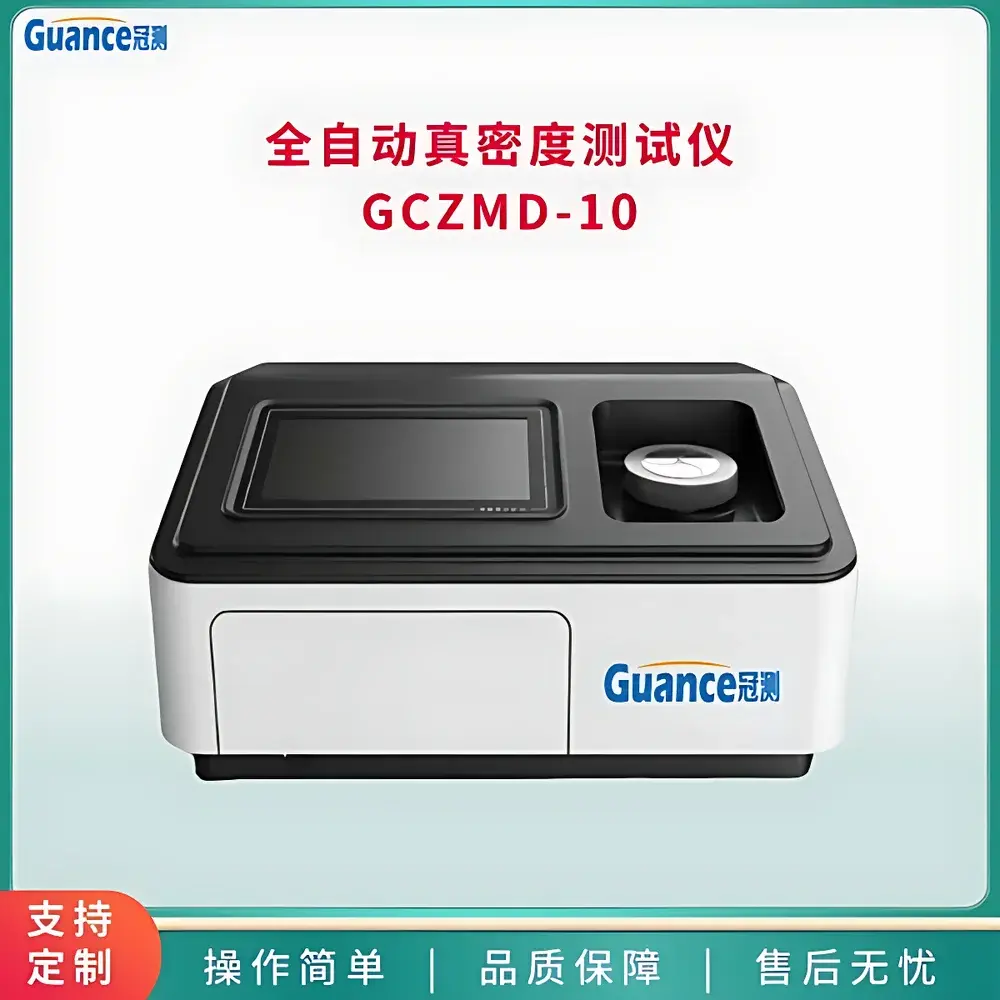
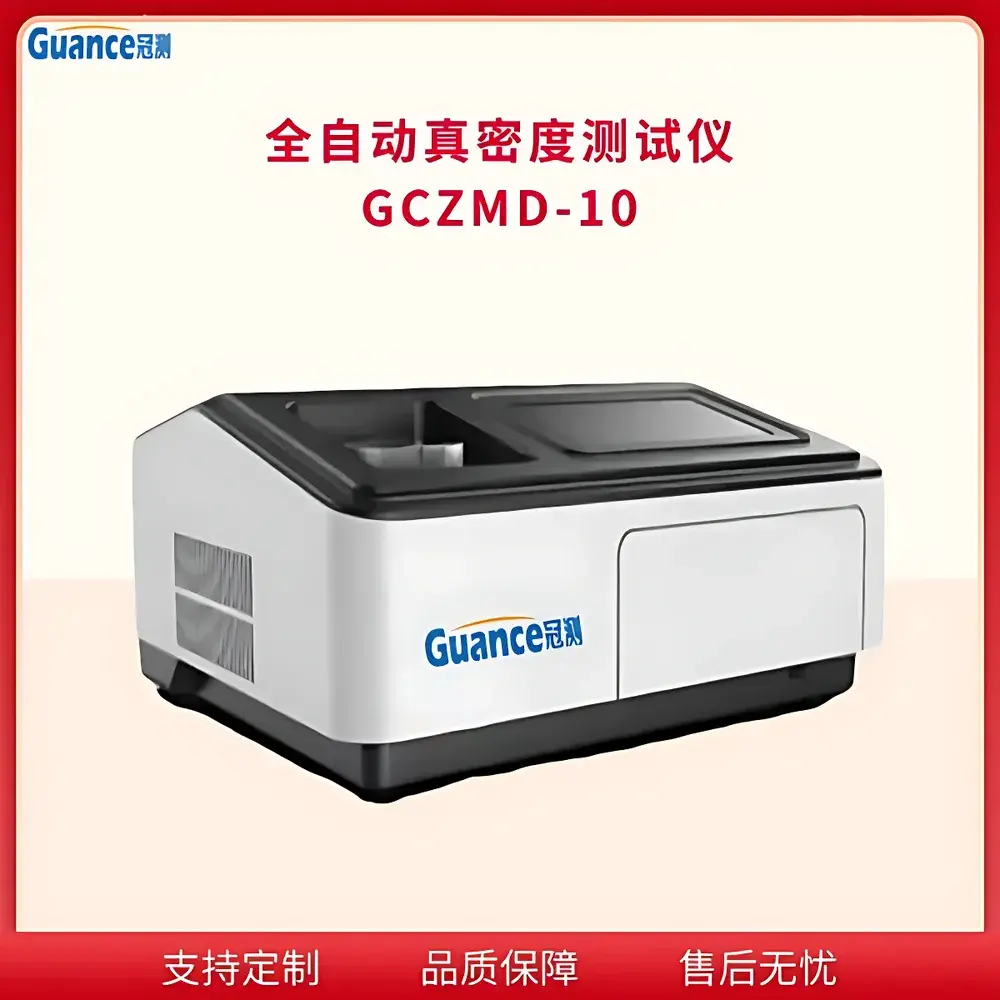
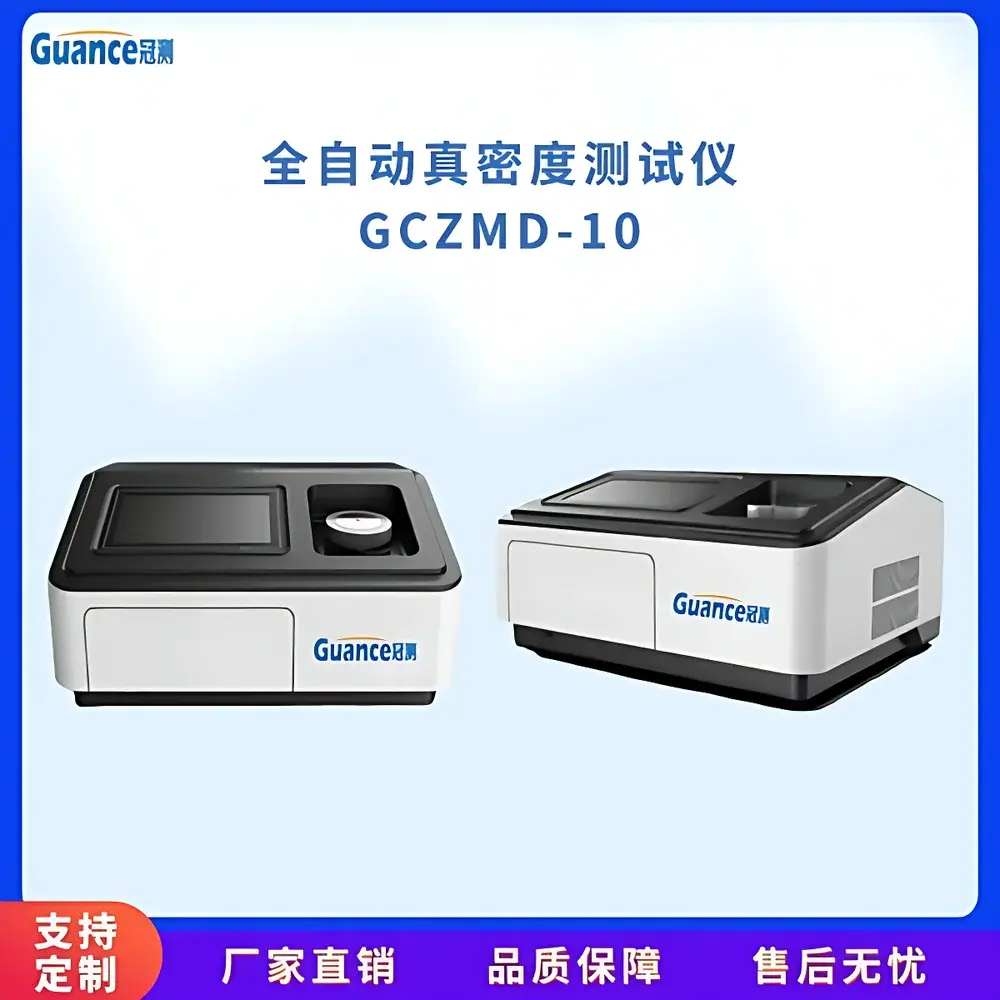
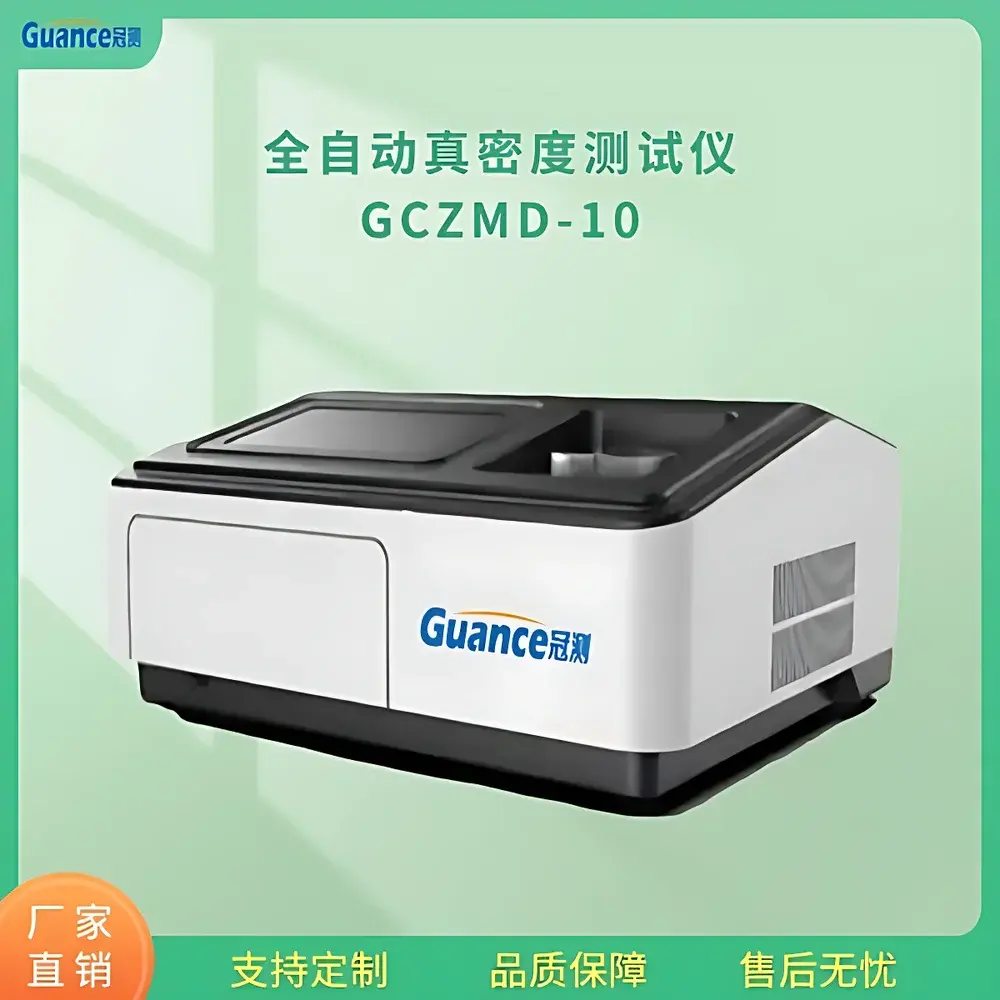
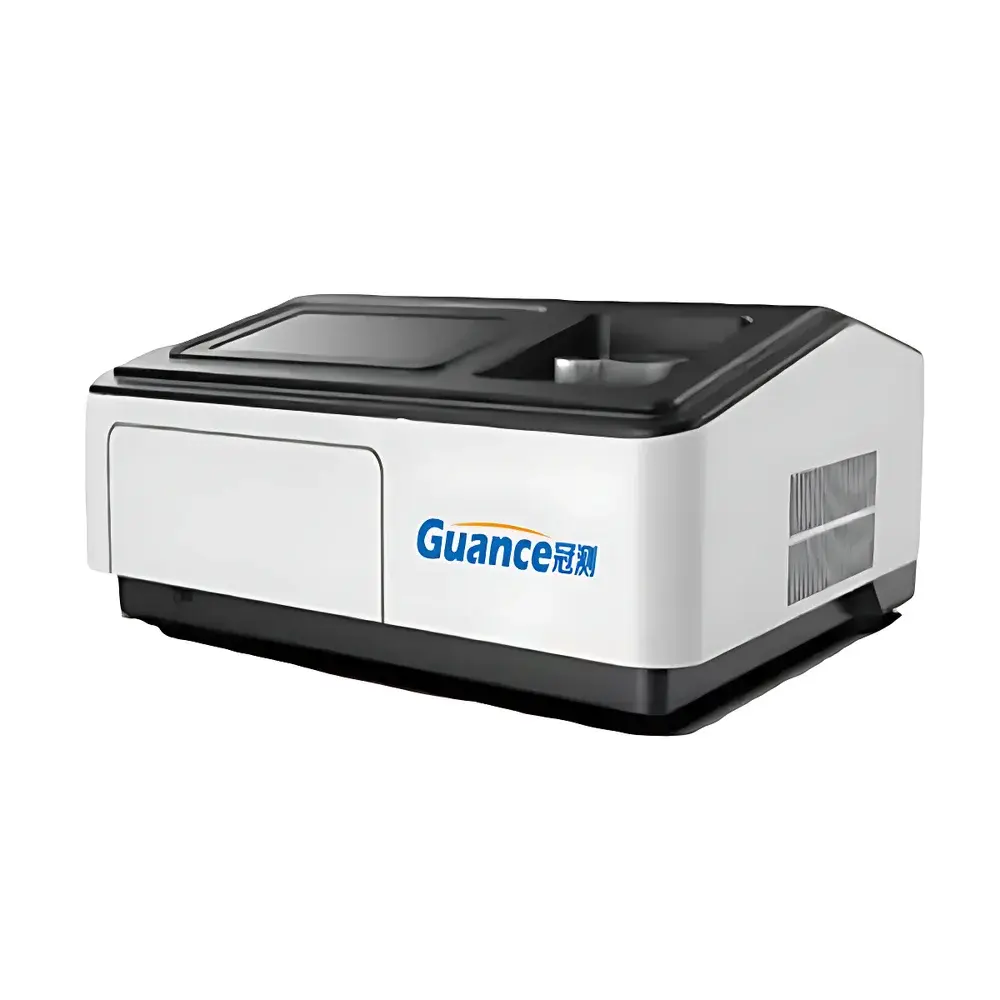
English Product Name
| Brand | Guance Instruments |
|---|---|
| Model | GCZMD-10b |
| Origin | Beijing, China |
| Instrument Type | True Density Analyzer |
| Design | Portable |
| Sample Type | Solids and Liquids |
| Density Range | 0.1–20 g/cm³ |
| Maximum Sample Weight | 20 g |
| Density Resolution | 0.01 g/cm³ |
| Density Accuracy | ±0.1 g/cm³ (typical repeatability ≤0.3% RSD) |
| Measurement Principle | Gas Expansion Displacement (Helium Pycnometry) based on Boyle’s Law (PV = nRT) |
| Sample Chamber Volume | 10 mL ±0.2 mL |
| Measurement Time | ~4 min per run |
| Operating Temperature | 0–40 °C |
| Pressure Range | 1.3–2.0 bar |
| Recommended Analysis Gas | Helium (N₂ compatible with calibration adjustment) |
| Data Interface | RS485, RJ45 Ethernet, USB for U-disk storage |
| Display | Touchscreen with handwriting input |
| Power Supply | AC 220 V / 50 Hz |
| Rated Power | 28 W |
| Dimensions | 410 × 320 × 155 mm |
| Net Weight | 4.6 kg |
| Minimum Sample Mass | 0.1 g |
| Data Output | Real-time process logging + CSV export via USB |
| Compliance | Designed for GLP-compliant lab environments |
Overview
The Guance Instruments GCZMD-10b True Density Analyzer is a portable, helium-based pycnometer engineered for high-reproducibility determination of true (skeletal) density of powders, granules, monoliths, and liquids. It operates on the fundamental gas expansion displacement principle—applying Boyle’s Law (PV = nRT) within a sealed, temperature-stabilized measurement system. By introducing high-purity helium into a calibrated reference chamber and subsequently expanding it into a sample chamber containing a known mass of material, the instrument precisely quantifies the volume displacement caused by the solid or liquid phase. This yields the true volume excluding open pores and interstitial voids—enabling calculation of true density as ρ = m/Vtrue. Unlike bulk or apparent density measurements, this method eliminates compaction artifacts and surface adsorption bias, making it indispensable for R&D and QC in advanced materials development where pore structure, crystallinity, and phase purity critically influence performance.
Key Features
- Modular integrated architecture: Electromagnetic valves (imported Japanese CFVB25 series), pressure sensors, and 10 mL sample cell are co-located to minimize dead volume and maximize sealing integrity.
- Uniform thermal field design: Tubeless, compact module layout ensures rapid thermal equilibrium between ambient and measurement chamber—reducing gas temperature gradients that affect PV accuracy.
- Intelligent pressure regulation: Adaptive algorithm dynamically compensates for upstream gas cylinder pressure fluctuations, maintaining stable flow control and measurement repeatability.
- Script-driven operation: Advanced users may modify test protocols via embedded C-based firmware—customizing cycle count, equilibration time, purge sequences, and pressure ramp profiles.
- High-fidelity data acquisition: 24-bit ADC resolution ensures precise digitization of pressure transients during gas expansion events.
- Multi-interface connectivity: RS485 for industrial PLC integration, RJ45 for networked lab data collection, and USB port for direct U-disk logging of raw and processed datasets (CSV format).
- Onboard touchscreen interface with handwriting support enables intuitive parameter entry, real-time curve visualization, and immediate pass/fail assessment against user-defined tolerance bands.
Sample Compatibility & Compliance
The GCZMD-10b accommodates diverse physical forms—including free-flowing powders (e.g., TiO₂, Al₂O₃), cohesive agglomerates (e.g., catalyst pellets), irregular solids (e.g., ceramic sintered bodies), and low-viscosity liquids (e.g., solvents, polymer solutions). Its 10 mL sample chamber accepts masses from 0.1 g to 20 g, supporting high-precision analysis even for trace quantities of high-value materials such as nuclear fuel simulants or pharmaceutical actives. The system meets foundational requirements for ISO 12154 (determination of true density by gas pycnometry) and ASTM D5550 (standard test method for true density of calcined petroleum coke). When deployed with timestamped, user-authenticated workflows and electronic signature support (via external LIMS), it aligns with FDA 21 CFR Part 11 expectations for regulated environments—including pharmaceutical excipient qualification and catalyst lot release testing.
Software & Data Management
Data capture includes full-cycle pressure-time profiles, intermediate equilibration states, and final calculated density values with uncertainty estimates. All measurements are automatically time-stamped and tagged with operator ID, sample ID, and environmental conditions (ambient temperature recorded at start/end). Raw data files are stored in open CSV format on removable USB media, enabling direct import into statistical analysis tools (e.g., JMP, Minitab) or enterprise QA databases. Optional TMS-printer integration provides hard-copy reports featuring statistical summaries (mean, SD, RSD), calibration verification logs, and instrument condition flags—facilitating internal audits and regulatory submissions. Firmware updates are delivered via secure USB load, preserving configuration integrity across versions.
Applications
This analyzer serves critical roles across multiple sectors: In ceramics and refractories, it validates green-body densification and sintering efficiency; in catalysis, it correlates metal dispersion with support porosity and surface area; in battery materials research, it distinguishes between graphite anode tap density and true particle density to model electrode packing behavior; in pharmaceuticals, it supports polymorph identification and excipient compatibility studies by detecting subtle density shifts linked to crystal lattice changes; and in environmental science, it characterizes soil aggregate stability and contaminant sorption capacity through skeletal density mapping. Routine use spans quality control labs for incoming raw material inspection, production line monitoring of powder metallurgy feedstocks, and academic laboratories investigating porous media transport phenomena.
FAQ
What gases are supported for analysis, and why is helium preferred?
Helium is recommended due to its small atomic diameter (2.6 Å), enabling penetration into sub-nanometer pores and minimizing adsorption-related errors. Nitrogen may be used with appropriate calibration but exhibits higher surface interaction—particularly with polar or microporous samples—potentially inflating measured volumes and lowering reported density values.
How does the GCZMD-10b ensure long-term calibration stability?
The system supports routine verification using certified reference standards (e.g., solid PVC, aluminum, or copper blocks with NIST-traceable density values). Built-in self-diagnostic routines monitor valve timing, pressure sensor drift, and chamber seal integrity before each run—flagging deviations beyond ±0.5% of baseline performance.
Can the instrument operate unattended in a production environment?
Yes—its robust embedded firmware, low power consumption (28 W), and passive cooling design allow continuous deployment in non-climate-controlled settings. Scheduled auto-calibration and error-log generation enable predictive maintenance without interrupting workflow.
Is data export compatible with laboratory information management systems (LIMS)?
Raw CSV outputs and metadata headers conform to ASTM E1482 and ISO/IEC 17025 data exchange conventions. When paired with middleware drivers (e.g., LabWare, Thermo Fisher SampleManager), the GCZMD-10b supports bidirectional communication for automated result ingestion and electronic batch record generation.



