
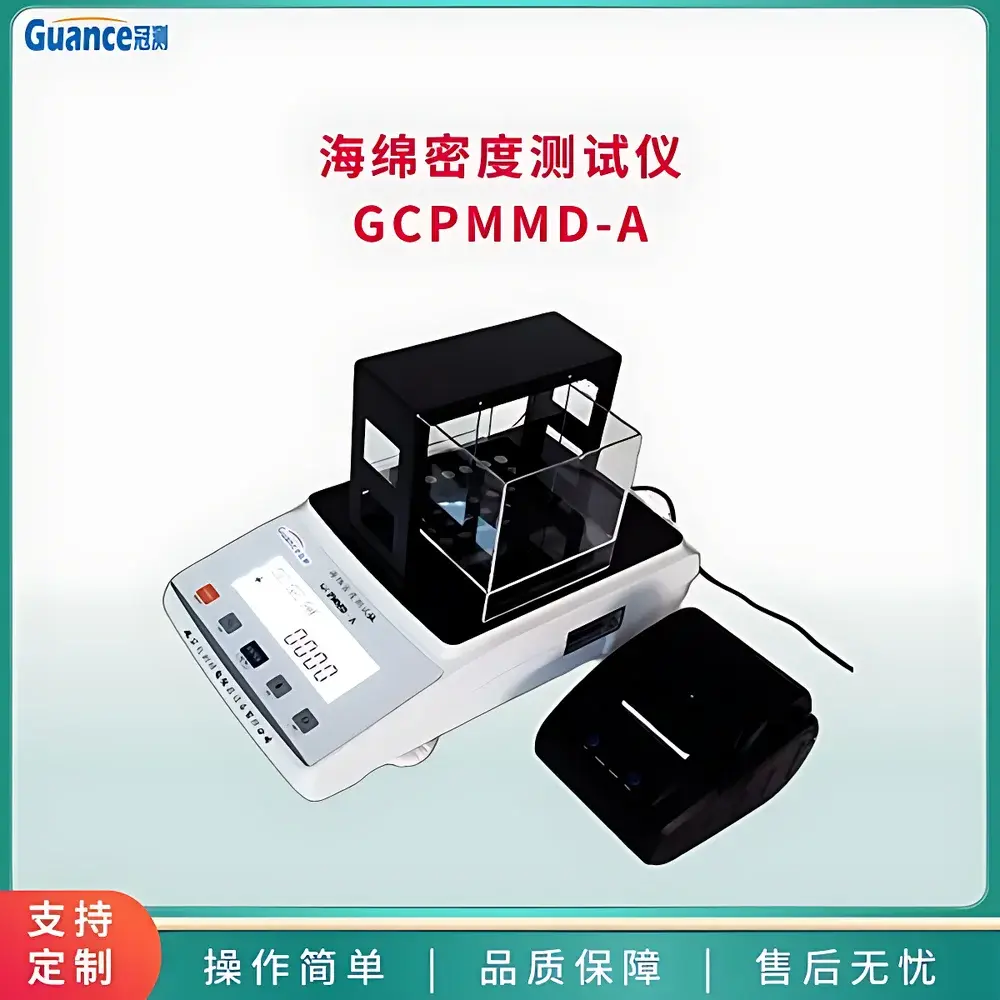
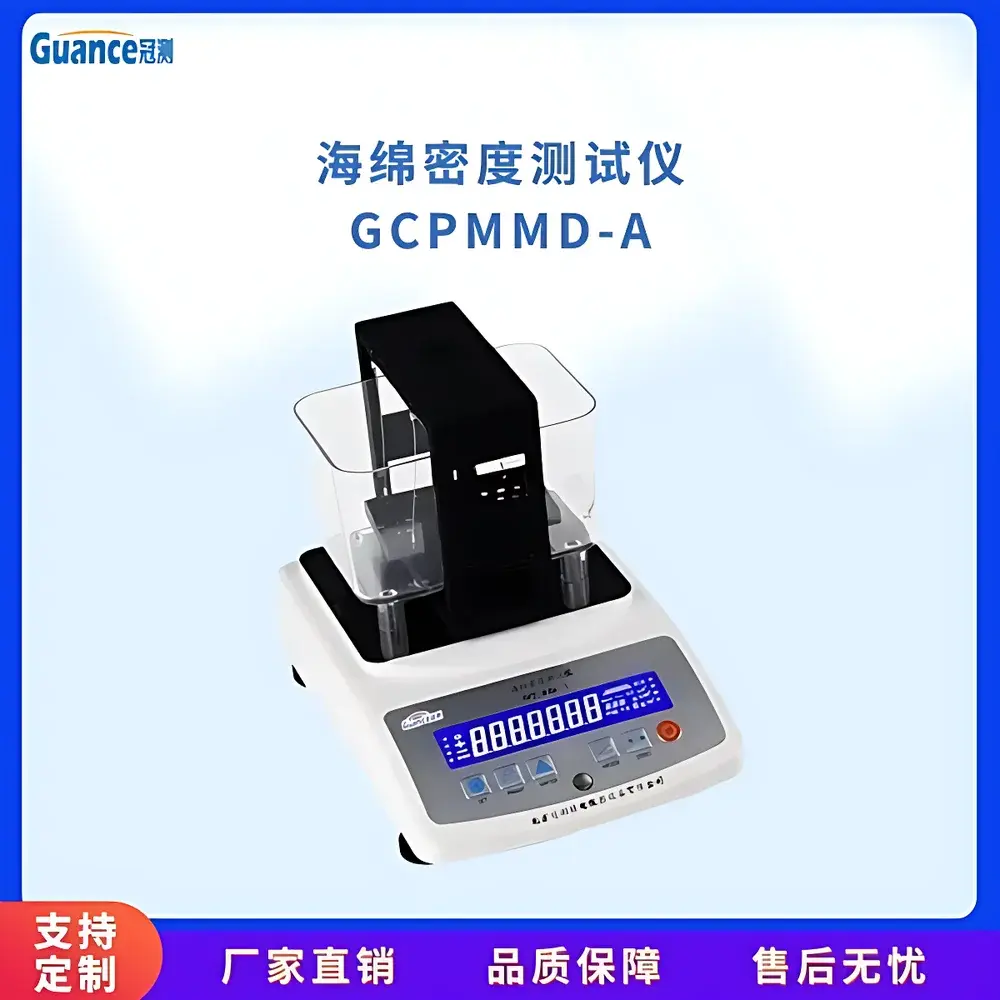
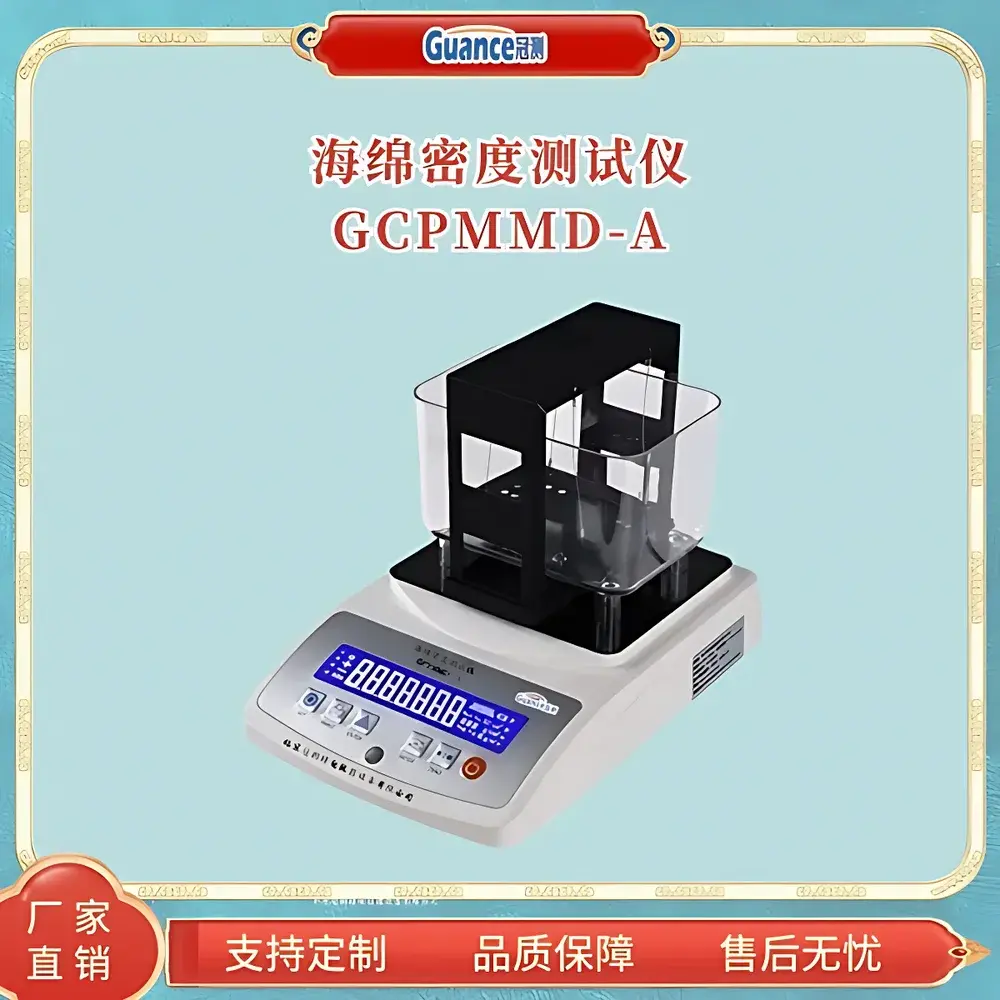
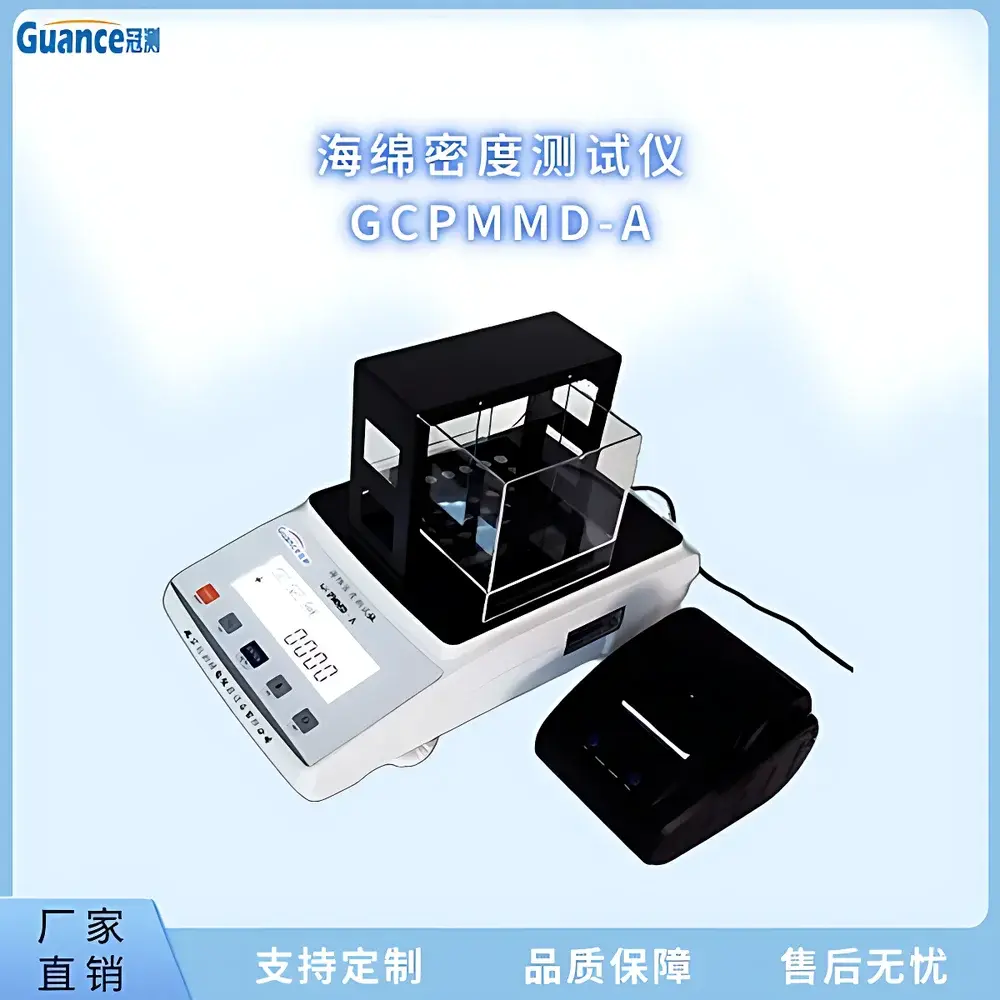
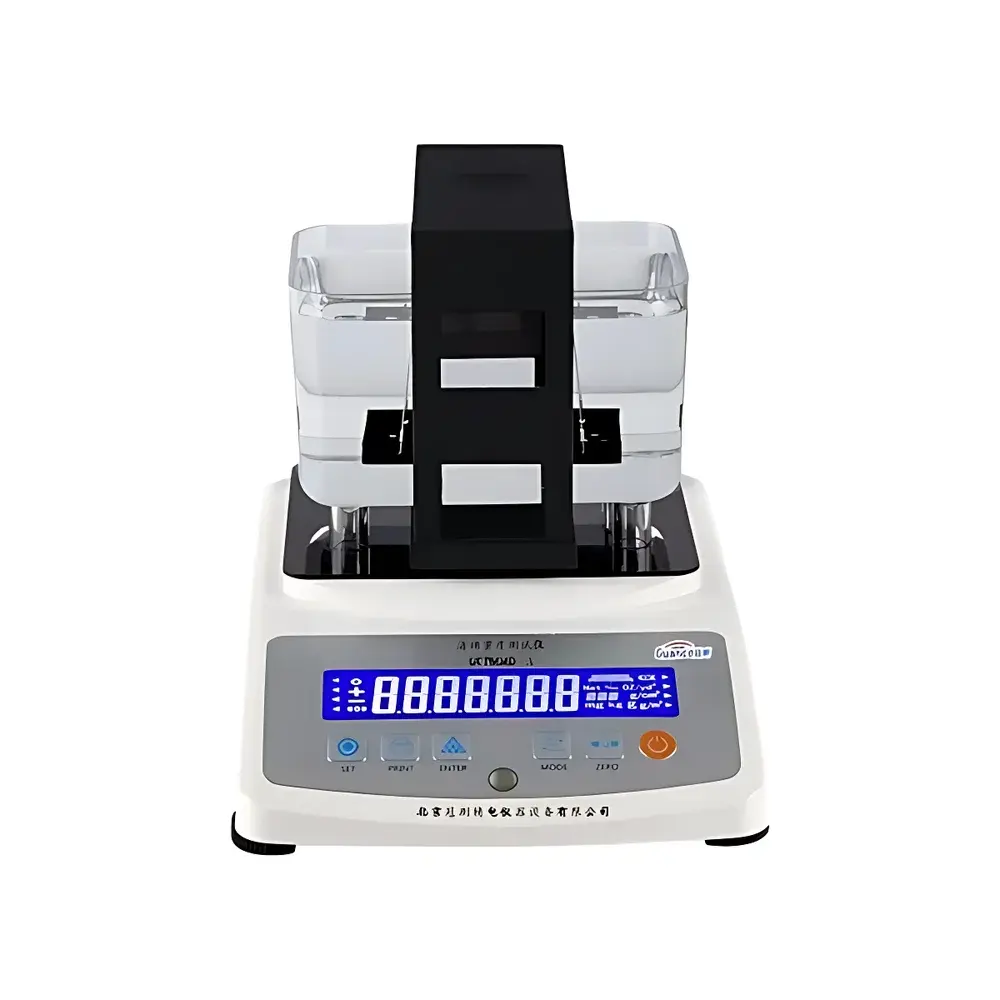
GuanCe Instruments GCPMMD-A Digital Direct-Reading Sponge & Foam Density Analyzer
| Brand | GuanCe Instruments |
|---|---|
| Origin | Beijing, China |
| Manufacturer Type | Authorized Distributor |
| Country of Origin | China |
| Model | GCPMMD-A |
| Price | USD 3,500 (FOB Beijing) |
| Application Field | Universal Solid Density Measurement |
| Instrument Type | Bulk Density Analyzer |
| Form Factor | Portable |
| Measurement Principle | Archimedean Buoyancy Method (Liquid Displacement) |
| Density Range | 0.001–999.999 g/cm³ |
| Density Resolution | 0.001 g/cm³ |
| Maximum Sample Weight | 200 g |
| Minimum Sample Weight | 0.001 g |
| Repeatability | ±0.001 g/cm³ |
| Display | High-Contrast LCD, Direct Digital Readout |
| Operating Temperature | 0–40 °C |
| Temperature Compensation | Adjustable |
| Density Accuracy | ±0.01 g/cm³ (calibrated with standard weights and certified reference fluids) |
| Connectivity | RS-232C interface for PC and thermal printer |
| Construction | Anodized aluminum chassis with corrosion-resistant components |
| Water Tank Capacity | 200 mL (transparent acrylic, large-volume design for irregular/low-density samples) |
| Compliance Standards | GB/T 533, ISO 2781, ASTM D297-93, ASTM D792-20, ASTM D618, ASTM D891, ISO 1183, GB/T 1033, JIS K6530, DIN 53479 |
Overview
The GuanCe Instruments GCPMMD-A Digital Direct-Reading Sponge & Foam Density Analyzer is a precision portable densimeter engineered for rapid, non-destructive density determination of porous polymeric materials—specifically flexible and rigid polyurethane foams, latex sponges, melamine foams, and other low-density cellular solids. It operates on the fundamental principle of Archimedean buoyancy (liquid displacement method), compliant with internationally recognized test standards including ASTM D792 (Standard Test Methods for Density of Plastics), ISO 2781 (Rubber—Determination of Density), and GB/T 533 (Rubber—Determination of Density). Unlike conventional pycnometers or gas pycnometers, the GCPMMD-A eliminates vacuum degassing requirements and complex calibration routines by integrating dual-mode weighing—dry mass in air and apparent mass in liquid—with automatic density computation. Its design accommodates both hydrophilic and hydrophobic foam specimens without pre-treatment, enabling consistent measurement of open-cell, closed-cell, and hybrid-structure materials across R&D labs, QC departments, and production floor environments.
Key Features
- Direct digital readout of density (g/cm³) and volume (cm³) without manual calculation or conversion tables
- High-resolution analytical balance subsystem (0.001 g readability) coupled with temperature-compensated transduction for stable metrology under ambient lab conditions (0–40 °C)
- Large-capacity transparent acrylic water tank (200 mL) and extended measurement platform to accommodate irregularly shaped foam blocks up to 200 g
- Dual-mode operation: standard immersion mode for ρ > 1 g/cm³; sinker-assisted anti-buoyancy fixture included for accurate measurement of low-density specimens (ρ < 1 g/cm³), such as soft polyether foams (0.02–0.15 g/cm³)
- RS-232C serial interface supporting GLP-compliant data export to LIMS or Excel via terminal emulation software; optional driver available for Windows-based reporting tools
- Anodized aluminum housing with sealed electronics compartment—prevents electrolyte ingress during repeated wet-dry cycles and ensures long-term stability in humid manufacturing environments
- Onboard memory stores up to 99 measurement records with timestamp and operator ID fields (when paired with optional authentication module)
Sample Compatibility & Compliance
The GCPMMD-A is validated for use with uncompressed and compression-set foam samples conforming to dimensional limits of ≤120 mm × 120 mm × 80 mm. It supports granular, slab, molded, and die-cut geometries—including irregular scrap pieces—without requiring machining or surface sealing. The instrument meets the mechanical and procedural requirements of ASTM D792-20 Section 7 (Procedure A: Immersion Method) and ISO 2781 Clause 6.2 (Hydrostatic Weighing), and is routinely employed in laboratories subject to ISO/IEC 17025 accreditation. All internal calibration routines trace to NIST-traceable stainless steel and ceramic reference masses. Optional documentation packages include Factory Calibration Certificate (traceable to CNAS-accredited lab) and IQ/OQ protocols aligned with pharmaceutical GMP Annex 15 expectations.
Software & Data Management
While the GCPMMD-A operates autonomously via its embedded firmware, its RS-232C port enables integration into regulated workflows. Raw output includes ASCII-formatted strings containing sample ID, dry mass (g), immersed mass (g), calculated density (g/cm³), temperature (°C), and timestamp (YYYY-MM-DD HH:MM:SS). When connected to validated third-party software (e.g., LabWare LIMS or custom Python-based QA dashboards), the device supports 21 CFR Part 11-compliant audit trails—including user login tracking, parameter change logs, and electronic signature capture—provided the host system implements appropriate access controls and electronic record retention policies. Firmware updates are distributed via secure FTP with SHA-256 checksum verification.
Applications
- Quality control of raw polyol/isocyanate blends prior to foaming
- In-process verification of foam density uniformity across conveyor-belt production lines
- Comparative analysis of aging effects on foam structure (e.g., compression set-induced density gradients)
- Validation of flame-retardant additive dispersion homogeneity through localized density mapping
- Research-grade characterization of bio-based foams (soy, castor oil derivatives) versus petrochemical analogs
- Regulatory submission support for medical device packaging (ISO 10993-12) and automotive seating compliance (FMVSS 302)
FAQ
Does the GCPMMD-A require calibration with certified reference liquids?
Yes—initial calibration must be performed using distilled water at 23 °C (density = 0.99754 g/cm³) and a certified solid standard (e.g., borosilicate glass sphere, ρ = 2.23 g/cm³). Subsequent daily verification uses the included 100 g stainless steel weight.
Can it measure foam density after compression recovery testing?
Yes—provided the specimen regains ≥95% of original thickness within 30 min post-compression, the GCPMMD-A delivers repeatable results per ASTM D3574 Annex A5.
Is the anti-buoyancy fixture compatible with ISO 845 foam density testing?
Yes—the sinker assembly satisfies ISO 845:2006 Clause 6.3 requirements for “immersion devices with auxiliary weights” and is supplied with calibration certificate.
What maintenance is required to sustain metrological integrity?
Monthly cleaning of the water tank and measurement platform with isopropyl alcohol; annual verification of load cell linearity and temperature sensor drift by authorized service center.
Does the instrument support density measurement in ethanol or other immersion fluids?
Yes—user-defined fluid density compensation is supported via front-panel menu; reference values for common solvents (e.g., ethanol 0.789 g/cm³ at 20 °C) are preloaded in firmware v2.3+.



