
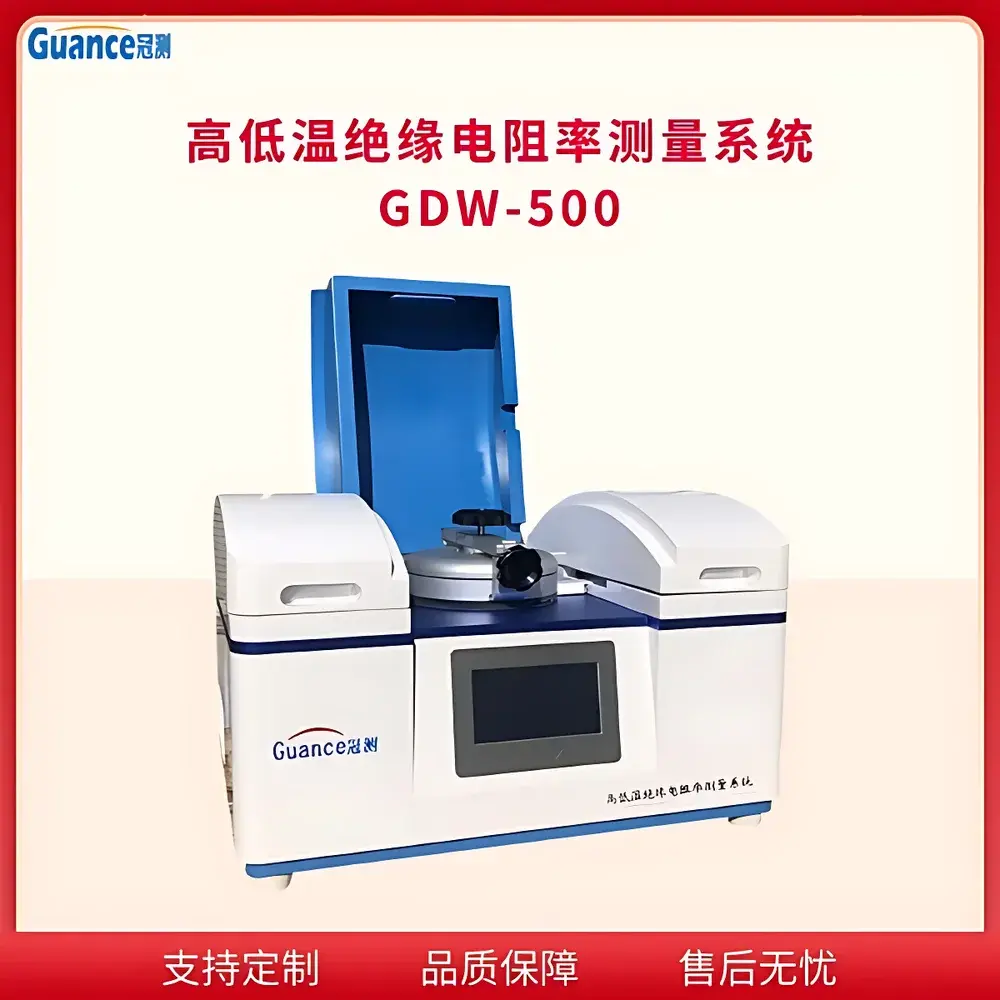
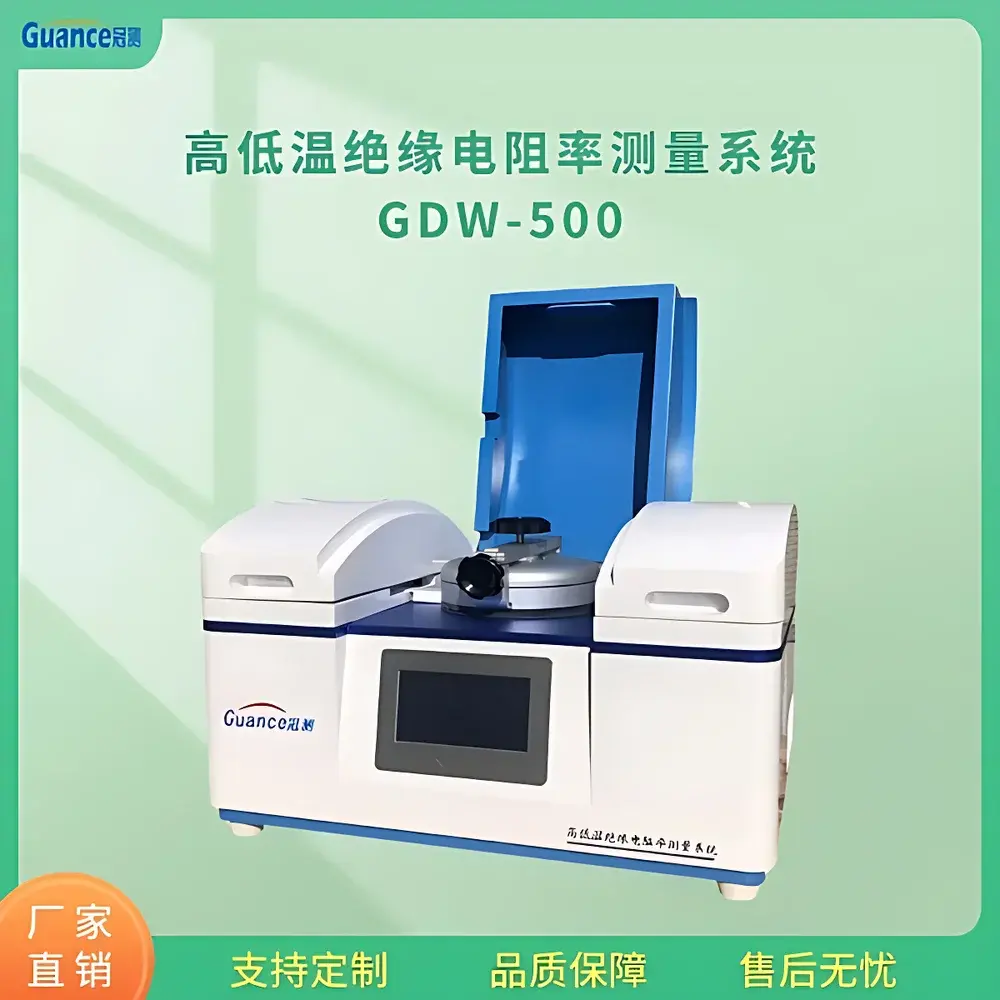
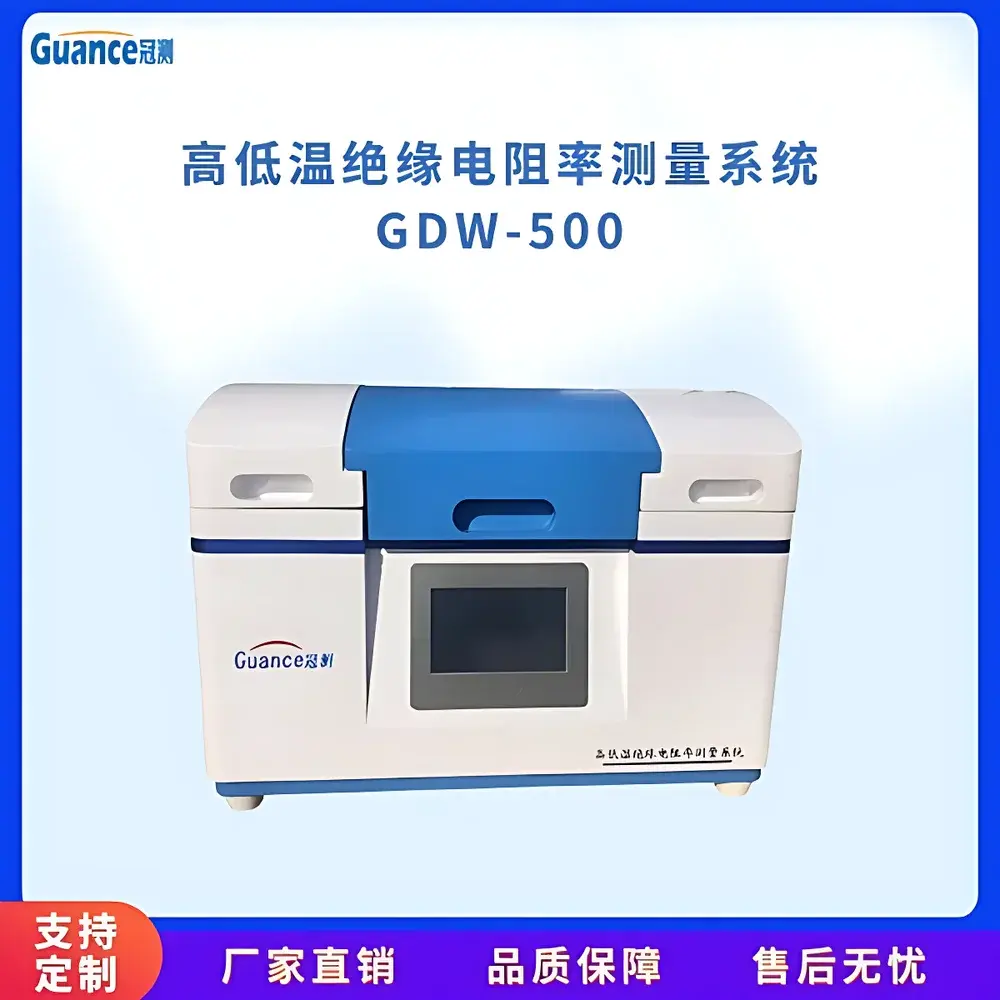
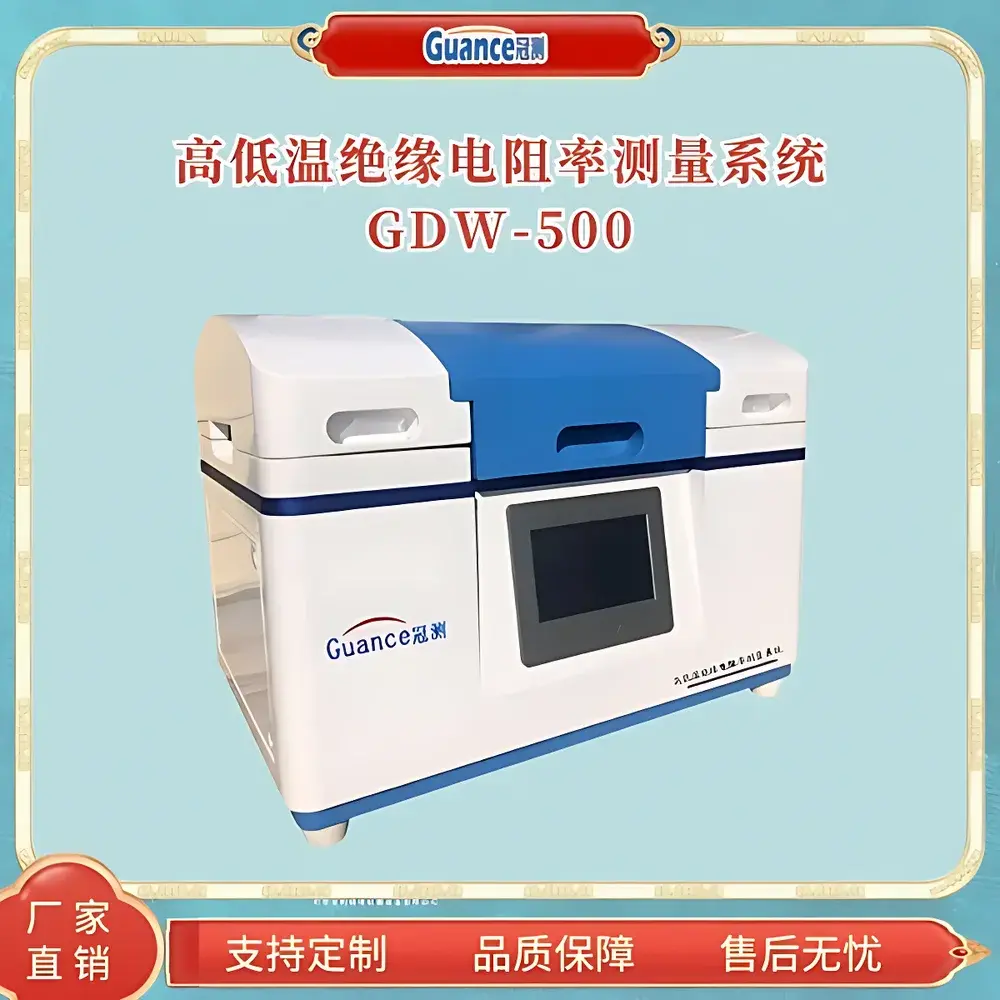
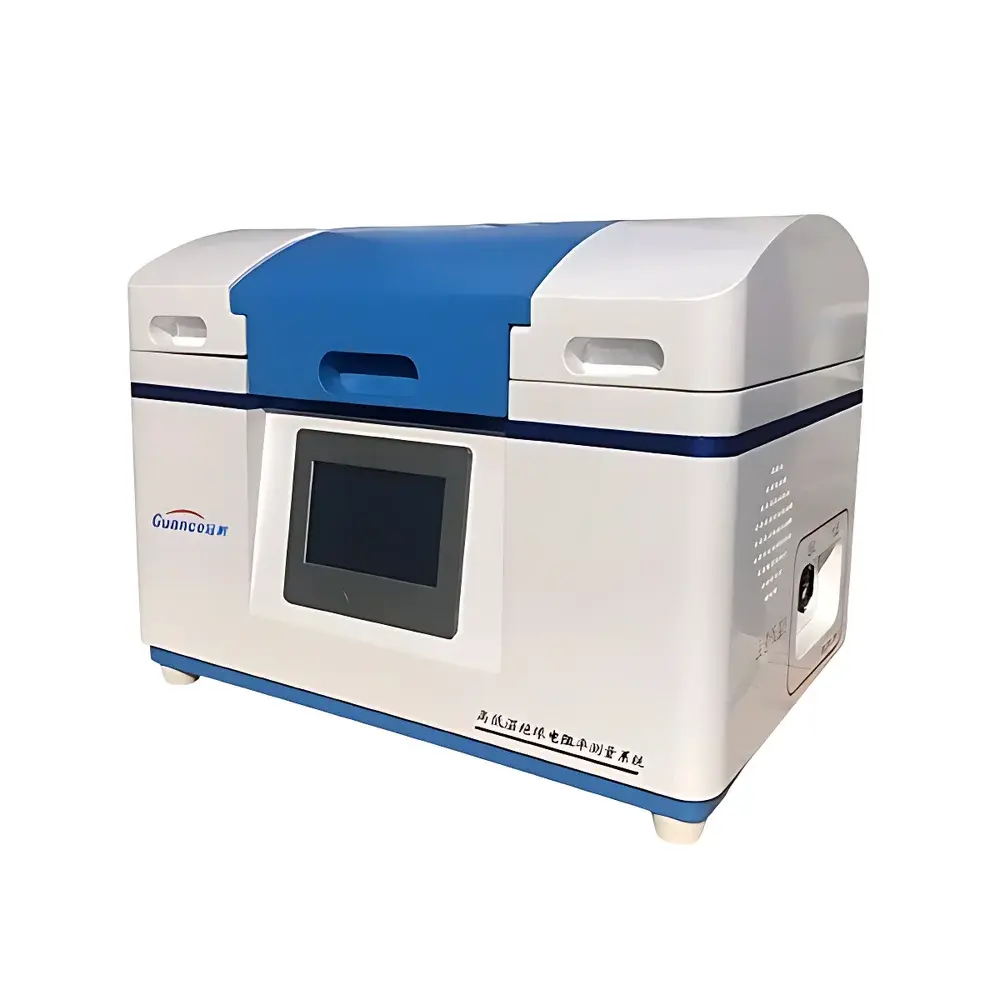
GuanCe GDW-500 High-Low Temperature Insulation Resistivity & Dielectric Spectroscopy System
| Brand | GuanCe Instruments |
|---|---|
| Origin | Beijing, China |
| Manufacturer Type | Authorized Distributor |
| Country of Origin | China |
| Model | GDW-500 |
| Price | USD 270 (approx. based on ¥1888 at 1 USD = ¥7) |
| Heating Method | Electric Resistance Heating |
| Cooling Method | Liquid Nitrogen Cryogenic Cooling |
| Temperature Control Accuracy | ±0.5 °C |
| Temperature Range | −160 °C to +500 °C |
| Electrode Material | Brass |
| Electrode Diameter | 25 mm |
| Test Frequency Range | 20 Hz – 2 MHz |
| Compliance Standards | GB/T 1409–2006, GB/T 1693–2007, ASTM D150, IEC 60250 |
Overview
The GuanCe GDW-500 High-Low Temperature Insulation Resistivity & Dielectric Spectroscopy System is an engineered platform for precision measurement of volume resistivity, surface resistivity, dielectric constant (ε′ and ε″), and dielectric loss tangent (tan δ) across extreme thermal conditions. It operates on the principle of impedance spectroscopy—applying a sinusoidal AC voltage across a sample sandwiched between parallel-plate brass electrodes and analyzing the complex admittance response as a function of frequency and temperature. Designed for rigorous materials science laboratories, the system enables quantitative characterization of insulating and semi-insulating solids—including ceramics, polymers, glass, metal oxides, and advanced dielectrics—under thermally controlled environments ranging from cryogenic (−160 °C) to high-temperature (500 °C) regimes. Its architecture integrates thermal stability with electrical fidelity, supporting fundamental research into charge transport mechanisms, polarization relaxation dynamics, and thermally activated conduction processes in functional dielectrics.
Key Features
- Wide thermal operating range: −160 °C to +500 °C, achieved via dual-mode thermal control—liquid nitrogen cryogenics for sub-ambient cooling and precision electric resistance heating for elevated temperatures.
- High-stability parallel-plate electrode assembly fabricated from oxygen-free brass (25 mm diameter), optimized for low contact impedance and minimal thermal expansion mismatch.
- Integrated LCR meter with 20 Hz–2 MHz frequency sweep capability, offering 0.05% basic impedance accuracy and programmable test signal levels (10 mV–2 V RMS).
- Real-time temperature-synchronized data acquisition: each impedance measurement is time-stamped and tagged with calibrated thermocouple readings (Type K, ±0.3 °C accuracy).
- Robust thermal chamber design featuring vacuum-jacketed insulation and PID-controlled thermal ramping (0.1–5 °C/min), minimizing thermal gradients across the sample zone.
- Compliance-ready hardware architecture: supports audit trails, user access levels, and electronic signature logging for GLP/GMP-aligned workflows.
Sample Compatibility & Compliance
The GDW-500 accommodates disk-shaped, pelletized, or thin-film specimens (thickness 0.1–10 mm) with flat, parallel surfaces. Compatible material classes include alumina, zirconia, barium titanate, polyimide, PTFE, silica glass, and sintered ferrites. Electrode configurations can be adapted for two-terminal (bulk resistivity) or guarded three-terminal (surface resistivity) measurements per IEC 60093. The system fully implements test protocols defined in GB/T 1409–2006 (capacitance and dissipation factor at power/audio/radio frequencies), GB/T 1693–2007 (vulcanized rubber dielectrics), ASTM D150–2022 (AC loss and permittivity of solid insulating materials), and IEC 60250 (dielectric properties at power frequencies). All calibration procedures follow ISO/IEC 17025 traceable standards, and temperature sensors are NIST-traceable.
Software & Data Management
The proprietary GDW-Control Suite (v3.2) provides full instrument orchestration under Windows 10/11. It supports both manual and automated test sequences, including isothermal frequency sweeps, isofrequency temperature ramps, and multi-step thermal cycling profiles. Raw impedance data (Z*, θ, C, R, tan δ) are stored in HDF5 format with embedded metadata (timestamp, temperature, humidity, operator ID, calibration certificate ID). Real-time plotting includes ε′(f), ε″(f), tan δ(f), ρᵥ(f), Cole-Cole diagrams, and Arrhenius plots. Export options include CSV, MATLAB .mat, and PDF report generation with customizable templates compliant with internal QA documentation requirements. Software adheres to FDA 21 CFR Part 11 principles—enabling electronic signatures, role-based permissions, and immutable audit logs for regulated environments.
Applications
- Development and qualification of high-k gate dielectrics and low-k interlayer materials for semiconductor packaging.
- Thermal stability assessment of polymer electrolytes in solid-state batteries (e.g., PEO-LiTFSI systems between −40 °C and 80 °C).
- Phase transition detection in ferroelectric ceramics (e.g., Curie point mapping in BaTiO₃ via ε′(T) inflection analysis).
- Quality control of ceramic substrates used in high-frequency RF modules (measuring ε′ consistency at 1 GHz equivalent via extrapolation).
- Fundamental studies of hopping conduction and space-charge-limited currents in amorphous oxide semiconductors.
- Accelerated aging evaluation of insulating varnishes and encapsulants under thermal stress (IEC 60216-compliant protocols).
FAQ
What sample preparation is required for accurate resistivity measurement?
Samples must be polished to optical flatness (Ra < 0.1 µm), cleaned ultrasonically in acetone and isopropanol, and dried under nitrogen flow. Electrode contact area must be free of contaminants or voids; silver paste or sputtered gold electrodes may be applied for non-conductive surfaces.
Can the system perform simultaneous DC bias + AC impedance measurements?
No—the GDW-500 is configured for pure AC impedance spectroscopy. DC bias superposition requires external source-meter integration, which is not natively supported but possible via GPIB/LAN trigger synchronization.
Is liquid nitrogen handling training included with installation?
Yes—on-site commissioning includes certified cryogen safety briefing, Dewar filling procedure, and emergency venting protocol review per OSHA 1910.101 and CGA P-1 guidelines.
How is electrode capacitance calibrated at extreme temperatures?
A two-point open/short compensation is performed at each temperature setpoint using NIST-traceable calibration standards; residual thermal drift is corrected via real-time electrode temperature feedback.
Does the software support custom mathematical modeling (e.g., Havriliak-Negami fitting)?
Yes—GDW-Control Suite includes built-in nonlinear regression tools for Debye, Cole-Cole, Davidson-Cole, and Havriliak-Negami models, with parameter confidence interval estimation.



