
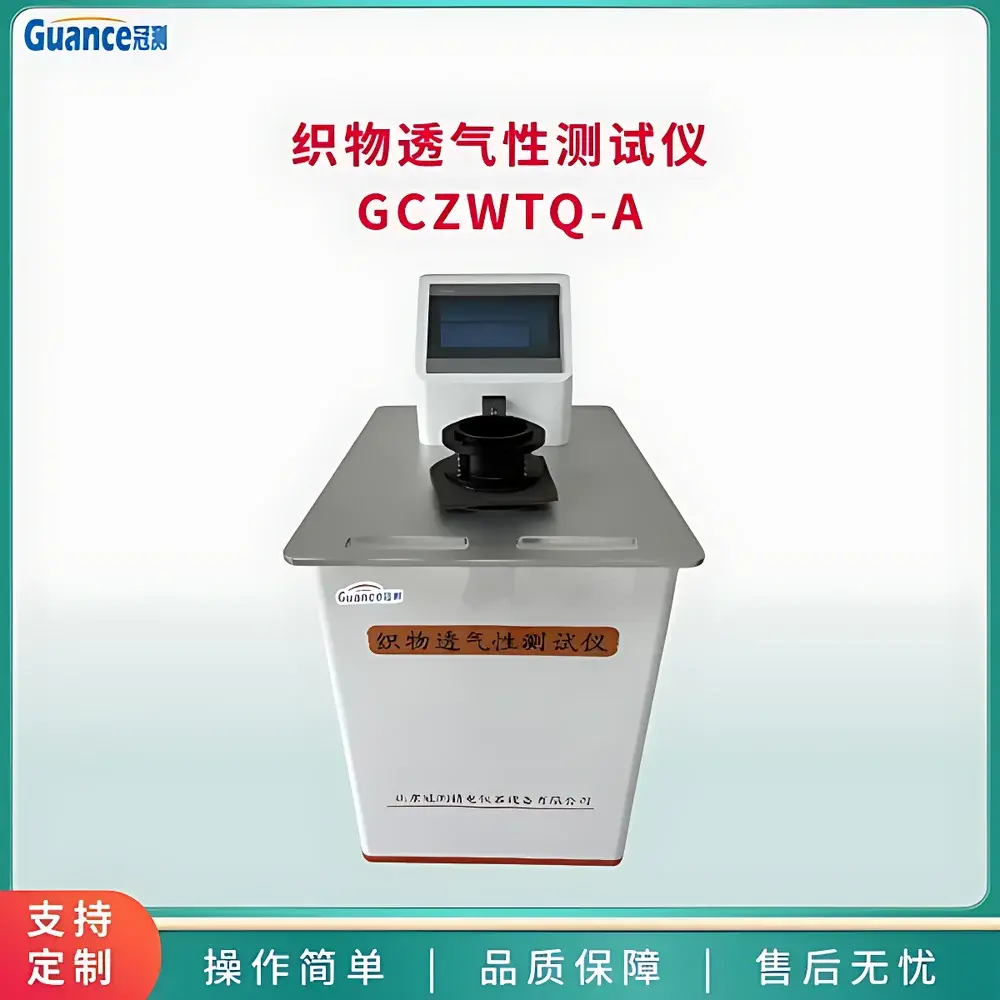
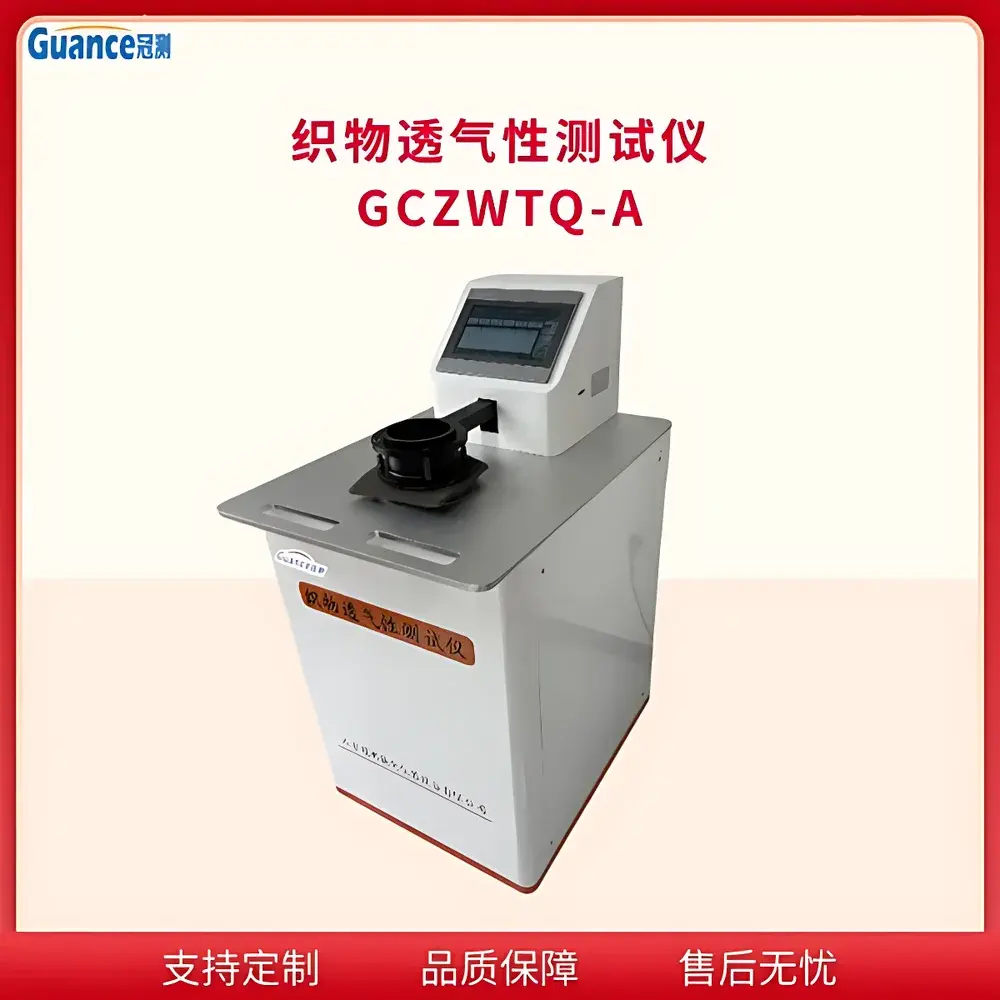
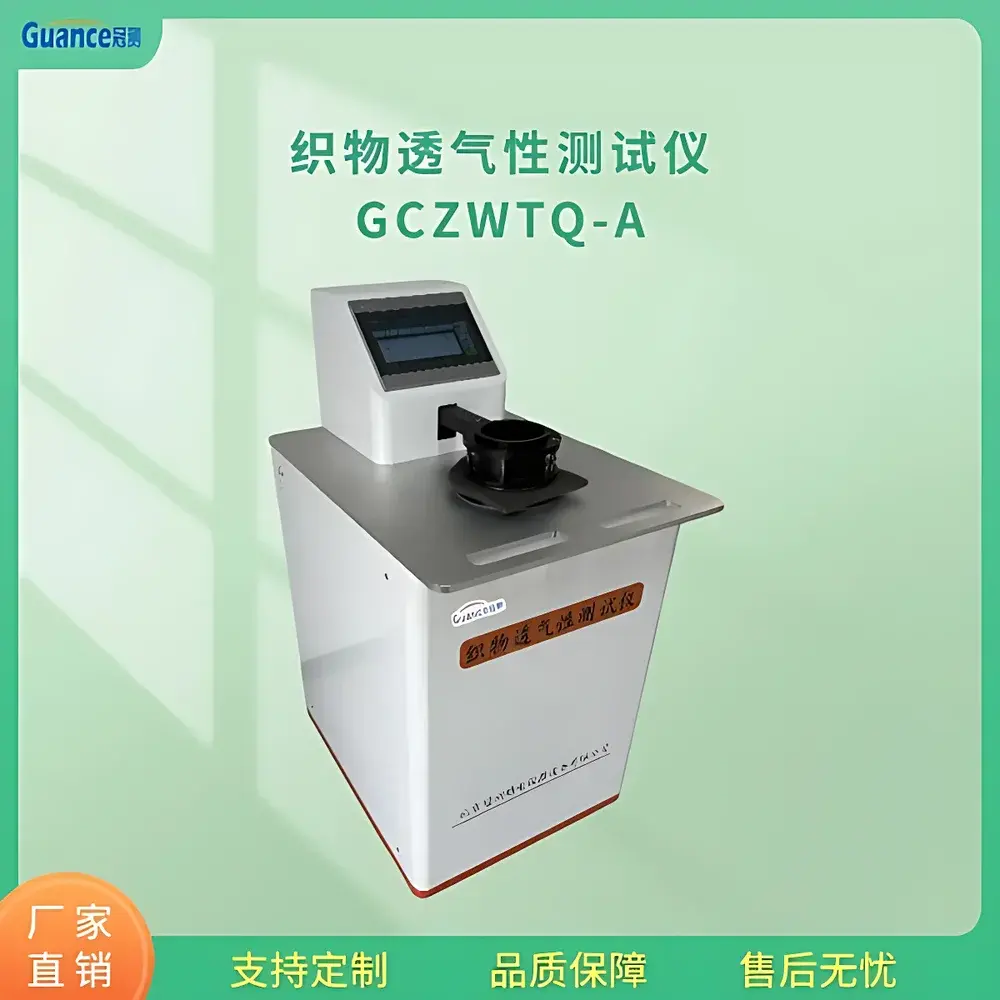
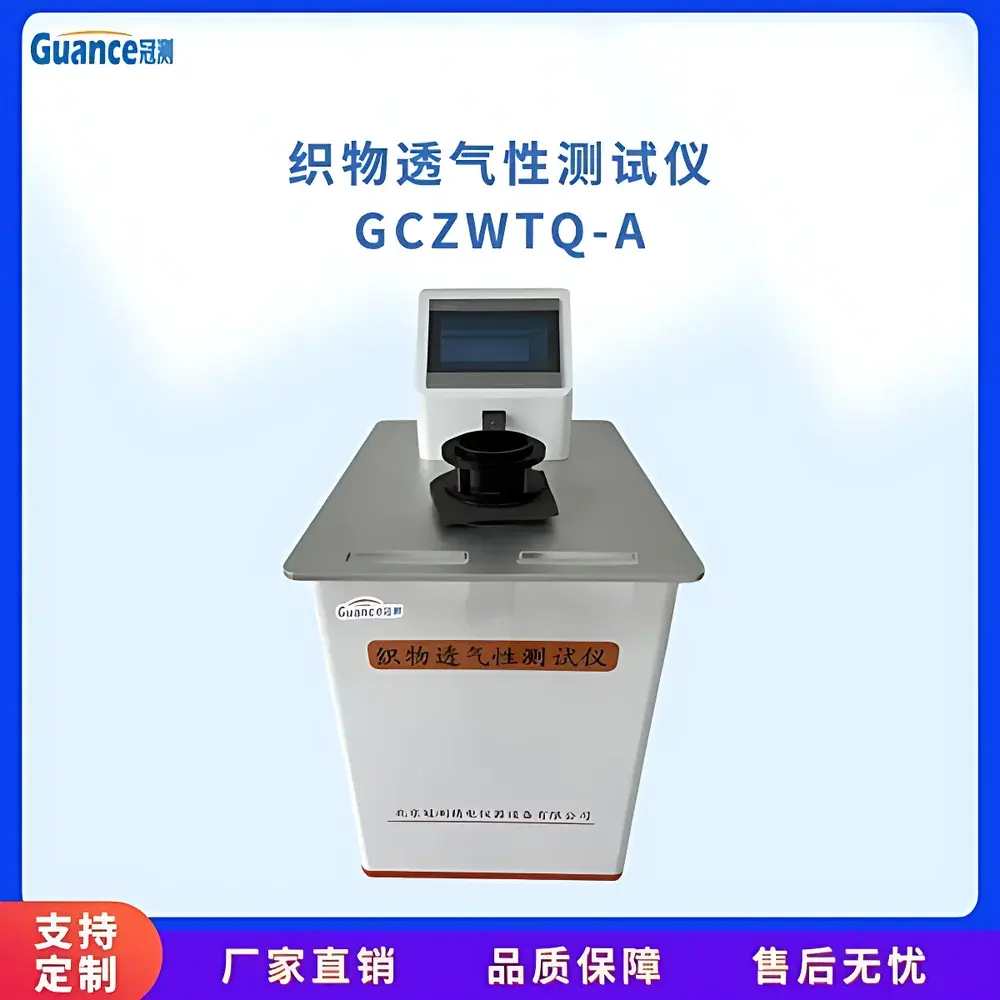
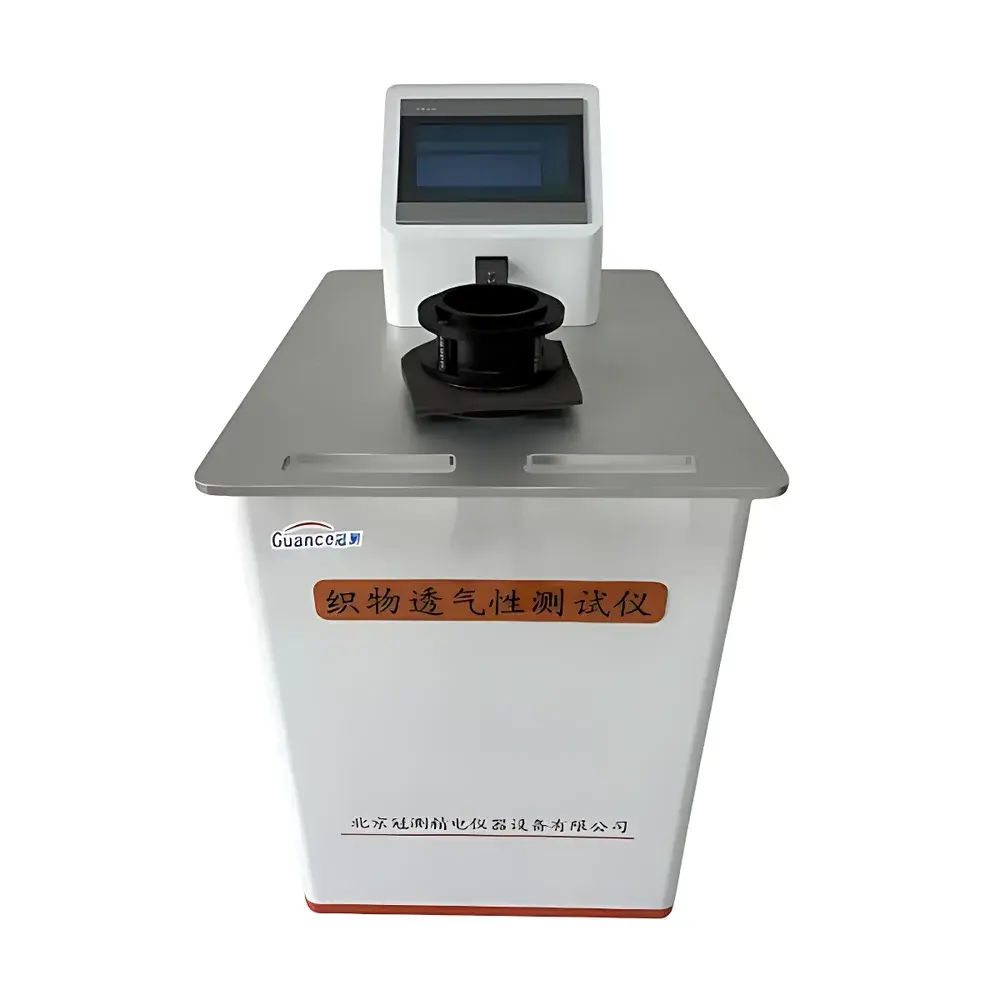
GuanCe GCZWTQ-A Automatic Fabric Air Permeability Tester
| Brand | GuanCe |
|---|---|
| Origin | Beijing, China |
| Manufacturer Type | Authorized Distributor |
| Country of Origin | China |
| Model | GCZWTQ-A |
| Price | Upon Request |
| Standard Compliance | ISO 4638:1984, GB/T 10655, GB/T 5453–1997, AQ 1088–2011, ASTM D3574–2005 |
| Display & Control | 10-inch industrial touchscreen HMI |
| Test Method | Constant-pressure differential method |
| Pressure Differential Sensor Range | 0–1000 Pa |
| Flow Sensor Range | 0–100 L/min |
| Sample Aperture Diameter | φ100 mm |
| Test Chamber Material | 4 mm thick brushed 304 stainless steel weldment |
| Safety Protections | Over-temperature, over-pressure, over-flow, and overload protection |
| Dimensions (L×W×H) | 400 × 600 × 1200 mm |
| Weight | 85 kg |
| Power Rating | 1 kW |
| Test Duration | ≤10 s per measurement |
| Data Output | Differential pressure, volumetric flow rate, air permeability coefficient (mm/s or mL/cm²·s), arithmetic mean of multiple tests |
| Operating Modes | Fully automatic test cycle or manual termination |
| Sensor Switching | Dual-range differential pressure sensors with auto-switching logic |
Overview
The GuanCe GCZWTQ-A Automatic Fabric Air Permeability Tester is an engineered solution for precise, repeatable quantification of air permeability in porous polymeric materials—including flexible foams, nonwovens, technical textiles, and sealing composites—under standardized constant-pressure differential conditions. Based on the fundamental principle of Darcy’s law for laminar gas flow through porous media, the instrument measures volumetric airflow (L/min) across a defined sample area (φ100 mm) at a controlled pressure gradient (up to 1000 Pa), then calculates air permeability (typically expressed in mm/s or mL·cm⁻²·s⁻¹) per ISO 4638, GB/T 5453, and ASTM D3574 protocols. Its fully integrated architecture eliminates manual calibration steps, operator-dependent timing, and mechanical valve actuation—replacing them with closed-loop digital control, real-time sensor fusion, and deterministic test sequencing. Designed specifically for quality control laboratories, R&D centers, and third-party testing facilities operating under GLP or ISO/IEC 17025 frameworks, the GCZWTQ-A delivers metrological traceability without requiring external data loggers or post-processing software.
Key Features
- 10-inch industrial-grade resistive touchscreen HMI with intuitive icon-driven workflow navigation—no keyboard or mouse required
- Sub-10-second test cycle time, including sample pressurization, stabilized flow acquisition, and result computation
- Dual-range differential pressure sensing system (high- and low-sensitivity channels) with automatic range switching based on real-time signal amplitude
- Integrated safety interlocks: thermal cutoff at 85 °C, pressure relief at 1050 Pa, flow limiter at 105 L/min, and motor current monitoring for blower overload
- Test chamber fabricated from 4 mm-thick brushed 304 stainless steel—resistant to corrosion, abrasion, and cleaning agents used in regulated environments
- Support for both automatic termination (upon reaching steady-state flow stability ±1.5% over 3 s) and operator-initiated manual stop
- On-device statistical processing: single-test output plus arithmetic mean, standard deviation, and coefficient of variation for up to 99 sequential measurements
Sample Compatibility & Compliance
The GCZWTQ-A accommodates rigid and semi-flexible sheet materials up to 25 mm thickness, provided they seal reliably against the φ100 mm test orifice using the pneumatic clamping mechanism. It is validated for use with open-cell polyurethane foams (ASTM D3574 Type A–F), knitted and woven technical fabrics (GB/T 5453), elastomeric gasketing compounds (AQ 1088–2011), and filtration media used in industrial PPE. All firmware logic, measurement algorithms, and calibration constants conform to the procedural requirements of ISO 4638:1984 (including specified upstream/downstream manometer placement), GB/T 10655 (sample conditioning humidity control recommendations), and USP Annex 3 for barrier material characterization. The device supports audit-ready operation when paired with optional external USB-printer logging or networked data export (via RS-232 or Ethernet MODBUS TCP).
Software & Data Management
The embedded Linux-based controller runs deterministic real-time firmware with dual-layer memory architecture: volatile RAM for active test buffers and non-volatile eMMC storage (8 GB) retaining ≥10,000 test records with timestamps, operator IDs, environmental metadata (ambient T/P if external sensors connected), and raw sensor waveforms. Export formats include CSV (tab-delimited, UTF-8 encoded) and PDF reports compliant with ISO/IEC 17025 clause 7.8.2. Audit trail functionality logs all parameter changes, user logins, calibration events, and error resets—with SHA-256 hashing applied to critical entries. While not FDA 21 CFR Part 11-certified out-of-the-box, the system supports integration into validated laboratory information management systems (LIMS) via standard OPC UA or HTTP REST APIs upon customer-specific configuration.
Applications
- Quality assurance of cushioning foams in automotive seating and medical mattresses per ISO 4638 pass/fail thresholds
- Batch release testing of flame-retardant textile substrates for protective clothing (EN 11612, NFPA 2112)
- R&D evaluation of breathability trade-offs in laminated membranes for outdoor apparel
- Stability monitoring of spray-applied polymer sealants in coal mine ventilation ducts (AQ 1088–2011 Section 6.4)
- Comparative analysis of pore structure evolution during accelerated aging of filtration nonwovens
FAQ
What standards does the GCZWTQ-A natively support?
ISO 4638:1984, GB/T 10655, GB/T 5453–1997, AQ 1088–2011, and ASTM D3574–2005 are preloaded in the test method library with default parameters aligned to each standard’s specified pressure differentials and sampling durations.
Can the instrument be calibrated in-house?
Yes—NIST-traceable reference orifices and certified pressure/flow calibrators (e.g., Fluke 754 with DP module) may be used; full calibration procedure documentation and uncertainty budget templates are supplied with the instrument.
Is remote monitoring supported?
Standard configuration includes RS-232 serial port and 10/100 Mbps Ethernet; optional Wi-Fi module enables secure TLS 1.2–encrypted data streaming to cloud-hosted dashboards.
What maintenance intervals are recommended?
Filter replacement every 6 months under continuous operation; annual verification of pressure sensor linearity and flow transducer zero drift using factory-provided check fixtures.
Does the system meet electromagnetic compatibility (EMC) requirements for laboratory use?
Complies with IEC 61326-1:2013 Class A emission limits and immunity performance per EN 61000-4-x series for industrial environments. CE marking valid for EU markets.




