
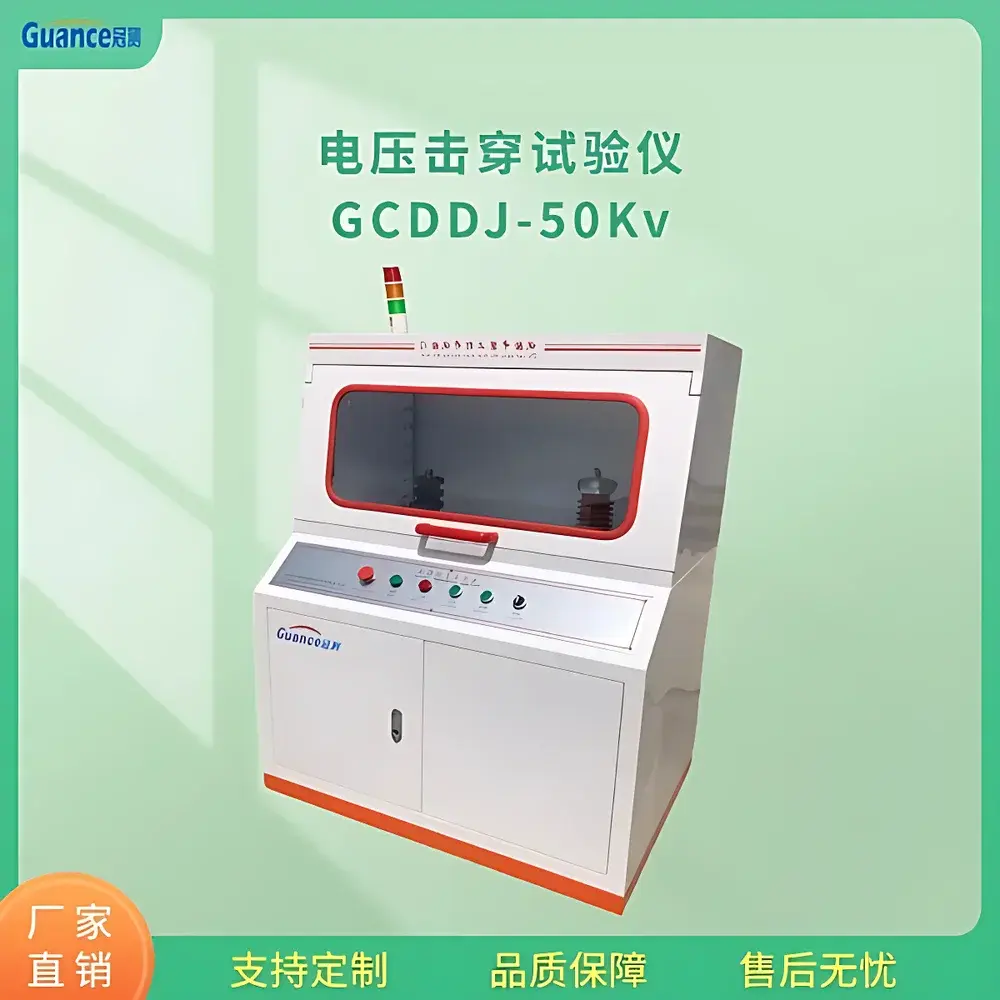
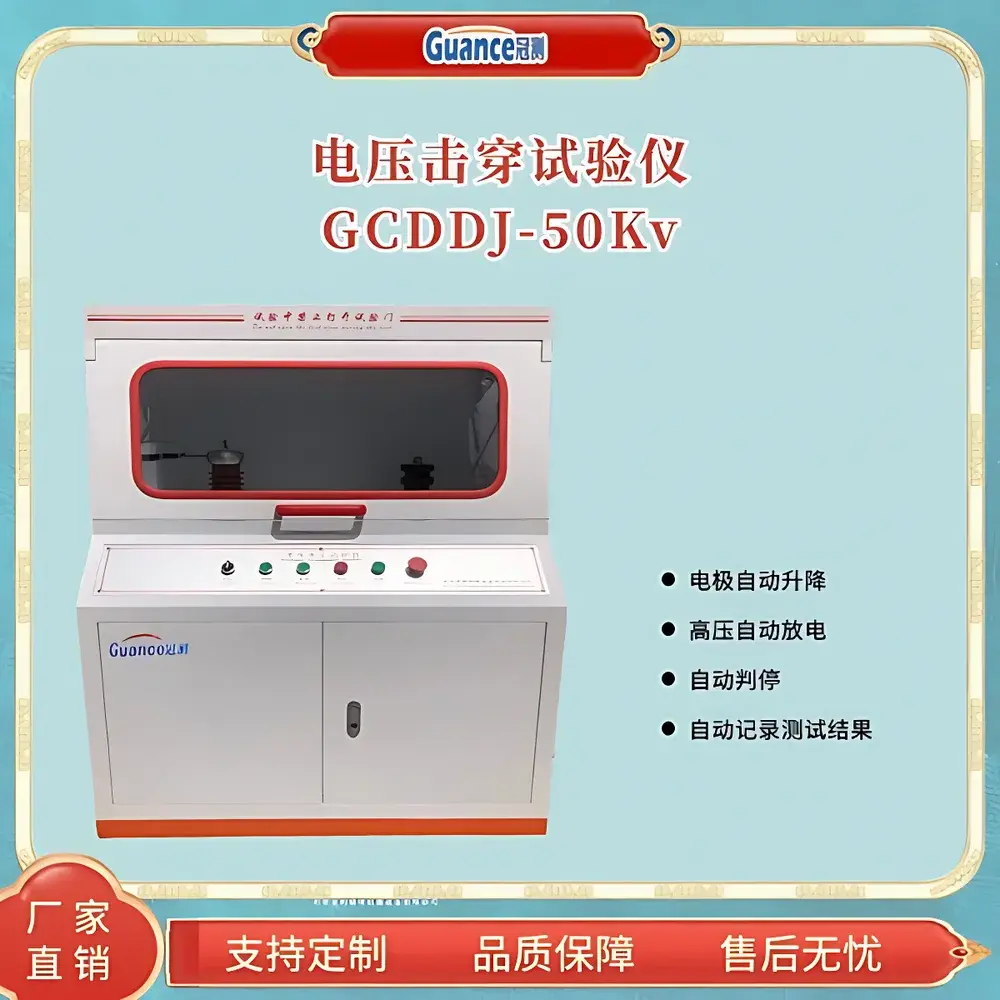
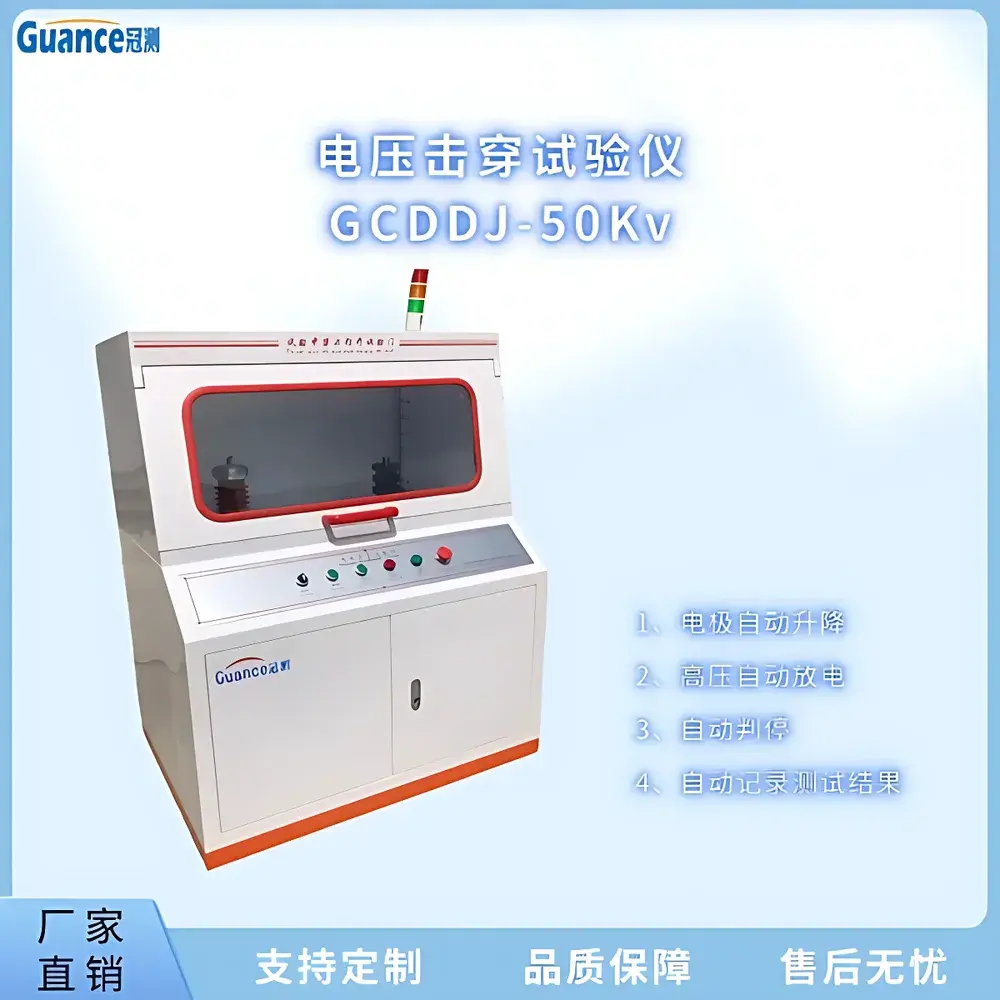
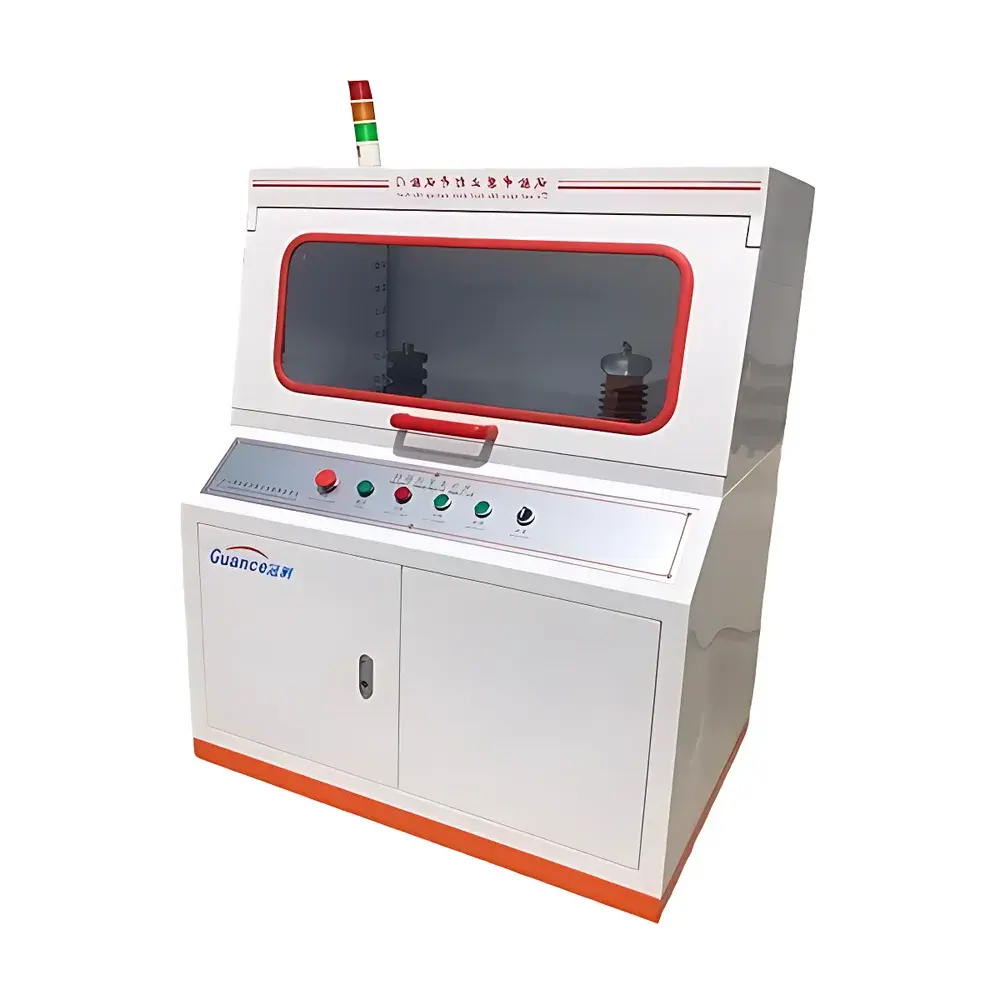
GuanCe GCDDJ-50kV Computer-Controlled Voltage Breakdown Tester
| Brand | GuanCe Instruments |
|---|---|
| Origin | Beijing, China |
| Manufacturer Type | Authorized Distributor |
| Country of Origin | China |
| Model | GCDDJ-50kV |
| Breakdown Voltage Range | 0–50 kV AC/DC |
| Electrical Capacity | 5 kVA |
| Input Voltage | AC 220 V / 50 Hz |
| Rise Rate Adjustment | 0.1–5 kV/s (continuously variable) |
| Voltage Accuracy | ≤ ±1.5% |
| Leakage Current Measurement Range | 0–100 mA |
| Electrode Options | φ25 mm (×2), φ75 mm (×1), customizable |
| Test Medium | Air, oil bath (300×150×200 mm tank), or elevated temperature environment |
| Safety Protections | Overvoltage, overcurrent, short-circuit, and leakage current protection |
| Host Dimensions (L×W×H) | 1600 × 850 × 1700 mm |
| Weight | ~300 kg |
Overview
The GuanCe GCDDJ-50kV Computer-Controlled Voltage Breakdown Tester is an industrial-grade dielectric strength testing system engineered for precise determination of electrical breakdown voltage and withstand voltage performance of solid insulating materials under AC or DC stress conditions. Based on the fundamental principle of controlled voltage ramping until dielectric failure occurs—detected via abrupt current surge or voltage collapse—the instrument complies with internationally recognized test standards including ASTM D149, IEC 60243-1, GB/T 1408.1–2016, GB/T 1695–2005, GB/T 3333, GB/T 12656, and HG/T 3330. It employs a dual-loop control architecture integrating Siemens PLC-based real-time logic with optically isolated data acquisition to ensure electromagnetic immunity in high-voltage laboratory environments. Designed for reliability in QC labs, R&D centers, and certification facilities, the system delivers repeatable, traceable, and auditable test outcomes suitable for GLP-compliant reporting and regulatory submissions.
Key Features
- Full computer control via Windows-based software with intuitive GUI, supporting real-time visualization of voltage ramp curves and leakage current dynamics
- Three operational modes: stepwise voltage ramp (gradient test), constant-rate rise (uniform breakdown test), and fixed-voltage hold (dielectric withstand test)
- Programmable rise rate from 0.1 kV/s to 5 kV/s, adjustable in 0.1 kV/s increments for fine-tuned test protocol alignment
- Dual-trigger breakdown detection: configurable voltage threshold stop or current threshold stop (0–100 mA range with high-linearity sensor)
- Integrated high-voltage generation module featuring custom-wound transformer, EMI-suppressed shielding, and zero-voltage return limit switch
- Robust safety architecture including automatic motorized discharge, pneumatic interlocked test door, multi-point overcurrent/overvoltage cutoff, and LED tower status indicator
- Modular electrode configuration: standard brass electrodes (φ25 mm × 2, φ75 mm × 1), oil bath tank (300 × 150 × 200 mm), and optional motorized electrode lift mechanism
Sample Compatibility & Compliance
The GCDDJ-50kV accommodates a broad spectrum of solid dielectrics—including thermoplastics, elastomers, laminates, polymer films, epoxy resins, mica composites, ceramics, glass substrates, varnish-coated components, and paper-based insulation systems. Testing may be conducted in ambient air, transformer oil immersion (per ASTM D877 and IEC 60156), or within externally heated environmental chambers (custom integration supported). All hardware and firmware comply with CE marking requirements for low-voltage directive (2014/35/EU) and electromagnetic compatibility (2014/30/EU). Software audit trail functionality supports FDA 21 CFR Part 11 readiness when deployed with validated user access controls and electronic signature protocols.
Software & Data Management
The proprietary Windows application provides full test lifecycle management: parameter configuration (voltage mode, rise rate, hold time, pass/fail criteria), real-time graphical monitoring (dual-axis plot of kV vs. time and mA vs. time), automated result capture upon breakdown, and post-test analysis tools. Export options include CSV and native Excel (.xlsx) formats for statistical evaluation and report generation. Users may define custom report templates with institutional headers, test identifiers, operator signatures, and calibration metadata. The system logs all critical events—including door open/close status, zero-reset confirmation, start/stop timestamps, and fault triggers—with timestamped records stored locally in encrypted binary format. Audit logs are exportable for internal quality audits or third-party accreditation reviews (e.g., ISO/IEC 17025).
Applications
This tester serves critical roles across multiple sectors: incoming material qualification of polymer pellets and sheet stock; process validation of cable jacketing and capacitor dielectrics; comparative aging studies of insulating varnishes under thermal-electrical stress; failure analysis of PCB substrates and encapsulants; and certification testing per UL 746, IEC 60674, and MIL-DTL-46842. It is routinely deployed in national metrology institutes, TÜV-accredited laboratories, automotive component suppliers validating HV battery insulation, and photovoltaic module manufacturers verifying backsheet dielectric integrity under damp heat exposure.
FAQ
What standards does the GCDDJ-50kV support out-of-the-box?
It natively implements test sequences aligned with ASTM D149, GB/T 1408.1–2016, GB/T 1695–2005, and IEC 60243-1. Custom test methods can be scripted using the built-in macro editor.
Can the system perform both AC and DC breakdown tests?
Yes—dual-mode high-voltage generator enables seamless switching between sinusoidal 50 Hz AC and ripple-free DC output without hardware reconfiguration.
Is remote operation or network integration possible?
The system supports TCP/IP communication for SCADA-level integration and optional OPC UA server add-on for factory-wide MES connectivity.
How is calibration traceability maintained?
Voltage and current sensors are calibrated annually against NIST-traceable reference standards; calibration certificates and uncertainty budgets are provided with each unit.
What maintenance intervals are recommended?
Biannual inspection of HV bushings, oil bath cleanliness verification, and annual verification of optical isolation integrity and grounding resistance (<1 Ω) per IEC 61000-4-5.



