
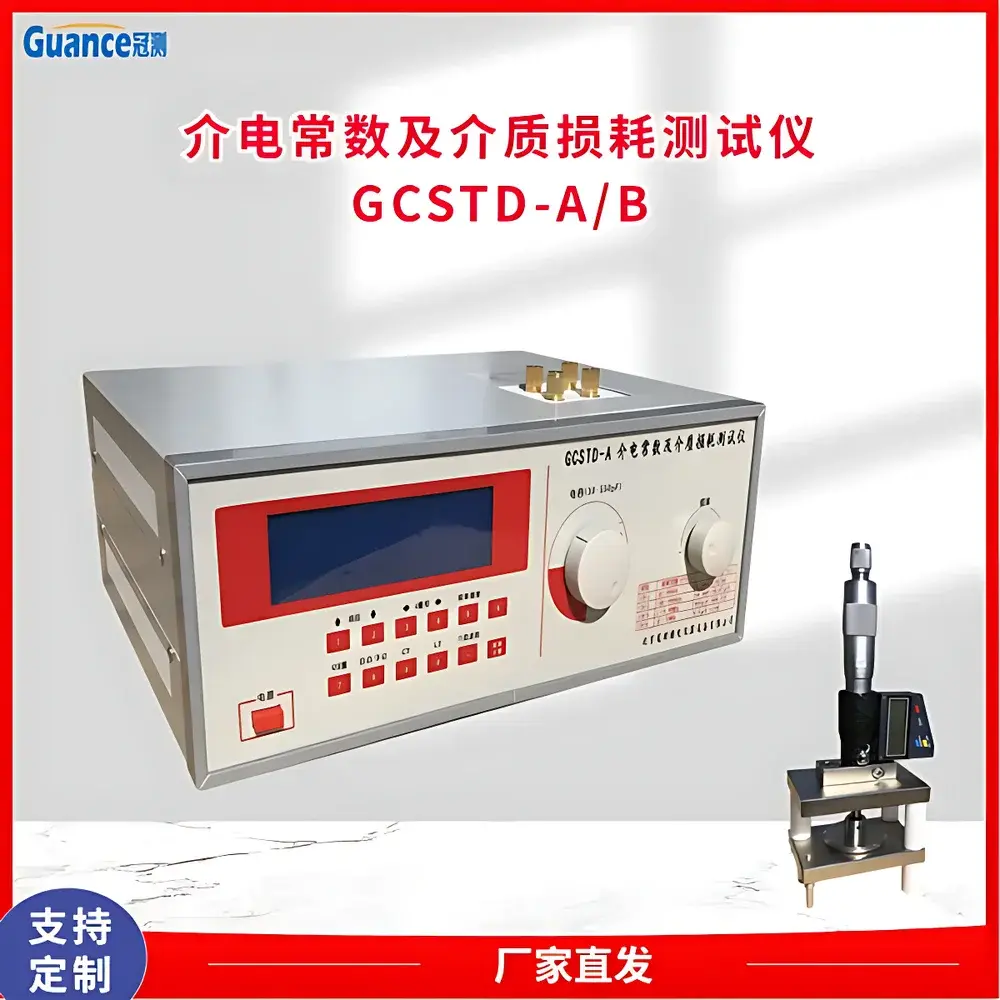
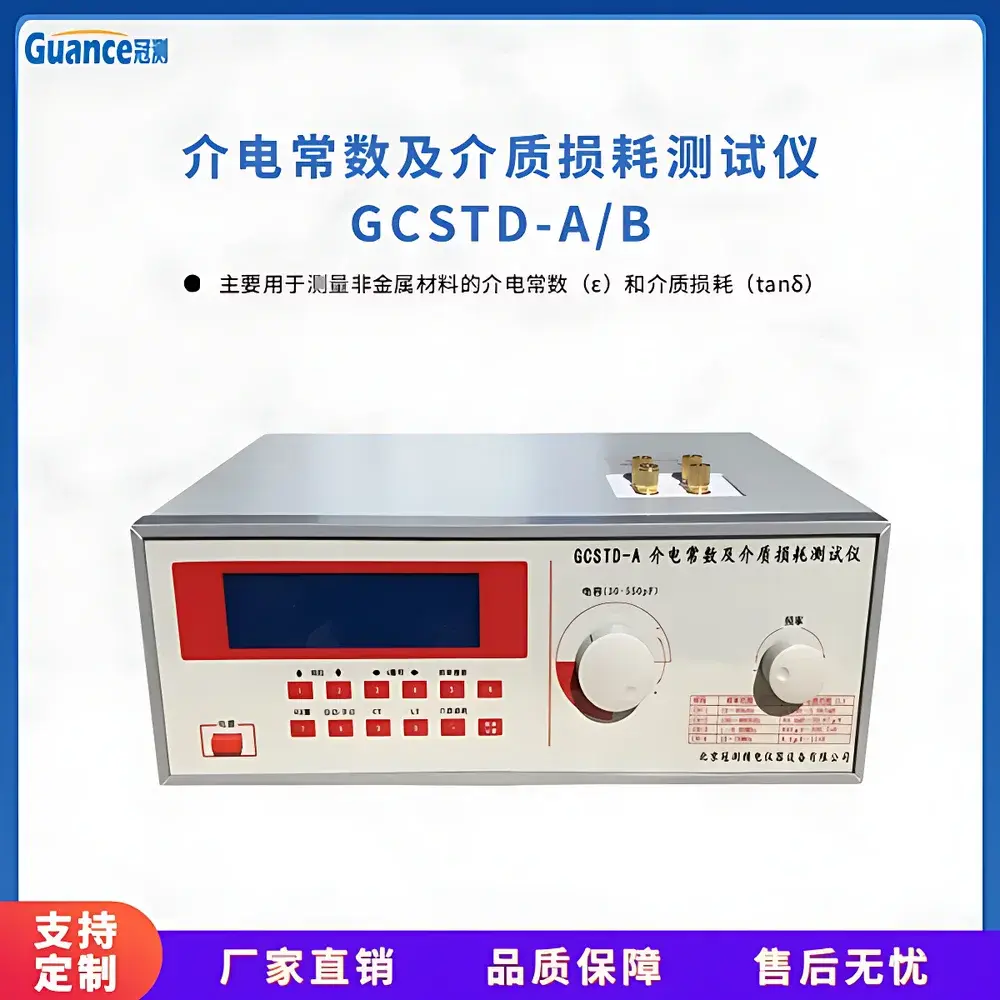
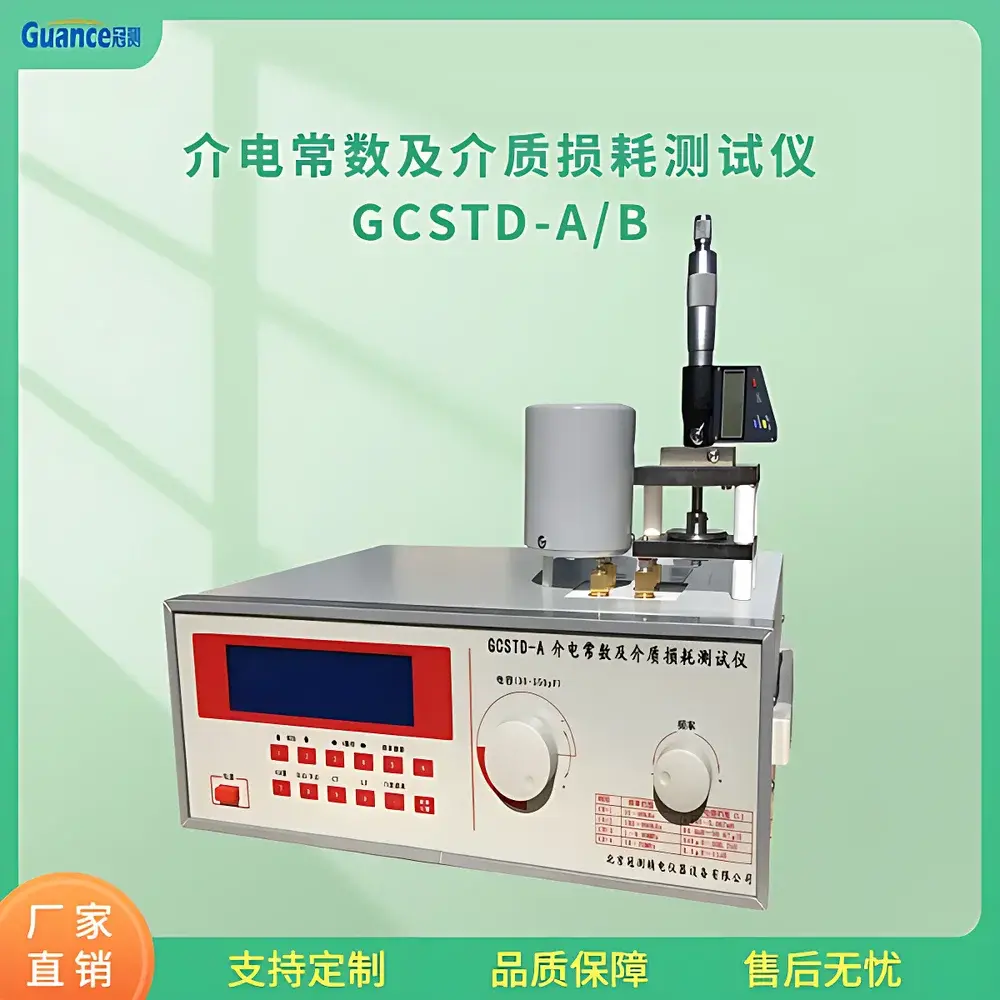
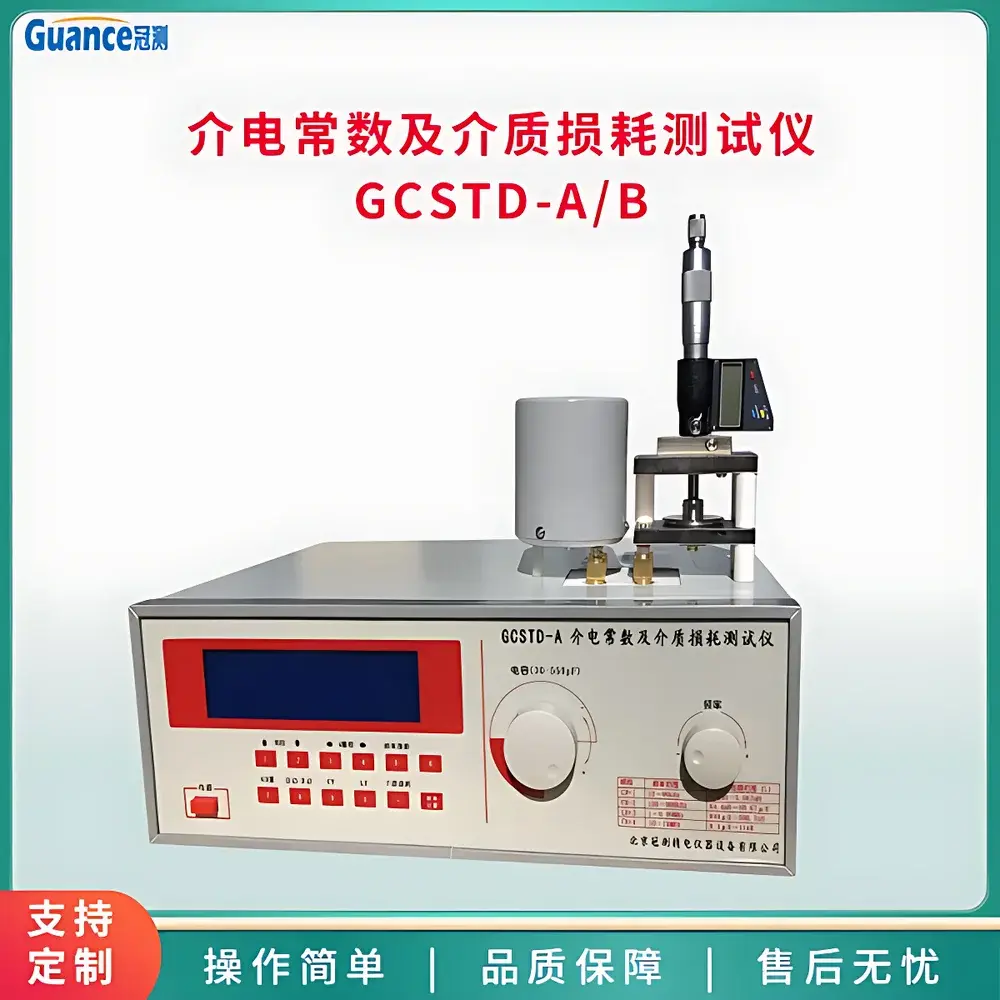
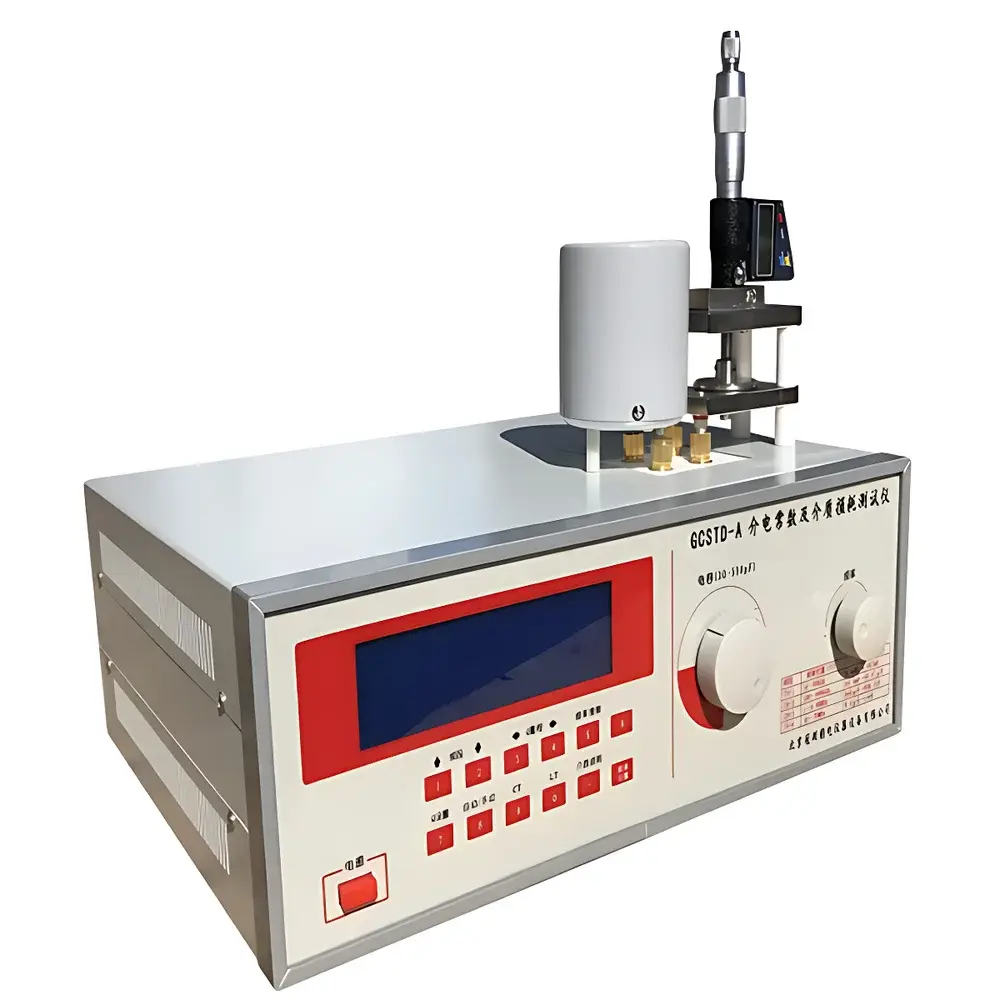
GuanCe Instruments GCSTD-AB.2 High-Frequency Dielectric Constant and Loss Tangent Analyzer
| Brand | GuanCe Instruments |
|---|---|
| Origin | Beijing, China |
| Manufacturer Type | Authorized Distributor |
| Country of Origin | China |
| Model | GCSTD-AB.2 |
| Price | USD 1,800 (FOB Beijing) |
| Frequency Range | 1 MHz – 100 MHz (typical for AB.2 variant) |
| Measurement Principle | High-Frequency Resonance Method (Q-factor based) |
| Display | Digital LCD with auto-resonance search & frequency lock |
| Test Modes | Solid, Liquid, Powder (with optional cells) |
| Electrode Diameter | Φ38 mm (standard) |
| Sample Thickness | 0.5–15 mm (solids) |
| Liquid Cell Dimensions | Φ48 mm × 7 mm depth |
| Compliance | GB/T 1409–2006, GB/T 5654–2007, GB/T 21216–2007, GB/T 1693–2007, GB/T 5594.4–1985, ASTM D150, IEC 60250 |
| Operating Environment | 0–40 °C, RH < 80 %, 220 V ±10 %, 50 Hz ±2.5 Hz |
| Power Consumption | ~25 W |
| Net Weight | ~7 kg |
| Dimensions (L×W×H) | 380 × 280 × 132 mm |
Overview
The GuanCe Instruments GCSTD-AB.2 High-Frequency Dielectric Constant and Loss Tangent Analyzer is an impedance-based precision instrument engineered for the quantitative characterization of dielectric properties in non-metallic materials across the 1 MHz to 100 MHz frequency band. It operates on the high-frequency resonance method—specifically, a Q-factor (quality factor) measurement technique—wherein the sample is integrated into a tunable resonant circuit, and changes in resonant frequency and bandwidth are used to derive complex permittivity (ε* = ε′ − jε″) and the loss tangent (tan δ = ε″/ε′). This principle enables traceable, repeatable determination of both real permittivity (dielectric constant, ε′) and imaginary component (dielectric loss factor, ε″), critical parameters for evaluating polarization mechanisms, interfacial effects, and energy dissipation in insulating and functional dielectrics. Designed for laboratory environments in R&D, quality control, and materials certification, the GCSTD-AB.2 meets the metrological requirements of international standards including ASTM D150 and IEC 60250 for solid insulators, as well as GB/T 1409–2006 for broadband dielectric spectroscopy under controlled test conditions.
Key Features
- Microcontroller-based architecture with digital frequency locking and automatic resonance point detection—eliminating manual tuning drift and improving measurement reproducibility.
- Auto-ranging Q-value measurement with dynamic scale switching, enabling accurate quantification of low-loss (tan δ < 10⁻⁴) and moderate-loss (tan δ up to 0.1) materials without range selection errors.
- Dual-mode electrode configuration: standardized Φ38 mm parallel-plate electrodes for solids (thickness-adjustable from 0.5 mm to 15 mm), and optional Φ48 mm × 7 mm cylindrical liquid/powder cells compliant with GB/T 5654–2007 and GB/T 21216–2007 geometries.
- Integrated calibration routine supporting open/short/load compensation, minimizing residual inductance (< 20 nH) and stray capacitance contributions to measurement uncertainty.
- Stabilized RF source with amplitude regulation ensures consistent excitation level across frequency sweeps—critical for maintaining linearity in tan δ response, especially near material relaxation peaks.
- Compact benchtop form factor (380 × 280 × 132 mm) with low power consumption (~25 W) and wide ambient tolerance (0–40 °C, RH < 80 %), suitable for shared lab spaces and ISO/IEC 17025-accredited testing facilities.
Sample Compatibility & Compliance
The GCSTD-AB.2 supports heterogeneous sample forms—including rigid ceramics, polymer films, elastomers (per GB/T 1693–2007), transformer oils (per GB/T 5654–2007), and fine ceramic powders (via slurry dispersion in matched-dielectric carriers). Its electrode geometry adheres to standard test specimen dimensions defined in national and international specifications, ensuring data comparability across laboratories. All measurement protocols align with the procedural rigor required by ASTM D150 (Section 8.2 on electrode system validation) and IEC 60250 (Clause 6 on environmental conditioning). For regulated industries—such as medical device component suppliers or aerospace-grade composite manufacturers—the instrument’s stable frequency control, documented calibration traceability, and deterministic resonance detection support GLP-compliant reporting and audit-ready data logs when paired with external timestamped recording.
Software & Data Management
While the GCSTD-AB.2 operates as a standalone hardware analyzer with real-time digital display, it features RS-232 and optional USB-to-serial interface for bidirectional communication with host PCs. Exported datasets include frequency, resonant Q, calculated ε′, ε″, tan δ, and derived values such as conductivity (σ = ωε₀ε″) and complex impedance magnitude. Raw data files conform to CSV format with header metadata (test date, operator ID, sample ID, temperature), facilitating integration into LIMS platforms or statistical process control (SPC) software. Though not FDA 21 CFR Part 11-certified out-of-the-box, the system supports electronic signature workflows when deployed with validated third-party acquisition software that enforces audit trails, user access controls, and data integrity safeguards per ISO/IEC 17025 Clause 7.5.
Applications
- Development and qualification of high-frequency substrate materials for 5G antenna modules and millimeter-wave packaging (e.g., LTCC, PTFE composites).
- Quality assurance of insulating varnishes and impregnating resins used in rotating machine windings per IEC 60034-18-41.
- Dielectric aging studies of epoxy-glass laminates under thermal-humidity stress (IEC 60270 partial discharge correlation).
- Characterization of ferroelectric thin films and relaxor ceramics for tunable capacitor applications.
- Batch verification of silicone encapsulants and polyimide flex-circuit dielectrics in electronics manufacturing.
- Academic research on dipole relaxation dynamics in biopolymers and ion-conducting gels using frequency-swept tan δ profiling.
FAQ
What frequency range does the GCSTD-AB.2 cover?
The GCSTD-AB.2 operates from 1 MHz to 100 MHz, optimized for the AB-series mid-band configuration; other variants (e.g., AB.1, AB.3) extend to lower or higher bands.
Can it measure conductive or semi-crystalline polymers?
Yes—provided bulk conductivity remains below ~10⁻⁶ S/m and sample thickness is within the 0.5–15 mm range; for highly conductive fillers, surface resistivity correction may be applied per ASTM D257 Annex A4.
Is calibration certificate included?
A factory calibration report (traceable to NIM, China) is supplied; users may request NIST-traceable calibration via authorized service centers.
How is electrode contact resistance minimized during solid-sample testing?
The instrument employs spring-loaded, gold-plated electrodes with adjustable pressure control and four-terminal sensing capability—ensuring minimal interfacial impedance contribution to measured Q.
Does it support automated temperature-controlled measurements?
No built-in temperature stage is provided, but the unit is compatible with external environmental chambers (−40 °C to +150 °C) via its analog trigger and status I/O ports.



