
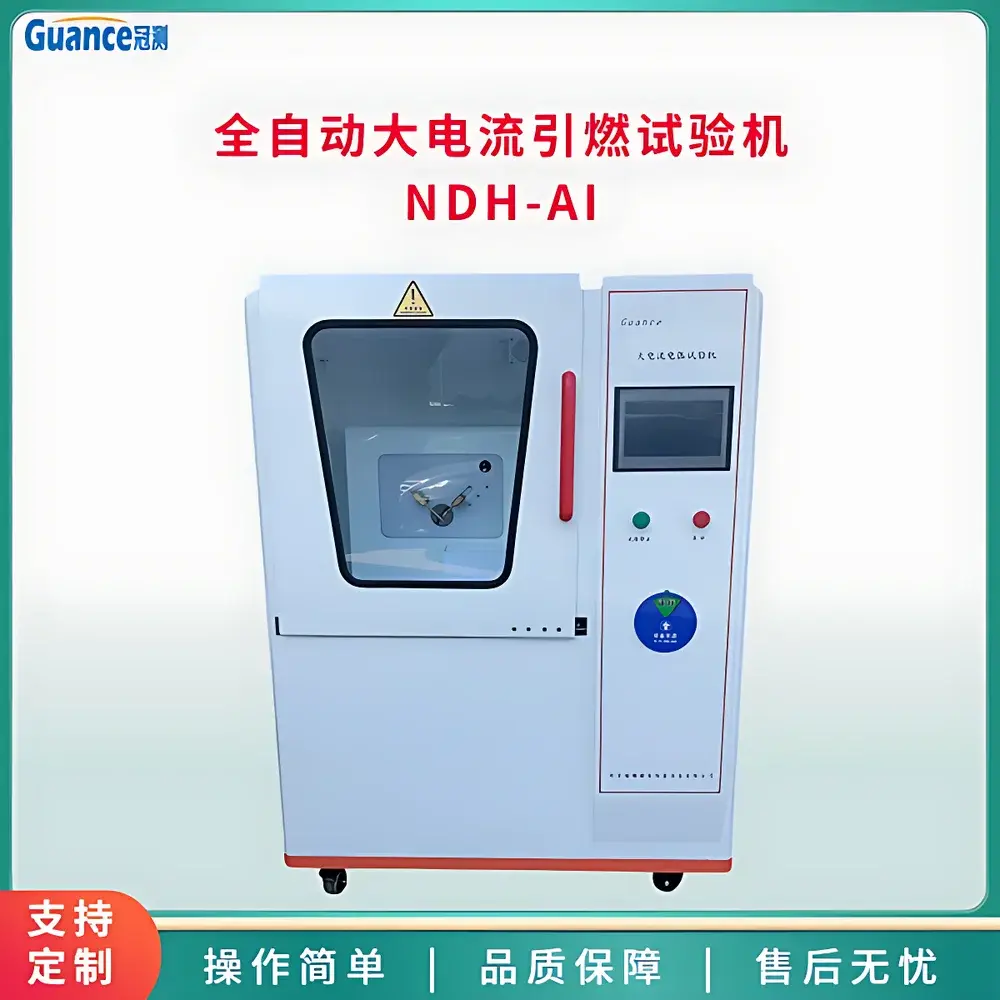
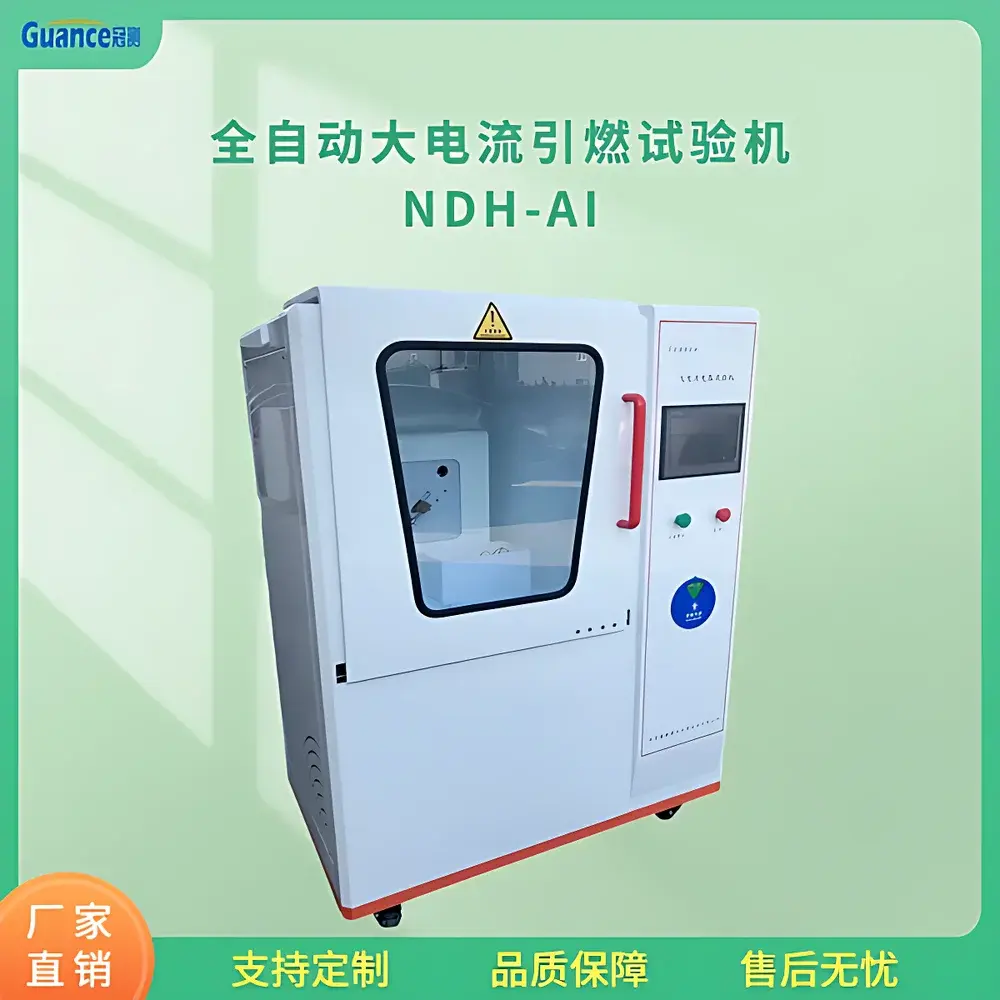
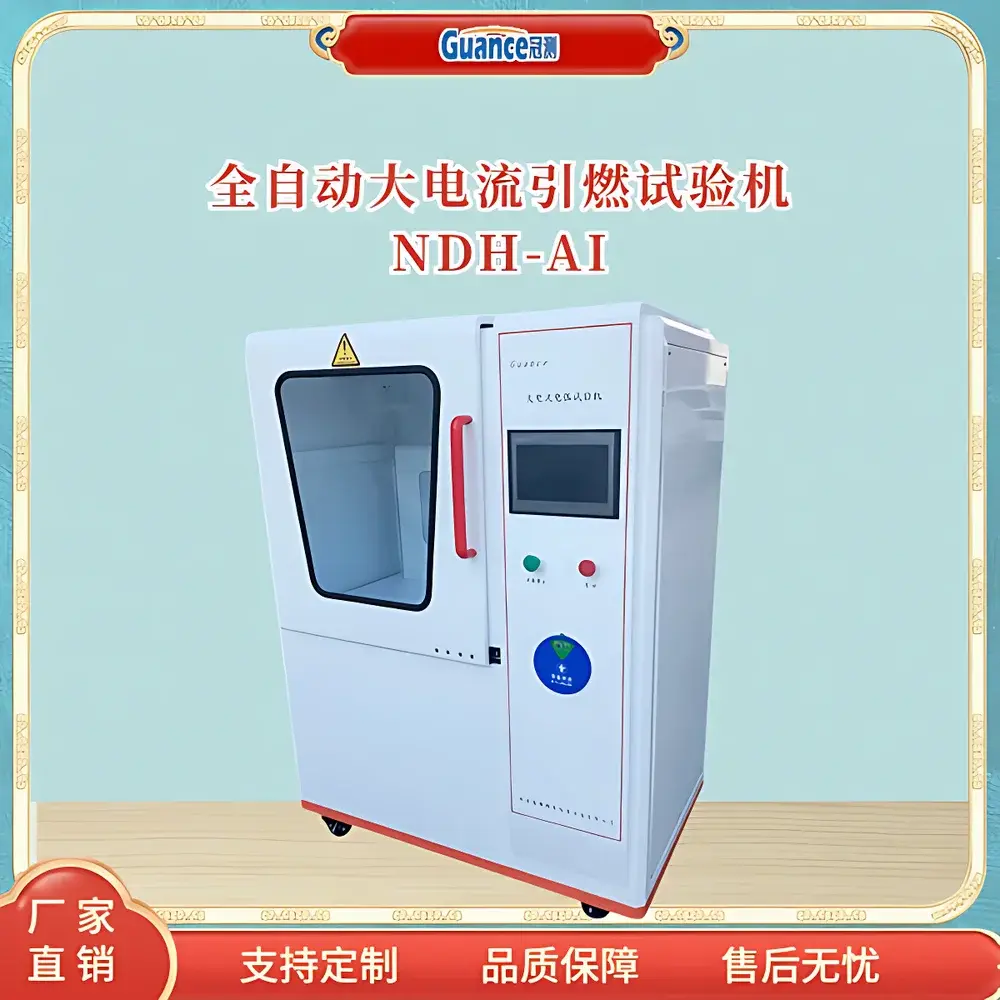
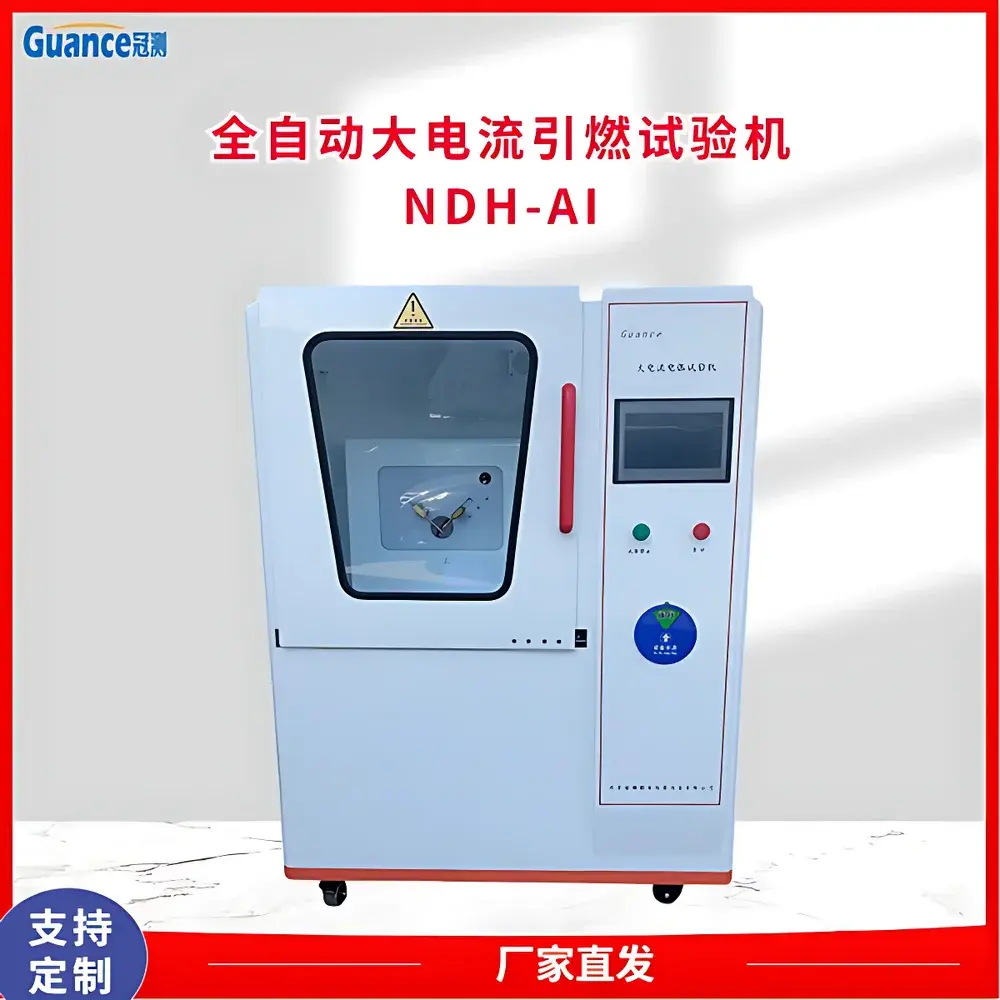
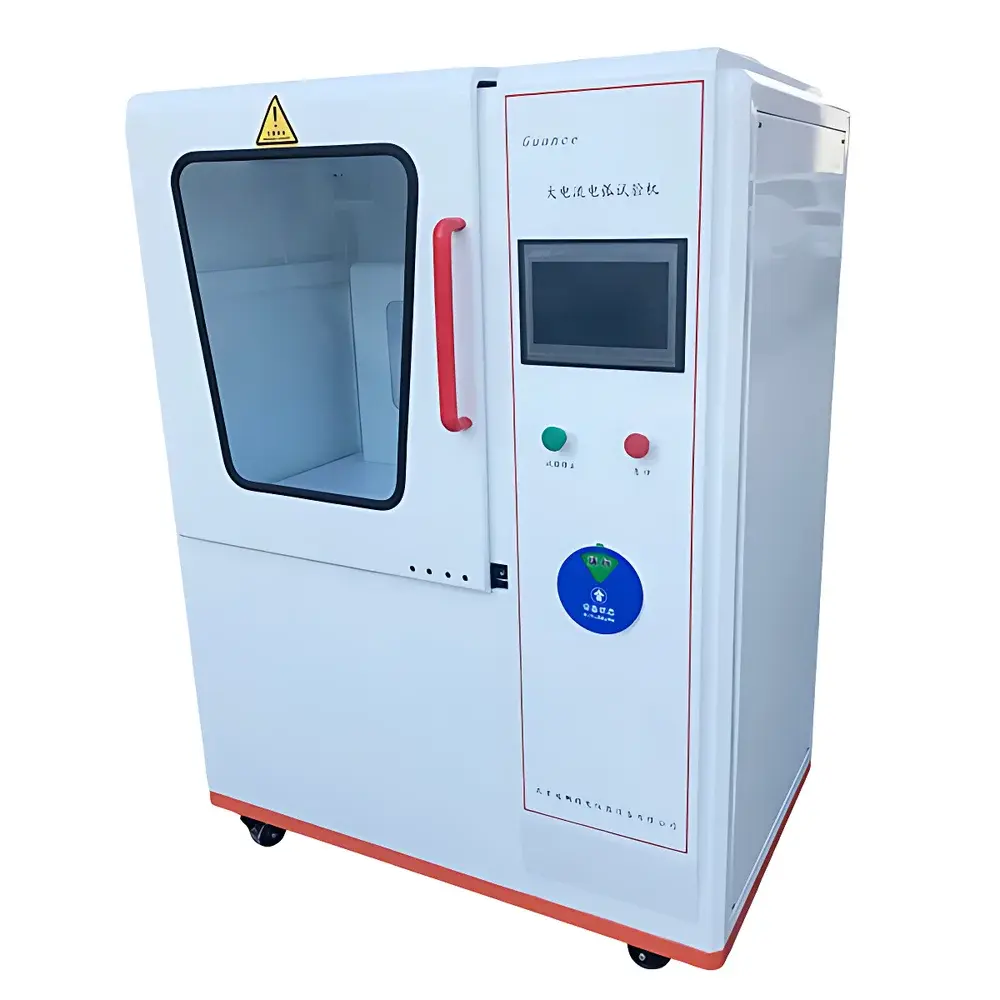
GuanCe NDH-AI Fully Automated High-Current Arc Ignition Tester
| Brand | GuanCe Instruments |
|---|---|
| Origin | Beijing, China |
| Manufacturer Type | Authorized Distributor |
| Country of Origin | China |
| Model | NDH-AI |
| Instrument Type | Electronic Universal Testing Machine |
| Rated Power | 10 kVA |
| Test Voltage | 220 V / 50 Hz |
| Arc Current | 33 ± 5 A (adjustable) |
| Power Factor | cosφ = 0.5 ± 0.05 (adjustable) |
| Arc Frequency | 40 arcs/min (adjustable) |
| Arc Speed | 254 ± 25 mm/s |
| Electrode Geometry | Static electrode — φ3.2–3.5 mm, 30° chisel tip |
| Electrode Angle | 45° to horizontal plane |
| Specimen Dimensions | 130 mm × 13 mm × (2–12) mm |
| Maximum Arc Cycles | 200 (programmable) |
| Overall Dimensions | 1250 mm (W) × 800 mm (D) × 1750 mm (H) |
Overview
The GuanCe NDH-AI Fully Automated High-Current Arc Ignition Tester is a purpose-built electromechanical test system engineered for evaluating the arc resistance and ignition susceptibility of solid insulating materials and structural components used in low-voltage electrical and electronic equipment. It operates on the principle of controlled high-current arcing—repeatedly establishing and extinguishing a low-voltage, high-current electric arc between two precisely aligned electrodes under standardized thermal and electromagnetic stress conditions. This simulates real-world fault scenarios where conductive contaminants, insulation degradation, or mechanical misalignment may initiate sustained arcing near critical circuit elements. The NDH-AI complies with internationally recognized safety standards governing flammability and fire propagation behavior—including IEC 60950-1:2001, BS EN 60950-1:2001, GB 4943-2001, UL 746A, IEC 60947-1:1999, GB/T 14048.1-2000, IEC 730-1:1993, and GB 14536.1-1998—making it suitable for pre-compliance verification and quality assurance in R&D, production, and third-party certification laboratories.
Key Features
- 10-inch industrial-grade capacitive touchscreen HMI with intuitive graphical interface and multi-level dynamic password authentication
- Siemens S7-1200 programmable logic controller (PLC) as the central control unit, ensuring deterministic timing, repeatability, and real-time process monitoring
- Dual-mode operation: manual mode for calibration and troubleshooting; fully automated mode for unattended sequential testing
- Configurable test profiles supporting both static (fixed-position) and dynamic (reciprocating arc motion) test protocols
- Programmable termination criteria: user-selectable stop condition based on either total arc count (e.g., 200 cycles) or elapsed test duration
- Dual-electrode assembly with precision-machined copper static electrode (30° chisel tip) and stainless-steel dynamic electrode (60° conical tip), mounted at a fixed 45° inclination to the horizontal plane
- Integrated safety architecture including interlocked sliding door with mechanical limit switches, overcurrent protection, and emergency stop circuitry compliant with IEC 61800-5-2
- Visual status indication via tri-color tower lamp (green = standby, yellow = running, red = fault/stop)
- Active smoke extraction system featuring variable-speed DC exhaust fan and internal LED task lighting for post-test specimen evaluation
- Audible completion alert via integrated piezoelectric buzzer with configurable tone duration
Sample Compatibility & Compliance
The NDH-AI accommodates flat, rigid specimens measuring 130 mm × 13 mm × (2–12) mm, compatible with thermoset plastics, laminated composites, molded insulators, terminal blocks, busbar supports, and other non-metallic structural parts used across lighting systems, household appliances, motor control centers, power distribution panels, and industrial automation hardware. Its test methodology aligns with the arc tracking and ignition assessment requirements defined in Clause 2.10.3 of IEC 60950-1 and Annex G of UL 746A. All operational parameters—including arc current magnitude, power factor, frequency, and electrode geometry—are traceably adjustable within specified tolerances to support method validation and laboratory accreditation (e.g., ISO/IEC 17025). The system does not require external gas supply or vacuum enclosure, enabling rapid setup and integration into standard electrical safety testing workflows.
Software & Data Management
The embedded control software provides full test parameter configuration, real-time arc event logging, and pass/fail classification per cycle. Each test record includes timestamped metadata: operator ID, specimen ID, setpoint values, actual measured arc current and power factor, total arc count, and final ignition status (ignited/not ignited). Export functionality supports CSV format for downstream analysis in Excel or LIMS environments. While the NDH-AI does not implement FDA 21 CFR Part 11-compliant electronic signatures or audit trails out-of-the-box, its PLC-based architecture permits integration with external SCADA or MES platforms via Modbus TCP/IP or OPC UA for centralized data governance and GLP/GMP-aligned documentation.
Applications
- Evaluation of comparative tracking index (CTI) precursor behavior in polymeric insulating materials
- Qualification of molded interconnect devices (MIDs) and PCB substrate materials under high-energy arc stress
- Verification of flame-retardant additive efficacy in engineering thermoplastics (e.g., PBT, PA66, PC/ABS)
- Design validation of terminal blocks, fuse holders, and relay bases exposed to potential short-circuit arcing
- Production line incoming inspection of insulating spacers and bushings for switchgear assemblies
- Supporting root-cause analysis of field failures attributed to arc-induced carbonization and surface tracking
FAQ
What standards does the NDH-AI directly support?
It is configured to execute test procedures defined in IEC 60950-1:2001, GB 4943-2001, UL 746A, and related national and regional derivatives covering arc ignition resistance of insulating materials.
Can the arc current be calibrated and verified traceably?
Yes—the current output is monitored via a Class 0.5 shunt and digital ammeter integrated into the main power circuit; calibration certificates for these components can be provided upon request.
Is remote monitoring or network connectivity available?
The base configuration includes Modbus RTU over RS-485; optional Ethernet/IP or Modbus TCP modules are available for factory automation integration.
What maintenance is required for the electrodes?
Electrodes must be visually inspected before each test series; tip geometry should be verified using optical profilometry or calibrated gauges, and resharpened or replaced when wear exceeds 0.1 mm deviation from nominal profile.
Does the system include test report generation capability?
It logs raw test data locally; formal compliance reports must be generated externally using lab-specific templates aligned with ISO/IEC 17025 reporting requirements.



