
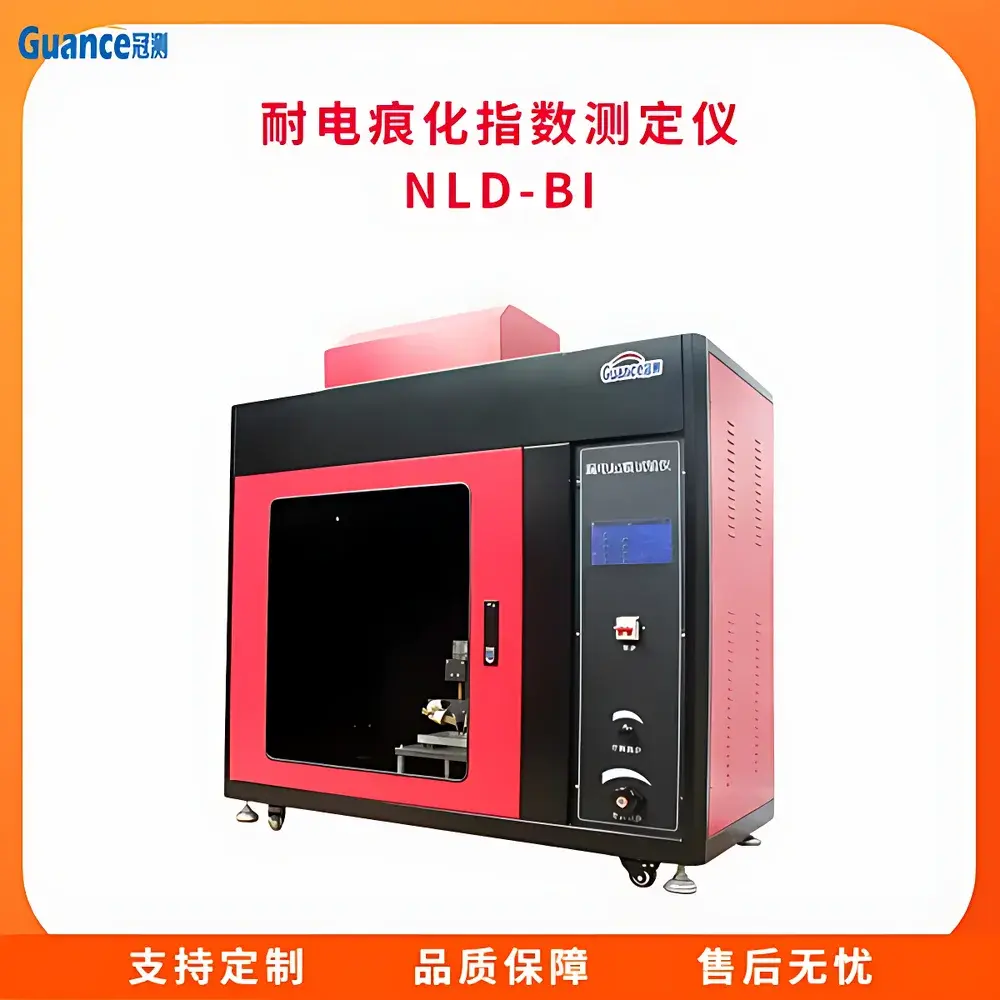
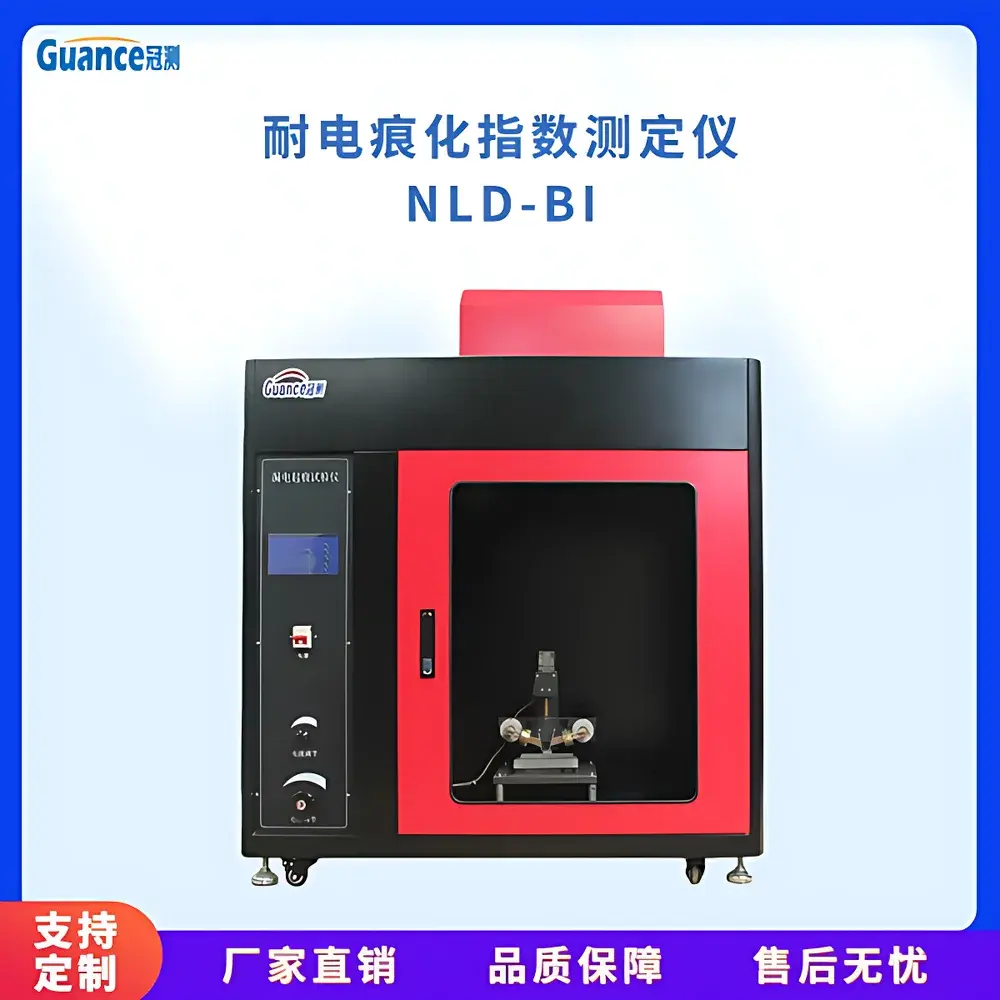
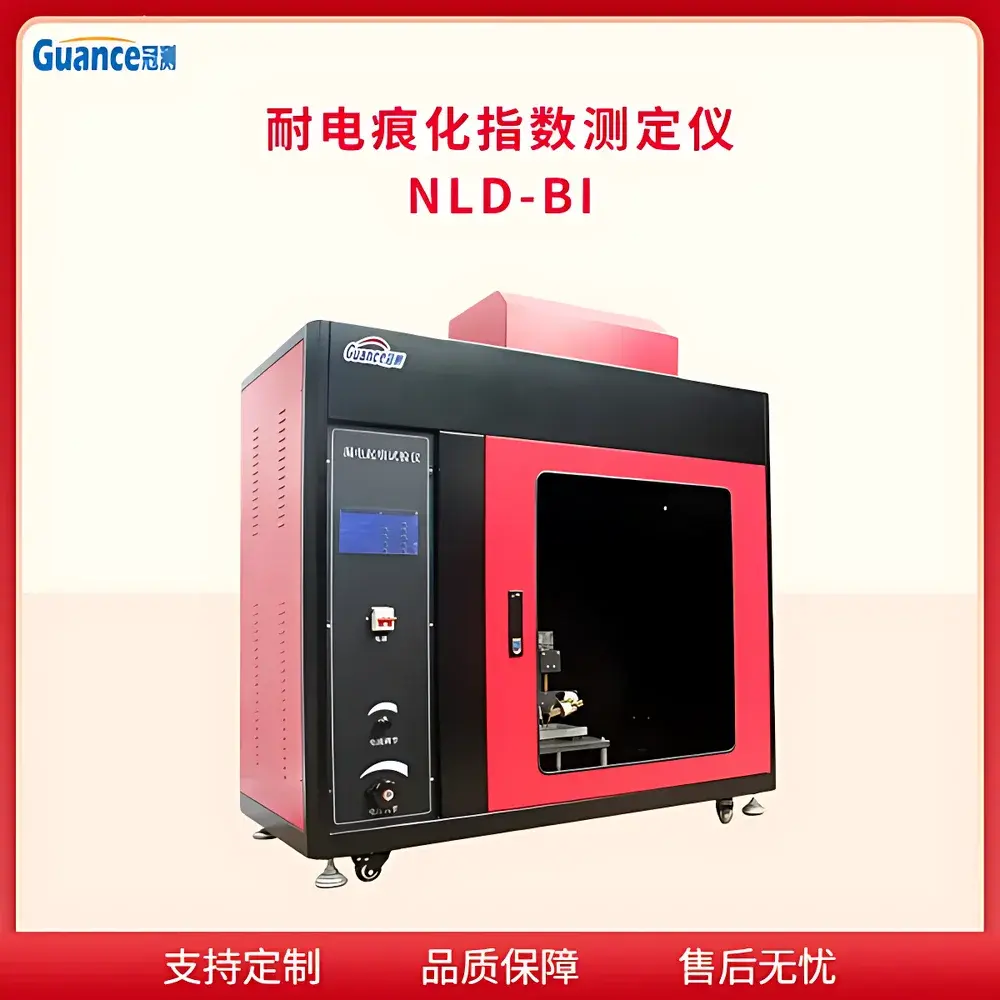
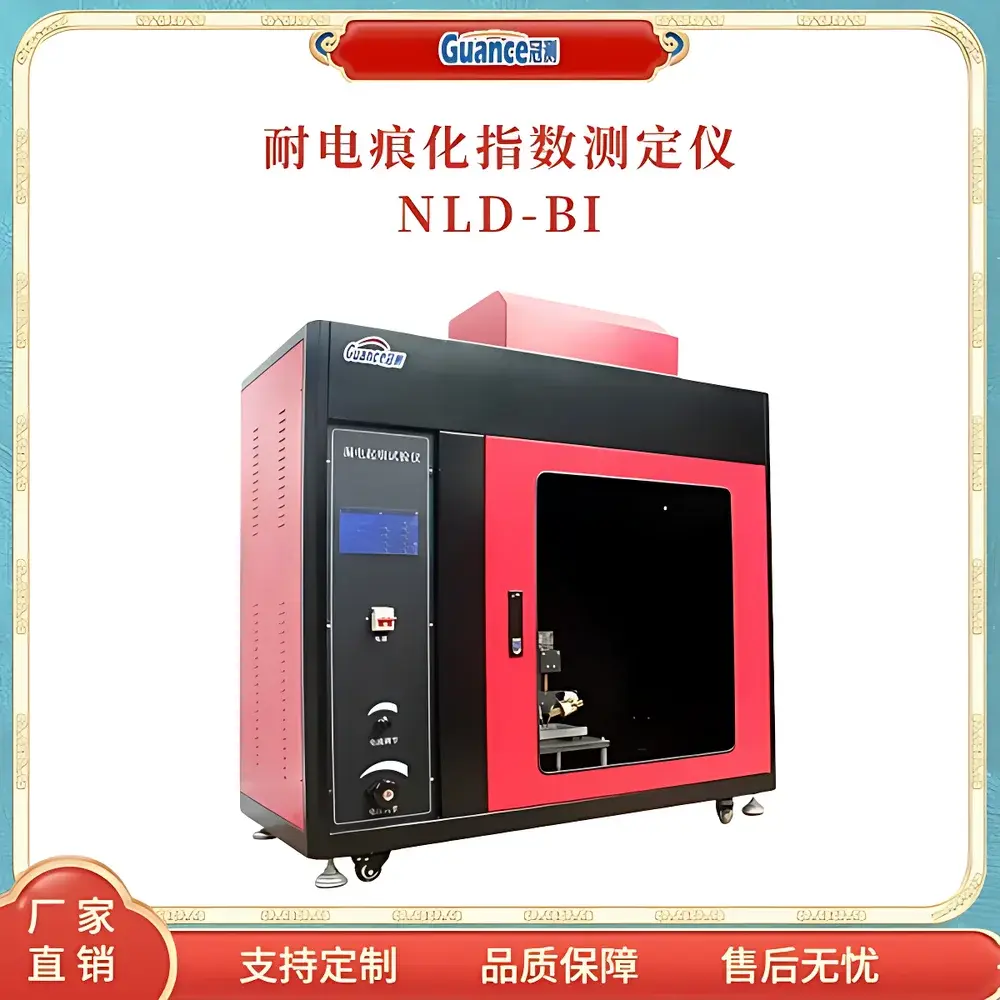
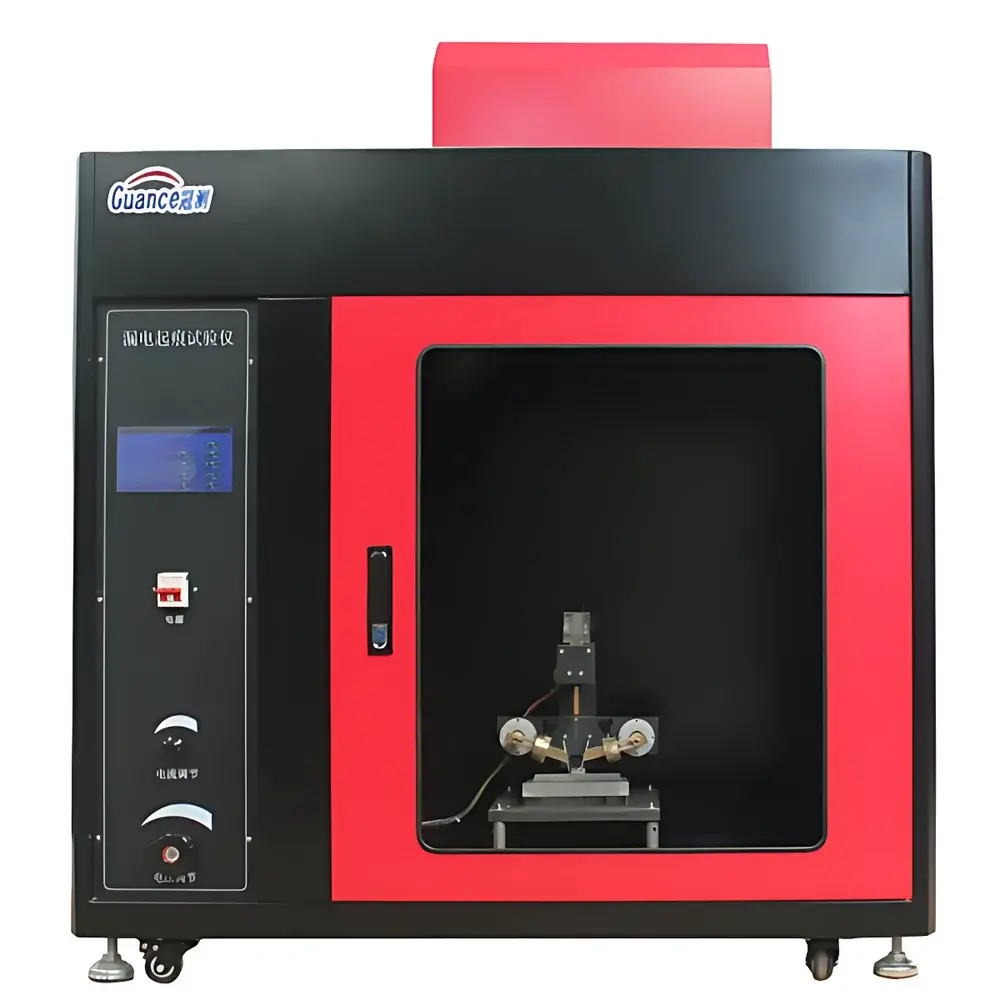
GuanCe NLD-BI2 Universal Tracking Resistance Tester
| Brand | GuanCe Instruments |
|---|---|
| Origin | Beijing, China |
| Model | NLD-BI2 |
| Instrument Type | Electronic Universal Testing Machine |
| Voltage Range | 100–600 V AC (48–60 Hz) |
| Electrode Material | 99% Pure Platinum (tips), Copper (holders) |
| Electrode Dimensions | (2.0 ± 0.1) mm × (5.0 ± 0.1) mm × (40 ± 5) mm |
| Pt tip length | 12 mm, bevel angle: 30° ± 2° |
| Electrode Spacing | 4.00 ± 0.01 mm, included angle: 60° ± 5° |
| Electrode Force | 1.00 ± 0.01 N |
| Test Solution Resistivity | Solution A: 3.95 ± 0.05 Ω·m (0.1% NH₄Cl) |
| Solution B | 1.98 ± 0.05 Ω·m |
| Droplet Height | 35 ± 5 mm (adjustable) |
| Droplet Interval | 30.00 ± 0.01 s (digital presettable) |
| 50-droplet duration | 24.5 ± 2 min |
| Droplet Count Range | 1–9999 (digital display & preset) |
| Airflow Velocity | 0.2 m/s (per IEC 60695-11-5) |
| Short-Circuit Current Threshold | 0.50 A ± 10%, hold time: 2.00 s ± 10% |
| Voltage Drop | ≤8% at 1.0 A ± 0.1 A |
| Power Supply | 220 V, 0.6 kVA, 50–60 Hz |
| Ambient Conditions | 0–40 °C, RH ≤80%, non-corrosive, low-vibration environment |
| Combustion Chamber Volume | >0.5 m³ (approx. 900 × 590 × 1050 mm), black background, illuminance ≤20 lux |
| Exhaust Port Diameter | Ø100 mm |
| Touchscreen | 7-inch color HMI with PLC-based control architecture |
| Compliance | GB/T 4207–2003, IEC 60695-11-5, IEC 60695-11-10 |
Overview
The GuanCe NLD-BI2 Universal Tracking Resistance Tester is an electronically controlled, standards-compliant instrument engineered for the precise determination of Comparative Tracking Index (CTI) and Proof Tracking Index (PTI) of solid electrical insulating materials under humid, contaminated conditions. It operates on the principle of controlled electrochemical degradation: a defined voltage (100–600 V AC, 48–60 Hz) is applied across two platinum-tipped electrodes positioned on the specimen surface, while standardized electrolyte droplets (NH₄Cl solutions of specified resistivity) are delivered at fixed intervals (30.00 ± 0.01 s). Under sustained electrical stress and ionic contamination, localized conductive paths—“tracks”—may form due to carbonization or erosion. The number of droplets required to initiate a conductive path (i.e., current ≥0.50 A for ≥2.00 s) defines the material’s resistance to tracking. This test method directly simulates real-world failure mechanisms in outdoor insulators, PCB substrates, and enclosure polymers exposed to pollution, moisture, and electrical loading.
Key Features
- PLC-integrated 7-inch color touchscreen HMI enabling full system control—including voltage ramping, droplet timing, current monitoring, ventilation activation, and lighting—without external software or PC dependency
- Precision-machined platinum electrodes (≥99% purity) with certified geometry: 2.0 ± 0.1 mm × 5.0 ± 0.1 mm × 40 ± 5 mm body, 12 mm Pt tip with 30° ± 2° bevel; electrode spacing maintained at 4.00 ± 0.01 mm at 60° ± 5° included angle and 1.00 ± 0.01 N contact force
- Droplet delivery system calibrated to deliver 30.00 ± 0.01 s intervals with digital pre-setting (1–9999 droplets), eliminating manual timing errors and ensuring repeatability per IEC 60695-11-5
- Integrated low-noise, anti-backflow exhaust system (Ø100 mm port) with regulated airflow of 0.2 m/s—critical for maintaining consistent thermal and chemical boundary conditions during flaming or charring events
- Real-time on-screen display of all critical parameters: applied voltage, instantaneous current, elapsed droplets, chamber temperature/humidity status, door interlock state, and pass/fail logic output
- Self-diagnostic safety architecture: automatic circuit interruption upon detection of ≥0.50 A current sustained for ≥2.00 s, or voltage drop exceeding 8% at 1.0 A load—ensuring compliance with GB/T 4207–2003 fault response requirements
Sample Compatibility & Compliance
The NLD-BI2 accommodates flat, rigid specimens up to 15 mm thick and 100 mm × 100 mm in planar dimension, compatible with thermoplastics (e.g., PBT, PA66), thermosets (e.g., epoxy, phenolic), filled composites, and laminated substrates. All mechanical and electrical tolerances—including electrode geometry, solution resistivity (A: 3.95 ± 0.05 Ω·m; B: 1.98 ± 0.05 Ω·m), droplet height (35 ± 5 mm), and background illumination (≤20 lux, matte black chamber walls)—are traceably aligned with IEC 60695-11-5 and GB/T 4207–2003. The combustion chamber volume (>0.5 m³) satisfies minimum enclosure requirements for safe observation of ignition and flame propagation without pressure buildup. No proprietary consumables or vendor-locked calibration modules are required; standard stainless-steel gauge blocks, glass reference tiles, and medical-grade stainless steel needles are supplied for daily verification.
Software & Data Management
Data acquisition and test execution are fully embedded within the device firmware—no external drivers, OS dependencies, or cloud connectivity are involved. All test records (voltage profile, droplet count, current waveform timestamps, pass/fail verdict, operator ID, and start/stop times) are stored locally on the HMI’s non-volatile memory with timestamped .CSV export capability via USB. Audit trails include system event logs (e.g., door open/close, emergency stop, parameter change history) compliant with GLP documentation principles. While not FDA 21 CFR Part 11-certified out-of-the-box, the deterministic PLC logic, write-once storage architecture, and absence of remote access interfaces provide a foundation for laboratory-specific validation under ISO/IEC 17025 quality management systems.
Applications
- Qualification of polymer formulations for high-voltage connectors, terminal blocks, and switchgear housings
- Comparative CTI screening during R&D of flame-retardant polyamide and polyester compounds
- Production lot acceptance testing per IEC 60695-11-10 for automotive EV battery module enclosures
- Root-cause analysis of field failures involving surface tracking on FR-4 PCBs or silicone rubber insulators
- Supporting UL 746A, EN 60695-11-10, and ASTM D3638 test protocols where CTI classification (e.g., CTI ≥600) determines material grouping for creepage/clearance design
FAQ
What standards does the NLD-BI2 explicitly support?
The instrument is mechanically and functionally aligned with GB/T 4207–2003 and IEC 60695-11-5 (for PTI/CTI determination) and IEC 60695-11-10 (for material classification). It does not perform glow-wire or needle-flame tests.
Is calibration certification included with shipment?
A factory-verified dimensional certificate for electrode geometry and spacing is provided. Users must perform periodic verification using supplied stainless-steel gauge blocks and conductivity meters for test solutions.
Can the NLD-BI2 operate continuously for extended qualification runs?
Yes—the robust industrial PLC architecture, forced-air cooling, and thermal cutoffs allow unattended operation for multi-hour sequences, provided ambient temperature remains ≤40 °C and humidity ≤80% RH.
Does the system support automated report generation?
Raw data export (.CSV) is supported; report formatting (e.g., PDF certificates with lab letterhead) requires user-side post-processing using spreadsheet or LIMS software.
What maintenance is required beyond routine cleaning?
Platinum electrodes require periodic inspection for pitting or residue buildup; cleaning with dilute nitric acid followed by DI water rinse is recommended after every 50 test cycles. The solenoid-driven dropper valve should be flushed weekly with deionized water when using NH₄Cl solutions.



