
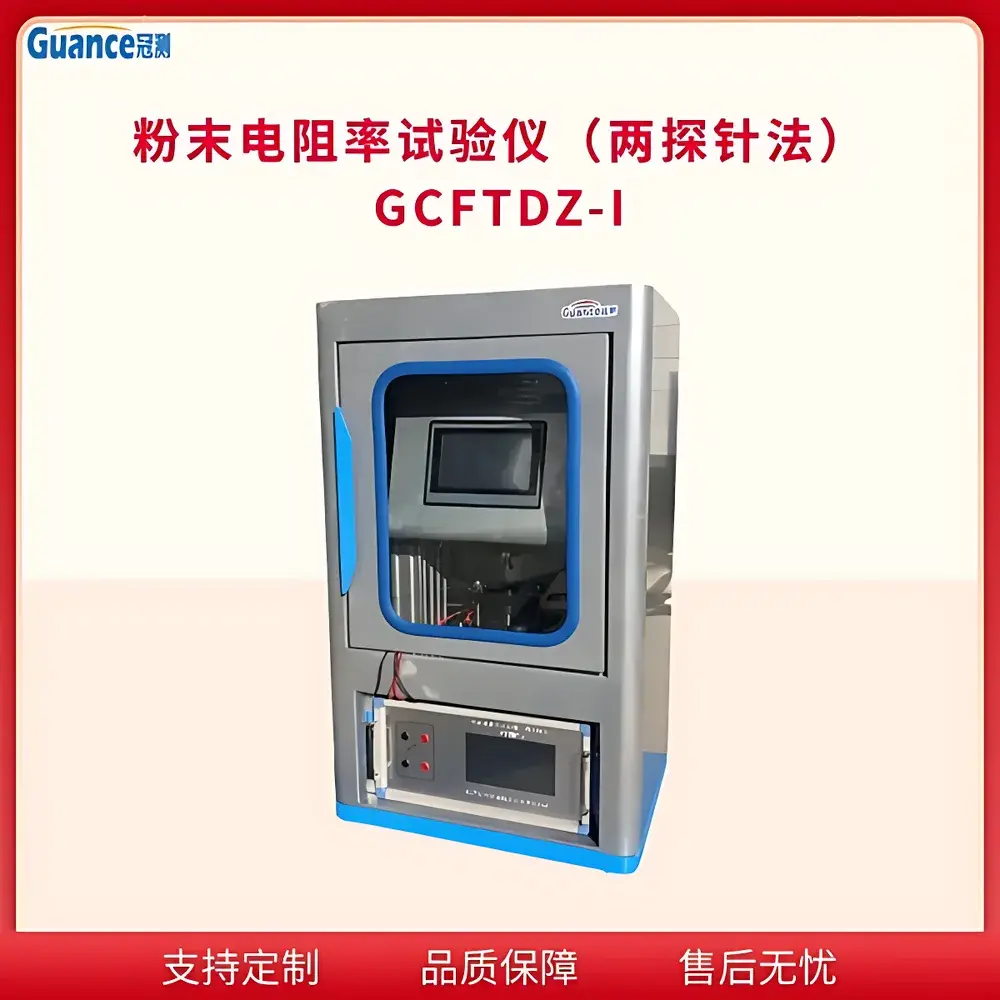
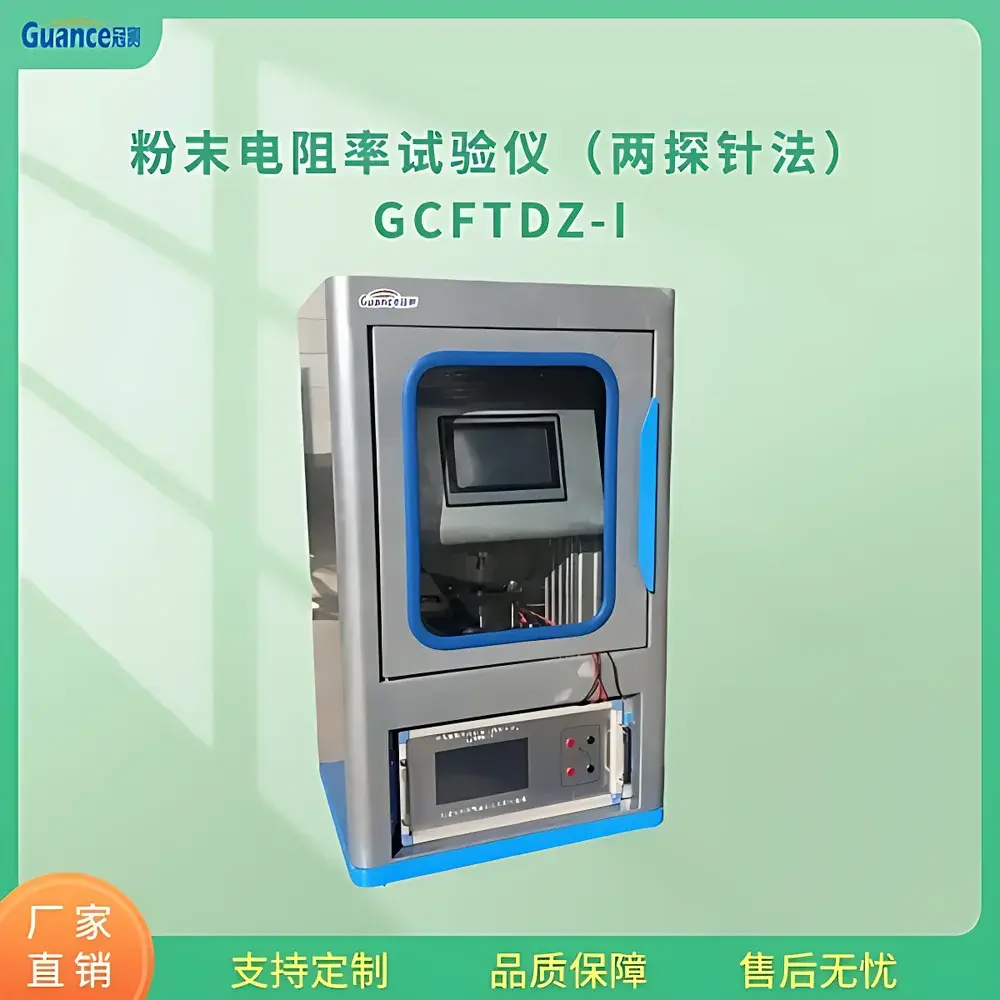
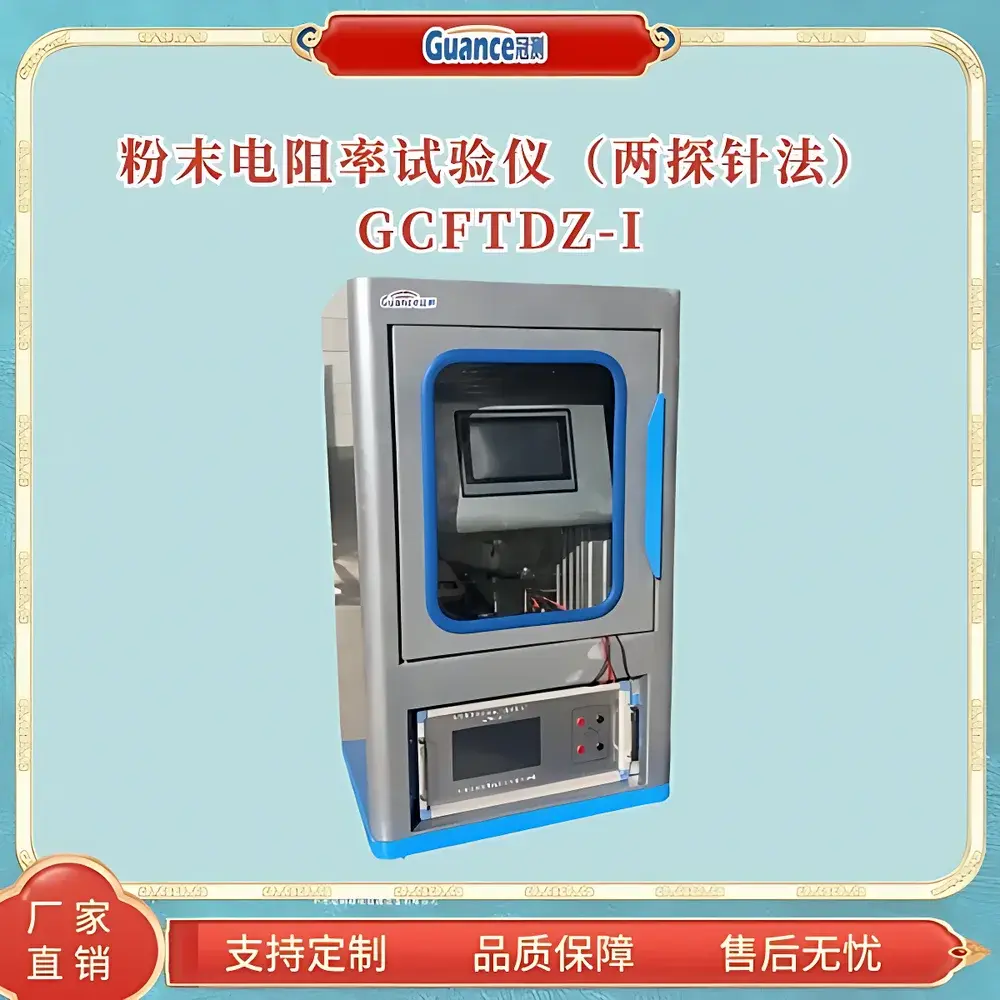
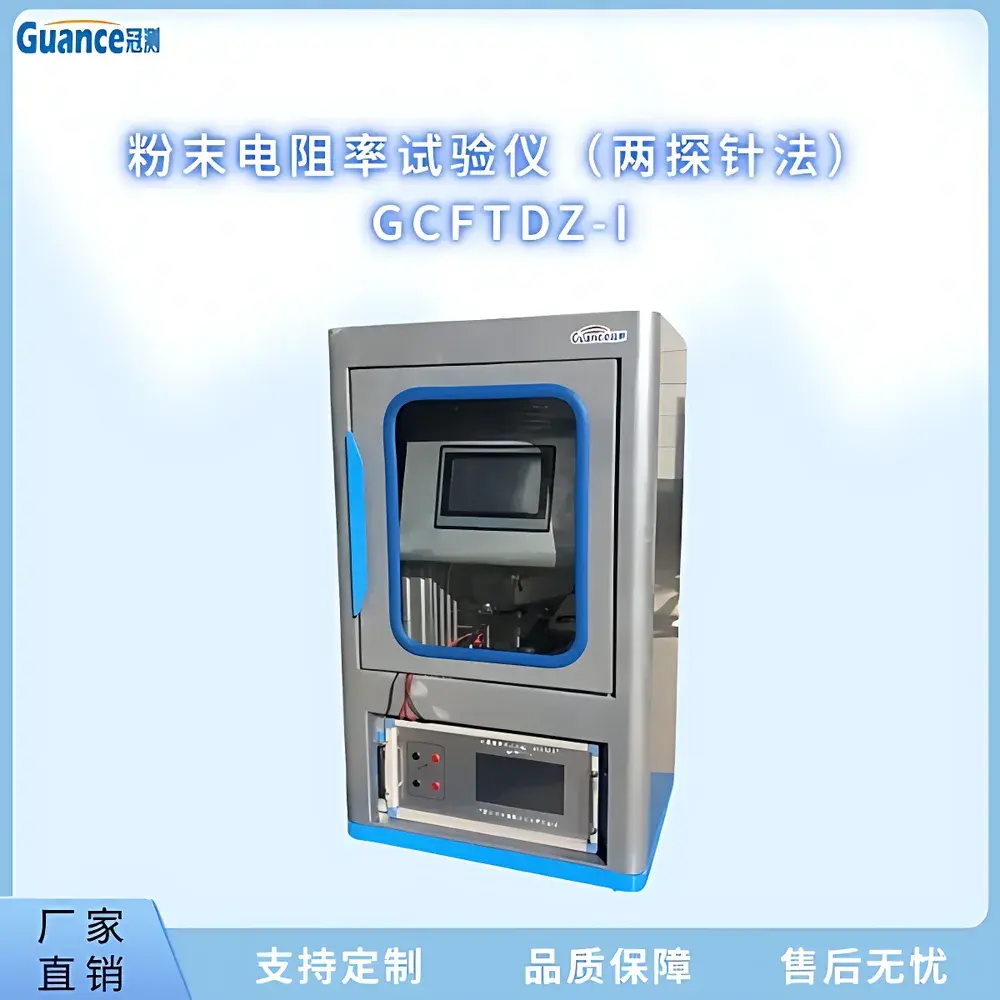
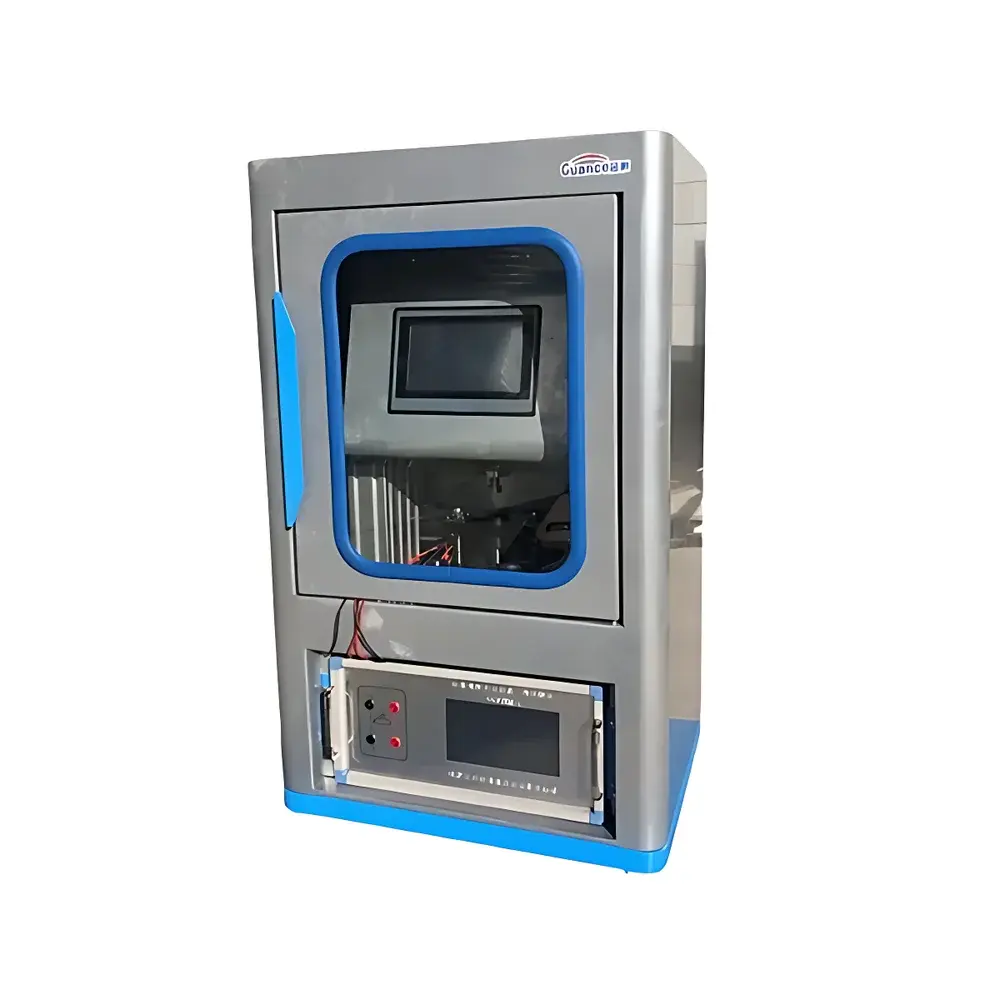
GCFTDZ-I Carbonaceous Powder Resistivity Tester (Two-Point Probe Method)
| Brand | Guance Instruments |
|---|---|
| Model | GCFTDZ-I |
| Origin | Beijing, China |
| Measurement Principle | Two-Point Probe DC Resistivity |
| Max Applied Pressure | 3.9 MPa |
| Electrode Diameters | φ16.0 mm & φ30.0 mm |
| Force Range | 0–5 kN |
| Force Accuracy | ±0.5% FS |
| Resistivity Range | 10⁻⁶ – 10⁵ Ω·m |
| Voltage Resolution | 1 µV (at 2 mV range) |
| Current Sources | 10 µA to 10 A (8 ranges) |
| Current Accuracy | ±0.5% |
| Voltage Accuracy | ±0.1% |
| Thickness Resolution | ±1 µm |
| Control Interface | 10-inch Industrial Touchscreen (Siemens PLC-based) |
| Compliance | GB/T 24521–2018 |
| Data Output | Thermal Printer + USB Export (CSV) |
Overview
The GCFTDZ-I Carbonaceous Powder Resistivity Tester is an industrial-grade, fully automated instrument engineered for precise DC resistivity characterization of granular carbonaceous materials under controlled uniaxial compaction. It operates on the two-point probe (collinear electrode) principle in accordance with GB/T 24521–2018, the Chinese national standard for resistivity determination of carbon raw materials and coke powders. Unlike four-point probe systems used for thin-film or bulk solid analysis, this tester applies calibrated mechanical pressure to consolidate powder samples into a defined geometry—enabling direct calculation of volume resistivity (ρ, in Ω·m) from measured resistance (R), electrode cross-sectional area (A), and compressed sample height (L): ρ = R × A / L. The system integrates servo-driven force application, high-stability constant-current excitation, and synchronized multi-parameter acquisition—including real-time pressure, compressive displacement, density, voltage drop, current, and derived electrical properties. Designed for QC laboratories in carbon anode manufacturing, graphite electrode production, and metallurgical coke processing, it eliminates operator-dependent variability inherent in manual press-and-measure workflows.
Key Features
- Fully automated test sequence: sample loading → programmable compaction → stabilized current injection → voltage measurement → data computation → auto-return to home position
- Dual electrode configuration: interchangeable φ16.0 mm (optimized for 0.315–0.5 mm particle size) and φ30.0 mm (for 0.5–1.0 mm fractions), both precision-machined stainless steel with gold-plated contact surfaces
- Seven configurable test modes: Constant Force, Constant Pressure, Stepwise Force Gradient, Stepwise Pressure Gradient, and Compression Ratio–controlled displacement testing
- Real-time display of 9 concurrent parameters: applied force (kN), pressure (MPa), compacted thickness (mm), apparent density (g/cm³), excitation current (A), measured voltage (mV), calculated resistance (Ω), volume resistivity (Ω·m), and conductivity (S/m)
- Eight selectable constant-current source ranges (10 µA to 10 A), each with ±0.5% accuracy and automatic range switching to maintain optimal signal-to-noise ratio
- High-resolution data acquisition: force resolution ≤0.01 kN; thickness resolution ±1 µm; voltage resolution 1 µV (2 mV range); resistivity resolution down to 10⁻⁸ Ω·m
- Integrated thermal printer and USB-C interface for immediate hardcopy output and CSV-formatted digital export compatible with LIMS and statistical process control (SPC) platforms
Sample Compatibility & Compliance
The GCFTDZ-I is validated for standardized testing of industrially relevant carbonaceous powders, including calcined anthracite, petroleum coke (calcined and graphitized), needle coke, carbon black, graphite flakes, and baked coke fragments. Sample preparation follows GB/T 24521–2018 protocols: air-dried material sieved to specified grain size fractions, weighed into the cylindrical die cavity, and compacted to target pressure (typically 3.0 or 3.9 MPa) for ≥60 s prior to measurement. The instrument meets mechanical and electrical metrological requirements for ISO/IEC 17025-accredited testing laboratories. While not certified to ASTM D3764 or IEC 62631-3-1, its operational methodology aligns with fundamental principles outlined in those standards for powder resistivity assessment. All firmware and calibration routines support audit-ready traceability, with timestamped test logs and electronic signatures compliant with GLP documentation practices.
Software & Data Management
Control and data handling are managed via a Siemens S7-1200 PLC interfaced with a 10-inch capacitive touchscreen HMI running embedded WinCE OS. The GUI provides intuitive navigation across setup, calibration, test execution, and reporting screens. Calibration procedures include automatic zero-force compensation, full-scale load verification using NIST-traceable deadweight standards, and current-source linearity validation. Each test generates a structured metadata record—including operator ID, sample ID, date/time stamp, environmental temperature/humidity (optional external sensor input), and all raw and derived values. Data export supports comma-separated values (CSV) with UTF-8 encoding, preserving unit annotations and gradient step identifiers. No cloud connectivity or remote access is implemented; all data resides locally to ensure compliance with internal IT security policies common in regulated manufacturing environments.
Applications
- Quality control of calcined petroleum coke batches prior to anode paste formulation
- Resistivity mapping of needle coke feedstock as a proxy for graphitizability and microstructure homogeneity
- Process monitoring of baking furnace output (baked anodes) to detect over- or under-baking through resistivity deviation
- R&D screening of novel carbon composites, including SiC-reinforced graphite or boron-doped carbon powders
- Comparative evaluation of raw material substitutions (e.g., anthracite vs. metallurgical coke) in cost-optimization studies
- Correlation of resistivity trends with XRD-derived crystallite size (La, Lc) and Raman ID/IG ratios in carbon science laboratories
FAQ
What standards does the GCFTDZ-I comply with?
It is designed and verified per GB/T 24521–2018. Its measurement methodology is technically consistent with core principles in ASTM D3764 (bulk resistivity of carbon products) and IEC 62631-3-1 (dielectric and resistive properties of solid insulating materials), though formal certification to those standards requires third-party validation.
Can the instrument measure anisotropic resistivity?
No—it implements isotropic compression and collinear two-probe geometry, yielding a scalar volume resistivity value representative of the compacted pellet’s bulk behavior. Anisotropy assessment requires directional pressing or four-point probe mapping, which are outside its scope.
Is calibration traceable to national standards?
Yes. Force transducer calibration utilizes NIST-traceable deadweight standards; current source accuracy is verified against Fluke 5720A multifunction calibrators; voltage measurements reference Fluke 732B DC voltage standards. Calibration certificates are generated per test cycle.
Does the system support FDA 21 CFR Part 11 compliance?
It does not implement electronic signatures, audit trails, or role-based access control required for Part 11. However, its local data logging, immutable CSV export, and time-stamped records facilitate manual compliance in non-GxP environments or as part of broader QMS documentation.
What maintenance is required for long-term stability?
Annual verification of force transducer linearity and electrode surface integrity (visual inspection and contact resistance check) is recommended. No consumables other than thermal paper rolls are required. Lubrication of the servo-driven ram is performed at factory intervals only.



