
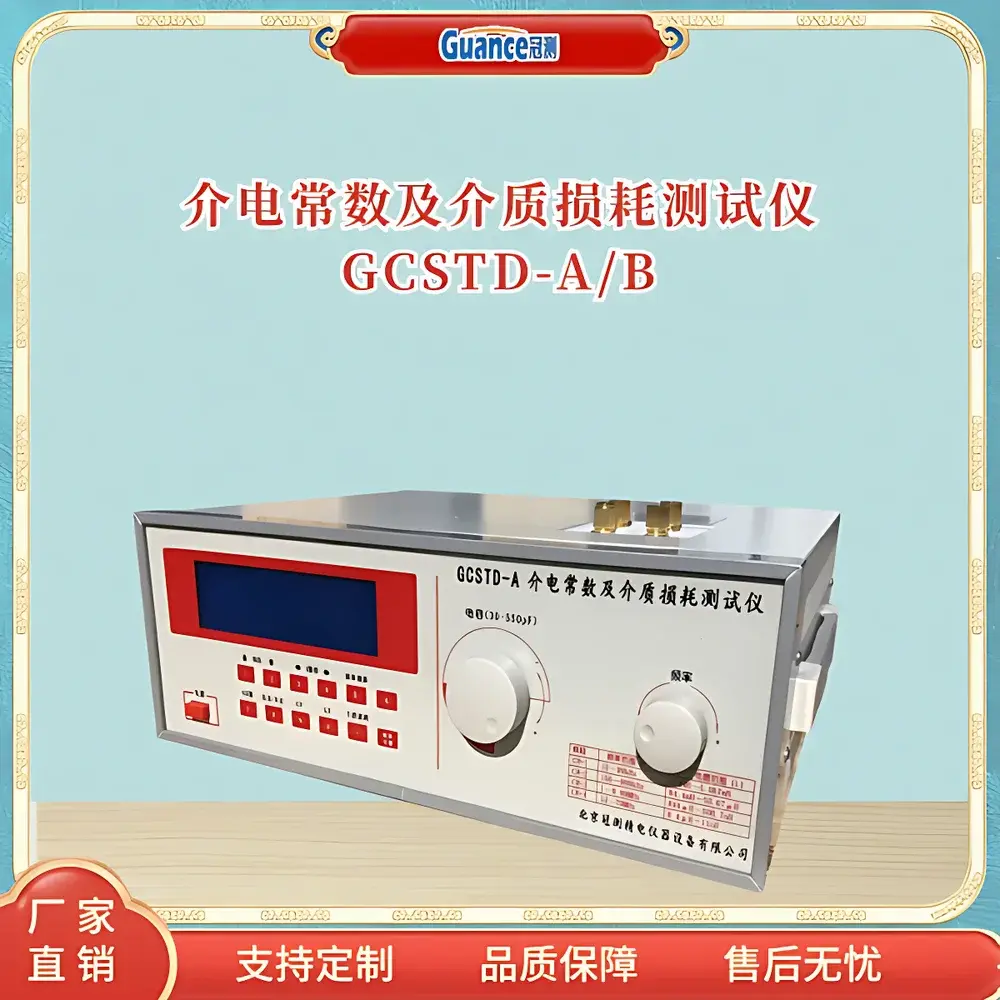
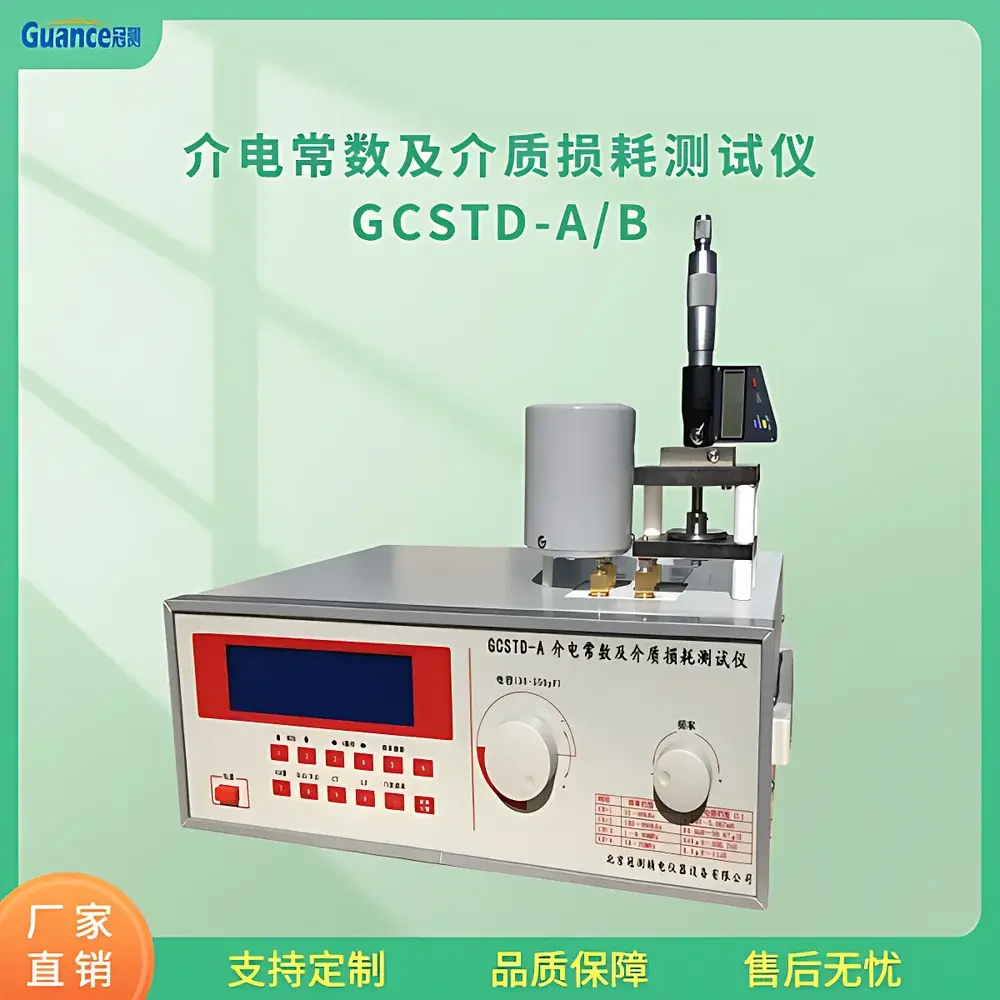
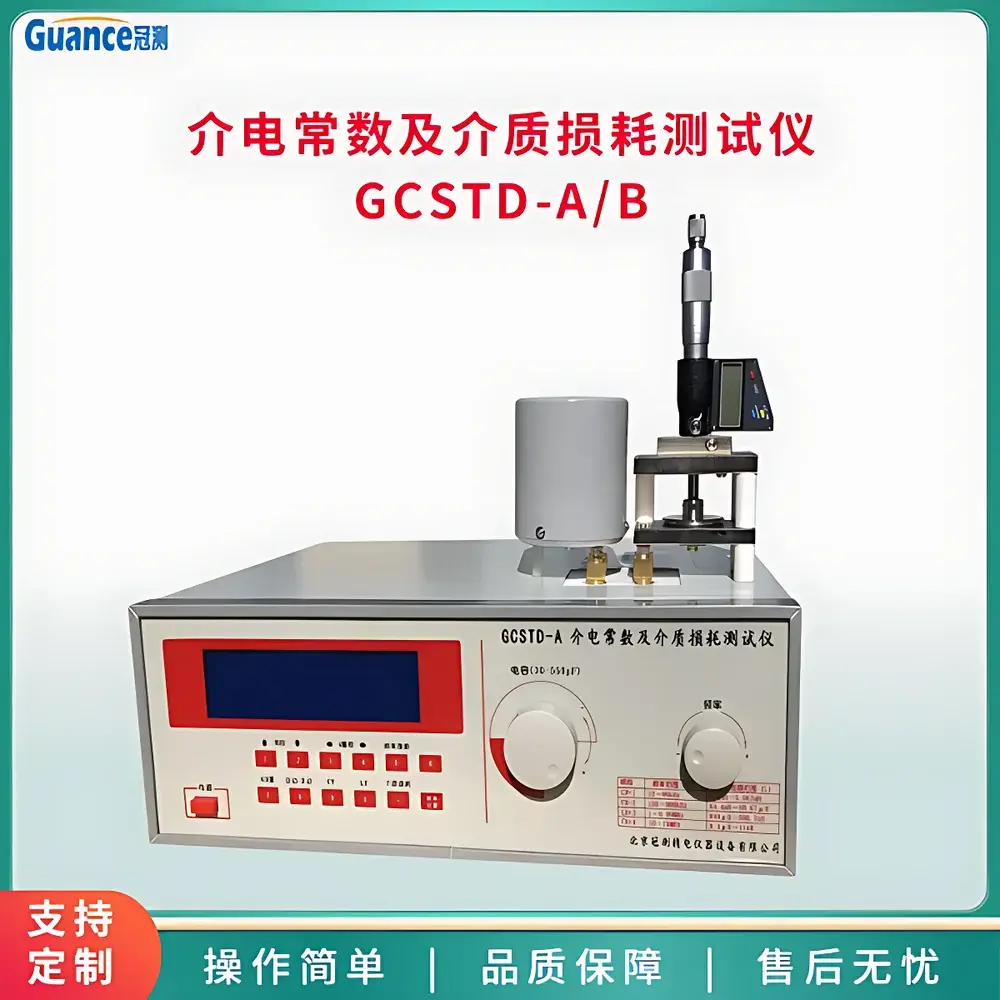
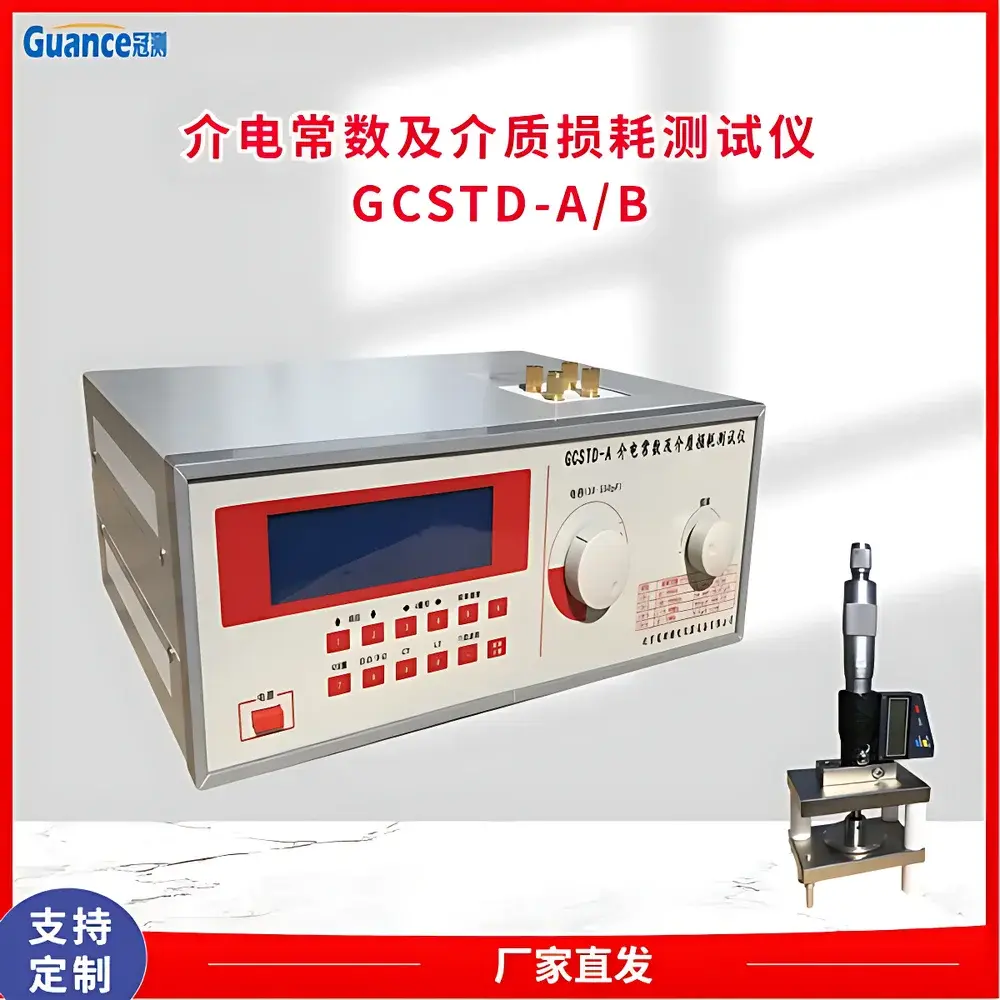
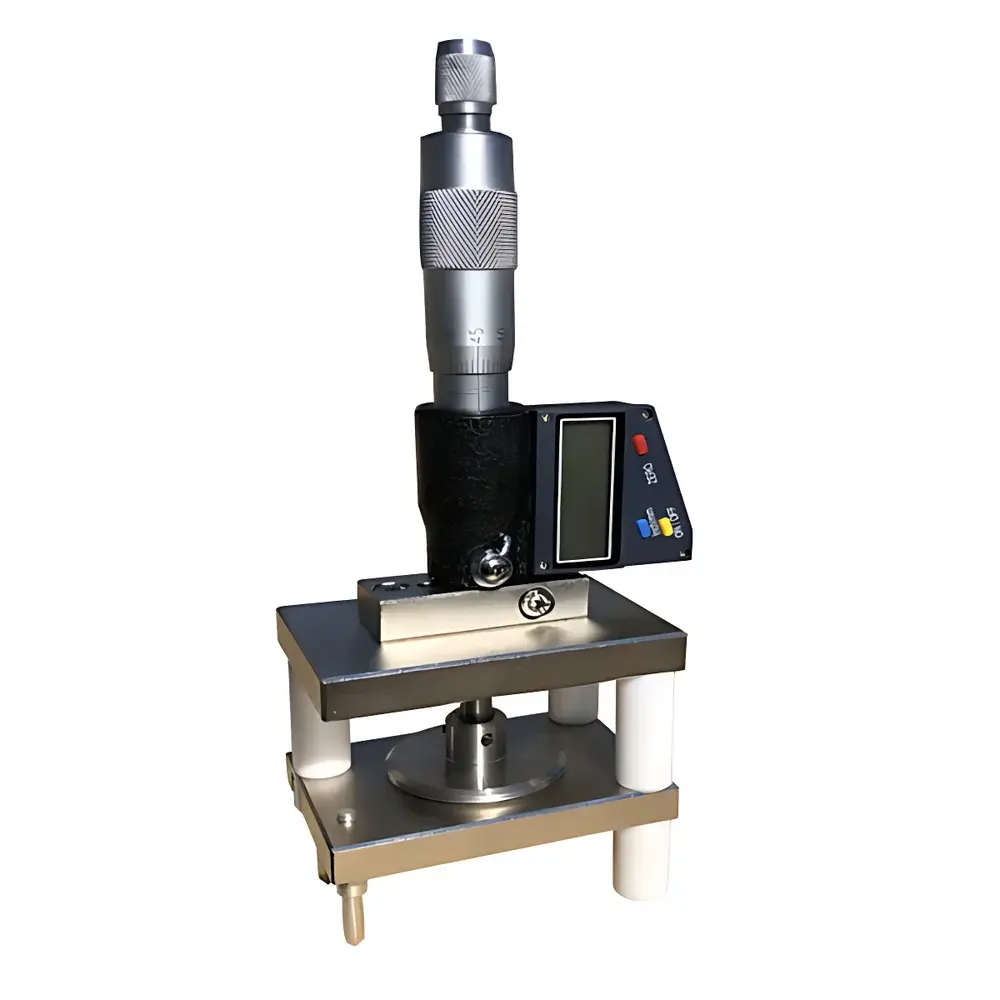
Guance Instruments GCSTD-AB5 High-Frequency Dielectric Constant Analyzer
| Brand | Guance Instruments |
|---|---|
| Origin | Beijing, China |
| Manufacturer Type | Authorized Distributor |
| Country of Origin | China |
| Model | GCSTD-AB5 |
| Price | USD 1,900 (FOB) |
| Frequency Range | 1 MHz – 70 MHz (typical for AB-series) |
| Measurement Principle | High-Frequency Resonance Method (Series/Parallel Resonant Circuit Analysis) |
| Key Parameters | ε (Dielectric Constant), tanδ (Dissipation Factor), Q-factor, C (Capacitance), L (Inductance), D (Loss Factor) |
| Electrode Configuration | Solid: Φ38 mm parallel-plate electrode, adjustable sample thickness ≥0.5 mm and ≤15 mm |
| Liquid/Powder | Optional Φ48 mm cup (7 mm depth) with Φ38 mm electrode |
| Compliance | GB/T 1409–2006, GB/T 5654–2007, GB/T 21216–2007, GB/T 1693–2007, GB/T 5594.4–1985, ASTM D150, IEC 60250 |
| Operating Environment | 0–40 °C, RH <80%, 220 V ±10%, 50 Hz ±2.5 Hz |
| Power Consumption | ~25 W |
| Dimensions (L×W×H) | 380 × 280 × 132 mm |
| Net Weight | ~7 kg |
Overview
The Guance Instruments GCSTD-AB5 High-Frequency Dielectric Constant Analyzer is a precision impedance measurement system engineered for the quantitative characterization of dielectric properties in non-conductive solid, liquid, and powdered materials. It operates on the high-frequency resonance method—specifically, series and parallel resonant circuit analysis—enabling accurate determination of complex permittivity (ε* = ε′ − jε″) and its derived parameters: relative dielectric constant (ε′ or εr) and dielectric loss tangent (tan δ = ε″/ε′). Designed for laboratory-grade R&D and quality control environments, the GCSTD-AB5 delivers traceable, repeatable measurements across a broad frequency range (1 MHz to 70 MHz), supporting fundamental studies of polarization mechanisms—including dipolar, interfacial (Maxwell–Wagner), and ionic relaxation—in ceramics, polymer composites, insulating oils, rubber formulations, and electronic structural ceramics. Its architecture integrates digital frequency synthesis with automatic resonance point detection, eliminating manual tuning drift and minimizing residual inductance in the test loop—critical for maintaining phase accuracy at elevated frequencies.
Key Features
- Microcontroller-based real-time control with digitally locked frequency synthesis for stable, low-phase-noise excitation.
- Auto-resonance search algorithm that identifies optimal series/parallel resonance points within user-defined frequency sweeps.
- Integrated Q-factor auto-ranging and dynamic amplitude stabilization to ensure consistent signal-to-noise ratio across wide impedance spans.
- Dual-mode electrode interface: standardized Φ38 mm parallel-plate configuration for solids (thickness-adjustable from 0.5 mm to 15 mm); optional Φ48 mm cylindrical cell for liquids and powders (7 mm depth).
- Multi-parameter output: simultaneous display of ε′, tan δ, capacitance (C), inductance (L), Q-value, dissipation factor (D), and effective series/parallel resistance.
- Compliance-ready design: firmware and calibration protocols aligned with GLP documentation requirements; audit trail support for lab record retention.
Sample Compatibility & Compliance
The GCSTD-AB5 accommodates heterogeneous sample forms without modification to core hardware. Solid specimens—including electrical porcelain, alumina substrates, silicone rubber sheets, and polymer films—are clamped between precision-ground stainless-steel electrodes with mechanical thickness adjustment. Liquid dielectrics (e.g., transformer oil, silicone fluid, propylene carbonate) are measured in the optional temperature-stable cup assembly, while fine ceramic powders may be compacted in situ using the same electrode geometry. All measurement procedures conform to internationally recognized standards: GB/T 1409–2006 (equivalent to IEC 60250), ASTM D150, GB/T 5654–2007 (for insulating liquids), and GB/T 1693–2007 (vulcanized rubber). Instrument validation includes factory calibration against NIST-traceable reference capacitors and certified loss standards, ensuring metrological integrity per ISO/IEC 17025–compliant QA workflows.
Software & Data Management
The GCSTD-AB5 supports USB-connected PC operation via proprietary Windows-compatible acquisition software. This application enables full sweep parameter definition (start/stop frequency, step resolution, dwell time), real-time Lissajous and Nyquist plot rendering, and batch export of CSV-formatted datasets with timestamping and operator ID fields. Raw data files include embedded metadata: instrument serial number, calibration date, electrode configuration, ambient temperature/humidity logs (via optional external sensors), and user-defined sample IDs. Software-generated reports comply with FDA 21 CFR Part 11 requirements when configured with electronic signature modules and role-based access control—making it suitable for regulated GMP/QbD environments in advanced materials development and electrical insulation qualification.
Applications
- Development and QC of high-frequency substrate materials for RF/microwave PCBs (e.g., PTFE composites, ceramic-filled laminates).
- Evaluation of aging effects in transformer oils and cable impregnants through longitudinal tan δ monitoring.
- Structure–property correlation in ferroelectric ceramics (e.g., BaTiO3, KNN) across Curie transitions.
- Quality screening of elastomeric seals and gaskets where dielectric loss impacts thermal runaway risk.
- Characterization of nanofiller dispersion homogeneity in polymer nanocomposites via frequency-dependent ε″ peaks.
- Validation of coating uniformity and interfacial defects in multilayer capacitor dielectrics.
FAQ
What frequency range does the GCSTD-AB5 cover?
The GCSTD-AB5 operates from 1 MHz to 70 MHz, optimized for high-resolution resonance tracking in the HF band. Frequency selection is programmable in 1 kHz increments.
Can it measure conductive or semi-crystalline polymers?
It is intended for low-conductivity (<10−6 S/m) insulators. Conductive fillers or highly crystalline phases require careful thickness normalization and may necessitate guard-ring electrode accessories (not included).
Is calibration traceable to national standards?
Yes—each unit ships with a calibration certificate referencing NIST-traceable reference standards, valid for 12 months under normal use conditions.
Does it support temperature-controlled measurements?
The base system operates at ambient temperature. For variable-temperature testing, third-party environmental chambers with feedthrough-compatible electrode extensions are recommended.
How is data integrity ensured during regulatory audits?
The software supports 21 CFR Part 11-compliant audit trails, including immutable event logs, electronic signatures, and encrypted raw data archives—fully compatible with internal QA and external accreditation reviews.



