
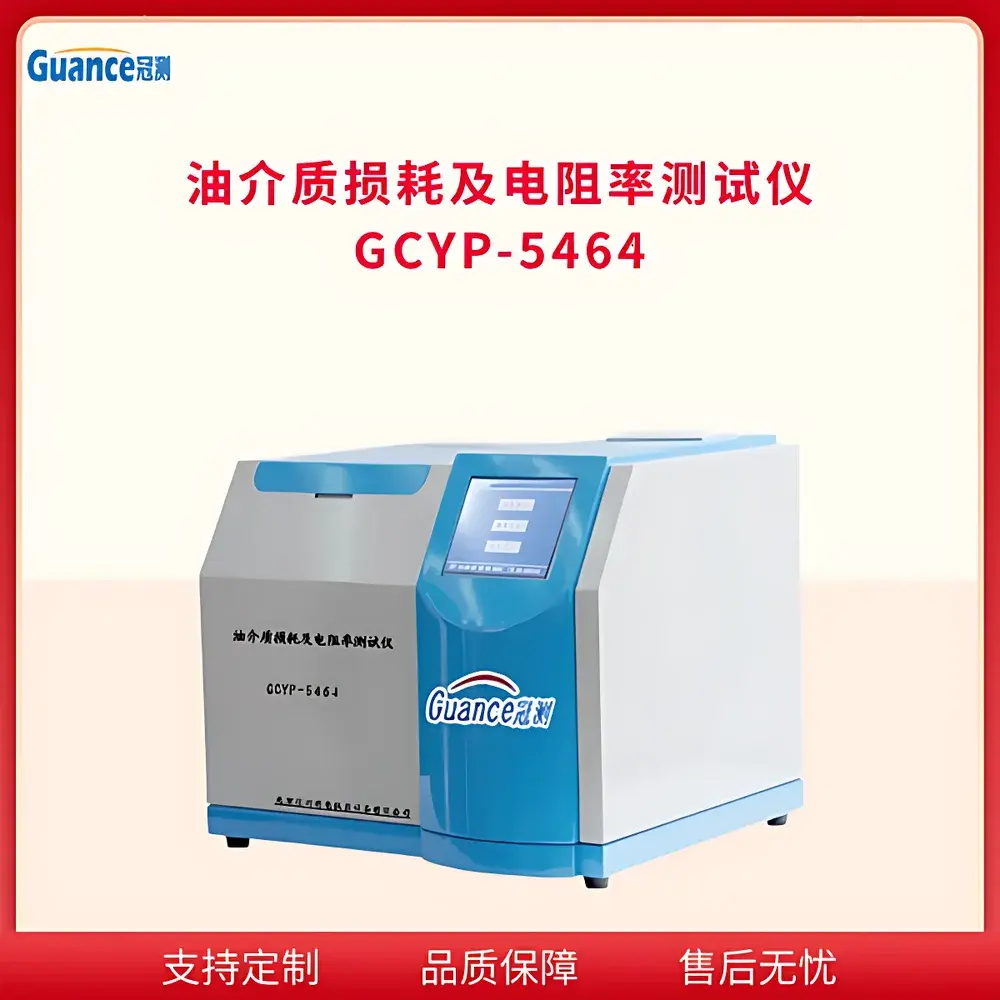
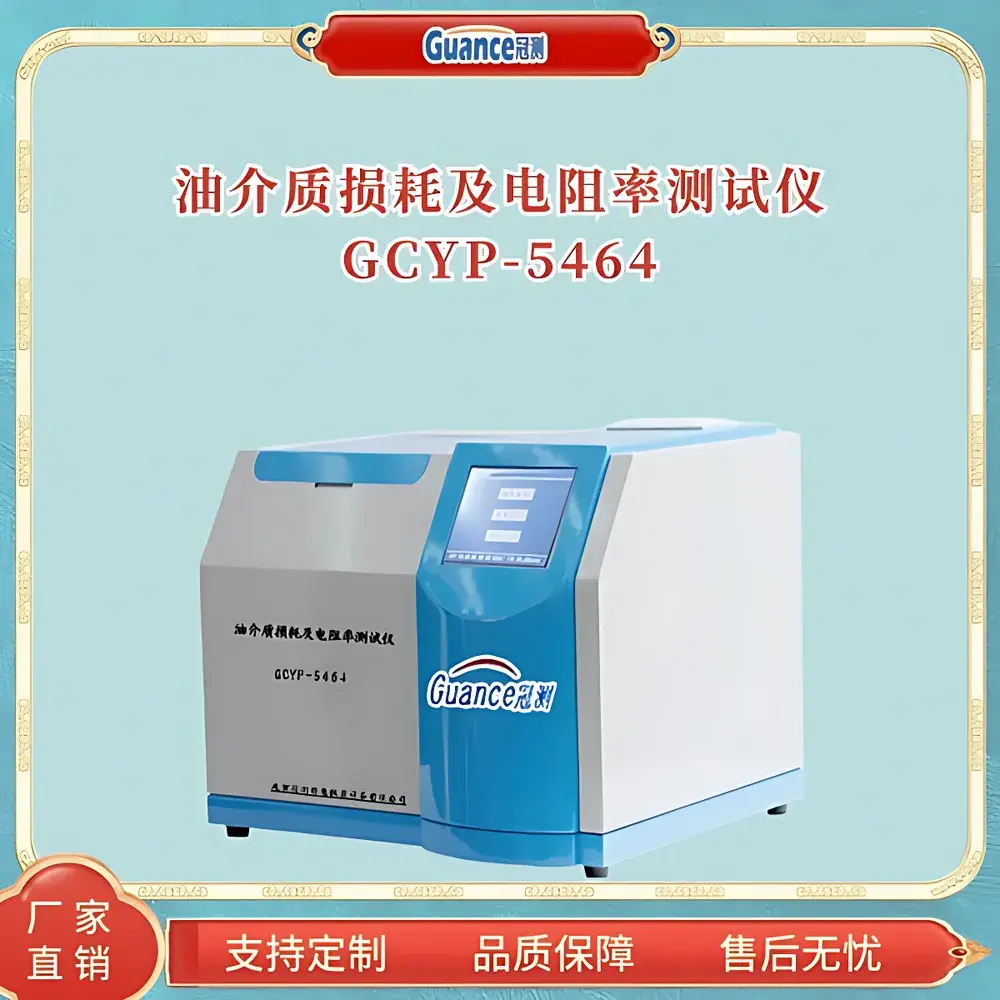
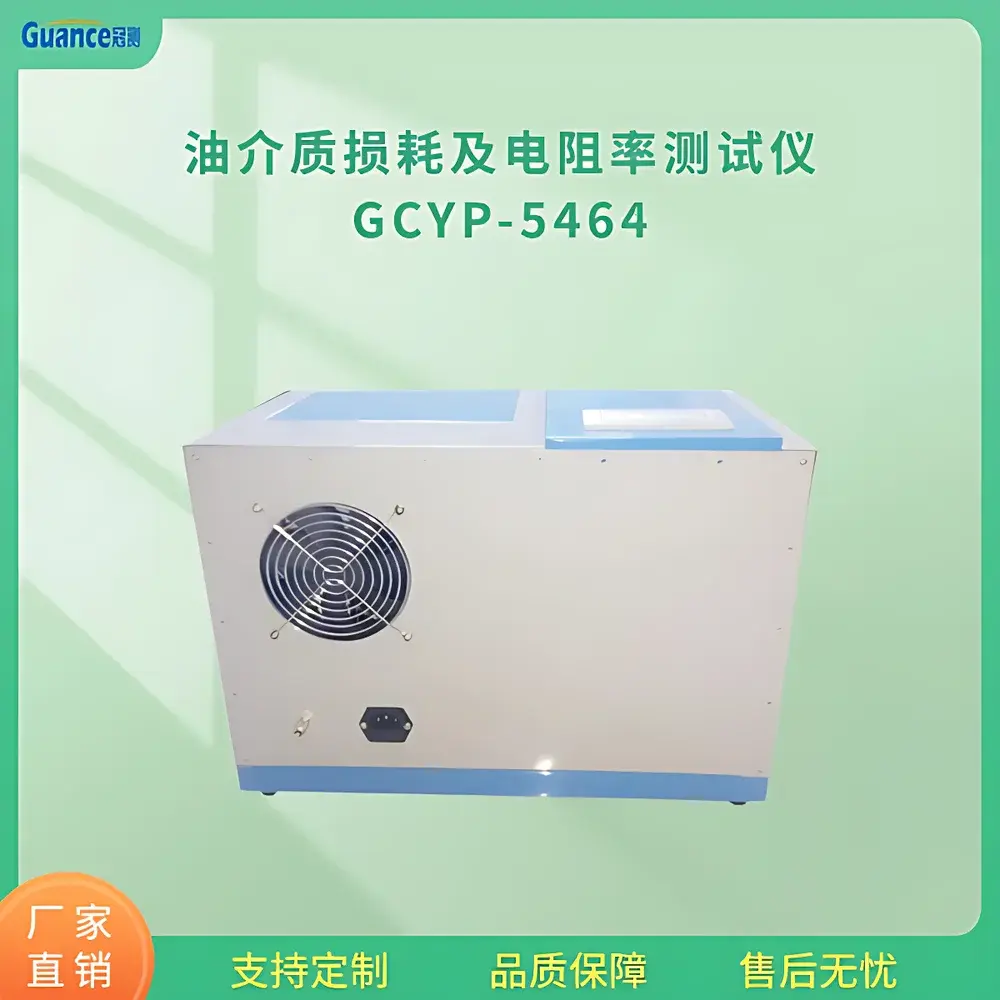
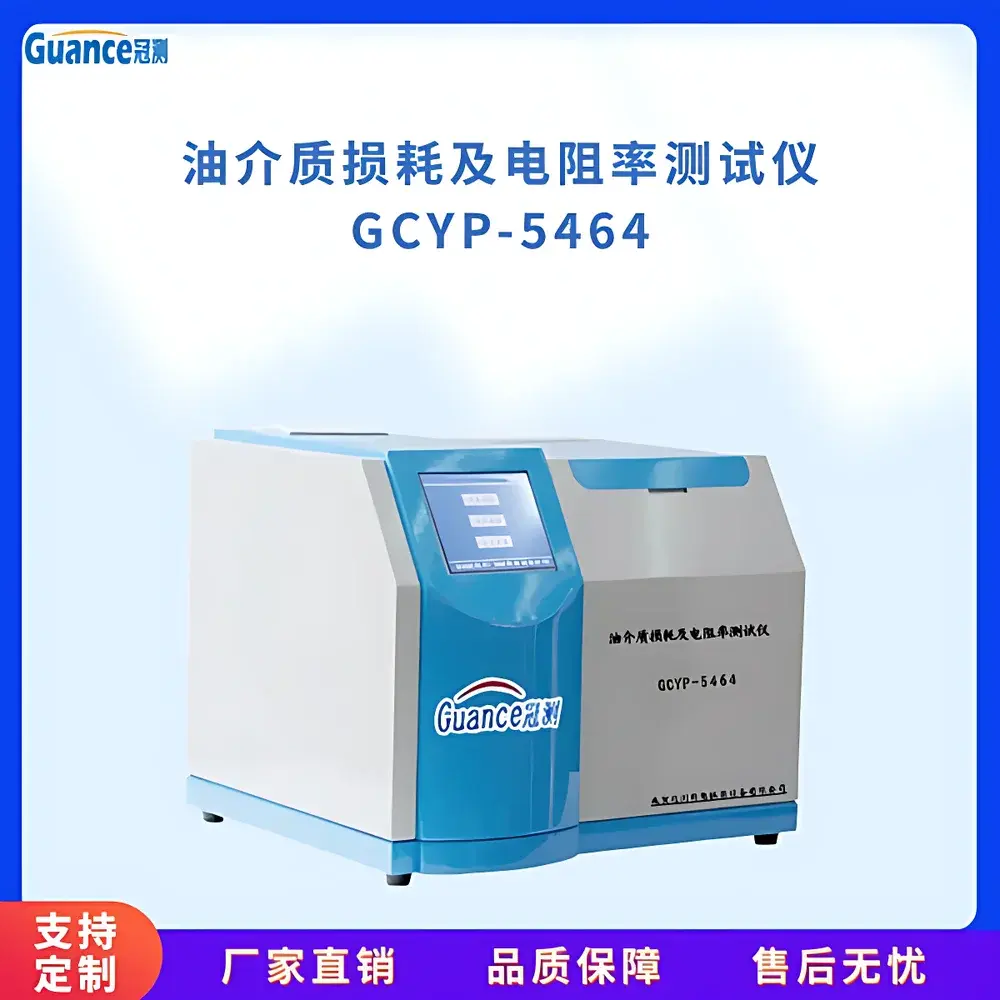
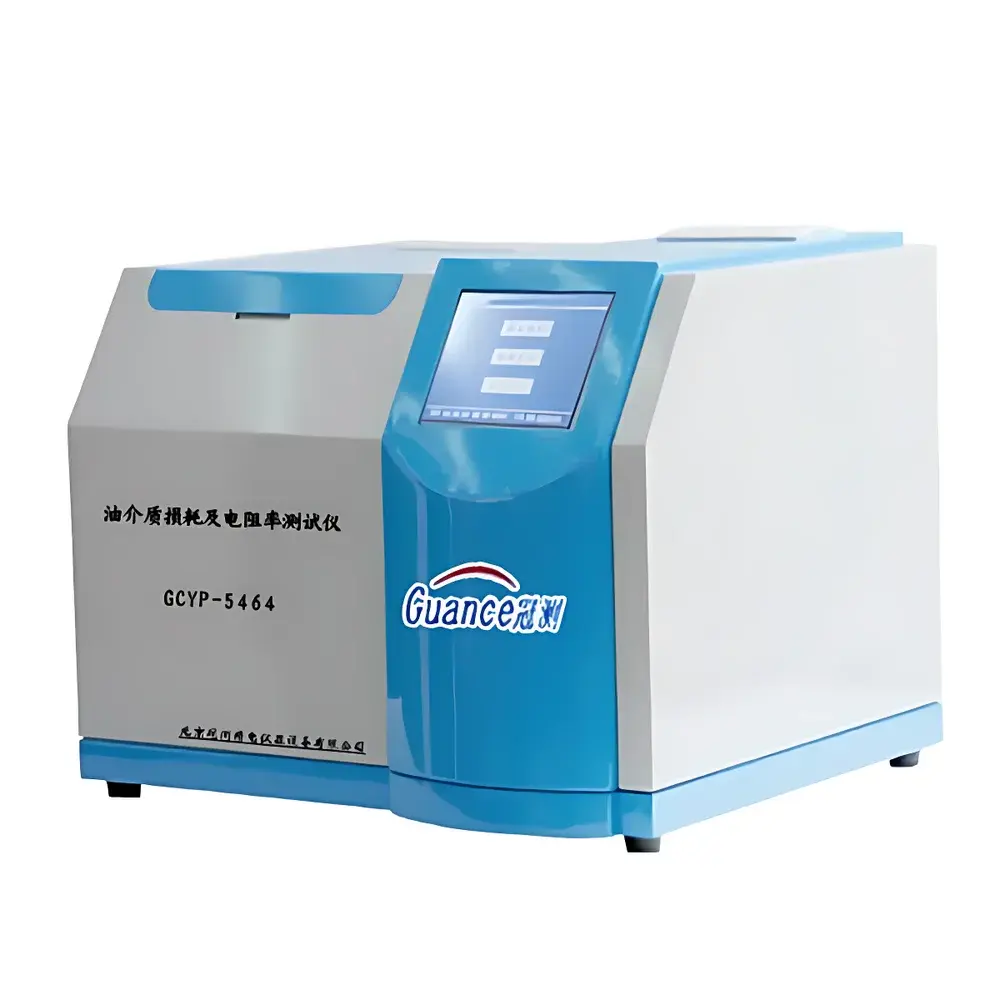
GuanCe GCYP-5464.2 Insulating Oil Dielectric Loss Tangent & DC Resistivity Analyzer
| Brand | GuanCe |
|---|---|
| Origin | Beijing, China |
| Manufacturer Type | Authorized Distributor |
| Country of Origin | China |
| Model | GCYP-5464.2 |
| Price | USD 1,700 (FOB) |
| Power Supply | AC 220 V ±10%, 50/60 Hz ±1% |
| Capacitance Range | 5–200 pF |
| Relative Permittivity Range | 1.000–30.000 |
| Dissipation Factor (tan δ) Range | 1×10⁻⁵–100 |
| DC Resistivity Range | 2.5 MΩ·m – 20 TΩ·m |
| tan δ Accuracy | ±(5% of reading + 0.0002) |
| Relative Permittivity Accuracy | ±(1–10)% of reading |
| Resistivity Accuracy | ±10% of reading |
| Temperature Control Range | 40–120 °C |
| Temp. Stability | ±0.5 °C |
| AC Test Voltage | 200–2200 V (50 Hz, continuously adjustable) |
| DC Test Voltage | 0–500 V (continuously adjustable) |
| Heating Method | Medium-frequency induction with PID control |
| Electrode System | Three-electrode cell per GB/T 5654–2007 (2 mm inter-electrode gap) |
| Display | 5.7″ TFT color touchscreen (full Chinese GUI) |
| Data Storage | Internal non-volatile memory with timestamp (date/time from built-in RTC) |
| Compliance | GB/T 5654–2007, IEC 60247 (equivalent), ASTM D924 (referenced), ISO 62 (for resistivity context) |
Overview
The GuanCe GCYP-5464.2 Insulating Oil Dielectric Loss Tangent & DC Resistivity Analyzer is a fully integrated, microprocessor-controlled instrument engineered for precise, standardized evaluation of electrical insulation performance in liquid dielectrics—primarily mineral insulating oils used in power transformers, circuit breakers, and high-voltage equipment. It implements the fundamental measurement principles defined in GB/T 5654–2007, which aligns closely with IEC 60247 and ASTM D924 for dielectric dissipation factor (tan δ) and relative permittivity (εr), and with ISO 62 and IEC 60167 for DC volume resistivity (ρv). The system combines a temperature-regulated three-electrode oil test cell, a digitally synthesized 50 Hz AC excitation source, a high-stability SF6-filled reference capacitor, a precision high-resistance meter, and a regulated DC high-voltage supply—all housed within a single robust chassis. Measurements are performed under controlled thermal conditions (40–120 °C), enabling assessment of aging-related degradation mechanisms such as oxidation byproduct formation, moisture ingress, and polar contaminant accumulation.
Key Features
- Three-electrode test cell conforming to GB/T 5654–2007 geometry: 2 mm electrode spacing, guard ring design minimizing stray capacitance and surface leakage currents—critical for low-loss (1 TΩ·m) measurements.
- Medium-frequency induction heating with closed-loop PID temperature control: contactless, uniform thermal distribution across the oil volume; temperature stability maintained within ±0.5 °C over full 40–120 °C range.
- Integrated SF6-filled standard capacitor: hermetically sealed, temperature- and humidity-insensitive, ensuring long-term calibration integrity without field recalibration.
- Dual-mode voltage sourcing: programmable 50 Hz AC test voltage (200–2200 V) for tan δ and εr; independently adjustable DC voltage (0–500 V) for resistivity determination per IEC 60167 procedures.
- Full digital signal processing architecture based on RAM9 platform: high-speed acquisition, real-time noise rejection, and automated null balancing for improved reproducibility.
- Comprehensive hardware protection: overvoltage/overcurrent cutoff, HV short-circuit detection, thermal cutout at 120 °C, and sensor fault monitoring with audible/visual alerts.
- Onboard 5.7″ TFT color touchscreen interface with full Chinese menu navigation, real-time parameter display, and embedded real-time clock (RTC) for traceable test metadata.
Sample Compatibility & Compliance
The GCYP-5464.2 is validated for use with hydrocarbon-based insulating oils—including naphthenic and paraffinic mineral oils—as well as synthetic esters and silicone fluids meeting IEC 60296 or ASTM D3487 specifications. It supports sample volumes of 35–45 mL per test. All measurements comply with national and international standards governing diagnostic testing of transformer oils: GB/T 5654–2007 (primary reference), IEC 60247 (dielectric response), IEC 60167 (DC resistivity), and ASTM D924 (dielectric dissipation factor). While not certified for FDA 21 CFR Part 11 or GLP/GMP environments out-of-the-box, its internal audit trail (timestamped results, user-initiated calibration logs, and configuration history) provides foundational data integrity suitable for quality assurance workflows in utility and manufacturing labs.
Software & Data Management
No external PC software is required for operation; all functions—including test initiation, parameter configuration, result calculation, and report generation—are executed locally via the embedded Linux-based firmware. Test results (capacitance, εr, tan δ, ρv, temperature, voltage, date/time) are stored automatically in non-volatile memory with up to 1,000 record capacity. Data export is supported via USB flash drive in CSV format for offline analysis in Excel or LIMS integration. The system includes an “empty cell calibration” routine that measures baseline capacitance and tan δ of the clean, dry electrode assembly—enabling correction of geometric and parasitic contributions during subsequent sample measurements. Calibration constants and system diagnostics are password-protected and logged with timestamps for internal verification.
Applications
- Routine condition monitoring of transformer oil in substation maintenance programs.
- Acceptance testing of new oil batches prior to equipment filling.
- Diagnosis of thermal and oxidative aging via progressive increase in tan δ above 90 °C.
- Quantification of ionic contamination and moisture content through resistivity deviation from baseline (e.g., <100 GΩ·m indicating significant degradation).
- Supporting IEEE C57.106 and IEC 60422 maintenance guidelines for oil reclamation decisions.
- Research and development of alternative insulating fluids (e.g., natural/synthetic esters) requiring comparative dielectric characterization.
FAQ
Does the GCYP-5464.2 support automatic temperature ramping during sequential measurements?
No. Temperature is set manually per test cycle; stabilization at target temperature is confirmed prior to measurement initiation.
Is the three-electrode cell removable for cleaning or replacement?
Yes—the cell is a modular, threaded assembly with PTFE insulation and stainless-steel electrodes; cleaning protocols follow GB/T 5654–2007 Annex B.
Can resistivity be measured at temperatures other than 20 °C or 90 °C?
Yes. The instrument allows DC resistivity measurement at any temperature between 40 °C and 120 °C, though reporting typically references standardized test points per IEC 60167.
What is the minimum detectable tan δ value, and how is noise minimized?
The system achieves a resolution of 1×10⁻⁵ in tan δ, enabled by synchronous demodulation, shielded cabling, and the guard-ring electrode’s suppression of surface conduction artifacts.
Is firmware upgrade capability available?
Yes—upgrades are delivered via USB stick and installed through the Settings > System Update menu; version history and checksum validation are displayed pre-installation.



