

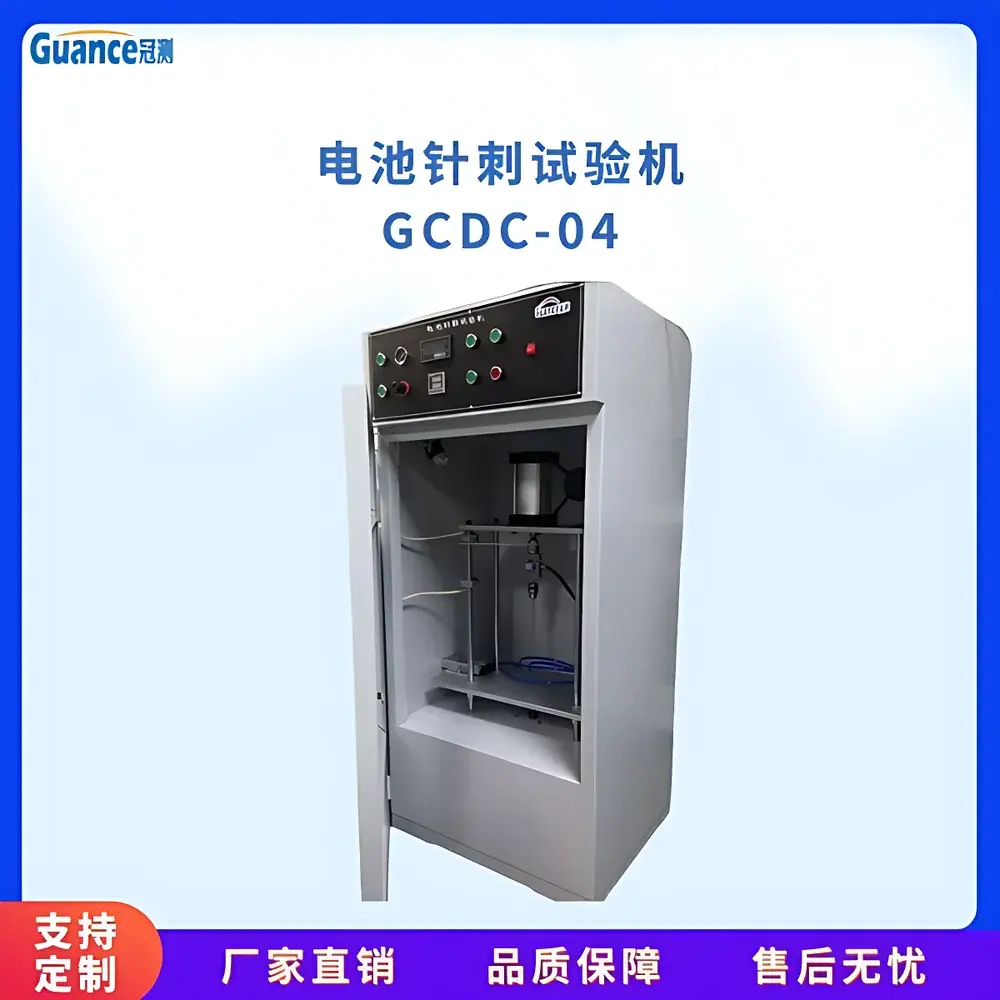

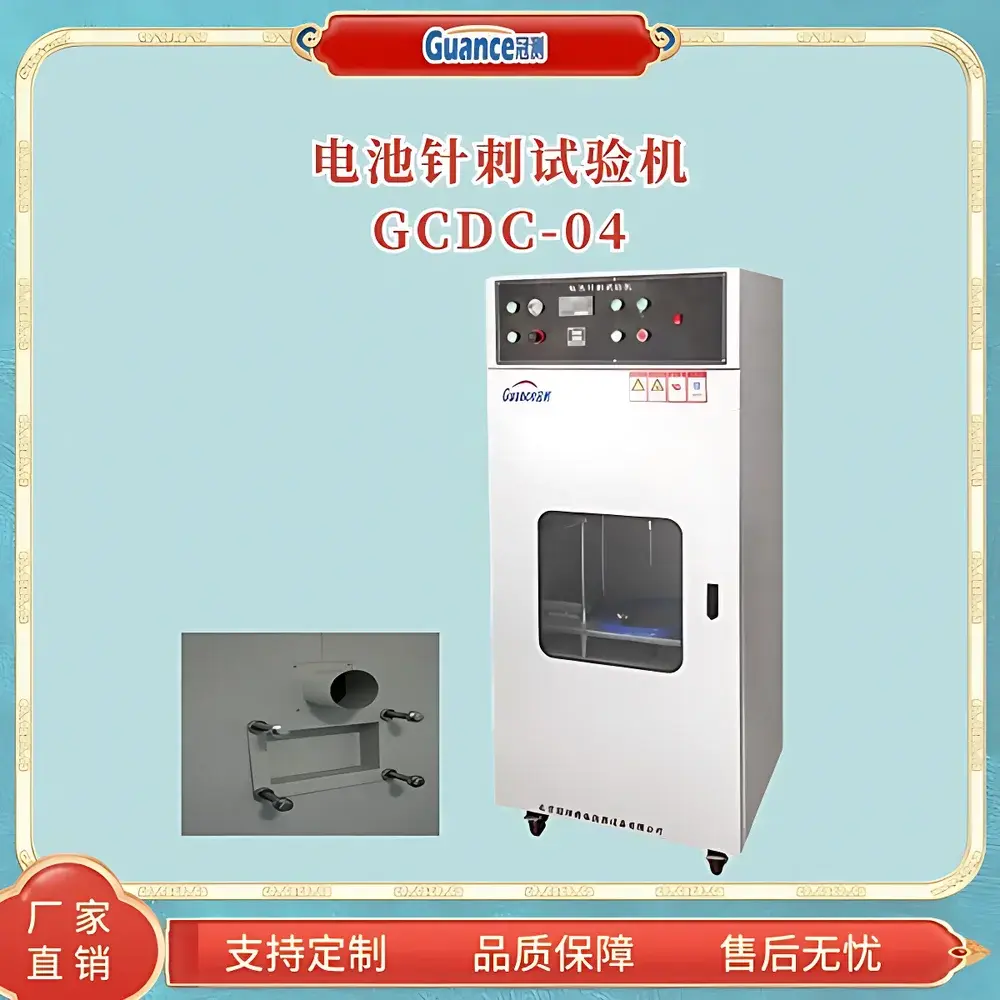
GuanCe Instruments GCDC04 Button Cell Nail Penetration & Physical Safety Tester
| Brand | GuanCe Instruments |
|---|---|
| Origin | Beijing, China |
| Manufacturer Type | Authorized Distributor |
| Region Classification | Domestic (China) |
| Model | GCDC04 |
| Price | USD 2,100 (FOB Beijing) |
| Drive Mechanism | Pneumatic Cylinder |
| Penetration Force Range | 0–200 kgf (0–1960 N) |
| Force Resolution | 10 N |
| Sensor Resolution | 1/10,000 |
| Penetration Speed | 10–40 mm/s (adjustable, ±5% accuracy) |
| Needle Diameter | Φ2–Φ8 mm stainless steel, L=100 mm, high-temp resistant |
| Needle Orientation | Perpendicular to electrode plane |
| Stroke | 100 mm |
| Test Chamber Dimensions | 300 × 200 × 300 mm (W×H×D) |
| Chamber Material | Inner—1.5 mm 304 stainless steel + PTFE lining |
| Observation Window | 200 × 200 mm triple-layer vacuum tempered glass with explosion-proof mesh and LED lighting |
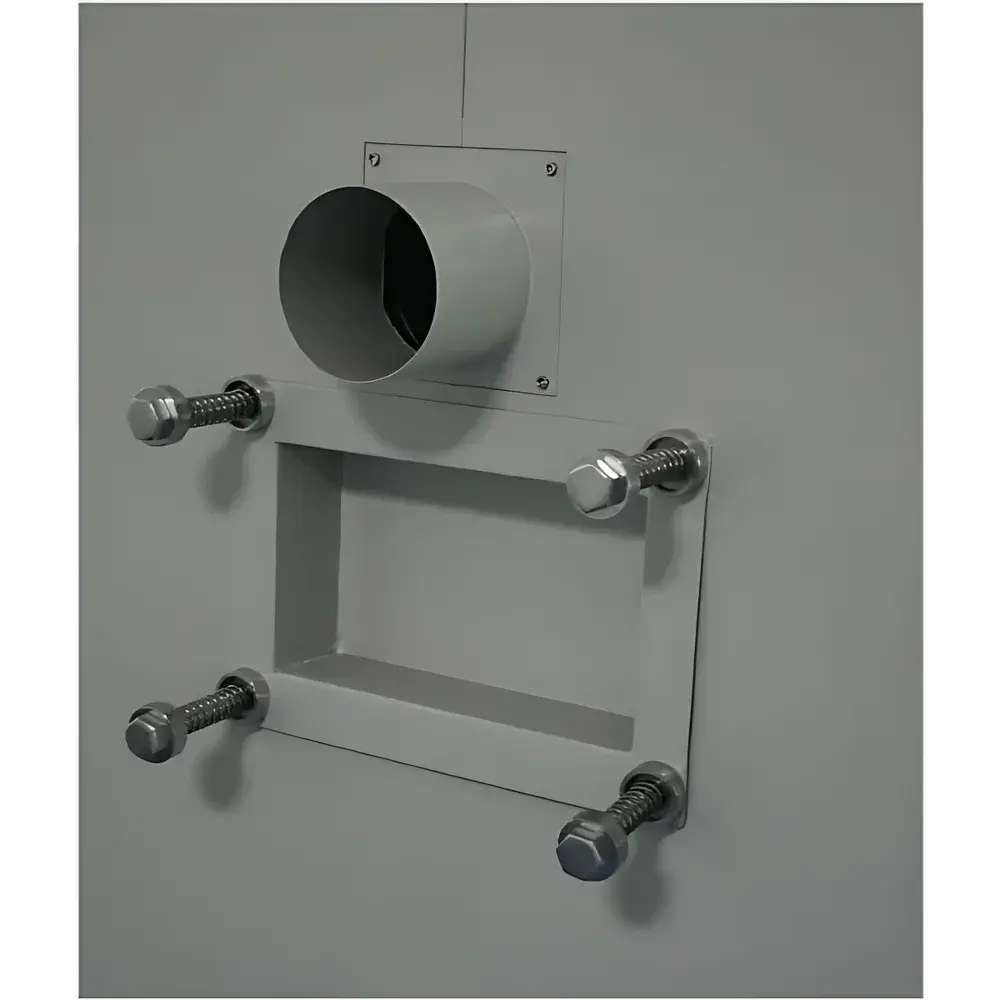
| Ventilation | 120 mm rear exhaust port with interlocked fan (auto-on at power-up) |
| Safety Interlock | Door-mounted limit switch (power cutoff on opening) |
| Data Acquisition | 80 Hz sampling rate, real-time force/speed/time logging |
| Delay Timer | 0–99 h/min/sec programmable |
| Weight | ~120 kg |
| Power Supply | AC 220 V, 50–60 Hz, 5 A, 1100 W |
Overview
The GuanCe Instruments GCDC04 Button Cell Nail Penetration & Physical Safety Tester is an engineered safety validation platform designed for controlled mechanical abuse testing of lithium-based primary and secondary button cells, cylindrical cells, pouch cells, and small-format battery modules. It operates on the principle of dynamic mechanical puncture—simulating worst-case penetration events that may occur during end-use, logistics handling, or accidental impact. The system delivers repeatable, traceable, and standards-compliant nail penetration under defined thermal and environmental conditions (20 ± 5 °C), with real-time monitoring of force, displacement, time, and optional external thermocouple voltage/current signals via standardized I/O interfaces. Its architecture adheres to fundamental safety engineering principles: containment, interlock, pressure relief, and operator isolation—ensuring compliance with internationally recognized battery safety test protocols without compromising measurement integrity.
Key Features
- Pneumatically actuated penetration mechanism with adjustable speed (10–40 mm/s) and precise stroke control (100 mm max), enabling consistent kinetic energy delivery across test cycles.
- High-fidelity load cell with 10 N resolution and 1/10,000 sensor resolution, supporting dual-unit display (kgf, N, lbf) and calibrated force feedback for pass/fail evaluation against threshold criteria.
- Explosion-resistant test chamber constructed from 1.5 mm 304 stainless steel interior with PTFE lining for corrosion resistance and flame retardancy, enclosed by powder-coated A3 steel outer casing.
- Triple-layer vacuum-sealed observation window (200 × 200 mm) with integrated LED illumination and reinforced anti-blast mesh—permitting visual verification without compromising containment integrity.
- Interlocked safety system including door-activated power cutoff, rear-mounted pressure-relief burst panel, and auto-start ventilation fan linked to main power supply.
- Modular needle fixture accommodating interchangeable stainless-steel needles (Φ2–Φ8 mm, L = 100 mm), each certified for thermal stability up to 600 °C and surface hardness ≥55 HRC.
- Onboard controller with programmable delay timer (0–99 hours/minutes/seconds), real-time speed readout, and 80 Hz synchronized data acquisition for force–time profiling.
Sample Compatibility & Compliance
The GCDC04 accommodates specimens up to 350 × 350 × 60 mm—including coin cells (CR2032, BR2032), prismatic micro-modules, and stacked button-cell arrays—secured via manual clamping aligned perpendicular to the electrode plane. All test configurations maintain strict alignment tolerances (<±1° angular deviation) to ensure reproducible stress localization. The instrument satisfies mandatory test requirements specified in GB 31241–2014, GB/T 8897.4–2008, IEC 62281:2004, UL 1642:2012, and UN 38.3 Section 38.3.2 (mechanical testing). Its design supports audit-ready documentation for GLP and GMP environments, with timestamped digital logs exportable in CSV format for traceability. While not FDA 21 CFR Part 11–compliant out-of-the-box, the system’s deterministic control logic and hardware-enforced interlocks provide a foundation for qualified electronic record implementation.
Software & Data Management
The GCDC04 utilizes embedded firmware with non-volatile memory storage for up to 1,000 test records. Each entry includes start/stop timestamps, peak force, penetration duration, average velocity, and user-defined test ID. Data export is supported via USB 2.0 interface to standard PC platforms running Windows 10/11. No proprietary software installation is required—raw .csv files are human-readable and compatible with Excel, MATLAB, or LIMS integration via ODBC drivers. Optional analog output (0–10 V) enables synchronization with external DAQ systems for concurrent thermal imaging or electrochemical impedance monitoring. Firmware updates are delivered via signed binary packages with SHA-256 checksum verification to ensure configuration integrity.
Applications
- Pre-production safety qualification of lithium manganese dioxide (Li-MnO₂), lithium thionyl chloride (Li-SOCl₂), and lithium iron phosphate (LiFePO₄) button cells.
- Root-cause analysis of thermal runaway initiation points under mechanical abuse, correlating force–displacement curves with post-test DSC/TGA residue analysis.
- Verification of separator integrity and current collector weld strength in miniature battery formats used in medical implants, RFID tags, and IoT edge sensors.
- Third-party certification lab testing per UN Manual of Tests and Criteria, Part III, Subsection 38.3, specifically for transport classification of lithium batteries.
- Research-grade parameter sweeps—e.g., needle diameter vs. ignition latency, penetration velocity vs. venting onset—to inform FMEA models for battery pack mechanical design.
FAQ
What standards does the GCDC04 explicitly support?
The system is configured to execute test procedures defined in GB 31241–2014, IEC 62281:2004, UL 1642:2012, and UN 38.3. Calibration certificates and test report templates aligned with these standards are provided upon request.
Can the GCDC04 be integrated into an automated test line?
Yes—the unit features dry-contact relay outputs (NO/NC) and TTL-level trigger inputs, allowing synchronization with PLC-controlled conveyors, robotic loaders, or environmental chambers.
Is operator training included with purchase?
GuanCe Instruments provides remote video-based commissioning and operation training (2 hours), plus access to bilingual technical documentation (English/Chinese) and firmware update notifications.
What maintenance is required for long-term reliability?
Annual verification of load cell calibration and pneumatic seal integrity is recommended. Replacement needles and PTFE chamber liners are stocked globally through authorized service partners.
Does the system meet CE or UKCA marking requirements?
The GCDC04 complies with EN 61000-6-2 (immunity) and EN 61000-6-4 (emissions) for industrial environments. CE declaration is available upon order confirmation; UKCA alignment requires additional notified body assessment for end-market deployment.



