
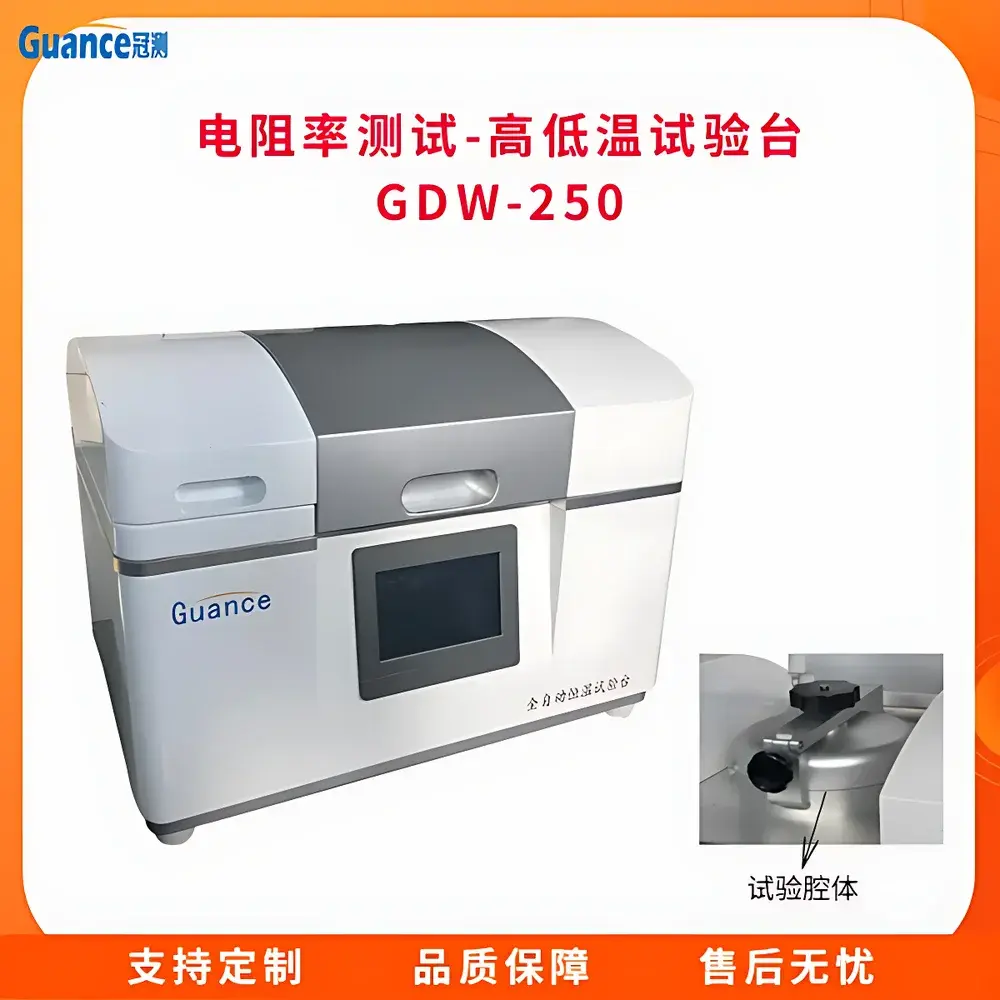
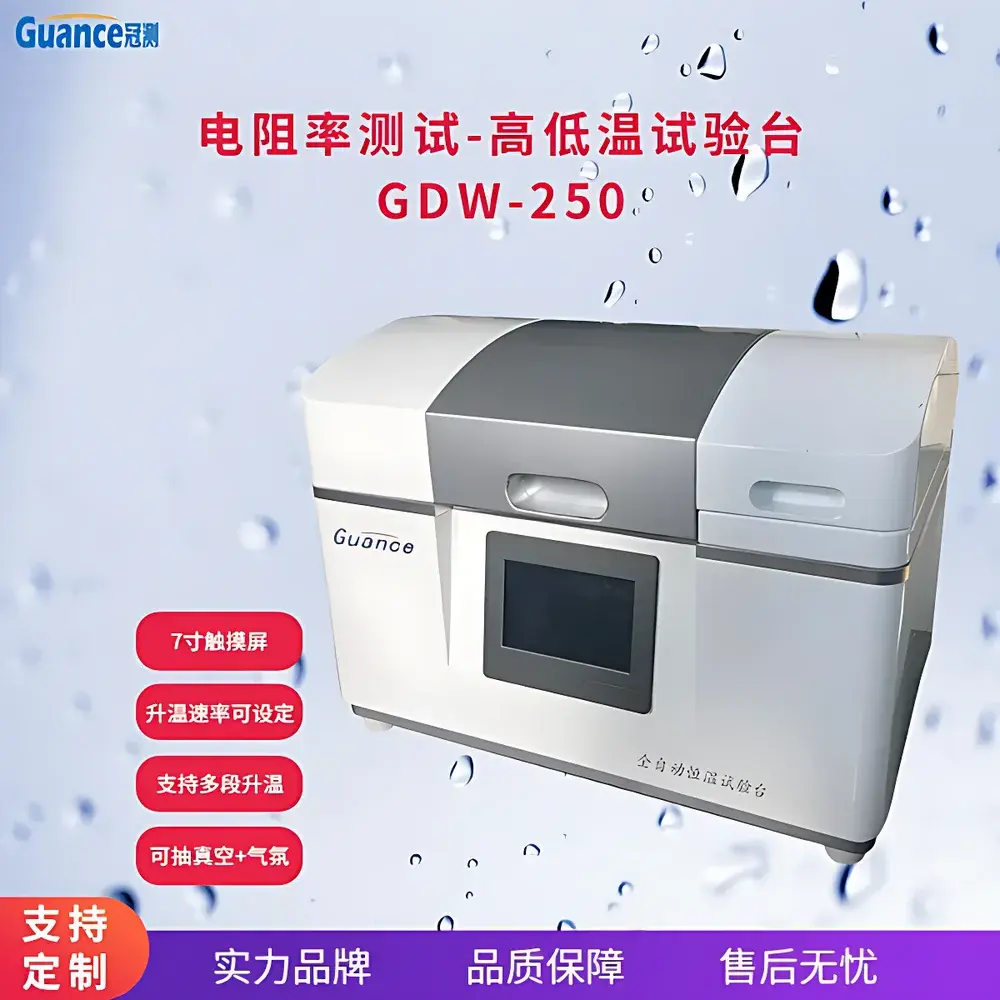
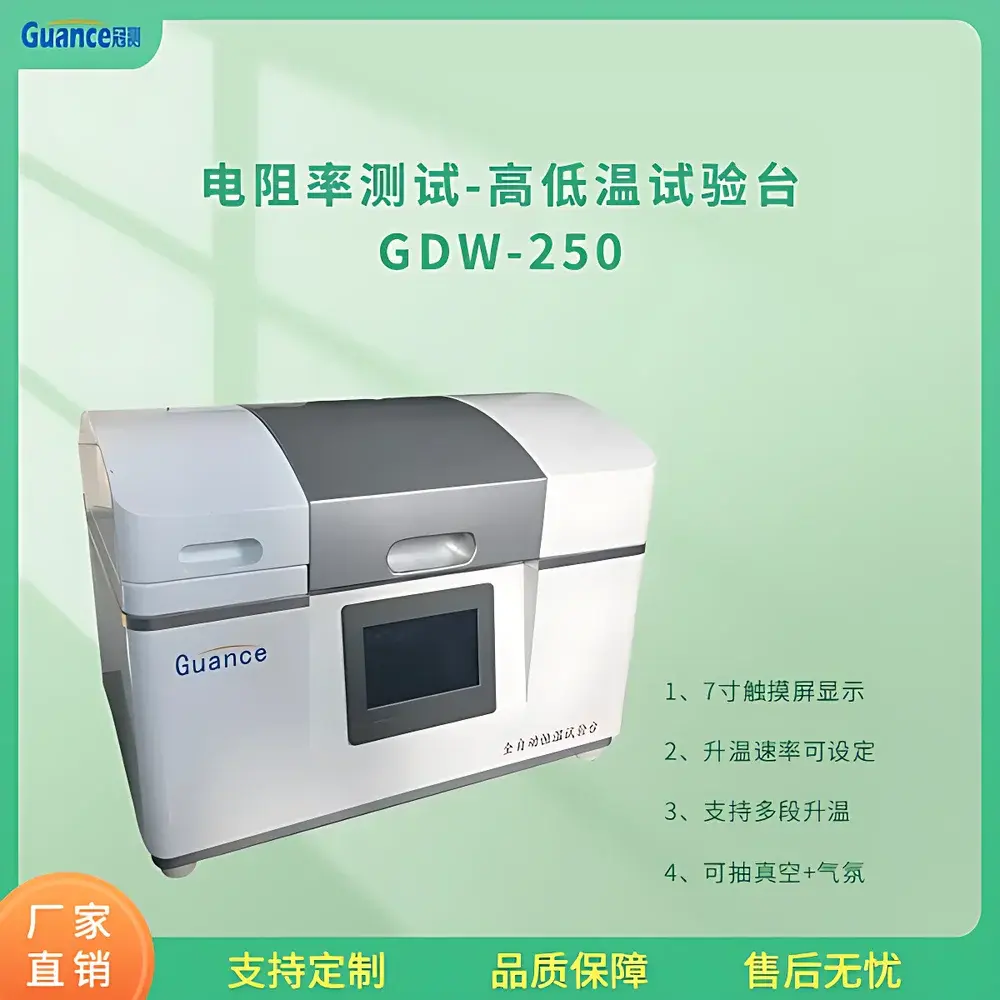
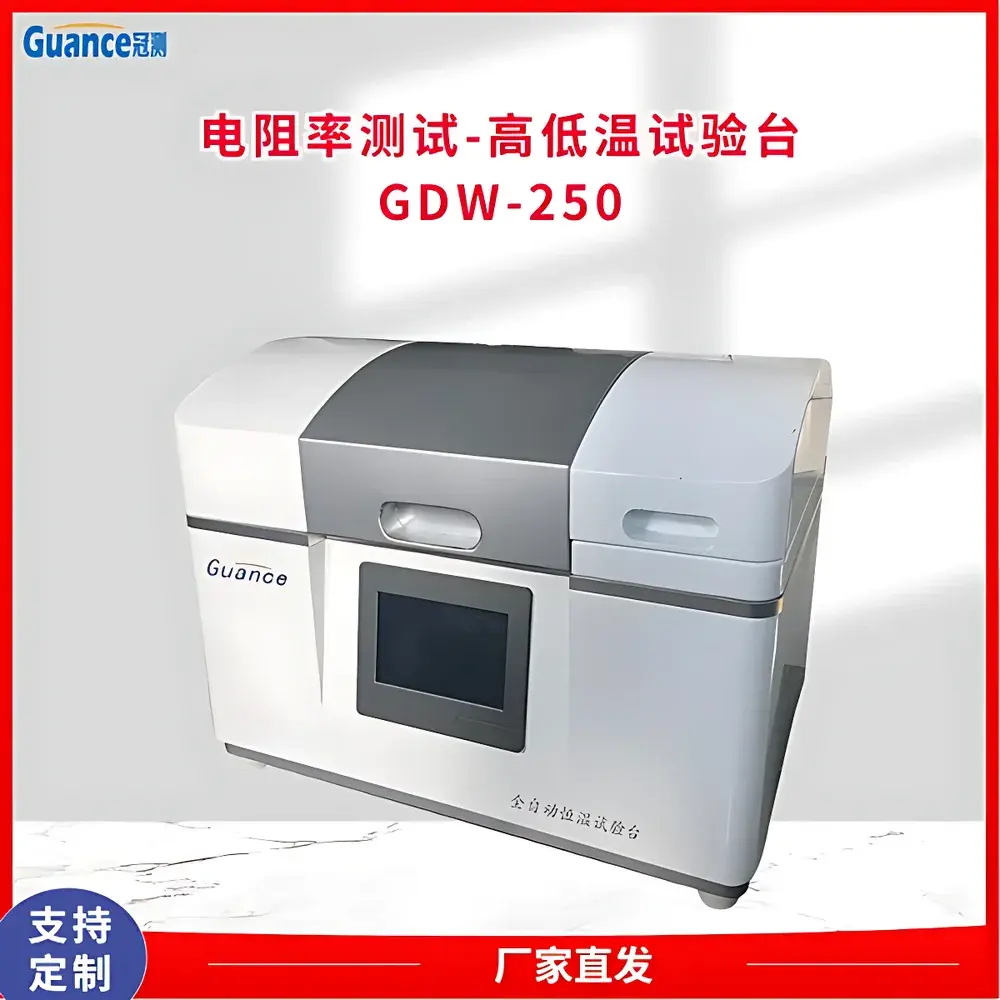
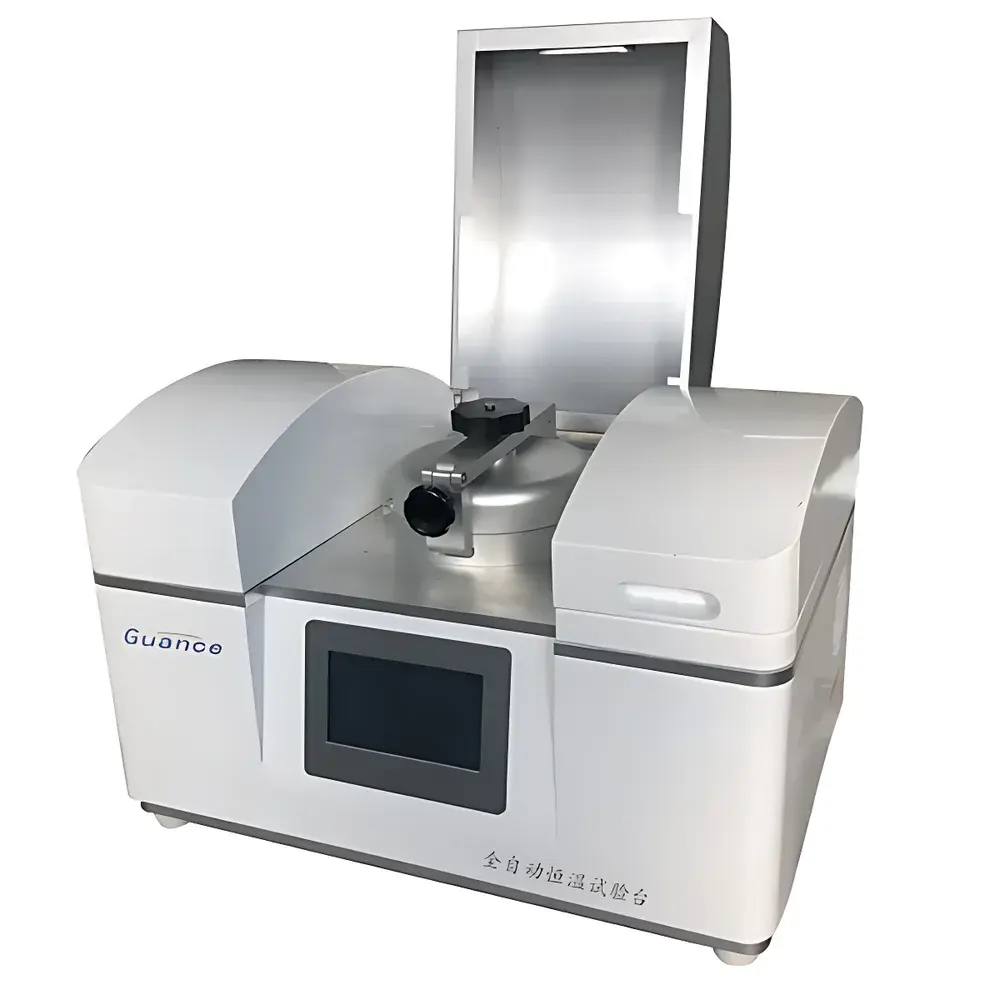
GuanCe Instruments GDW-250.1 High-Low Temperature Dielectric Constant Tester
| Brand | GuanCe Instruments |
|---|---|
| Origin | Beijing, China |
| Manufacturer Type | Authorized Distributor |
| Country of Origin | China |
| Model | GDW-250.1 |
| Price | USD 2,100 (approx.) |
Overview
The GuanCe Instruments GDW-250.1 High-Low Temperature Dielectric Constant Tester is a precision-engineered thermal–electrical characterization platform designed for controlled-environment measurement of dielectric properties across wide temperature ranges. It operates on the principle of impedance spectroscopy combined with guarded electrode configuration, enabling accurate determination of relative permittivity (εr) and dielectric loss tangent (tan δ) of solid insulating materials under programmable thermal conditions. The system integrates a thermally stabilized environmental chamber (−40 °C to +250 °C) with high-voltage AC/DC bias capability and calibrated electrode fixtures, supporting standardized test methods aligned with ASTM D150, IEC 60250, and GB/T 1409. Its modular architecture allows interoperability with third-party LCR meters or impedance analyzers (e.g., Keysight E4990A, Hioki IM3570), making it suitable for R&D laboratories, quality control departments, and material certification facilities requiring traceable, temperature-resolved dielectric data.
Key Features
- Temperature-controlled chamber with programmable ramp rates (0.1–5 °C/min), stability ±0.5 °C at steady state within the full −40 °C to +250 °C operating range
- Modular electrode system accommodating standard parallel-plate configurations (25 mm, 50 mm diameter) with adjustable spacing (0.1–5 mm); optional guarded electrodes available for surface resistivity compliance per ASTM D257
- Integrated high-voltage source (up to 1,000 V DC / 500 V AC RMS) with current-limiting protection and real-time leakage monitoring
- Real-time dual-axis plotting: resistivity (ρ) vs. temperature and tan δ vs. εr, synchronized with thermal profiling
- Robust enclosure: 600 × 400 × 400 mm (W × D × H), powder-coated steel chassis with thermal insulation and electromagnetic shielding
- Compliance-ready design: supports audit trails, user-level access control, and calibration log retention—facilitating GLP/GMP-aligned workflows
Sample Compatibility & Compliance
The GDW-250.1 accommodates rigid and semi-rigid dielectric specimens up to 50 mm in diameter and 10 mm in thickness, including ceramics, polymer films, epoxy composites, and sintered oxides. Sample mounting utilizes spring-loaded, gold-plated brass electrodes with PTFE-insulated feedthroughs to minimize parasitic capacitance. All mechanical and electrical interfaces conform to ISO/IEC 17025 requirements for testing laboratory competence. Test protocols are structured to meet ASTM D150-22 (dielectric constant and dissipation factor of electrical insulating materials) and IEC 60250:1969+AMD1:1977+AMD2:1985 (determination of permittivity and dielectric dissipation factor). Optional NIST-traceable calibration certificates are available upon request.
Software & Data Management
The embedded Windows-based control software provides full instrument orchestration via USB 2.0 or Ethernet interface. Users define multi-step thermal-electrical test sequences—including dwell time at target temperatures, voltage sweep profiles, and frequency sweeps (when paired with external impedance analyzers). All acquired datasets (temperature, voltage, current, phase angle, capacitance) are timestamped and stored in HDF5 format for long-term integrity. Export functions support CSV, Excel (.xlsx), and PDF report generation with embedded metadata (operator ID, calibration date, environmental logs). Software features include electronic signature support, password-protected method locking, and exportable audit trails compliant with FDA 21 CFR Part 11 requirements for regulated environments.
Applications
- Temperature-dependent permittivity mapping of high-k dielectrics for semiconductor packaging qualification
- Evaluation of thermal aging effects on polymeric insulators used in aerospace wiring harnesses
- Characterization of piezoelectric ceramic phase transitions near Curie temperature
- Quality assurance of capacitor-grade polymer films during batch release testing
- Research into space-charge dynamics in cross-linked polyethylene (XLPE) cable insulation under thermal stress
- Validation of low-outgassing materials for vacuum-compatible electronics per NASA ASTM E595
FAQ
What temperature uniformity can be expected inside the chamber during extended dwell periods?
Uniformity is maintained within ±1.0 °C across the central 60 mm zone when operating between −20 °C and +150 °C; tighter control (±0.5 °C) is achievable with active chamber tuning enabled.
Is the system compatible with external impedance analyzers from Keysight or Zurich Instruments?
Yes—standard BNC and SMB connectors support direct analog voltage/current signal routing; SCPI command sets are documented for seamless integration.
Does the software support automated pass/fail evaluation against user-defined εr tolerance bands?
Yes—threshold-based decision logic can be configured per test step, with visual alerts and flagged exports for nonconforming results.
What maintenance intervals are recommended for long-term accuracy?
Annual verification of thermal sensor calibration and electrode contact resistance is advised; chamber door gasket inspection should occur every six months.
Can the system operate unattended overnight for extended thermal cycling tests?
Yes—hardware watchdog timers, over-temperature cut-offs, and uninterruptible power supply (UPS) compatibility ensure safe autonomous operation for up to 72-hour sequences.



