
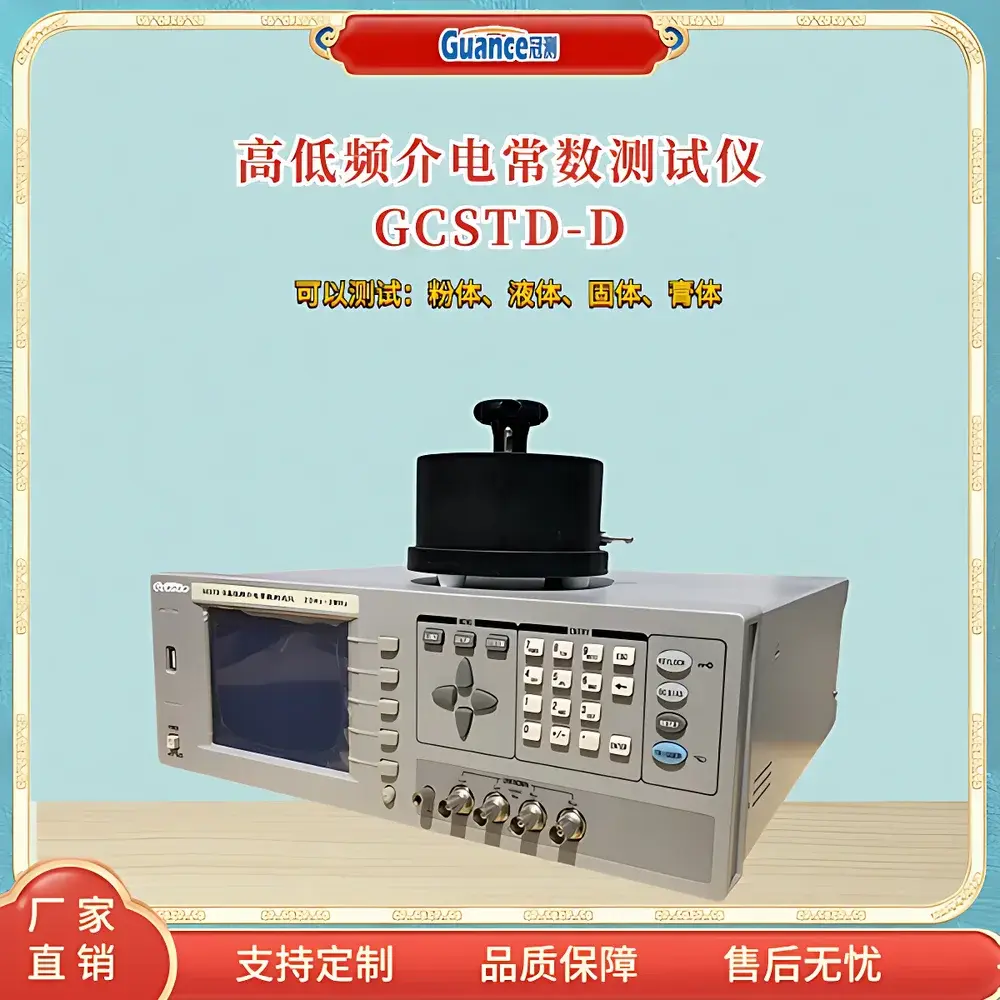
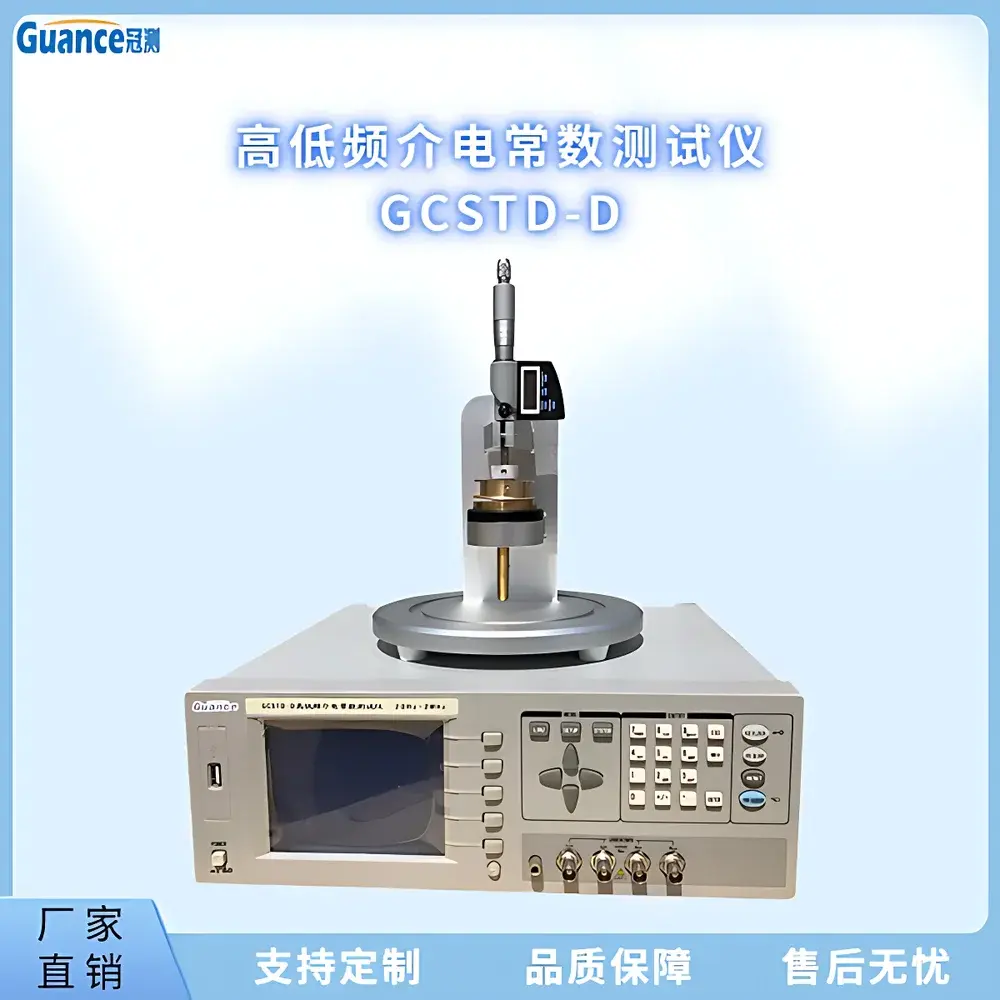
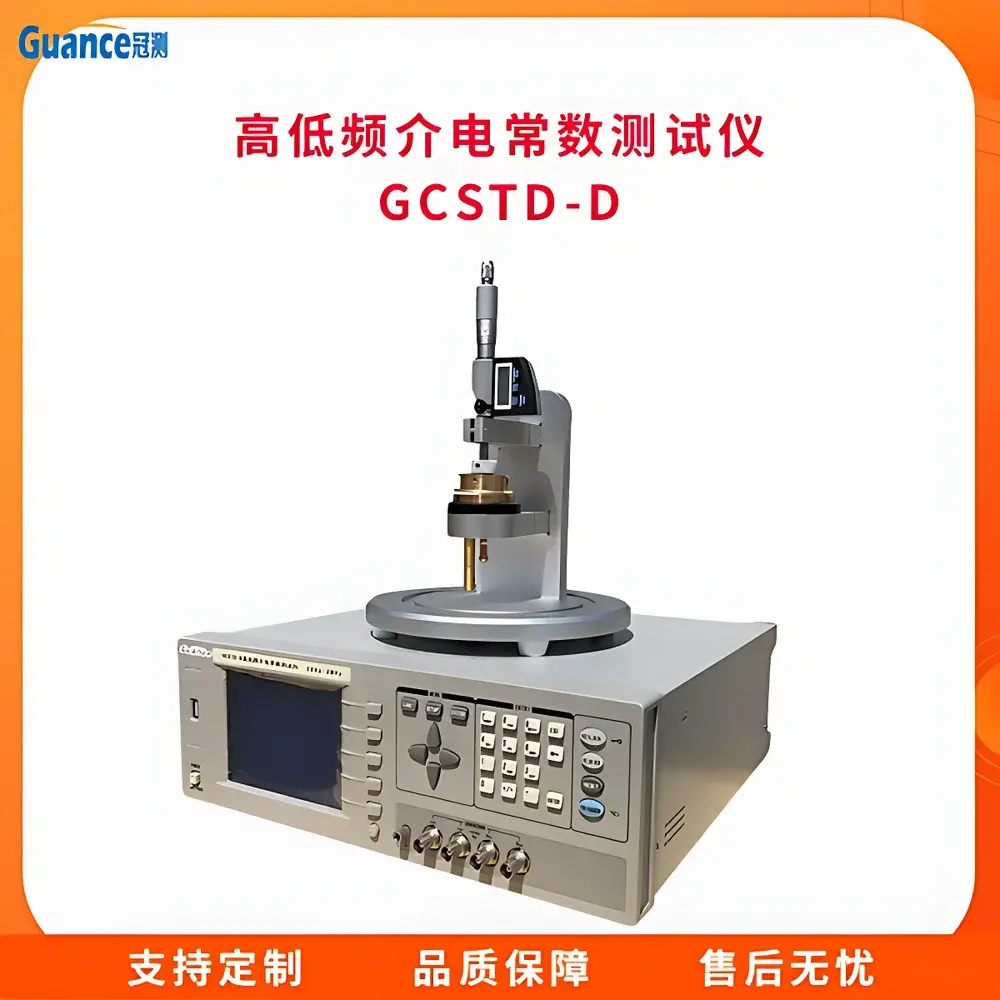
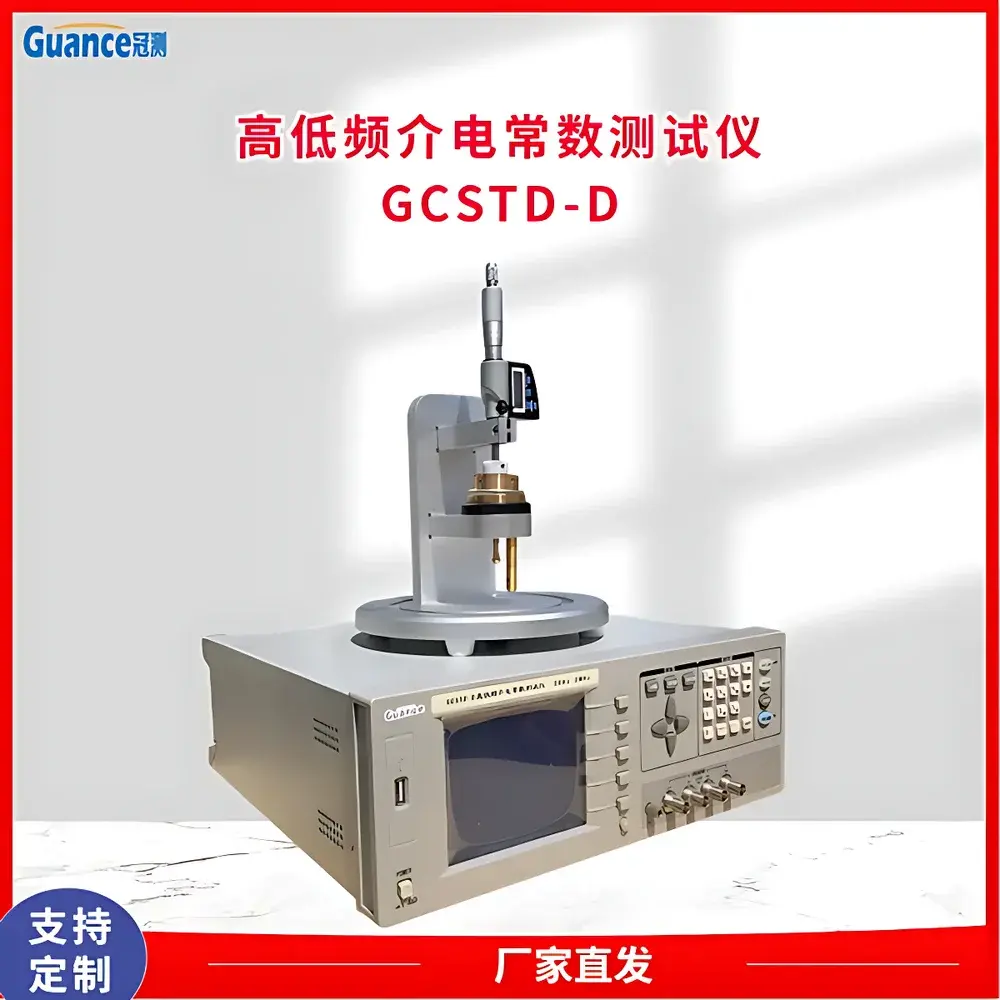
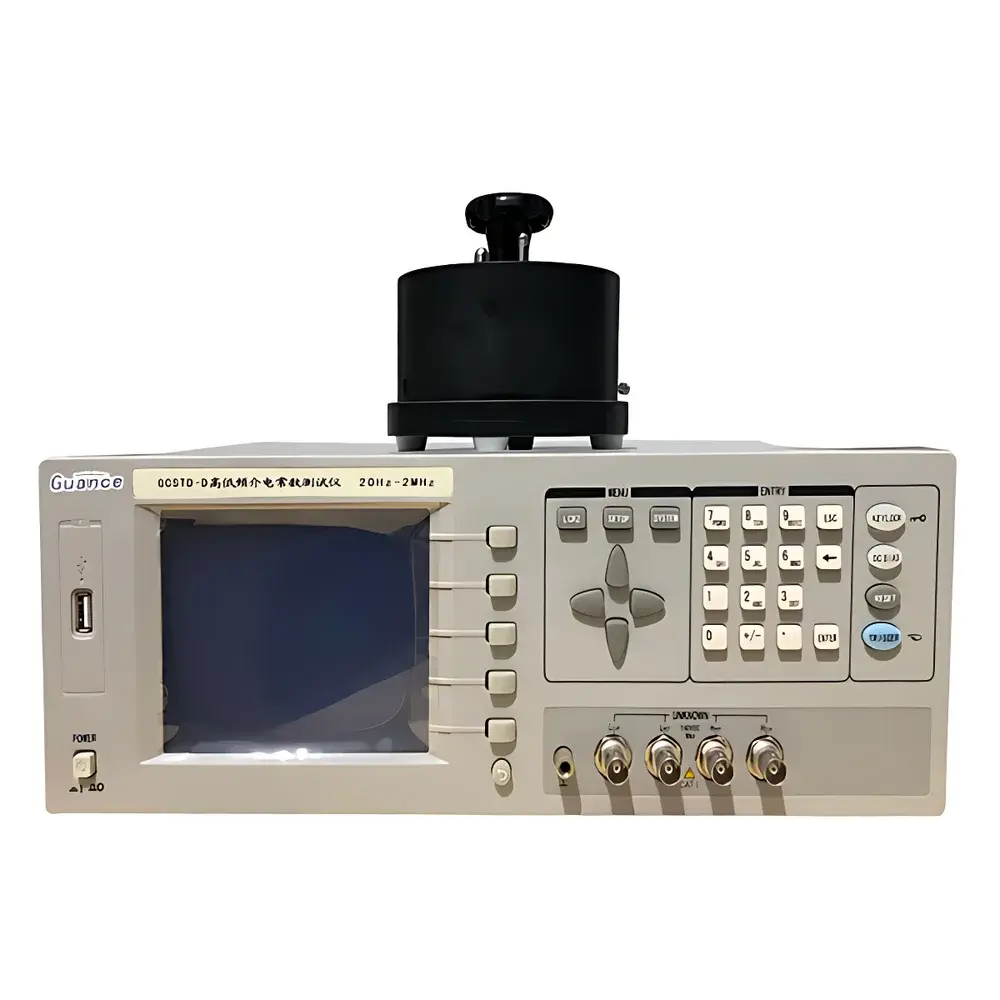
GuanCe GCSTD-D10 Broadband Dielectric Constant and Loss Tangent Analyzer
| Brand | GuanCe |
|---|---|
| Origin | Beijing, China |
| Manufacturer Type | Authorized Distributor |
| Product Origin | Domestic (PRC) |
| Model | GCSTD-D10 |
| Pricing | Available Upon Request |
| Frequency Range | 20 Hz – 2 MHz (10 mHz resolution) |
| Test Signal Level | 10 mV – 5 Vrms (1 mV step) |
| Basic Accuracy | ±0.1% |
| Measurement Speed | Up to 200 readings/sec |
| Display | 320 × 240 dot-matrix graphical LCD |
| Resolution | 5-digit |
| Impedance Parameters | 22 configurable combinations (e.g., C–D, C–Q, L–Q, R–X, Z–θ, etc.) |
| Electrode Options | Fixed parallel-plate electrodes (φ38 mm / φ50 mm standard), liquid cell (15 mL capacity), powder-specific electrode kits |
| Sample Types | Solids (flat or irregular), liquids, powders, pastes |
| Measurement Modes | Contact method (for uniform-thickness, smooth-surface specimens) |
| Compliance | GB/T 1409–2006, GB/T 1693–2007, ASTM D150, IEC 60250 |
| DC Bias | Internal ±10 V source |
| Signal Monitoring | Real-time V–I level monitoring |
| Scan Functions | 10-point list sweep, graphical frequency/level/DC-bias sweeps |
| Memory | 20 instrument setups |
| Interface | USB Host (firmware update), RS232, GPIB, Handler I/O |
| Language | English / Chinese selectable |
Overview
The GuanCe GCSTD-D10 Broadband Dielectric Constant and Loss Tangent Analyzer is a precision impedance spectroscopy platform engineered for the quantitative characterization of dielectric properties across a wide frequency spectrum—from power-frequency (20 Hz) through audio and radio frequencies up to 2 MHz. It operates on the principle of AC impedance analysis using a four-terminal-pair (Kelvin) measurement architecture, enabling high-fidelity extraction of complex permittivity (ε* = ε′ − jε″) and loss tangent (tan δ = ε″/ε′) under controlled electric field conditions. Designed for materials R&D laboratories, quality control departments, and academic research groups, the GCSTD-D10 supports standardized evaluation of insulating, semiconducting, and functional materials in compliance with GB/T 1409–2006 (equivalent to IEC 60250), GB/T 1693–2007, and ASTM D150. Its modular electrode system accommodates diverse physical forms—rigid solids, viscous liquids, granular powders, and soft pastes—without requiring sample metallization or geometric idealization.
Key Features
- Broadband frequency coverage from 20 Hz to 2 MHz with 10 mHz resolution, supporting both low-frequency polarization relaxation and high-frequency dipole response analysis.
- High-stability AC test signal generation (10 mV–5 Vrms, 1 mV step) with automatic level control (ALC) to maintain consistent field strength across variable sample impedances.
- Five-digit resolution and ±0.1% basic measurement accuracy traceable to NIST-calibrated reference standards.
- Up to 200 measurements per second—enabling rapid frequency sweeps and real-time process monitoring.
- Dual-mode electrode compatibility: contact-type parallel-plate electrodes (standard φ38 mm, optional φ50 mm), dedicated liquid cells (15 mL volume), and customizable powder electrodes for low-density or compressible media.
- Integrated DC bias source (±10 V, 100 mA) and external bias expansion capability (up to ±40 A via dual TH1776 current sources) for C–V profiling of semiconductors and field-dependent dielectric studies.
- Graphical sweep functions—including frequency, AC level, and DC bias sweeps—with on-screen Bode, Nyquist, and Cole–Cole plot rendering.
- Comprehensive parameter library: 22 impedance-derived quantities including capacitance (C), dissipation factor (D), quality factor (Q), conductance (G), susceptance (B), phase angle (θ), and complex modulus (M*).
Sample Compatibility & Compliance
The GCSTD-D10 accommodates heterogeneous sample geometries and physical states without compromising metrological integrity. Flat, polished solids are measured using the standard fixed parallel-plate configuration; irregular or temperature-sensitive specimens benefit from non-contact capacitance sensing modes. Liquid samples are evaluated in sealed, temperature-stabilized cells to minimize evaporation and interfacial artifacts. Powder electrodes employ adjustable pressure fixtures and guard-ring designs to suppress fringing fields and ensure volumetric homogeneity. All measurement protocols align with international standards governing dielectric characterization: GB/T 1409–2006 for electrical insulating materials, GB/T 1693–2007 for vulcanized rubber, and ASTM D150/IEC 60250 for solid dielectrics. Data records include full metadata (frequency, voltage, temperature, electrode type, calibration timestamp), supporting GLP-compliant reporting and audit readiness.
Software & Data Management
Instrument control, data acquisition, and post-processing are managed via an embedded real-time OS with dual-language UI (English/Chinese). Raw impedance data are exportable in CSV and TXT formats for integration into MATLAB, Python (NumPy/SciPy), or commercial modeling tools (e.g., COMSOL Multiphysics). The built-in 20-slot setup memory retains user-defined test sequences, electrode calibrations, and limit-check configurations. USB Host port enables firmware updates and direct data transfer to flash drives. Optional PC software provides advanced fitting routines—including Debye, Cole–Cole, and Havriliak–Negami models—for extracting relaxation time distributions and activation energies. All data files embed digital signatures and timestamps compliant with FDA 21 CFR Part 11 requirements when paired with network-authenticated user accounts.
Applications
- Dielectric spectroscopy of polymer composites, ceramic substrates, and thin-film coatings for permittivity dispersion and interfacial polarization analysis.
- Quality assurance of capacitor dielectrics (e.g., BaTiO₃, Al₂O₃), assessing batch-to-batch consistency in ε′ and tan δ across operational frequency bands.
- C–V profiling of semiconductor wafers and MOS structures to extract dopant profiles, oxide thickness, and interface trap density.
- Characterization of ferroelectric and relaxor materials—quantifying Curie–Weiss behavior, hysteresis loop dynamics, and domain switching losses.
- Electrochemical impedance spectroscopy (EIS) pre-screening of battery electrolytes and solid-state ion conductors (e.g., Li₇La₃Zr₂O₁₂).
- Non-destructive evaluation of moisture ingress, aging, or thermal degradation in epoxy-encapsulated electronics and fiber-reinforced laminates.
FAQ
What standards does the GCSTD-D10 comply with for dielectric testing?
It fully supports GB/T 1409–2006, GB/T 1693–2007, ASTM D150, and IEC 60250 for measurement of permittivity and loss tangent.
Can the instrument measure powdered samples without pelletization?
Yes—dedicated powder electrodes with adjustable compaction force and guarded geometry eliminate the need for sintering or binder addition.
Is temperature control integrated into the system?
Temperature control is not built-in but the instrument features analog and digital I/O ports compatible with third-party environmental chambers and thermocouple feedback modules.
How is calibration maintained over time and varying test conditions?
The system supports full two-port open/short/load calibration at user-defined frequencies, plus daily verification using NIST-traceable ceramic and air-dielectric standards.
Does the GCSTD-D10 support automated pass/fail sorting in production environments?
Yes—the internal comparator supports 10-bin classification based on any measured parameter, with Handler interface outputs for integration into automated test stations.



