
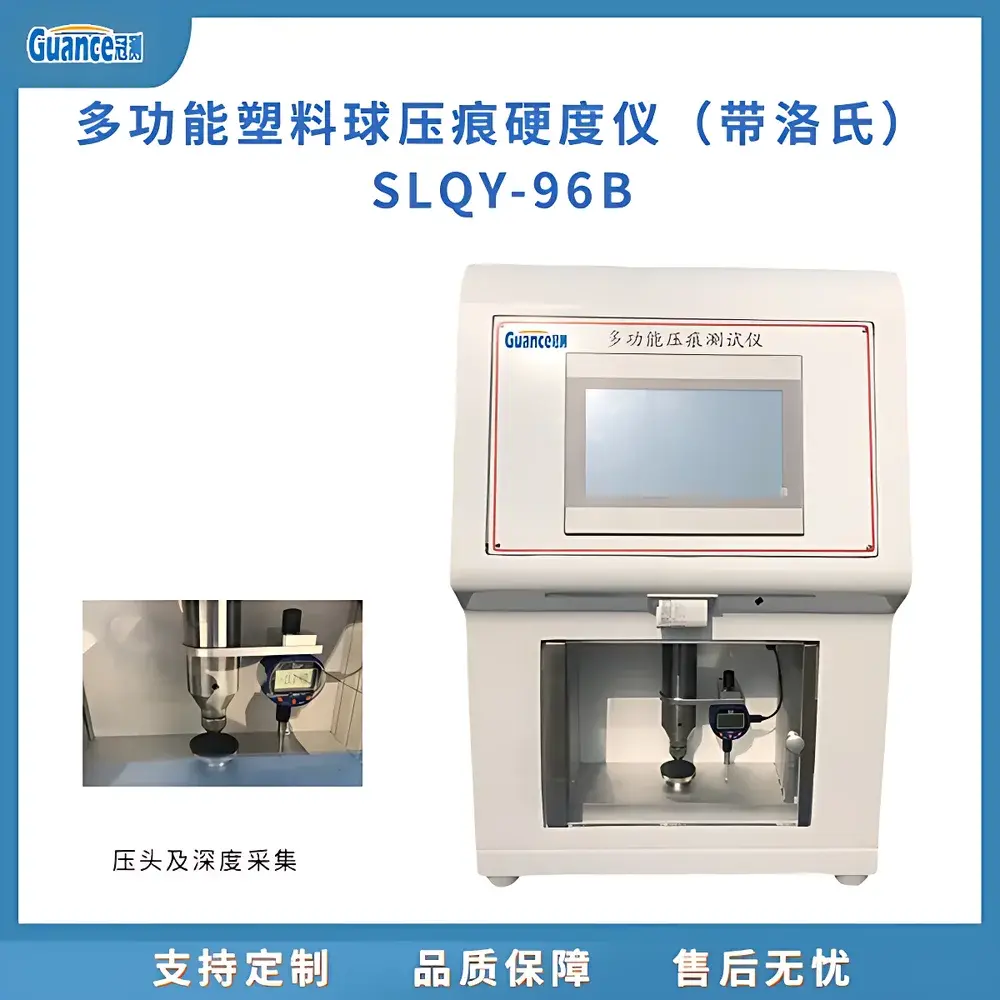
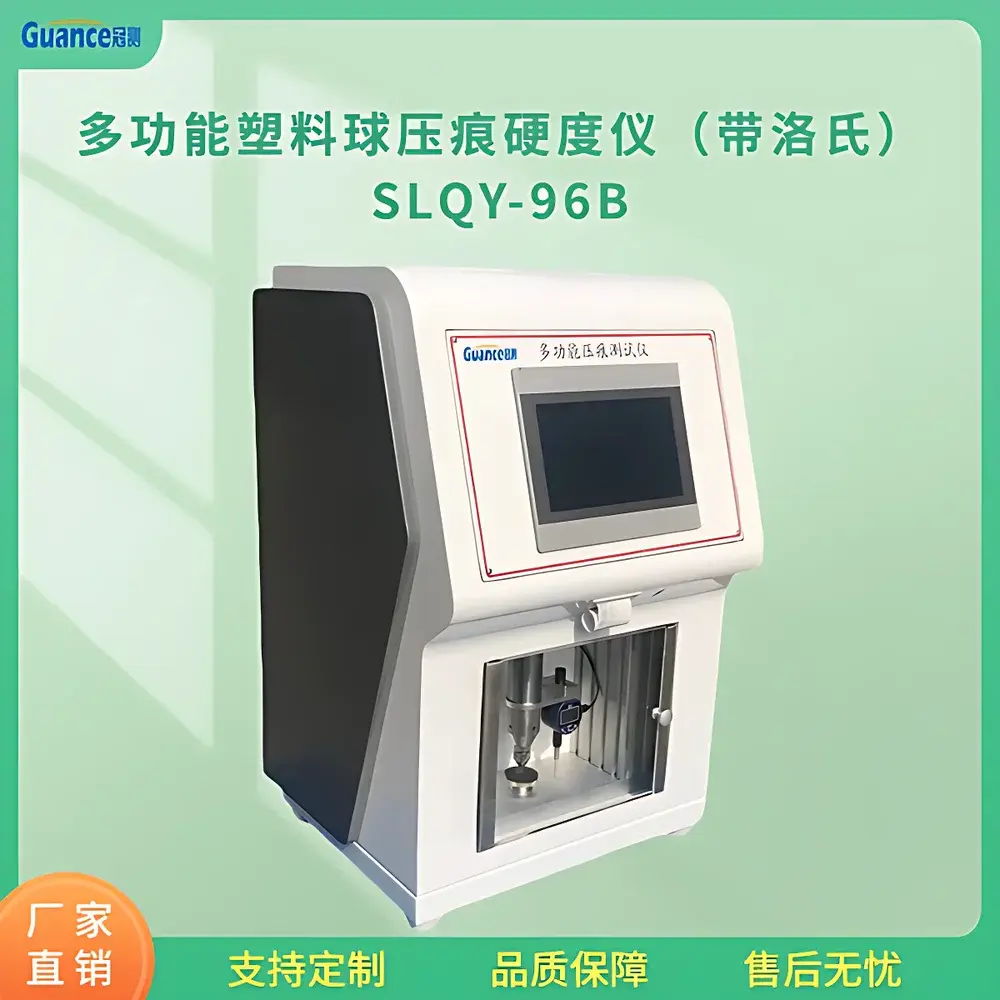
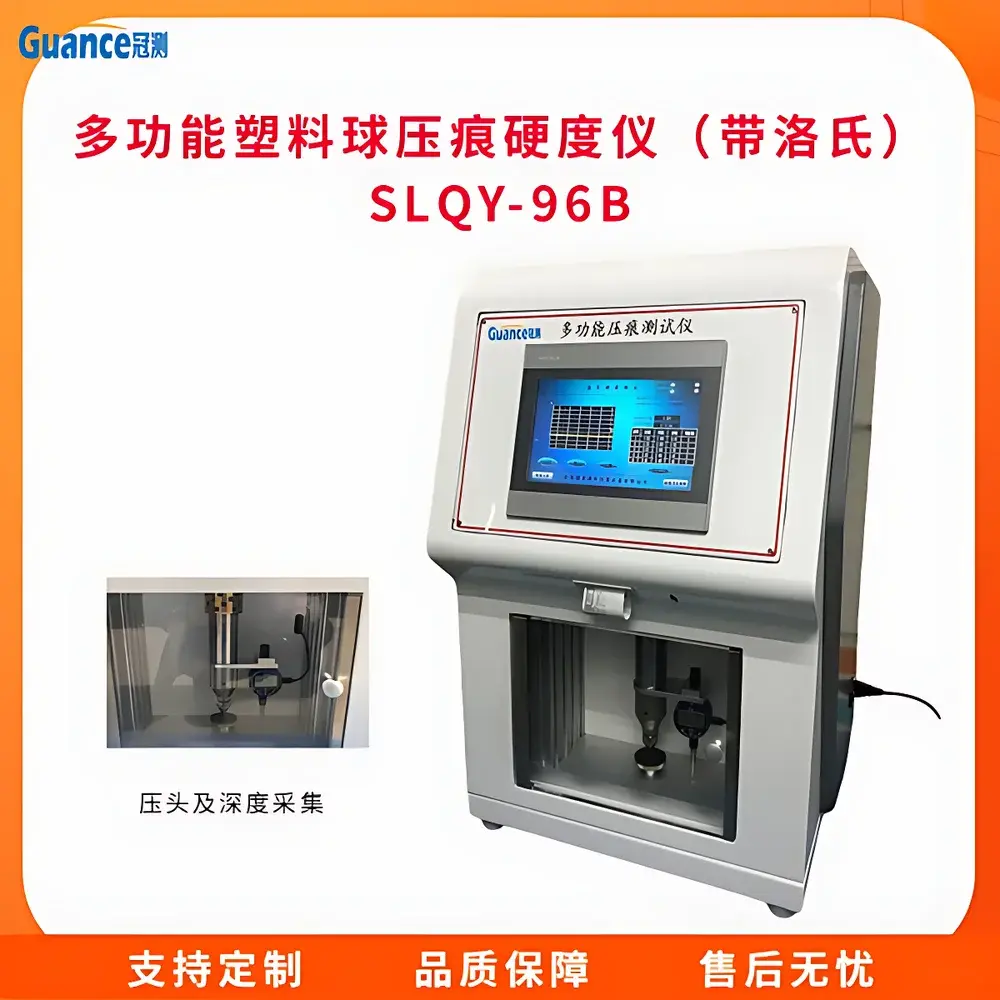
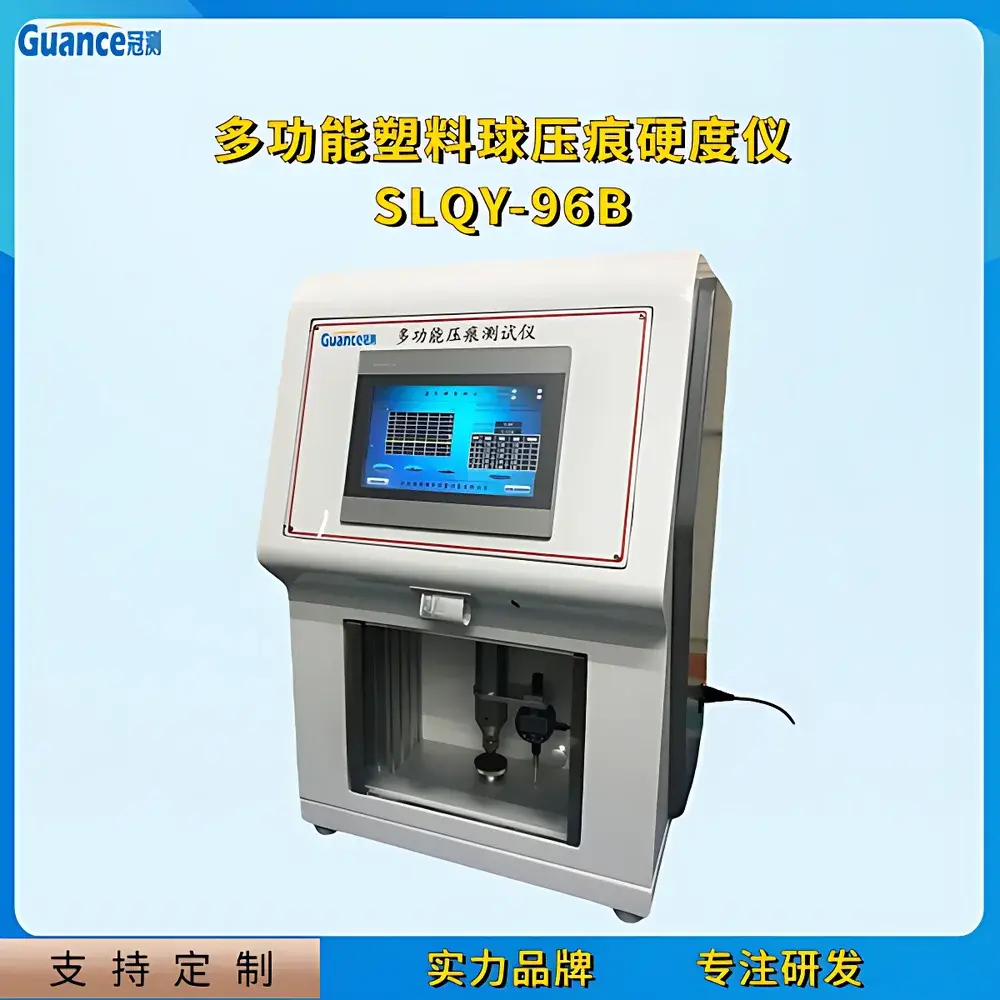
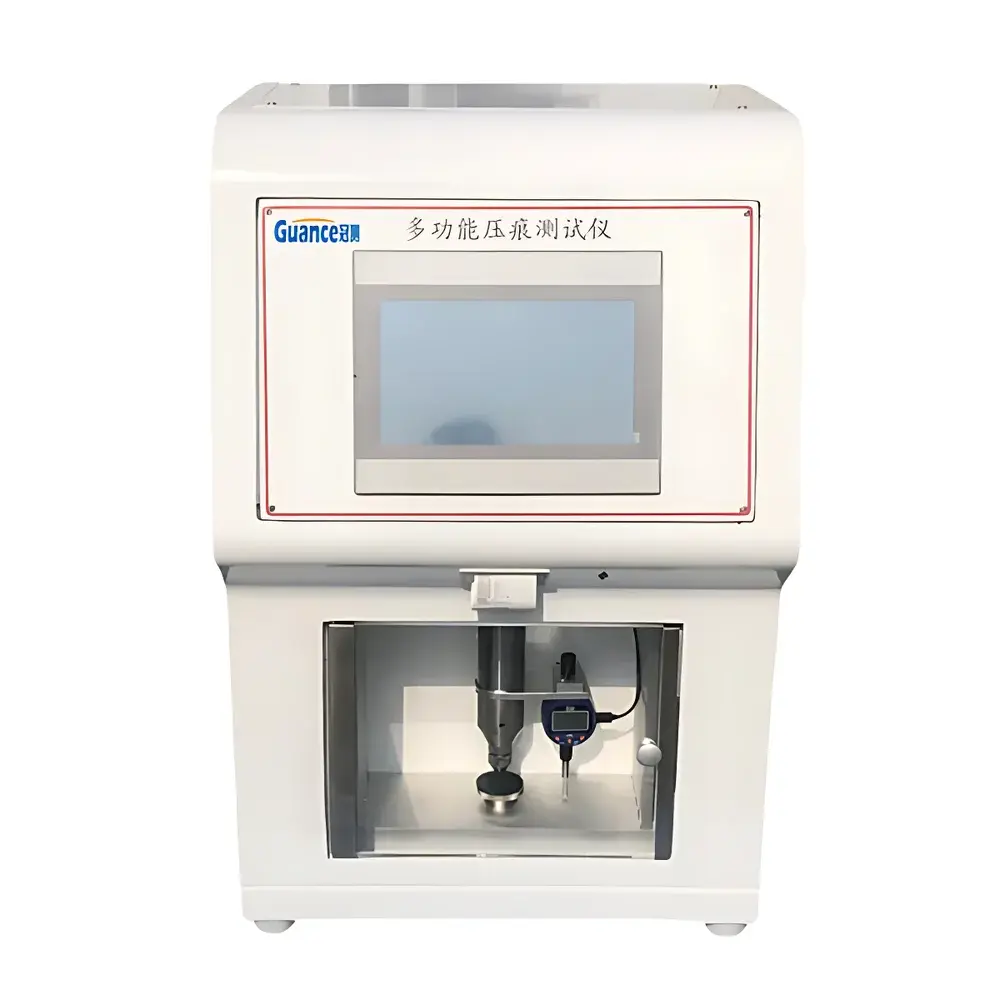
GuanCe Instruments SLQY-96B3 Fully Automated Ball Indentation Hardness Tester
| Brand | GuanCe Instruments |
|---|---|
| Origin | Beijing, China |
| Manufacturer Type | Authorized Distributor |
| Country of Origin | China |
| Model | SLQY-96B3 |
| Instrument Type | Rockwell Hardness Tester |
| Ball Indentation Load | 9.8 N |
| Total Test Forces | 49 N, 132 N, 358 N, 612 N, 961 N |
| Indentation Depth Resolution | 0.001 mm |
| Display Interface | 10-inch capacitive touch screen |
| Data Output | Integrated thermal micro-printer |
| Test Modes | Ball indentation, Rockwell hardness, compression resistance test |
Overview
The GuanCe Instruments SLQY-96B3 Fully Automated Ball Indentation Hardness Tester is a precision-engineered instrument designed for standardized mechanical characterization of thermoplastic polymers, elastomers, and rigid composite materials under ISO 2039-1, ASTM D785, and GB/T 3398.1–2018. Unlike conventional Rockwell hardness testers optimized for metals, the SLQY-96B3 implements a controlled-force ball indentation methodology—applying calibrated spherical indenters (typically 5 mm or 10 mm diameter steel balls) under defined static loads to measure material resistance to localized plastic deformation. Its architecture integrates closed-loop load application, high-stability frame mechanics, and real-time displacement feedback via a metrology-grade linear variable differential transformer (LVDT) sensor with sub-micron resolution. This enables direct quantification of indentation depth after specified dwell times (e.g., 30 s per ISO 2039-1), from which ball indentation hardness (HBW) is derived as HBW = F / (πD·h), where F is applied force (N), D is indenter diameter (mm), and h is residual indentation depth (mm). The system operates within a temperature-controlled laboratory environment (23 ± 2 °C) to ensure compliance with ISO 293 and ASTM D618 conditioning requirements.
Key Features
- Fully automated test sequence: Parameter configuration, force application, dwell timing, unloading, depth measurement, calculation, and indenter retraction are executed without manual intervention.
- 10-inch industrial-grade capacitive touchscreen HMI with intuitive GUI supporting multilingual interface (English, Chinese, Spanish), password-protected user levels, and audit-ready parameter logging.
- High-fidelity displacement sensing using a traceable LVDT transducer with 0.001 mm resolution and ≤ ±0.002 mm linearity error over full 5 mm stroke range.
- Five selectable total test forces (49 N, 132 N, 358 N, 612 N, 961 N) generated via precision electromechanical loading mechanism compliant with ISO 6508-2 force verification tolerances (±1.0%).
- Integrated thermal micro-printer providing immediate hard-copy output of test ID, date/time stamp, load value, measured depth, calculated HBW, and operator ID.
- Three standardized test modes: Ball indentation (ISO 2039-1), Rockwell hardness (ASTM E18, scale B/C for plastics), and compression resistance (custom protocol aligned with ISO 604).
Sample Compatibility & Compliance
The SLQY-96B3 accommodates flat, parallel-surface specimens with minimum thickness ≥ 4× indentation depth (per ISO 2039-1 Clause 6.2) and lateral dimensions ≥ 50 mm × 50 mm. It supports rigid plastics (e.g., PMMA, PC, ABS), semi-crystalline thermoplastics (PP, PE), vulcanized rubber compounds, and fiber-reinforced composites. All mechanical and electrical components conform to CE marking directives (2014/30/EU EMC, 2014/35/EU LVD), and software logic complies with GLP principles for data integrity. Test reports include metadata required for ISO/IEC 17025 accreditation—such as equipment ID, calibration certificate reference, environmental conditions, and operator signature field.
Software & Data Management
Firmware v3.2 embeds embedded Linux-based control logic with non-volatile memory for storing ≥ 5000 test records. Data export is supported via USB 2.0 to CSV or PDF formats; no proprietary software installation is required on host PCs. Audit trail functionality logs all parameter changes, test starts/stops, and calibration events with timestamp and user ID. While not natively 21 CFR Part 11 compliant, the system supports integration into validated LIMS environments through RS-232 or Ethernet TCP/IP protocols (optional module), enabling electronic signature capture and role-based access control when deployed in regulated QC laboratories.
Applications
- Quality assurance of injection-molded polymer parts in automotive interior trim and medical device housings.
- Batch-to-batch consistency verification of polyolefin sheets used in food packaging films.
- Research evaluation of creep recovery behavior in thermoplastic elastomers under sustained indentation load.
- Comparative hardness profiling across multi-layer coextruded structures (e.g., barrier films).
- Pre-compliance screening for ISO 10350-1 mechanical property declarations in technical datasheets.
FAQ
What standards does the SLQY-96B3 support for ball indentation testing?
It fully implements ISO 2039-1:2019 and GB/T 3398.1–2018, including prescribed dwell time, temperature conditioning, and calculation methodology.
Can the instrument perform Rockwell hardness tests on metallic samples?
No—the SLQY-96B3 is configured exclusively for polymeric and elastomeric materials per ASTM D785 and ISO 2039-1; it lacks the diamond cone indenter and higher-force range required for metallic Rockwell scales.
Is calibration certification included with delivery?
Yes—a factory-issued calibration report traceable to CNAS-accredited national standards (force: ±0.5%, displacement: ±0.001 mm) is supplied with each unit.
How is data integrity ensured during long-term deployment?
All test records are stored with cyclic redundancy check (CRC) validation; firmware includes automatic checksum verification at boot and write cycles.
Does the system support remote diagnostics or firmware updates?
Firmware updates are performed locally via USB drive; remote diagnostic capability is available through optional Ethernet-enabled service module (order code: SLQY-ETH-SVC).



