
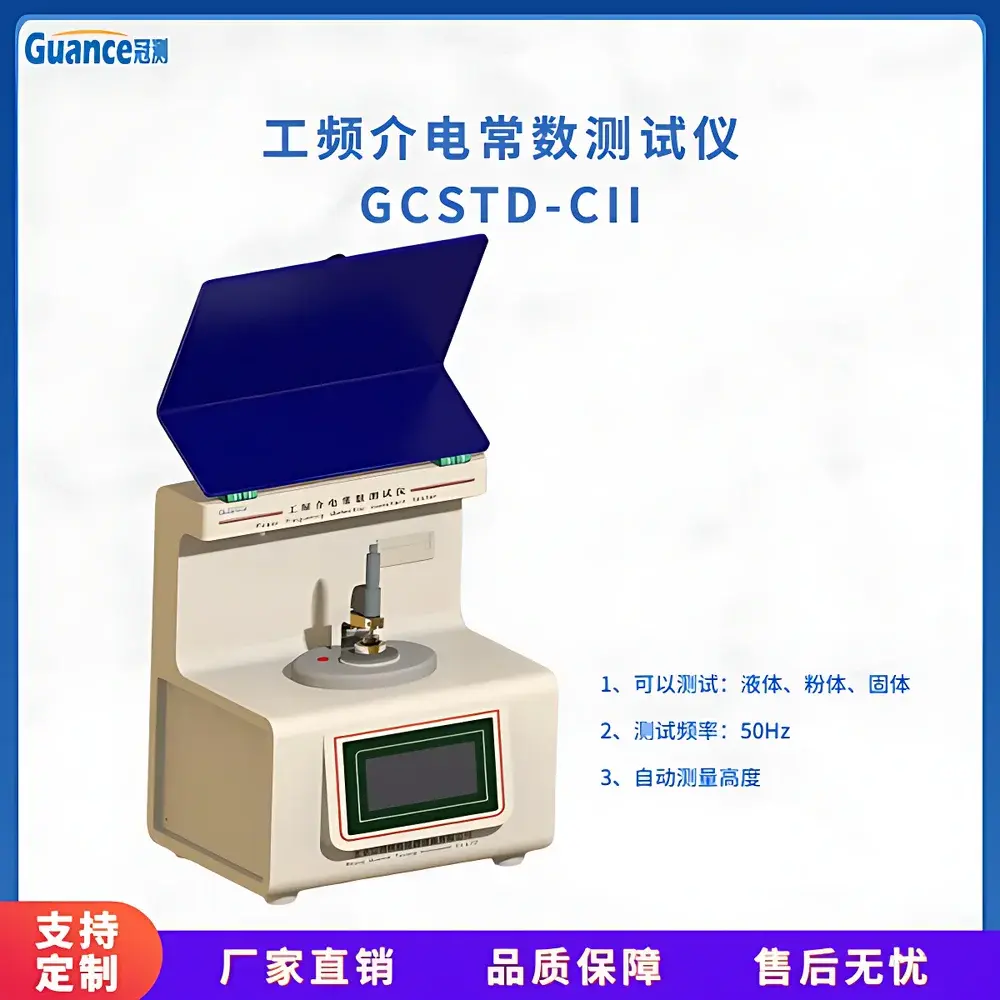
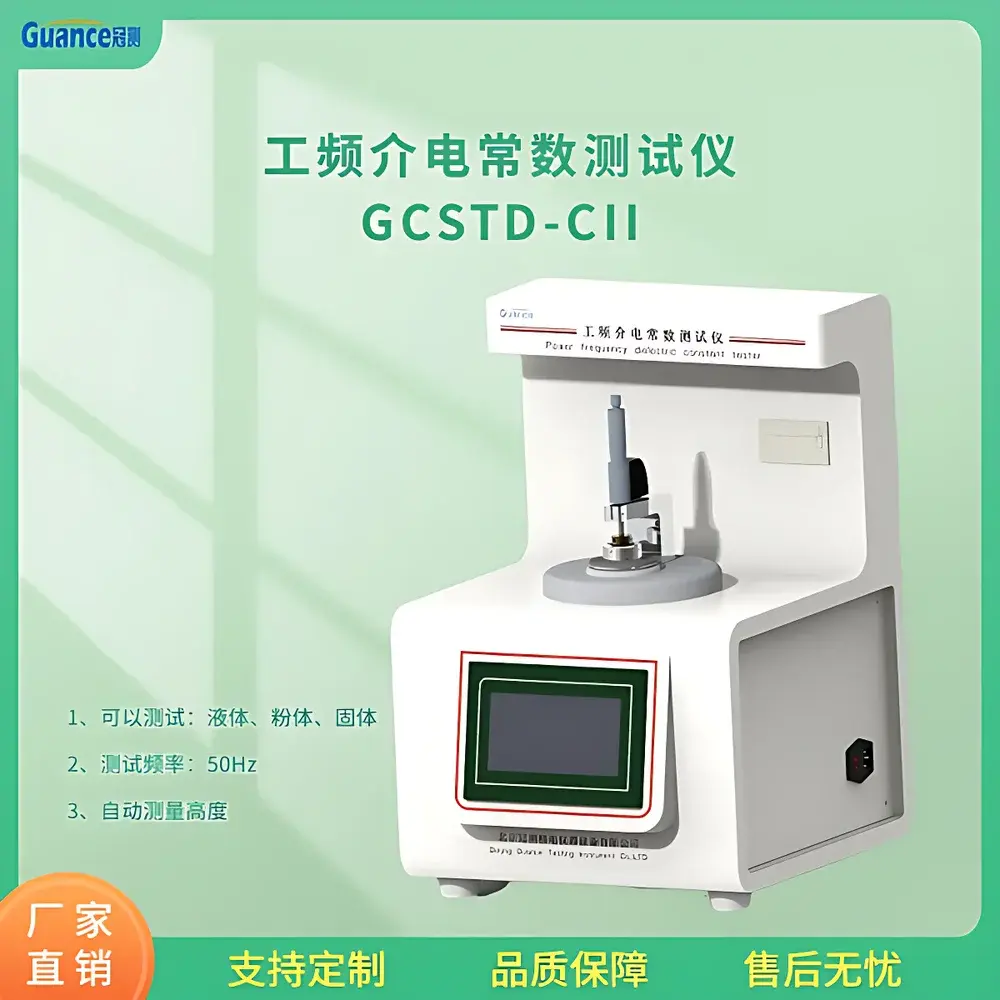
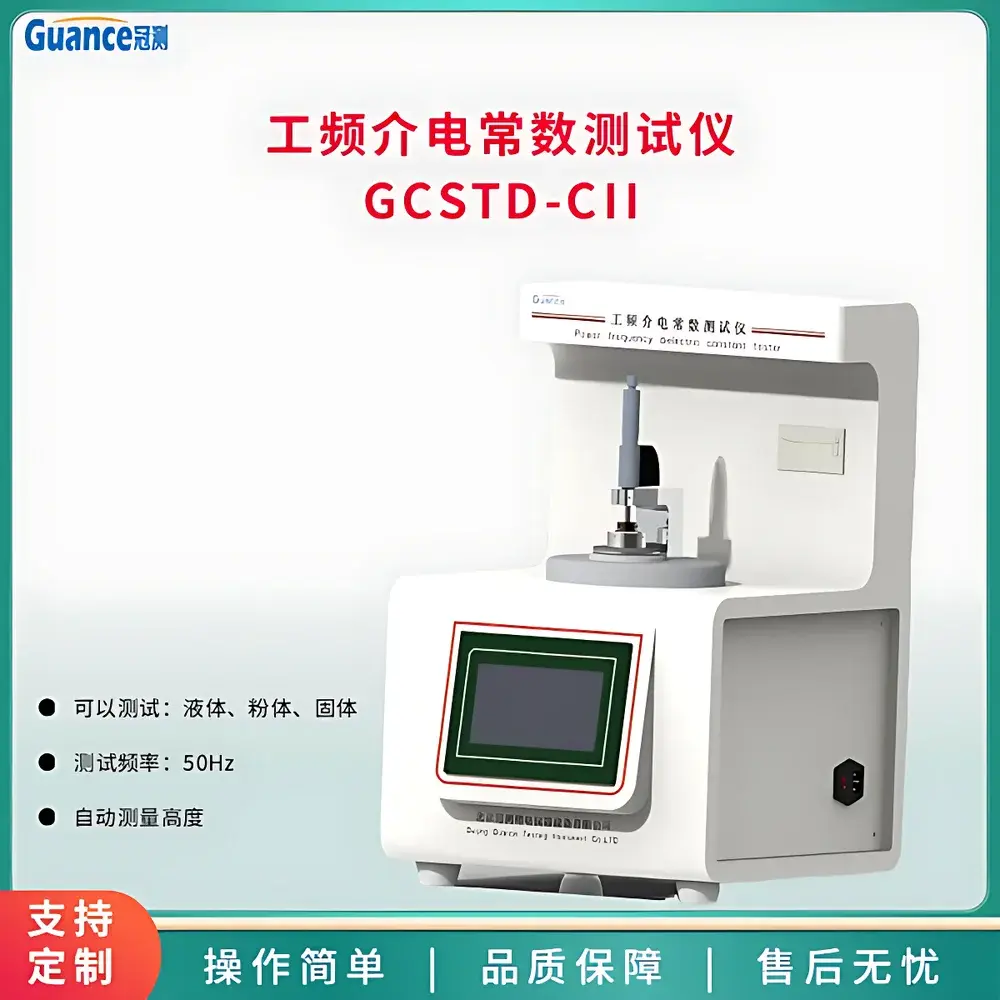
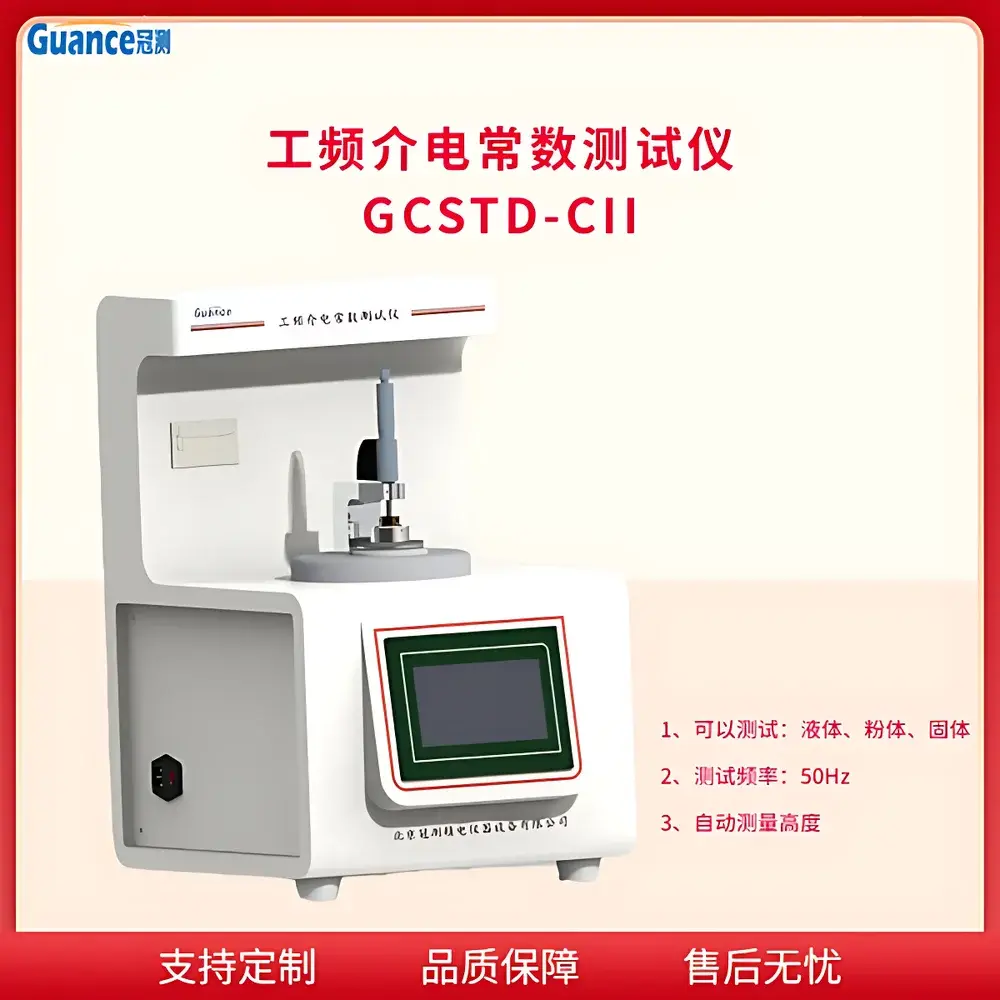
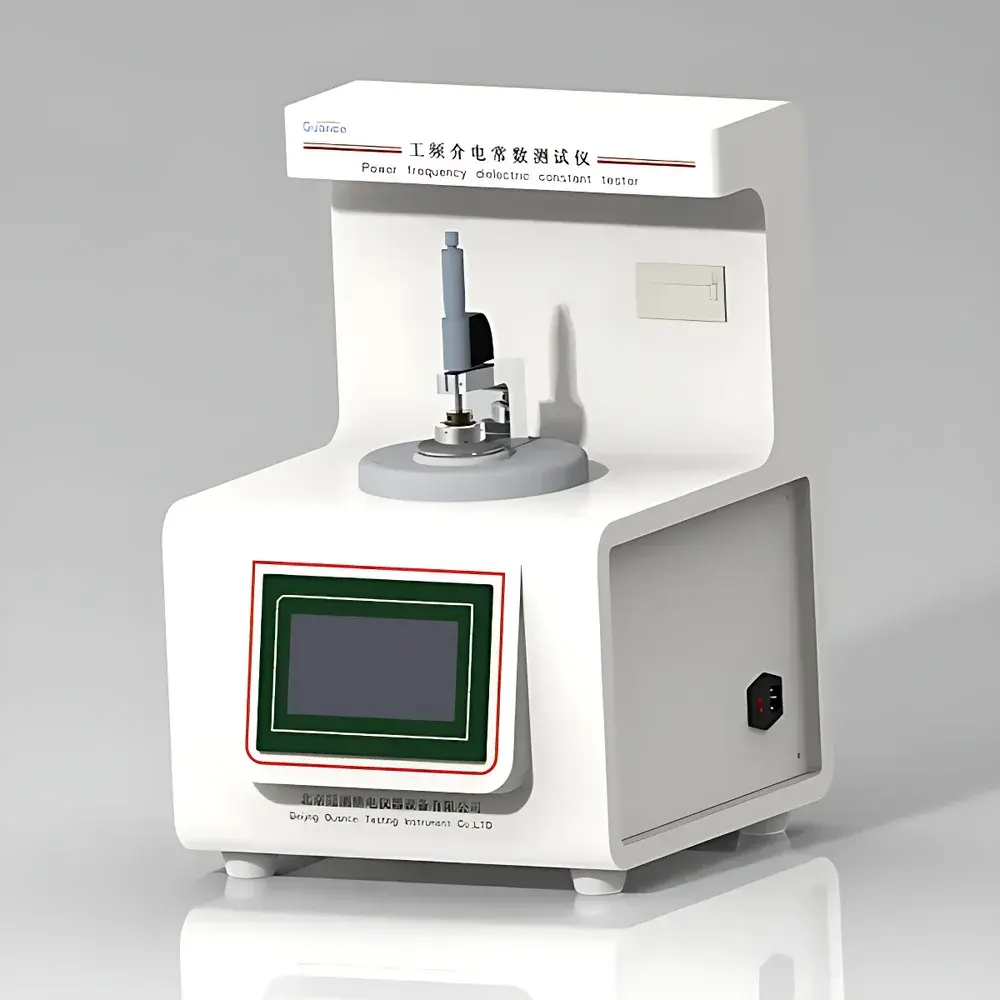
GuanCe Instruments GCSTD-CII3 Power Frequency Dielectric Constant and Dissipation Factor Analyzer
| Brand | GuanCe Instruments |
|---|---|
| Origin | Guangdong, China |
| Manufacturer Type | Authorized Distributor |
| Country of Origin | China |
| Model | GCSTD-CII3 |
| Price | USD 1,780 (FOB Guangdong) |
| Standard Compliance | GB/T 1409–2006, GB/T 5654–2007, GB/T 21216–2007, GB/T 1693–2007, GB/T 5594.4–1985 |
| Measurement Principle | Schering Bridge (High-Voltage AC Bridge) with Variable-Frequency Excitation |
| Test Voltage Range | 2.5 kV – 10 kV (5-step adjustable), Integrated High-Voltage Source & Measurement Unit |
| Measurement Modes | Direct Connection, Reverse Connection, External HV Source Mode |
| Accuracy | tanδ: ±(1% × reading + 0.09%), Cx: ±(1.5% × reading + 1 pF) |
| Resolution | tanδ: 0.01%, Cx: 0.1 pF |
| Sample Compatibility | Solid insulators (Φ50 mm / Φ100 mm / Φ38 mm discs), liquid dielectrics (using standard oil cup), cables, bushings, transformers, current/voltage transformers, power capacitors |
| Operating Environment | 10–30 °C, 20–80% RH |
| Power Input | 220 V ±10%, 50 Hz |
| Dimensions (L×W×H) | 470 × 320 × 360 mm |
| Weight | 16 kg |
| Output Capacity | 1.5 kVA |
| Display | Large-backlight monochrome LCD with Chinese menu interface |
| Protection | Overcurrent trip, arc detection, short-circuit/flashover safeguard |
| Data Output | Built-in thermal printer, RS232 interface for PC connectivity |
Overview
The GuanCe Instruments GCSTD-CII3 Power Frequency Dielectric Constant and Dissipation Factor Analyzer is an integrated high-voltage AC bridge instrument engineered for precise determination of dielectric permittivity (εr) and loss tangent (tan δ) of solid and liquid insulating materials under power-frequency (50 Hz) excitation. It operates on the principle of the Schering bridge — a classical four-arm AC impedance measurement configuration — enhanced with digital signal processing, variable-frequency excitation, and microcontroller-based auto-balancing algorithms. Unlike broadband or resonance-based systems, the GCSTD-CII3 delivers traceable, low-noise measurements at nominal system frequency (50 Hz), making it suitable for routine quality control, acceptance testing, and diagnostic evaluation in electrical equipment manufacturing, power utilities, and material R&D laboratories. Its built-in high-voltage source (2.5–10 kV, five-step selectable) eliminates dependency on external transformers during field or lab use, while its anti-interference architecture — based on adaptive frequency tuning and synchronous demodulation — ensures stable readings even in electrically noisy substations or industrial test bays.
Key Features
- Integrated high-voltage generator and precision bridge measurement unit in a single compact chassis (470 × 320 × 360 mm, 16 kg)
- Variable-frequency excitation (centered at 50 Hz) to suppress ambient electromagnetic interference from nearby busbars, switchgear, or welding equipment
- Three operational modes: direct connection (for grounded specimens), reverse connection (for ungrounded or floating samples), and external HV source mode (for compatibility with existing test transformers)
- Onboard thermal printer for immediate hardcopy output of test reports including date/time stamp, test voltage, tan δ, Cx, and pass/fail status per GB/T 5654–2007
- Overcurrent and flashover protection circuitry with automatic shutdown and fault logging to preserve instrument integrity during specimen breakdown
- High-resolution display (6-digit internal processing, 4-digit LCD readout) with intuitive Chinese-language menu navigation and real-time waveform feedback
- Pre-calibrated internal reference capacitor and digitally stabilized HV output ensure long-term repeatability without periodic recalibration under controlled environmental conditions (10–30 °C, 20–80% RH)
Sample Compatibility & Compliance
The GCSTD-CII3 supports standardized geometries defined in national and industry specifications: solid dielectric discs of Φ38 mm, Φ50 mm, and Φ100 mm per GB/T 1693–2007 and GB/T 1409–2006; liquid samples tested using IEC 60247-compliant oil cups (e.g., ASTM D924-type); and high-voltage components including bushings, cable terminations, and transformer windings via shielded test leads. All measurement protocols align with metrological requirements for electrical insulation characterization under GLP-aligned laboratory practices. The instrument’s uncertainty budget — validated against NIM-traceable standards — satisfies the reporting thresholds required by GB/T 5654–2007 for transformer oil certification and GB/T 21216–2007 for conductive/lossy liquid evaluation. While not FDA 21 CFR Part 11 compliant out-of-the-box, audit trail functionality can be enabled via optional RS232-linked data acquisition software meeting ISO/IEC 17025 documentation requirements.
Software & Data Management
Data export is supported via RS232 serial interface to Windows-based host applications (e.g., LabVIEW, Excel-compatible CSV exporters). Firmware includes configurable report templates aligned with GB-standard test record formats, including fields for operator ID, sample ID, ambient temperature/humidity, applied voltage, measured Cx, tan δ, and calculated εr. Raw measurement logs are timestamped and stored in non-volatile memory for up to 500 test cycles. Optional PC software provides statistical analysis (mean, SD, trend charts), batch comparison, and PDF report generation with digital signature support. All firmware updates are delivered via secure USB dongle and require password-authenticated installation to maintain configuration integrity.
Applications
- Quality assurance of polymer-based insulators (epoxy, silicone rubber, polyethylene) in cable and bushing production lines
- Condition monitoring of in-service transformer oil — detecting oxidation, moisture ingress, or particulate contamination through progressive tan δ elevation
- R&D evaluation of ceramic dielectrics for high-voltage capacitors per GB/T 5594.4–1985
- Acceptance testing of cast-resin dry-type transformers per IEC 60076-3 and GB 1094.3
- Comparative screening of nanocomposite insulation materials for improved dielectric strength and reduced loss
- Calibration verification of field-deployed portable tan δ testers using reference standards traceable to provincial metrology institutes
FAQ
What standards does the GCSTD-CII3 comply with?
It fully implements test methodologies specified in GB/T 1409–2006, GB/T 5654–2007, GB/T 21216–2007, GB/T 1693–2007, and GB/T 5594.4–1985.
Can it measure both solid and liquid samples?
Yes — with appropriate fixtures: parallel-plate electrodes for solids (Φ38/50/100 mm), and standardized oil cups (e.g., ASTM D924 geometry) for liquids.
Is external calibration required annually?
No — the internal reference capacitor and HV source are factory-trimmed and stable over time; however, annual verification against a certified reference standard is recommended per ISO/IEC 17025.
Does it support automated pass/fail judgment per GB limits?
Yes — user-defined threshold values for tan δ and Cx can be programmed, with visual and audible alerts upon limit violation.
What safety certifications does the unit carry?
It conforms to GB 4793.1–2007 (Safety requirements for electrical equipment for measurement, control, and laboratory use) and includes double-insulated HV output, earth leakage monitoring, and interlocked enclosure access.



