
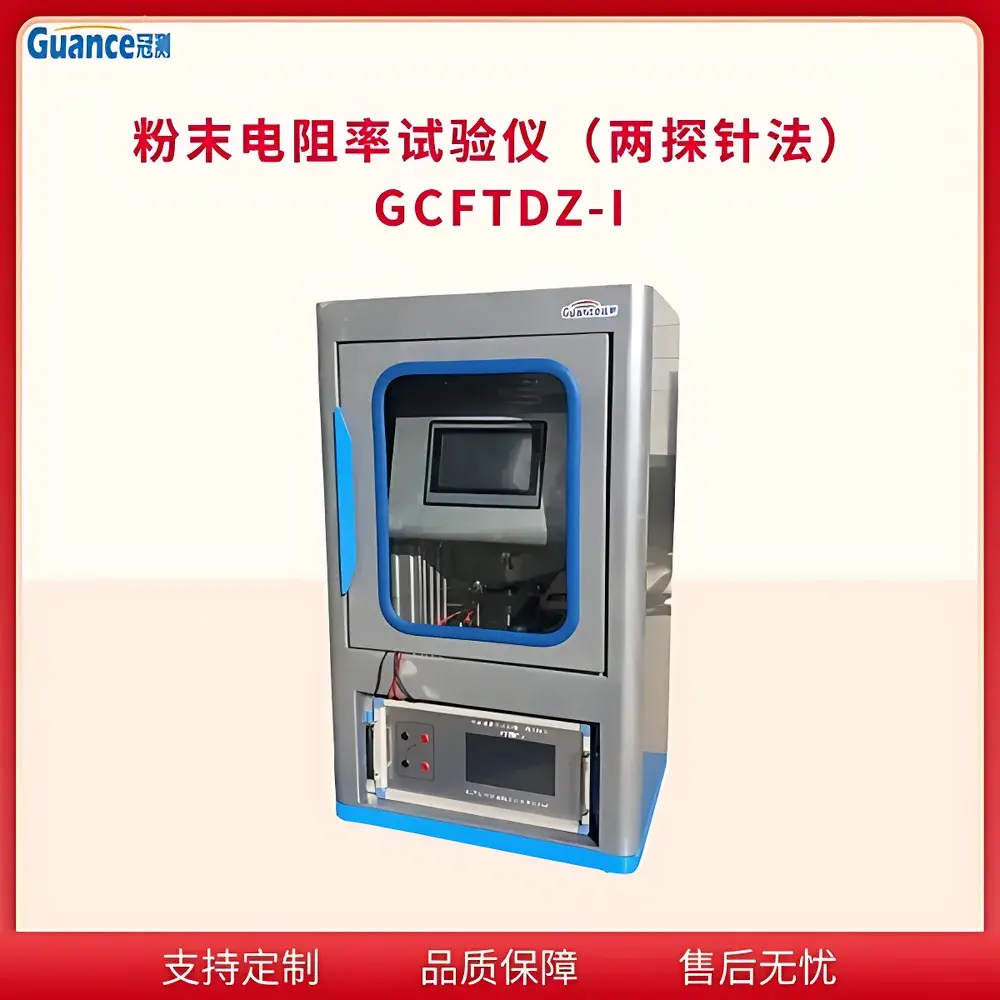
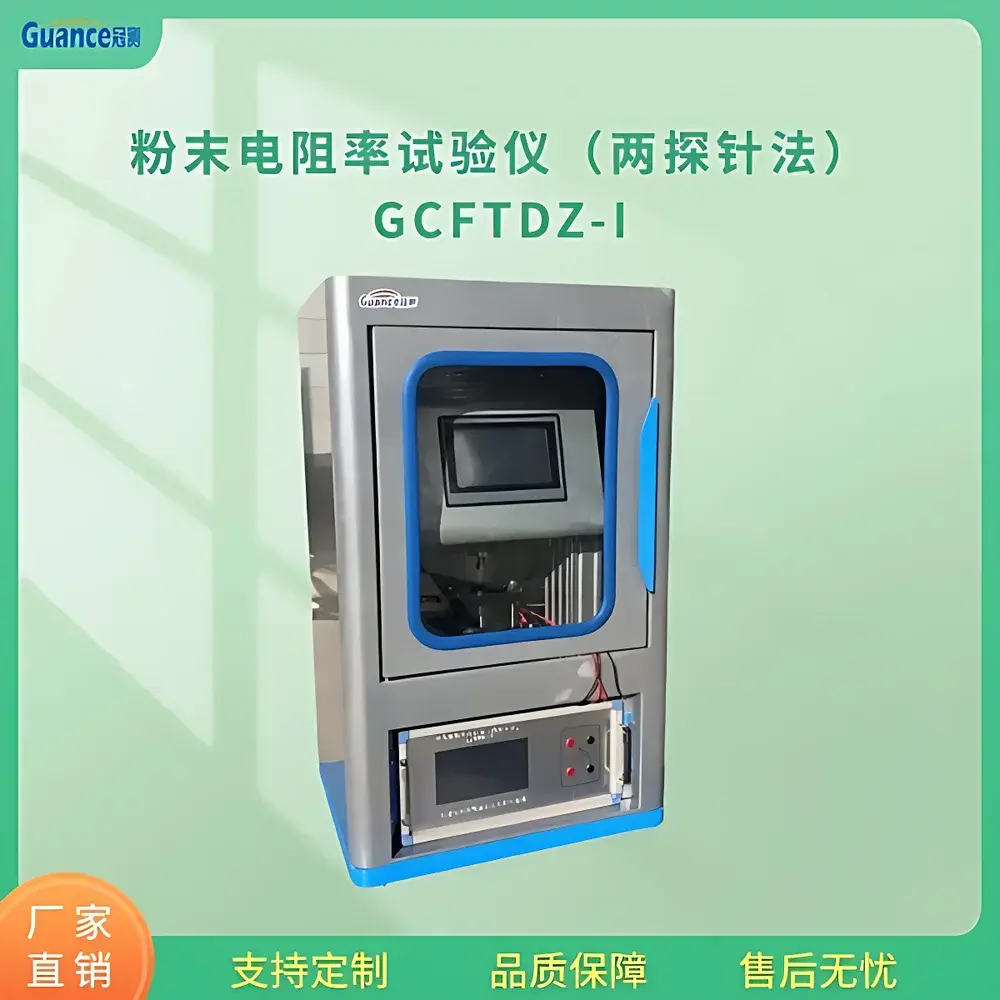
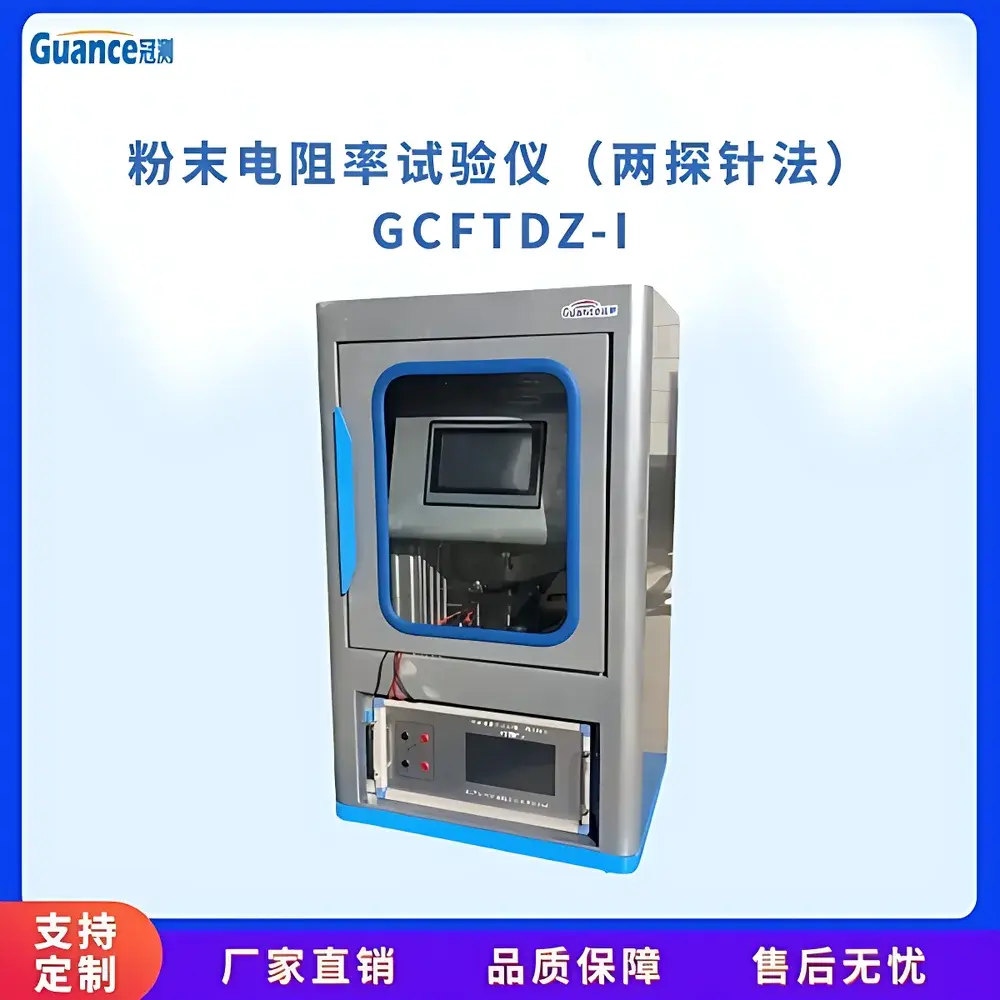
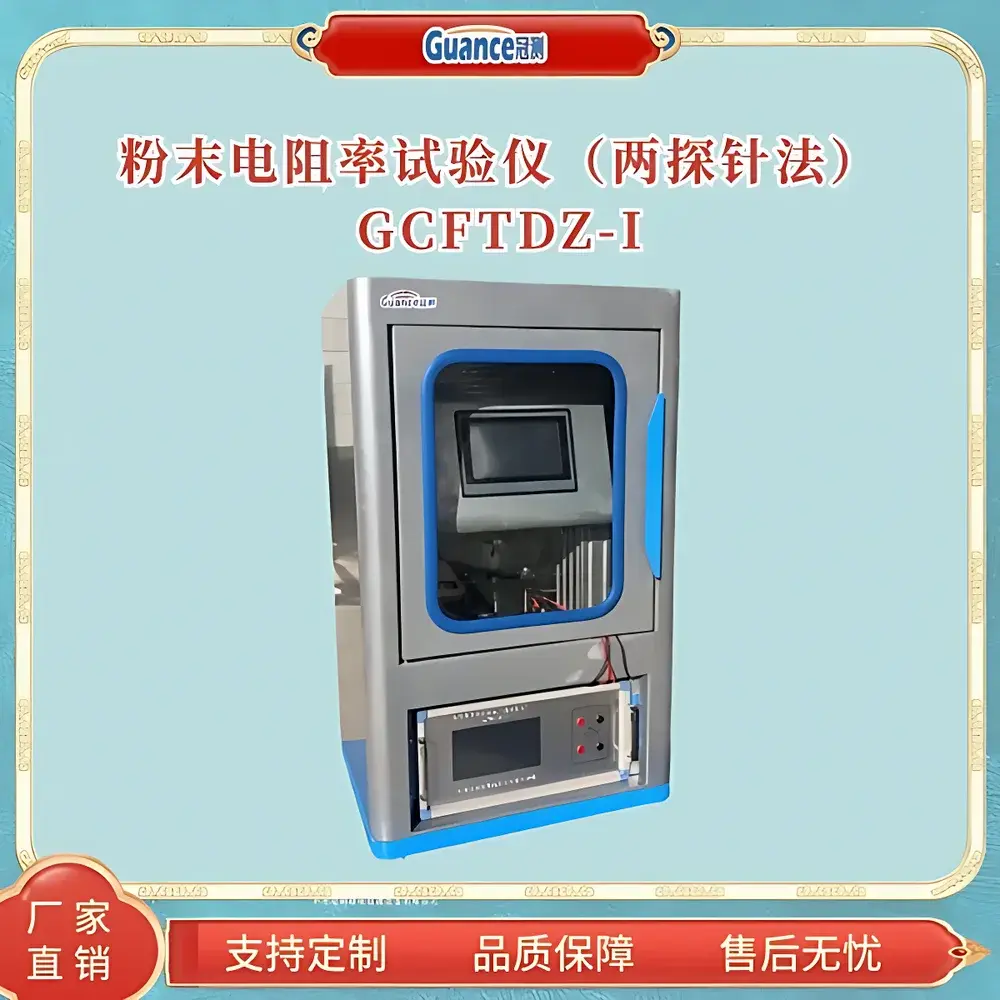
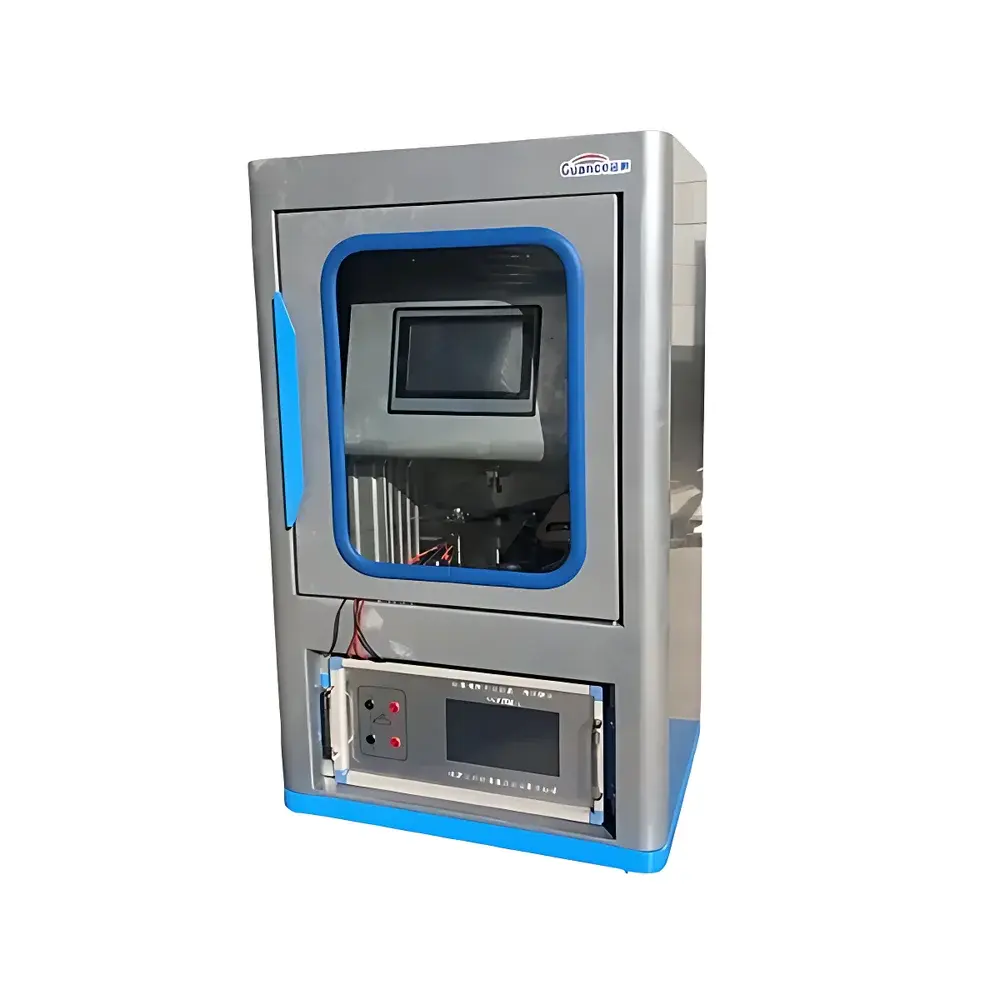
GuanCe GCFTDZ-I Two-Point Probe Powder Resistivity Tester
| Brand | GuanCe Instruments |
|---|---|
| Origin | Beijing, China |
| Model | GCFTDZ-I |
| Force Range | 0–5 kN (up to 3.9 MPa) |
| Force Accuracy | ±0.5% FS |
| Current Sources | 10 μA to 10 A (8 ranges) |
| Voltage Range | 2 mV–2 V |
| Voltage Accuracy | ±0.1% |
| Resistance Measurement Range | 10⁻⁶–10⁵ Ω |
| Resolution | 10⁻⁸ Ω |
| Resistance Accuracy | ±0.5% |
| Electrode Diameters | φ16.0 mm and φ30.0 mm |
| Compression Thickness Resolution | ±1 μm |
| Power Supply | 220 V / 50 Hz |
| Power Consumption | 1 kW |
| Dimensions (L×W×H) | 550 × 450 × 960 mm |
| Weight | ~75 kg |
Overview
The GuanCe GCFTDZ-I Two-Point Probe Powder Resistivity Tester is an automated, PLC-controlled instrumentation system engineered for precise and reproducible measurement of the electrical resistivity of granular carbonaceous materials under controlled uniaxial compression. It operates on the two-point probe (collinear electrode) principle, where a known direct current is applied across a compacted powder column confined between two parallel, coaxial stainless-steel electrodes; the resulting voltage drop is measured to compute bulk resistance, which—combined with geometric dimensions and mass-derived density—is converted into volume resistivity (Ω·cm or Ω·m). Designed in strict compliance with GB/T 24521–2018 (“Test Method for Electrical Resistivity of Carbon Raw Materials and Coke”), the instrument is optimized for quality control and R&D applications in carbon anode manufacturing, graphite electrode production, and metallurgical coke evaluation. Its core architecture integrates a high-precision servo-driven loading system, a multi-range programmable current source, low-noise voltage sensing circuitry, and real-time data acquisition synchronized with mechanical displacement and force feedback. All test sequences—including pressure ramping, dwell stabilization, electrical excitation, and automatic return—are executed without operator intervention, ensuring procedural consistency and minimizing human-induced variability.
Key Features
- 10-inch industrial-grade touch HMI interface with intuitive navigation, real-time graphical display of force, pressure, thickness, density, voltage, current, resistance, resistivity, and conductivity
- Dual interchangeable electrode sets: φ16.0 mm (optimized for particle size 0.315–0.5 mm) and φ30.0 mm (optimized for 0.5–1.0 mm), enabling method flexibility per material morphology
- Seven programmable test modes: constant-force, constant-pressure, stepped-force, stepped-pressure, compression-ratio (displacement-based), time-controlled, and custom gradient protocols
- Automated zero-point calibration, load-hold synchronization, and post-test mechanical reset to initial position
- Integrated thermal-stable current source (8 ranges: 10 μA–10 A) with ±0.5% accuracy and low-drift voltage measurement (±0.1% over 2 mV–2 V range)
- Sub-micron axial displacement resolution (±1 μm) and closed-loop force control via servo motor, eliminating hydraulic noise and hysteresis
- Onboard micro-printer for immediate hardcopy output and USB export of CSV-formatted datasets with full metadata (timestamp, parameters, raw readings)
Sample Compatibility & Compliance
The GCFTDZ-I is validated for use with dry, free-flowing powders and granules commonly encountered in carbon and graphite processing—including calcined anthracite, petroleum coke (green and calcined), graphitized coke, needle coke, carbon black, and baked anode scrap. Sample preparation follows standardized sieving (per GB/T 24521–2018), drying, and mass dosing into the cylindrical die cavity. The instrument’s mechanical and electrical design adheres to IEC 61000-6-2 (immunity) and IEC 61000-6-4 (emission) standards. Data integrity is supported by audit-ready operation logs, parameter locking during test execution, and non-volatile storage of all calibration coefficients and user-defined methods—facilitating GLP-compliant documentation and internal QA audits. While not FDA 21 CFR Part 11-certified out-of-the-box, its deterministic test sequencing and immutable data export enable straightforward validation for regulated environments upon site-specific IQ/OQ/PQ protocols.
Software & Data Management
Control firmware runs on a Siemens S7-1200 PLC platform, interfaced via Profinet to the HMI for deterministic cycle timing (<50 ms loop update). The embedded software supports user-defined method templates with password-protected editing, version-stamped test records, and automatic calculation of derived metrics—including apparent density (g/cm³), specific electrical conductivity (S/cm), and relative resistivity change across pressure gradients. All measurements are timestamped and tagged with operator ID, sample ID, electrode configuration, and environmental conditions (if external sensors are integrated). Exported CSV files contain column headers compliant with ASTM E1252 conventions for spectral and resistive property reporting. Remote firmware updates are supported via secure HTTPS OTA (over-the-air) protocol, requiring authenticated access credentials.
Applications
- Quality assurance of raw materials for aluminum smelting anodes and steelmaking electrodes
- Correlation studies between green density, heat treatment schedule, and final electrical performance of carbon composites
- Process optimization of coke calcination and graphitization through resistivity-pressure hysteresis profiling
- Research into particle packing effects, interparticle contact resistance, and percolation thresholds in conductive fillers
- Validation of binder distribution uniformity in extruded or molded carbon preforms
- Comparative analysis of alternative carbon feedstocks (e.g., biochar vs. petroleum coke) under identical compaction protocols
FAQ
What standards does the GCFTDZ-I comply with?
It is fully aligned with GB/T 24521–2018 and incorporates measurement principles consistent with ASTM D3764 (bulk resistivity of carbon and graphite materials) and ISO 18513 (electrical resistivity of particulate carbon blacks).
Can the instrument measure both resistivity and conductivity simultaneously?
Yes—resistivity (Ω·cm) and conductivity (S/cm) are calculated and displayed in real time using the same dataset; unit selection is configurable per user preference.
Is calibration traceable to national standards?
Force transducers are factory-calibrated against NIM (National Institute of Metrology, China)-certified deadweight standards; electrical modules are verified using certified reference resistors (10⁻³ Ω to 10⁴ Ω, ±0.01% tolerance).
How is sample height measured during compression?
A linear encoder integrated into the upper platen provides continuous, high-resolution displacement feedback (±1 μm), enabling accurate cross-sectional area derivation and density calculation.
Does the system support third-party data integration?
Yes—CSV exports are structured for direct import into LIMS platforms, MATLAB, Python (pandas), or Excel; optional Modbus TCP interface enables real-time SCADA connectivity.



