
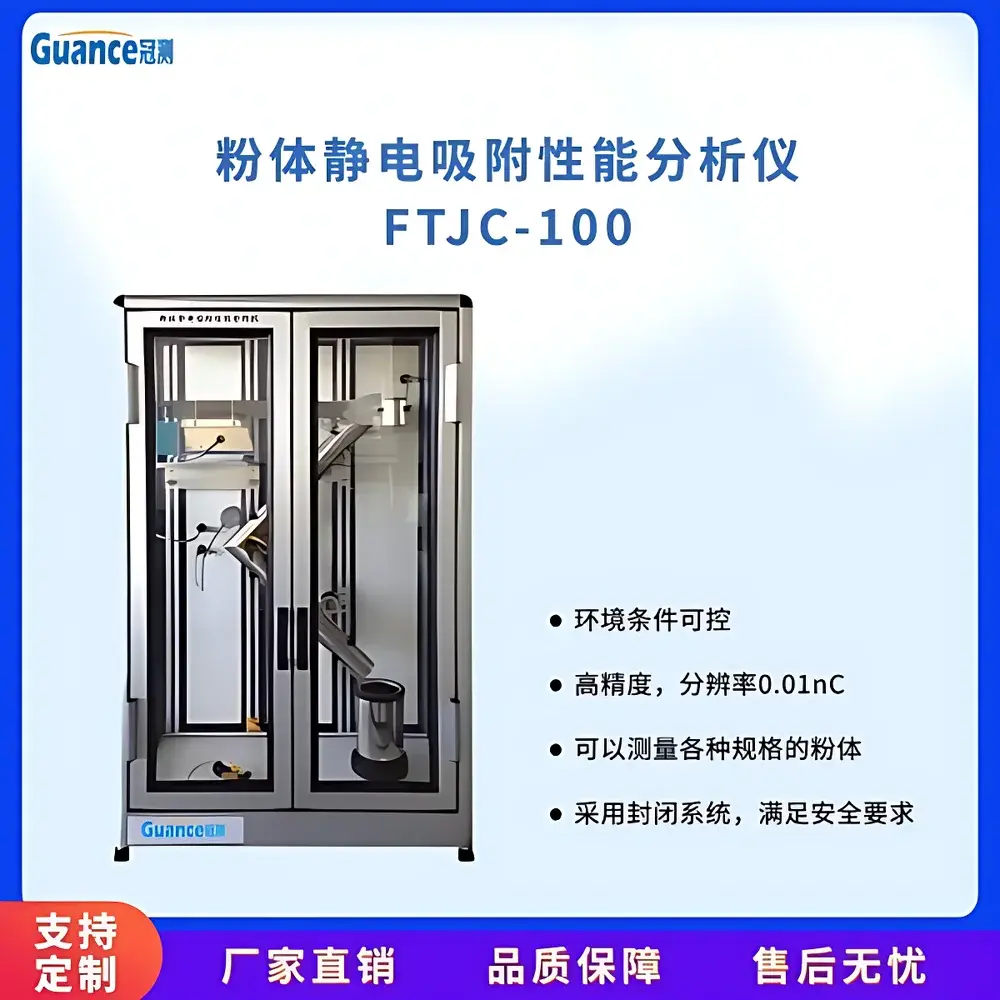
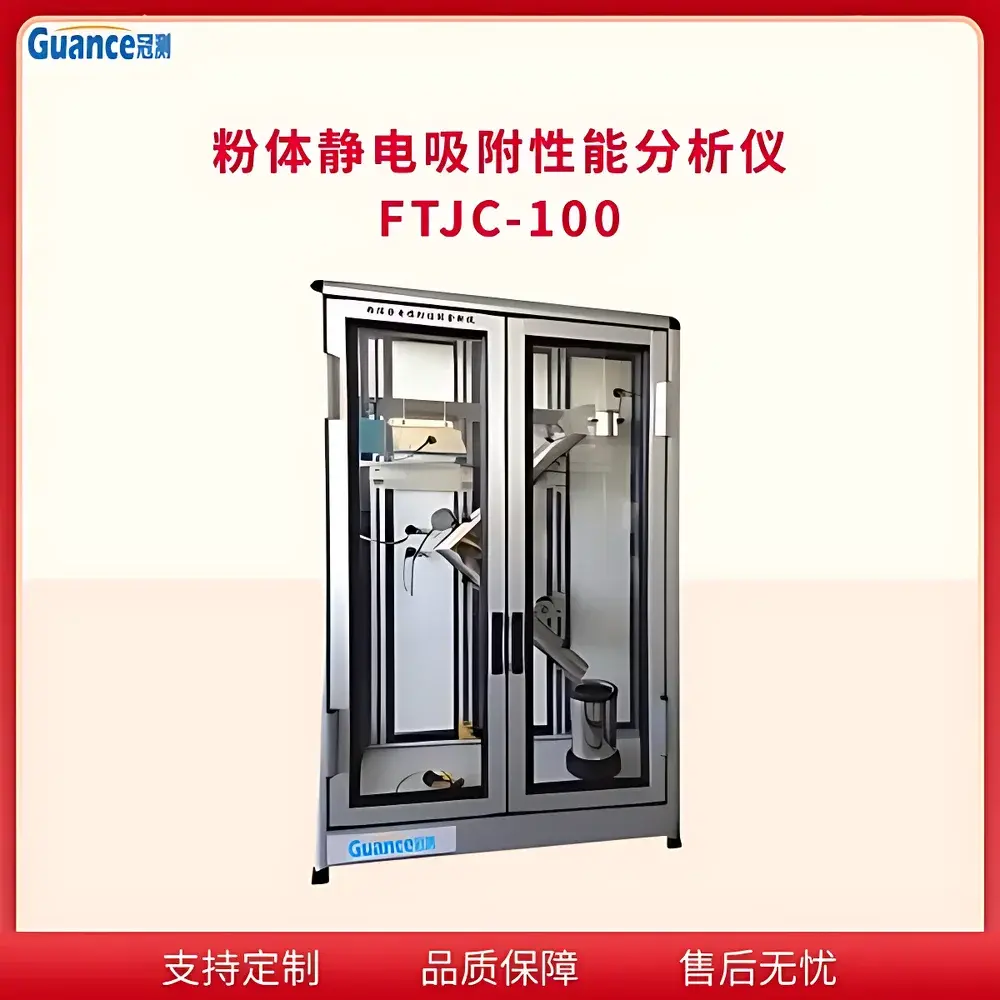
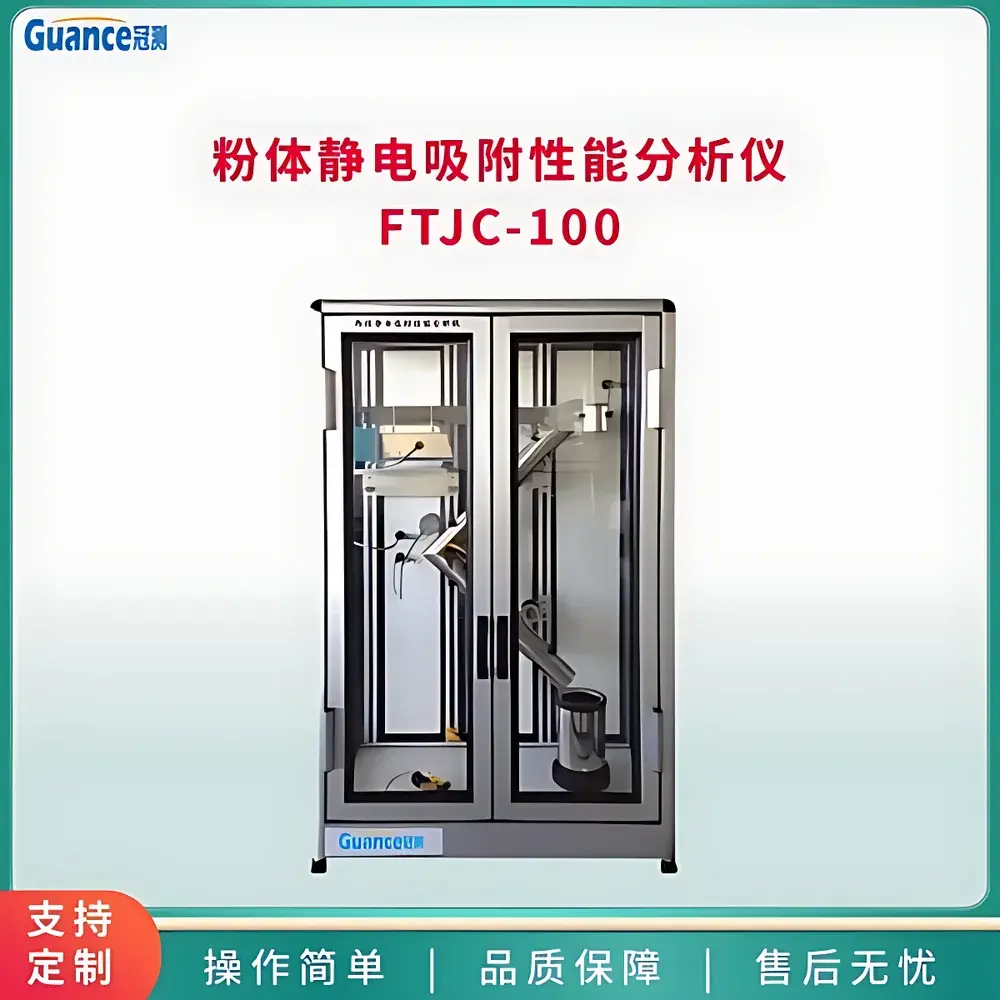
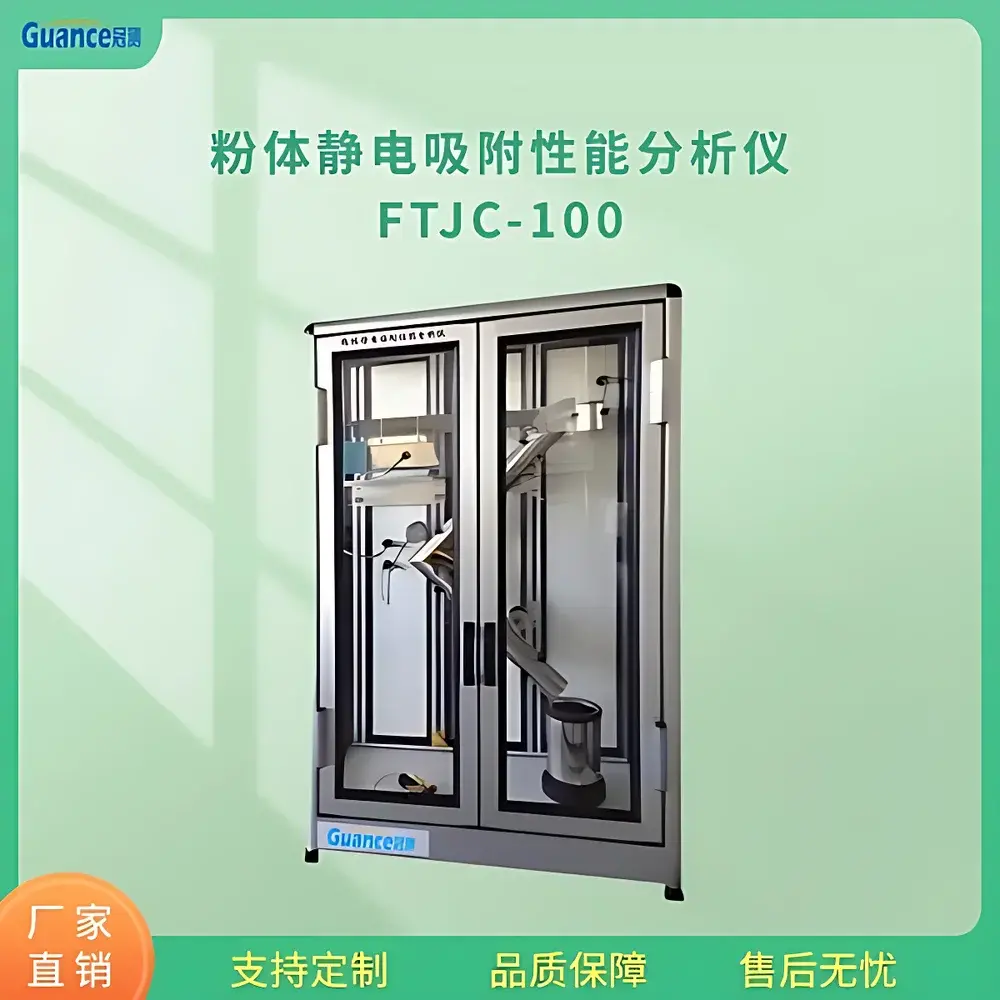
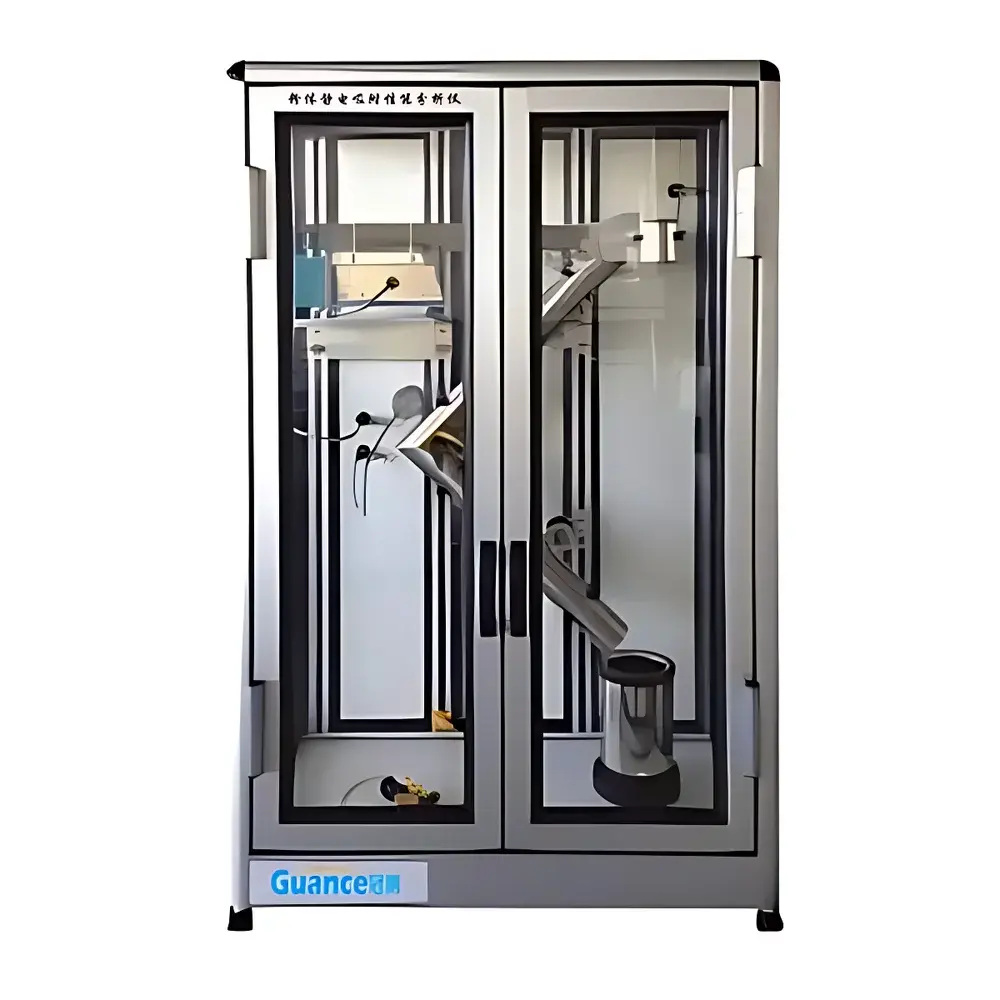
GuanCe Instruments FTJC-100 Powder Electrostatic Charge Analyzer
| Brand | GuanCe Instruments |
|---|---|
| Origin | Beijing, China |
| Manufacturer Type | Authorized Distributor |
| Country of Origin | China |
| Model | FTJC-100 |
| Price | USD 1,750 (FOB Beijing) |
| Measurement Principle | Faraday Cup-based Triboelectric Charge Quantification |
| Charge Range | ±50.00000 µC / ±500.0000 nC |
| Resolution | 0.01 nC (10 pC) |
| Basic Accuracy | ±0.05% of Full Scale |
| Adjustable Filtering | 32-step digital low-pass filter |
| Sampling Rate | Up to 600 Hz (selectable: 5/10/20/50/100/200/400/600 Hz) |
| Interface | RS-232 with included PC cable and proprietary data acquisition software |
| Environmental Control | Integrated temperature & relative humidity monitoring |
| System Architecture | Modular, fully enclosed Faraday cage design compliant with IEC 61340-2-3 and ASTM D257 |
Overview
The GuanCe Instruments FTJC-100 Powder Electrostatic Charge Analyzer is an engineered solution for quantitative triboelectric charge characterization of dry particulate solids under controlled process-relevant conditions. It operates on the fundamental principle of Faraday cup electrostatic induction: as powder flows through a vibration-driven V-shaped stainless-steel tube—designed to replicate shear and contact dynamics observed in hoppers, pneumatic conveyors, mixers, and feeders—the generated tribocharge is fully captured upon deposition into a grounded, shielded Faraday cup connected to a high-stability electrometer. This architecture ensures near-zero charge leakage and eliminates external electromagnetic interference, enabling trace-level charge quantification down to 0.01 nC. The instrument is purpose-built for laboratories conducting material hazard assessment (e.g., dust explosion risk per EN 13821 and NFPA 77), formulation development for pharmaceutical dry powder inhalers (DPIs), toner performance evaluation in electrophotography, and quality control of polymer granules, catalysts, and battery electrode powders.
Key Features
- Fully enclosed, grounded Faraday cage housing with EMI shielding—meets IEC 61000-4-3 immunity requirements and supports GLP-compliant operation
- Vibration-controlled powder feeding mechanism ensuring consistent mass flow rate and reproducible contact history between particles and tube surface
- Dual-range high-resolution electrometer: ±50.00000 µC (0.01 nC resolution) and ±500.0000 nC (0.1 pC resolution), auto-ranging with full-scale accuracy of ±0.05%
- 32-step programmable digital low-pass filtering to suppress mechanical vibration noise and optimize signal-to-noise ratio for diverse powder rheologies
- Configurable sampling rates from 5 to 600 Hz—enabling transient charge profiling during start-up, steady-state flow, and cessation phases
- Integrated environmental sensors for real-time monitoring of ambient temperature (±0.5 °C) and relative humidity (±2% RH), with optional N₂/Ar purge interface for moisture-sensitive or reactive materials
- Modular mechanical design: interchangeable V-tube geometries (angle, surface finish, material—e.g., stainless steel, PTFE, aluminum oxide) allow systematic study of material-pair triboelectric series effects
Sample Compatibility & Compliance
The FTJC-100 accommodates free-flowing and cohesive powders ranging from 10 µm to 2 mm in particle size, including crystalline APIs, micronized excipients, metal flakes, ceramic precursors, and carbon black. Sample loading volume is adjustable (1–50 g), with automated vibration amplitude and frequency control to prevent bridging or rat-holing. All wetted components are non-magnetic, corrosion-resistant, and compatible with IPA, ethanol, and acetone cleaning—validated per ISO 14644-1 Class 8 cleanroom maintenance protocols. The system conforms to electrostatic measurement standards including ASTM D257 (DC resistance and conductivity), IEC 61340-2-3 (tribocharging of granular materials), and supports audit-ready documentation for FDA 21 CFR Part 11 compliance when used with validated software configuration.
Software & Data Management
The included Windows-based acquisition software provides real-time charge vs. time waveform visualization, automatic baseline correction, peak charge magnitude extraction, and integrated statistical reporting (mean, SD, CV%, min/max). Raw time-series data (.csv) and metadata (operator ID, SOP version, environmental logs, calibration timestamp) are stored with SHA-256 hash integrity verification. Software supports user-defined SOP templates with parameter locking, electronic signatures, and configurable pass/fail thresholds aligned with internal QC specifications. Export modules generate PDF reports compliant with ISO/IEC 17025 technical record requirements, including uncertainty budgets derived from electrometer calibration certificates traceable to NIM (National Institute of Metrology, China).
Applications
- Pharmaceutical: Quantifying tribocharging behavior of lactose blends and API-coated particles to predict DPI aerosolization efficiency and device fouling
- Chemical Processing: Assessing electrostatic hazard potential of catalyst powders prior to fluidized-bed reactor charging
- Electronics Manufacturing: Evaluating charge decay kinetics of conductive polymer composites used in ESD-safe packaging
- Energy Storage: Screening cathode/anode active material blends for static-induced segregation risks during electrode slurry drying and calendering
- Food & Agriculture: Measuring charge accumulation in flour, sugar, and powdered dairy products to mitigate silo ignition hazards
FAQ
What standards does the FTJC-100 comply with for electrostatic testing?
The instrument meets the core measurement methodology requirements of IEC 61340-2-3 and ASTM D257, and its enclosure design satisfies IEC 61000-4-3 for electromagnetic compatibility.
Can the system be calibrated internally without external equipment?
Yes—it includes a built-in precision charge injection circuit traceable to NIM-certified reference standards, enabling daily verification per ISO/IEC 17025 Clause 6.5.2.
Is inert atmosphere operation supported out-of-the-box?
A standard gas purge port (¼” NPT) is provided; users supply regulated inert gas and optional humidity-controlled glovebox integration.
How is data integrity ensured during long-duration tests?
All acquisitions include time-stamped CRC-32 checksums; software enforces write-once archival mode and prevents post-acquisition editing unless explicitly unlocked with dual-factor authentication.
Does the modular V-tube system require recalibration when swapping configurations?
No—mechanical interchangeability is factory-verified; only SOP parameters (vibration profile, dwell time) require revalidation per ISO 9001 Section 8.5.1.
Related Products



