
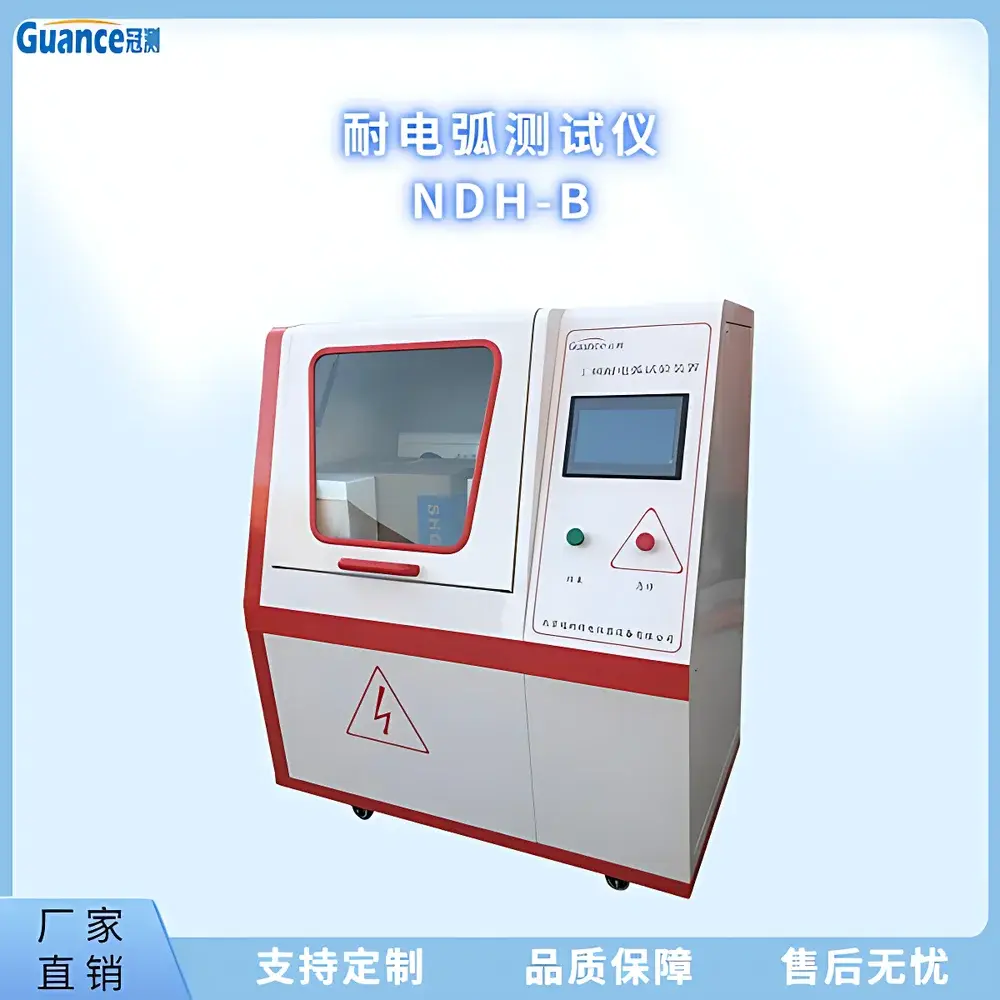
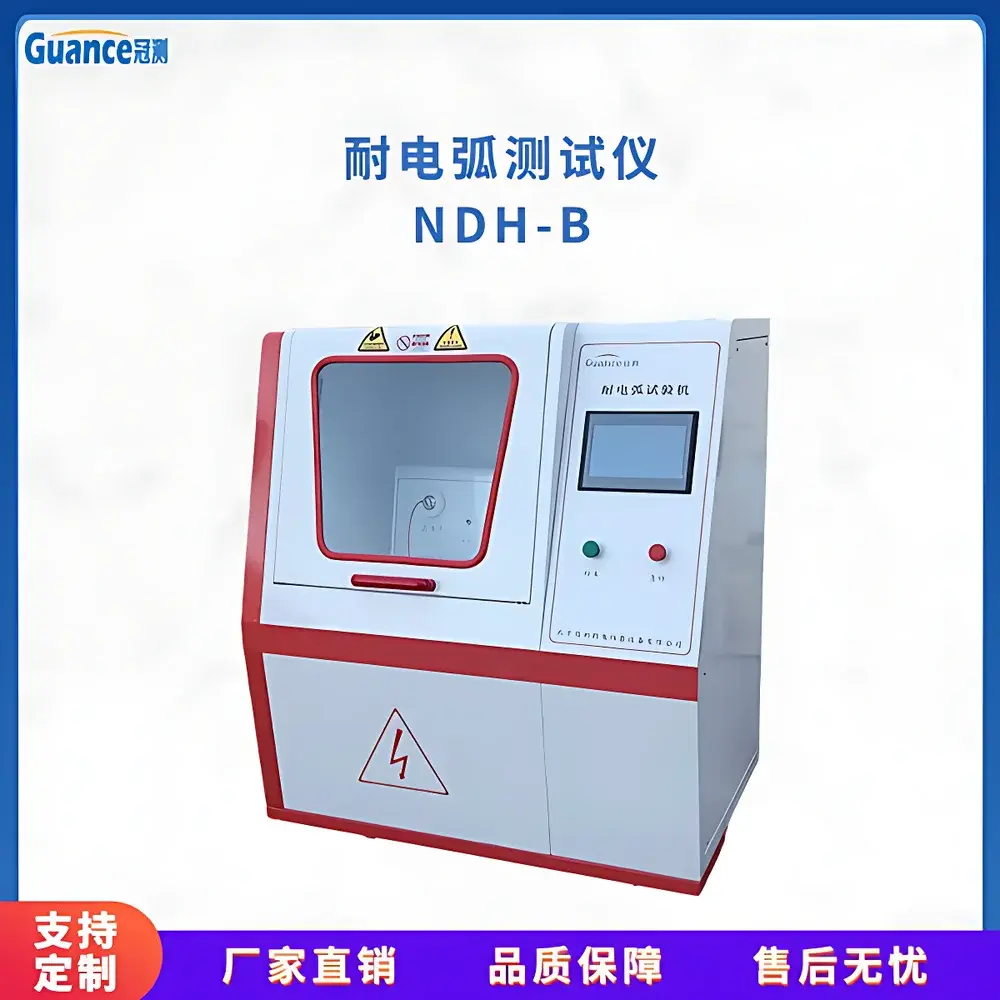
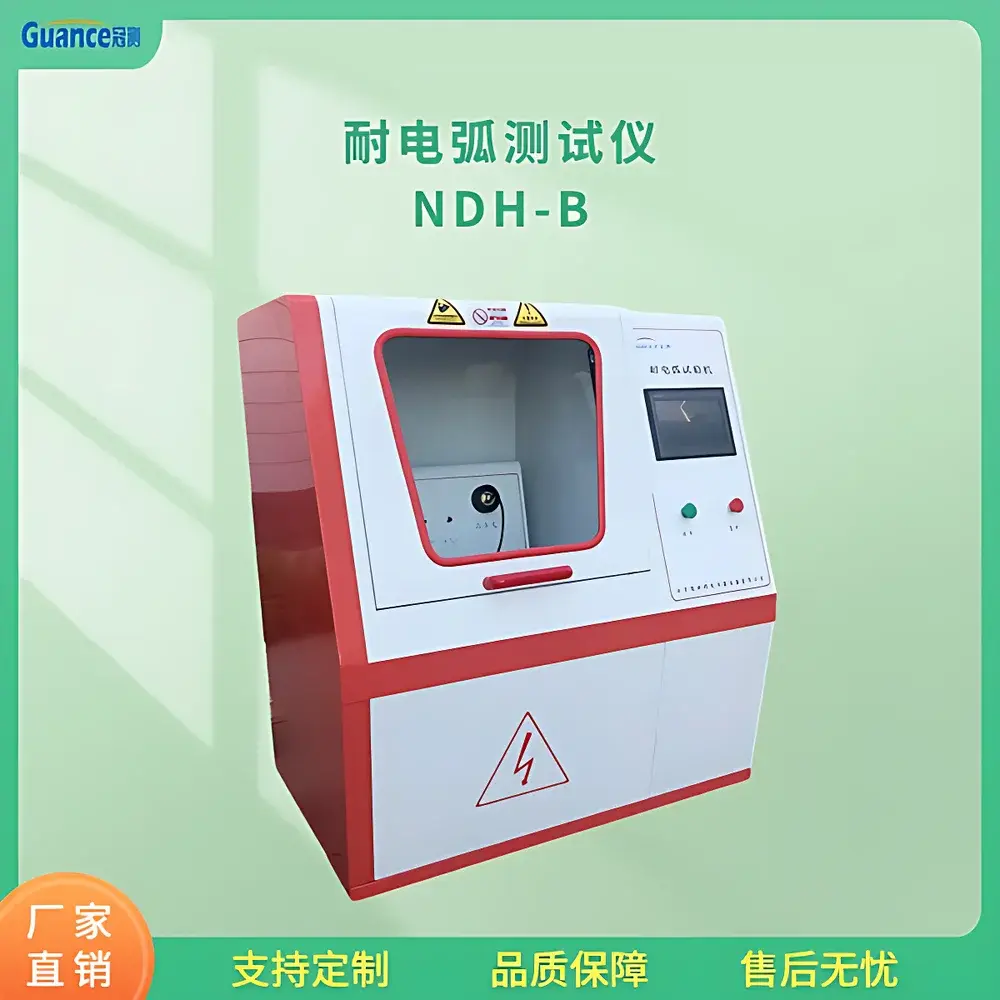
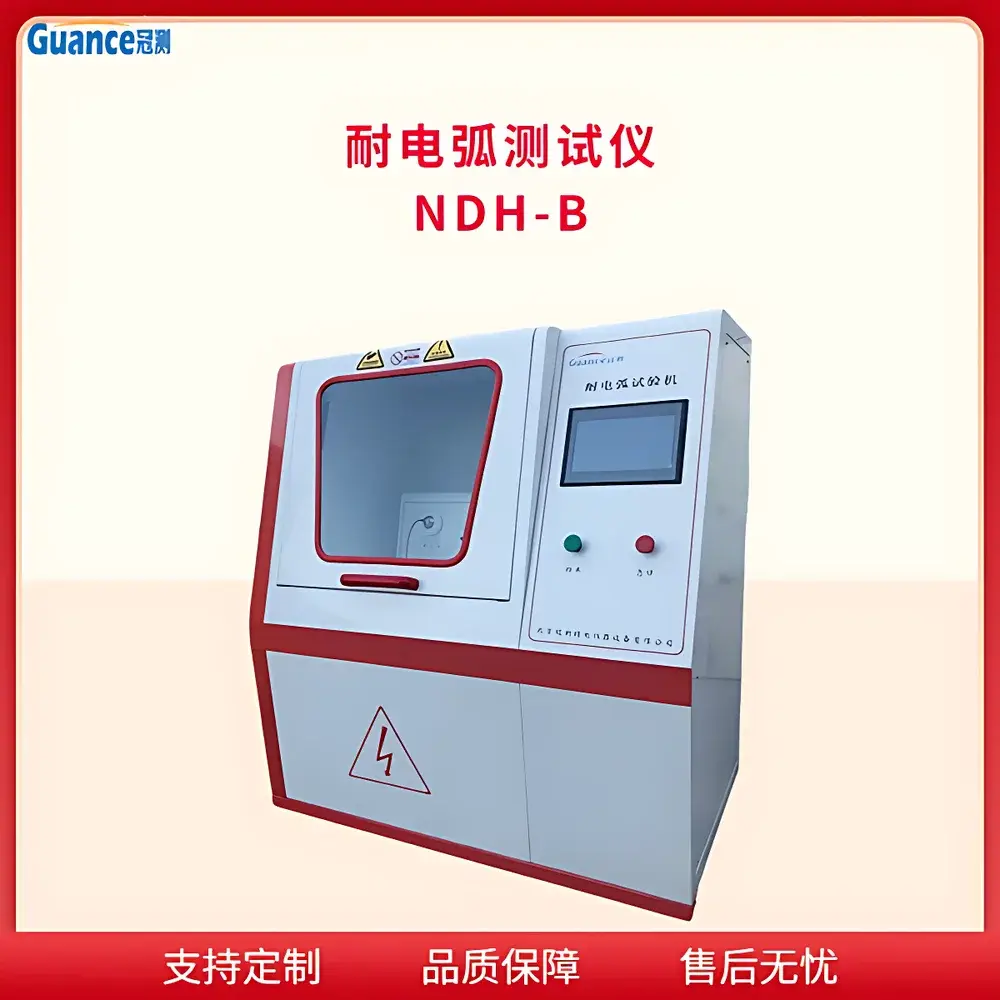
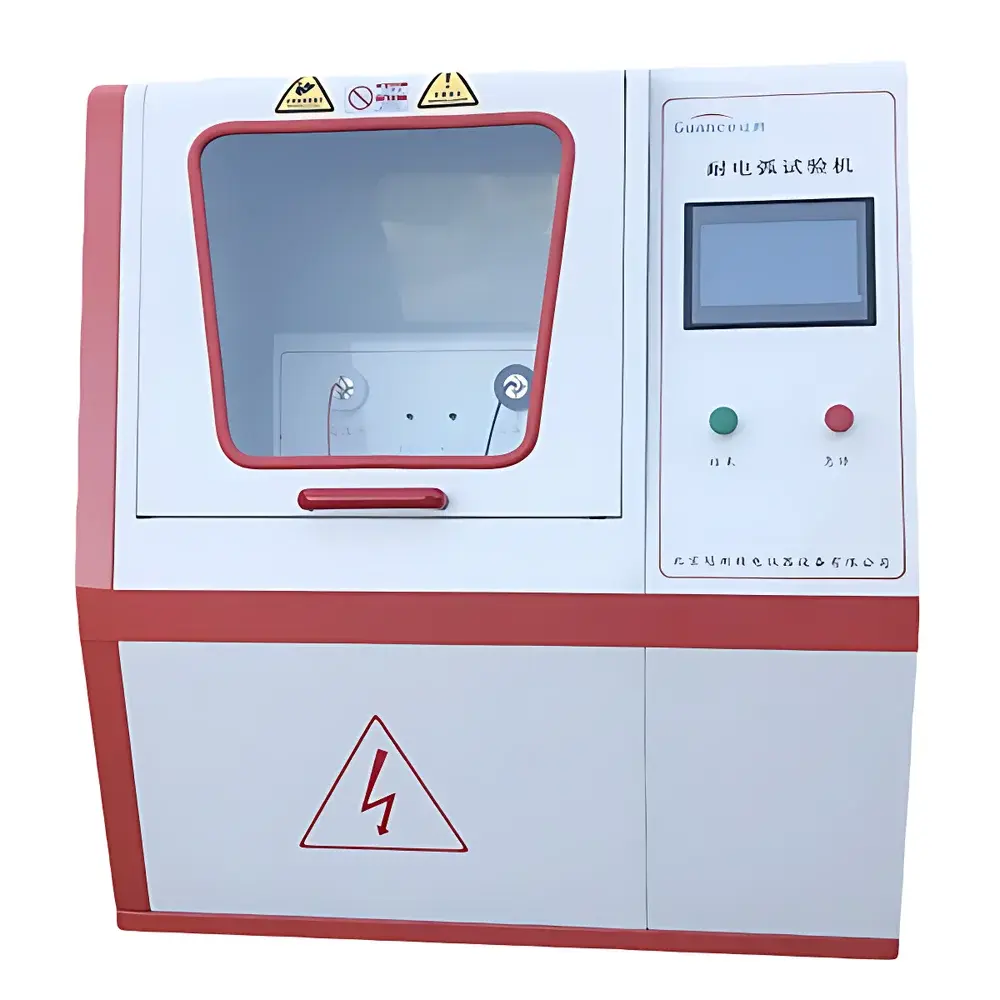
Guance Instruments NDH-B4 Universal Arc Resistance Tester with 10-inch Touchscreen
| Brand | Guance Instruments |
|---|---|
| Origin | Beijing, China |
| Manufacturer Type | Authorized Distributor |
| Country of Origin | China |
| Model | NDH-B4 |
| Instrument Type | Electronic Universal Testing Machine |
| Compliance Standards | GB/T 1411–2002, IEC 61621:1997, ASTM D495, IEC 149, UL 746A |
| Rated Test Voltage | 12.5 kV |
| Voltage Range | 0–17.5 kV AC |
| Current Range | 10–40 mA (selectable steps) |
| Arc On/Off Timing Accuracy | ±1 ms |
| Electrode Force | (0.5 ± 0.05) N |
| Electrode Material | Tungsten Rod |
| Electrode Spacing | (6.35 ± 0.1) mm (IEC), (6.0 ± 0.1) mm (ASTM) |
| Test Transformer Capacity | 3 kVA |
| Variac Capacity | 3 kVA |
| Voltage Regulation Accuracy | ±1% |
| Current Control Accuracy | ±3% |
| Current Measurement Accuracy | ±1.5% |
| Operating Environment | 23 ± 2 °C, 50 ± 5 % RH |
| Input Power | 220 V AC / 50 Hz |
Overview
The Guance Instruments NDH-B4 Universal Arc Resistance Tester is an industrial-grade, microprocessor-controlled testing system engineered for precise evaluation of arc resistance in solid insulating materials under high-voltage, low-current arcing conditions. It operates on the principle of controlled high-voltage arc initiation and propagation between two tungsten electrodes positioned at standardized spacing—either 6.0 mm (per ASTM D495) or 6.35 mm (per IEC 61621:1997)—while applying a regulated test voltage of 12.5 kV and adjustable current levels from 10 to 40 mA. The instrument measures the time-to-failure (in seconds) of a specimen subjected to repetitive or continuous arcing, enabling quantitative classification of material performance per internationally recognized grading systems. Designed in strict accordance with GB/T 1411–2002 (identical to IEC 61621), this tester supports compliance-driven quality assurance workflows in R&D labs, QC departments, and third-party certification facilities serving the electrical insulation industry.
Key Features
- Bilateral modular architecture: left-side test chamber (featuring tempered glass observation door, integrated high-voltage output terminals, and analog current meter) and right-side control cabinet housing Siemens PLC and industrial 10-inch capacitive touchscreen interface.
- Programmable test execution: automatic selection between IEC and ASTM test protocols, including predefined arc-on/off timing sequences, voltage ramping, and post-test zeroing—all executed without manual intervention.
- High-fidelity electrical control: solid-state relay bank managed by PLC ensures arc timing resolution better than ±1 ms; real-time voltage and current feedback enables closed-loop regulation.
- Dual-mode current monitoring: simultaneous analog ammeter readout and digital display on touchscreen provide redundant verification of arc current magnitude, enhancing measurement traceability.
- Enhanced safety infrastructure: illuminated warning beacon activates during high-voltage operation; protective series resistors integrated into low-voltage terminal block; interlocked access door with mechanical cut-off.
- Inert atmosphere compatibility: optional gas inlet port allows purging of test chamber with nitrogen or argon to suppress oxidation during extended arcing cycles—critical for evaluating thermally sensitive resins and nanocomposites.
- Self-calibration support: built-in voltage and current verification routines simplify periodic metrological validation and facilitate ISO/IEC 17025-compliant calibration documentation.
Sample Compatibility & Compliance
The NDH-B4 is validated for use with rigid sheet-type insulating specimens conforming to standard dimensions: minimum 5 specimens per test batch, thickness 3.0 ± 0.4 mm, surfaces ground flat and free of burrs or contaminants. Compatible material classes include thermosetting plastics (e.g., phenolic, epoxy, melamine-formaldehyde), laminates (G10/FR-4, paper- and glass-based), insulating varnishes, cast resins, and filled polymer composites. All test procedures align with mandatory regulatory frameworks—including UL 746A (polymeric materials for electrical equipment), IEC 60243-1 (dielectric strength), and ASTM D495 (arc resistance of plastics)—and support audit readiness for GLP, GMP, and FDA 21 CFR Part 11 environments where electronic records and operator authentication are required.
Software & Data Management
The embedded HMI software delivers full test lifecycle management via the 10-inch touchscreen interface. Users configure test parameters—including electrode spacing mode, current step sequence, arc duration profile, and pass/fail criteria—through intuitive menus. Real-time graphical plots display voltage, current, and elapsed time during active testing. All raw data—including timestamped event logs, operator ID, environmental readings (temperature/humidity), and final arc resistance duration—are stored locally in CSV format and exportable via USB. Audit trails record parameter changes, test starts/stops, and system alerts, satisfying requirements for data integrity under ISO 9001 and IEC 61000-4-3 electromagnetic compatibility standards.
Applications
- Classification of arc resistance ratings (e.g., CTI, PTI) for printed circuit board substrates and encapsulation compounds.
- Comparative evaluation of flame-retardant additives in polyamide, PBT, and polycarbonate formulations.
- Qualification testing of motor winding insulation systems prior to type approval (IEC 60034-18-41).
- Failure analysis of aged or thermally degraded insulation in power electronics modules.
- Supporting material selection for high-reliability aerospace and rail traction applications governed by EN 45545-2 and DO-160 Section 25.
- Research into surface tracking mechanisms in nano-filled dielectrics under accelerated aging protocols.
FAQ
What standards does the NDH-B4 comply with?
The instrument meets GB/T 1411–2002, IEC 61621:1997, ASTM D495, IEC 149, and UL 746A. Its design and verification protocols support conformance to ISO/IEC 17025 laboratory accreditation requirements.
Can the NDH-B4 operate in inert gas environments?
Yes—the test chamber includes a dedicated gas inlet port compatible with nitrogen or argon supply lines, enabling oxidation-free testing for oxygen-sensitive materials.
Is operator training required to run compliant tests?
While intuitive operation is enabled by the touchscreen interface, users must complete documented procedure training per internal SOPs to ensure adherence to ASTM/IEC timing sequences and specimen preparation requirements.
How is measurement traceability maintained?
Voltage and current calibration routines are accessible through service mode; all test reports include metadata such as calibration due date, environmental conditions, and operator credentials—supporting 21 CFR Part 11 electronic signature workflows.
What maintenance intervals are recommended?
Electrode inspection and cleaning after every 10 test cycles; annual verification of transformer insulation resistance and PLC firmware updates per manufacturer bulletin; biannual verification of timing accuracy using external oscilloscope reference.



