
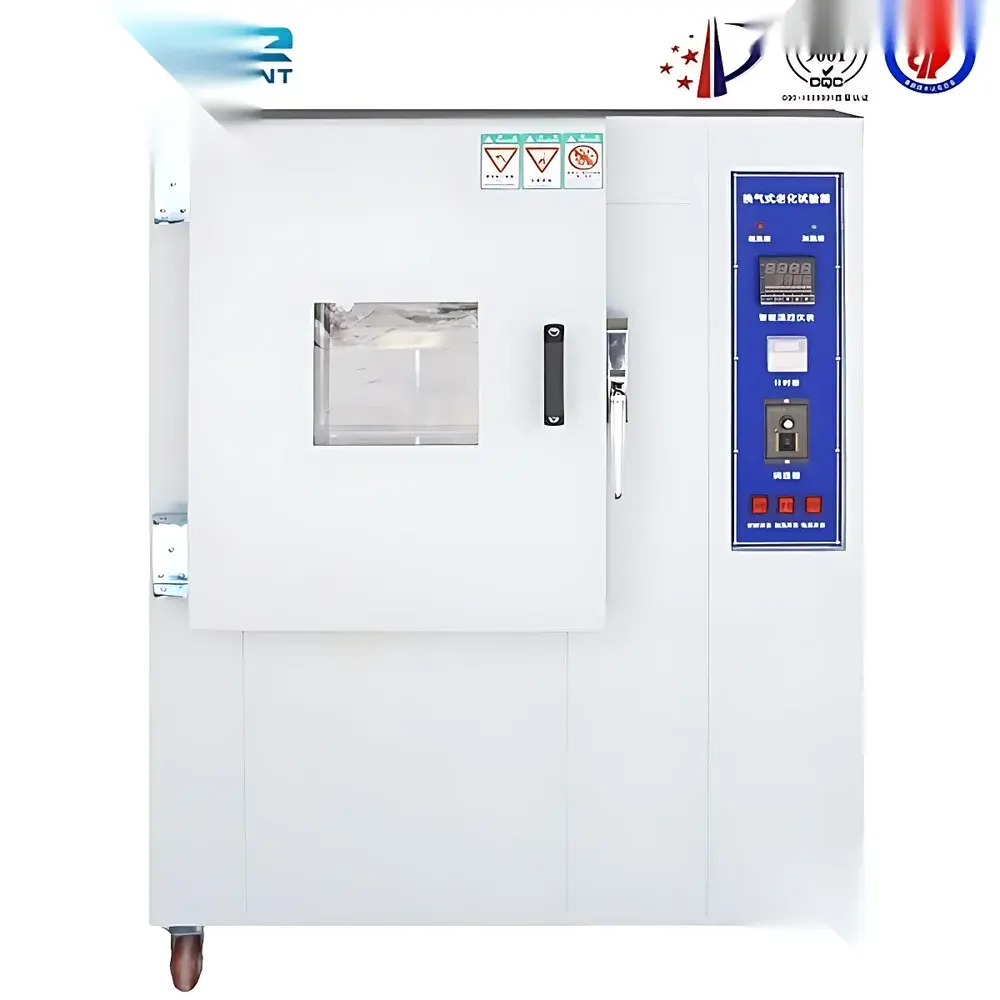
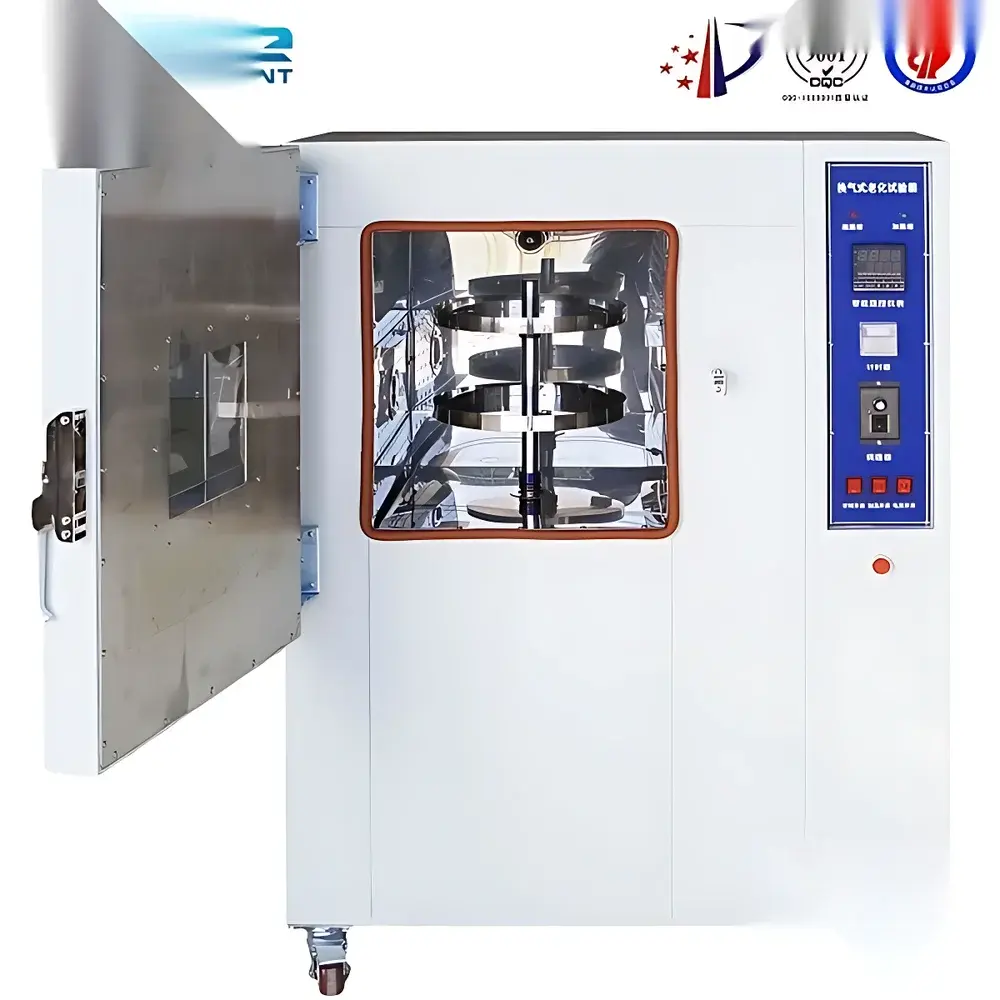
OK-HQ Series Forced-Air Thermal Aging Test Chamber
| Brand | OK Instruments |
|---|---|
| Origin | Imported |
| Manufacturer Type | Authorized Distributor |
| Temperature Range | RT+10°C to 200°C / 300°C |
| Temperature Uniformity | ±2°C |
| Temperature Stability | ±0.5°C |
| Air Exchange Rate | 2–100 cycles/hour (measurable and adjustable at 80°C) |
| Air Exchange Timing | 1 min – 99 h programmable |
| Internal Chamber Volume | 100 L – 800 L (model-dependent) |
| Power Consumption | 4.0–9.0 kW |
| Rotating Turntable Speed | 8–10 rpm |
| Compliance | ASTM D5423-09 (Type II), ASTM D5374-93(2005), UL 1581, IEC 60811, JIS K7212, GB/T 2951, VDE 0472 |
| Construction | SUS304 stainless steel inner chamber, A3 steel outer cabinet with powder coating |
| Insulation | High-density fiberglass wool |
| Viewing Window | Multi-layer vacuum-sealed tempered glass with LED lighting |
Overview
The OK-HQ Series Forced-Air Thermal Aging Test Chamber is an engineered environmental test system designed for accelerated thermal aging evaluation of polymeric, elastomeric, and insulating materials under controlled, ventilated high-temperature conditions. Based on the principle of forced convection and regulated air exchange, it replicates long-term thermal degradation effects in a compressed timeframe—enabling predictive assessment of material service life, oxidation resistance, and dimensional stability. Unlike static ovens, this chamber maintains continuous, quantifiable airflow across the test specimen surface, ensuring consistent oxidative stress exposure aligned with international standards for electrical insulation (e.g., ASTM D5423 Type II) and wire/cable qualification (UL 1581, IEC 60811-501). Its architecture integrates precision thermal control, traceable air exchange rate calibration, and mechanical rotation—critical for eliminating localized hot spots and ensuring representative aging across heterogeneous samples such as insulated wires, rubber hoses, textile laminates, and molded plastic components.
Key Features
- Programmable air exchange system calibrated per JIS K7212 methodology—using digital watt-hour metering and timer-based power consumption analysis to determine actual air change rate (2–100 cycles/hour at 80°C)
- Microprocessor-based PID controller with 0.1°C setpoint and display resolution, supporting ramp-soak profiles and multi-stage aging protocols
- Horizontal forced-air circulation with dual adjustable baffle plates and high-temp centrifugal blower—achieving ±2°C temperature uniformity across working volume
- SUS304 mirror-finish stainless steel interior (electropolished option available) and A3 steel exterior with corrosion-resistant powder coating
- Rotating turntable (Φ250–Φ700 mm, 8–10 rpm, removable) to ensure uniform thermal exposure of asymmetric or vertically oriented specimens
- Multi-layer vacuum-insulated observation window with integrated LED lighting—enabling real-time visual monitoring without thermal disturbance
- Standard 50 mm diameter test port (left side) for external sensor feedthrough, power supply, or data acquisition wiring
- Comprehensive safety suite: over-temperature cut-off, motor thermal overload protection,漏电 (earth leakage) detection, short-circuit interruption, and fail-safe door interlock
Sample Compatibility & Compliance
The OK-HQ chamber accommodates rigid and flexible specimens—including insulated conductors, elastomeric seals, polymer films, coated fabrics, and composite laminates—without requiring sample encapsulation or inert gas purging. Its forced-ventilation design meets the airflow velocity and exchange requirements specified in ASTM D5423-09 (Type II laboratory oven), ASTM D5374-93(2005), UL 1581 Section 1060, and IEC 60811-501 for heat aging of electric cables. It supports full compliance documentation generation for GLP/GMP-regulated laboratories, including audit-ready calibration logs for watt-hour metering, temperature mapping reports (per ISO/IEC 17025), and traceable air exchange verification records. Optional NIST-traceable temperature sensors and third-party validation packages are available upon request.
Software & Data Management
While the base configuration features an LED-display PID controller with manual parameter entry, optional RS485/Modbus RTU or Ethernet-enabled controllers support integration into centralized lab management systems (LIMS) or SCADA platforms. Logged data—including chamber temperature, elapsed time, cumulative energy consumption, and programmed air exchange intervals—can be exported in CSV format for post-test statistical analysis. All controllers maintain internal event logs (power loss, alarm triggers, setpoint changes) compliant with FDA 21 CFR Part 11 requirements when paired with user-access-controlled authentication and electronic signature modules.
Applications
- Aging performance validation of PVC, PE, XLPE, EPR, and silicone rubber insulation in wire & cable manufacturing
- Oxidative stability assessment of automotive gaskets, under-hood hoses, and thermoplastic elastomers (TPEs)
- Thermal endurance classification (IEC 60216) of insulating materials used in motors, transformers, and switchgear
- Accelerated shelf-life testing of medical device polymers per ISO 10993-12
- Quality control screening of textile coatings, adhesives, and laminated composites subjected to prolonged elevated temperatures
FAQ
What standards does the OK-HQ chamber comply with?
It is fully aligned with ASTM D5423-09 (Type II), ASTM D5374-93(2005), UL 1581, IEC 60811-501, JIS K7212, GB/T 2951, and VDE 0472 for thermal aging of electrical insulation and polymeric materials.
How is air exchange rate measured and verified?
Per JIS K7212, the system calculates air changes per hour using real-time digital watt-hour metering (Taiwan TAIK unit included) and timed heating cycle data—eliminating reliance on theoretical fan CFM ratings.
Can the chamber operate continuously at 300°C?
Yes—models rated for 300°C maximum include upgraded heating elements, enhanced insulation, and high-temp bearing assemblies; continuous operation is validated per IEC 60068-2-2.
Is temperature mapping required for qualification?
Yes—ISO/IEC 17025-accredited labs must perform initial and periodic temperature uniformity mapping (minimum 9-point grid) using calibrated PT100 probes; OK Instruments provides mapping templates and uncertainty budgets.
What maintenance is recommended for long-term reliability?
Quarterly inspection of air baffles and turntable bearings, biannual recalibration of watt-hour meter and temperature sensors, and annual replacement of fiberglass insulation if exposed to organic volatiles or halogenated compounds.



