
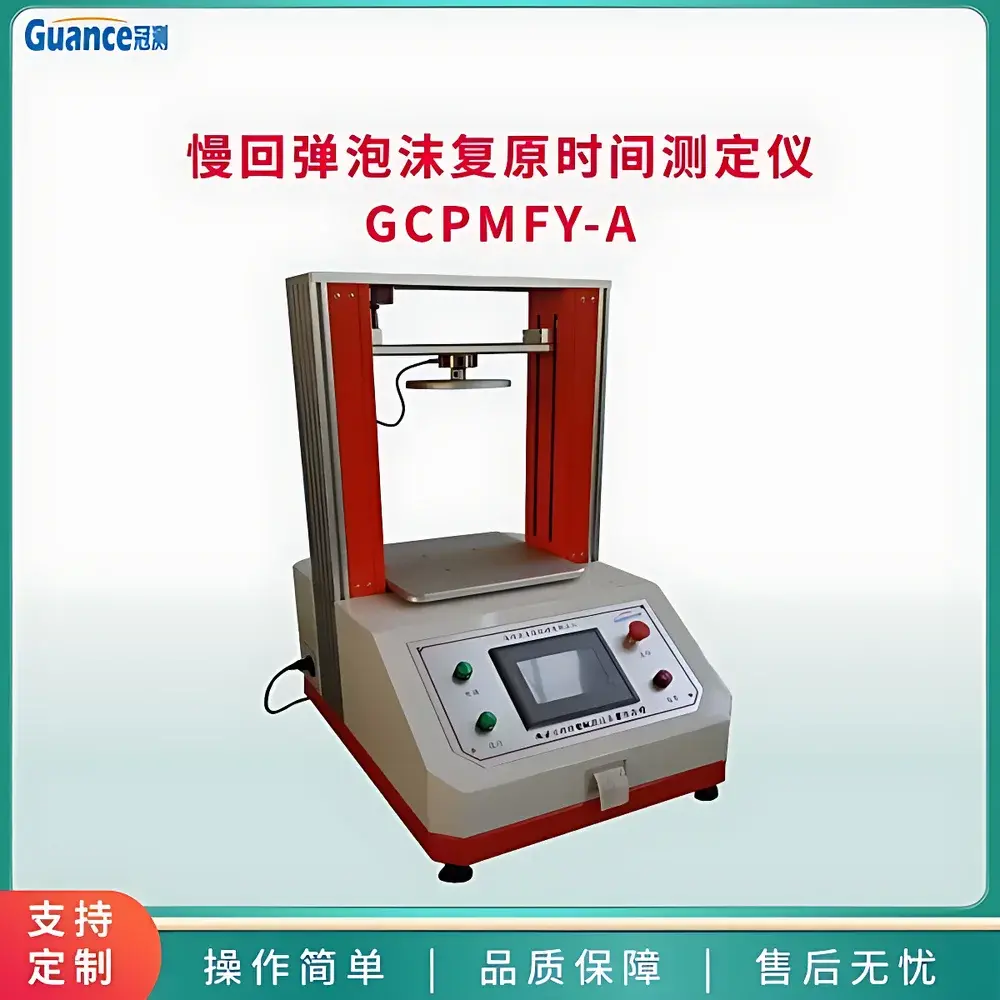
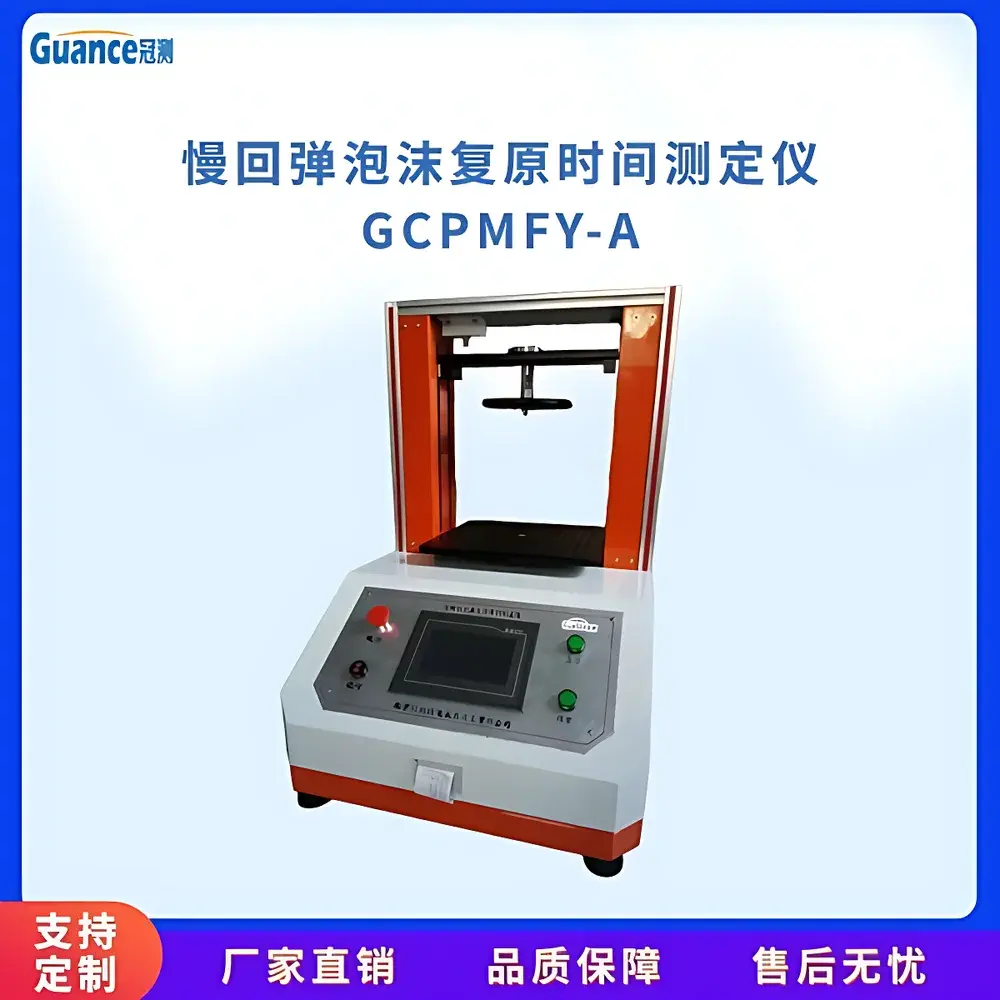
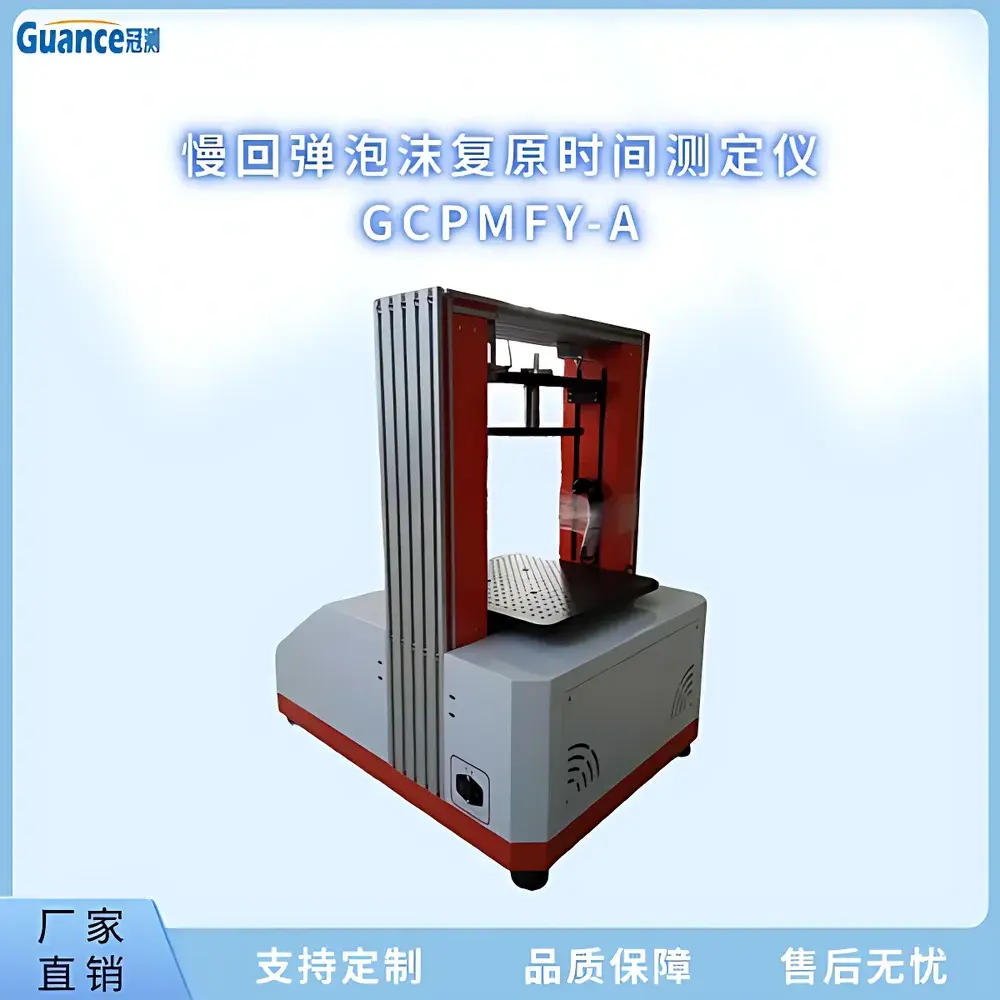
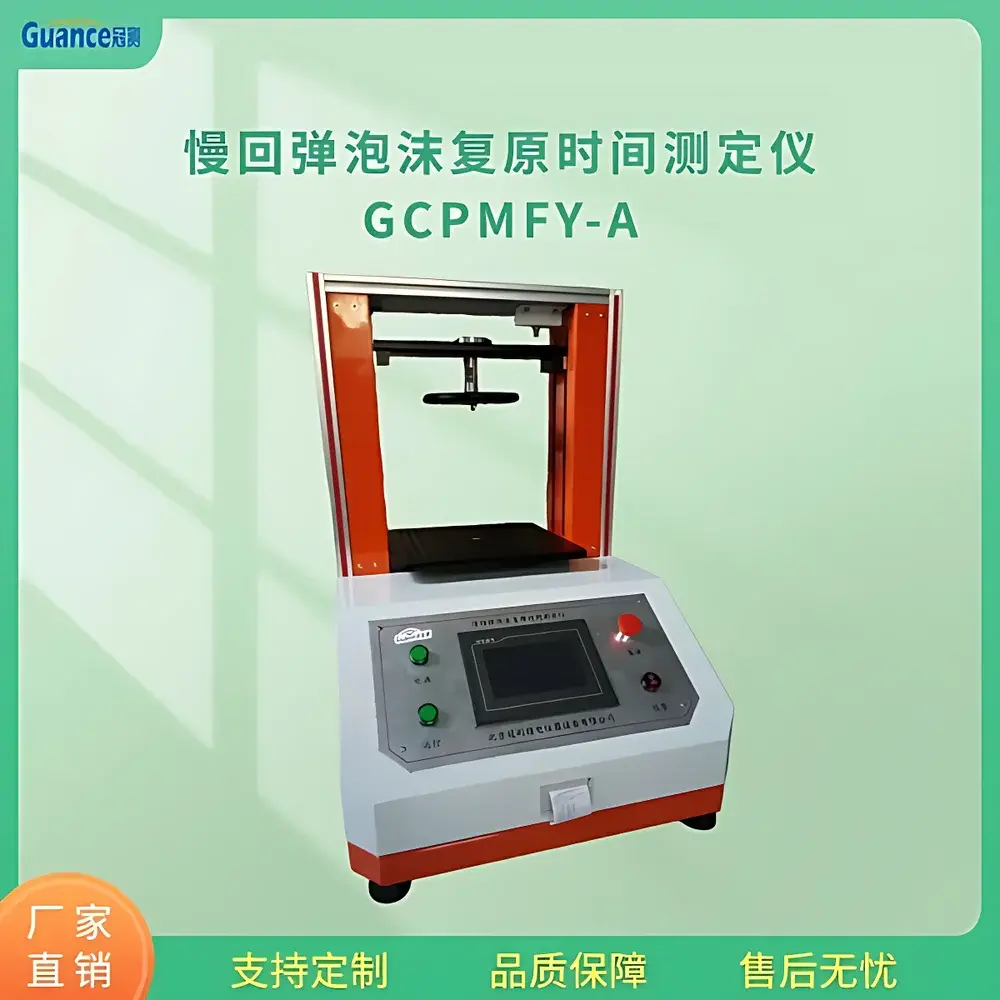
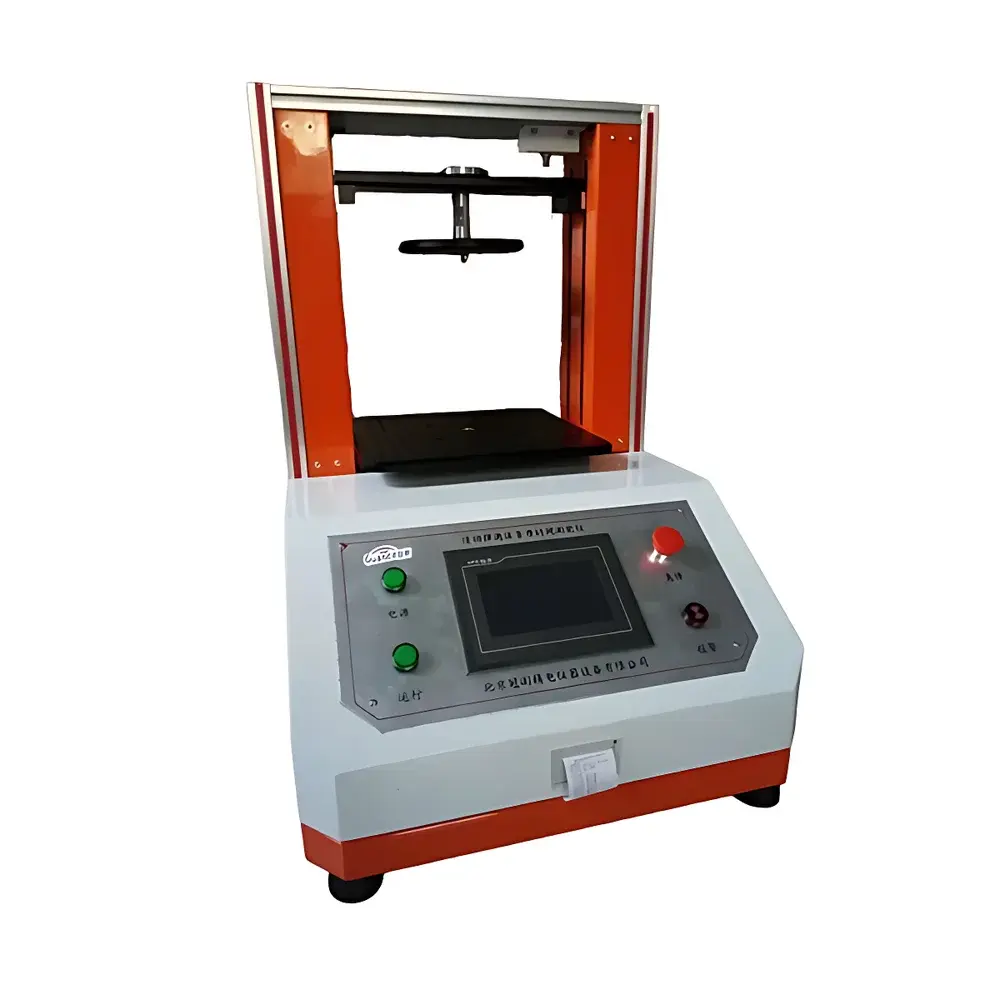
Guance Instruments GCPMFY-A Slow-Recovery Foam Recovery Time Tester
| Brand | Guance Instruments |
|---|---|
| Origin | Beijing, China |
| Manufacturer Type | Authorized Distributor |
| Country of Origin | China |
| Model | GCPMFY-A |
| Price | USD 2,650 (FOB Beijing) |
| Compliance | GB/T 26392–2011, ASTM D3574–08 Section 12 (Recovery Time for Viscoelastic Polyurethane Foams) |
| Measurement Principle | Controlled-compression dynamic recovery timing via high-precision laser displacement sensing and load-controlled indentation |
| Control System | Siemens S7-1200 PLC with integrated motion control |
| Display | 7-inch industrial capacitive touchscreen HMI |
| Time Resolution | 0.01 s |
| Thickness Measurement | Non-contact laser triangulation (±1 mm accuracy) |
| Indentation Force Sensor | 1000 N capacity, ±0.5% FS accuracy |
| Indenter | Rigid circular plate, Ø203 mm |
| Support Plate | Perforated steel plate, hole Ø6.5 mm, pitch 20 mm |
| Test Speed | (1000 ± 100) mm/min (programmable bidirectional) |
| Specimen Dimensions | 380 × 380 × 100 mm (L × W × H) |
| Preload Force | 4.5 N (automatically applied and verified) |
| Compression Depth | 75% of initial specimen thickness (user-confirmed via real-time laser thickness reading) |
| Hold Duration | 60 s (configurable) |
| Recovery Threshold | Time elapsed until specimen re-applies 4.5 N preload force upon upward indenter return |
| Data Output | CSV via USB |
| Software Architecture | Embedded deterministic real-time control firmware |
Overview
The Guance Instruments GCPMFY-A Slow-Recovery Foam Recovery Time Tester is an automated, PLC-driven instrumentation system engineered for precise, repeatable quantification of viscoelastic recovery kinetics in polyurethane and other slow-rebound foam materials. It operates on the fundamental principle of controlled mechanical compression followed by time-resolved measurement of force reacquisition during spontaneous structural rebound. Unlike static hardness or compression set testers, the GCPMFY-A captures dynamic recovery behavior under standardized loading protocols defined in GB/T 26392–2011 and ASTM D3574–08 (Section 12), making it suitable for QC laboratories in foam manufacturing, automotive seating R&D, mattress material validation, and medical cushioning development. The system integrates a high-stiffness electromechanical actuator, a calibrated 1000 N load cell, and a Class II laser displacement sensor to simultaneously track indenter position and reaction force at sub-millisecond temporal resolution—enabling unambiguous determination of the “recovery time” endpoint: the moment the specimen re-establishes a predefined preload force (4.5 N) after release.
Key Features
- Industrial-grade 7-inch capacitive touchscreen HMI with intuitive test sequence navigation and real-time waveform visualization (force vs. time, displacement vs. time)
- Laser-based non-contact thickness measurement (±1 mm accuracy) prior to each test cycle, eliminating manual caliper dependency and operator-induced variability
- Siemens S7-1200 PLC core with deterministic motion control ensures strict adherence to ASTM-specified speed tolerances: (1000 ± 100) mm/min during both compression and recovery phases
- Automated test execution—from preload application and initial thickness acquisition, through 75% depth compression, 60 s dwell, and controlled upward return—to final recovery time calculation
- Time measurement resolution of 0.01 seconds, traceable to internal quartz oscillator, with hardware-timestamped event logging synchronized to force and displacement channels
- Configurable non-standard test modes: users may define custom compression depths, dwell durations, recovery thresholds, and preload forces via parameterized script templates
- Built-in thermal micro-printer for immediate hardcopy output of test ID, specimen dimensions, raw timestamps, and final recovery time (ISO/IEC 17025-compliant reporting format)
Sample Compatibility & Compliance
The GCPMFY-A accommodates standard foam specimens measuring 380 mm × 380 mm × 100 mm (L × W × H), mounted on a perforated support plate (6.5 mm holes, 20 mm pitch) to ensure uniform air escape and prevent hydrodynamic resistance artifacts. Its Ø203 mm rigid indenter plate complies with both GB/T 26392–2011 and ASTM D3574–08 dimensional requirements for viscoelastic foam testing. The instrument meets essential metrological criteria for regulatory use: force transduction conforms to ISO 376:2011 (class 0.5), laser displacement accuracy aligns with ISO 10360-2:2009 (MPE ±1 mm), and timing functionality satisfies IEC 60601-2-57:2011 Annex BB requirements for biomedical device test instrumentation. While not FDA 21 CFR Part 11-certified out-of-box, audit-ready data logs (with user authentication, electronic signatures, and immutable timestamps) can be exported in CSV format for integration into validated LIMS or ELN environments supporting GLP/GMP workflows.
Software & Data Management
The embedded firmware implements a deterministic real-time control loop without reliance on external PCs or operating systems—eliminating latency, OS-level interruptions, or software version drift. All test parameters, raw sensor streams (100 Hz sampling), and calculated metrics are stored locally on industrial-grade SD card with cyclic overwrite protection. Data export supports UTF-8 encoded CSV files containing column headers: Test_ID, Timestamp_UTC, Initial_Thickness_mm, Compression_Depth_%, Dwell_Time_s, Recovery_Time_s, Max_Load_N, Rebound_Velocity_mm_s. Optional firmware upgrades include SCADA-compatible Modbus TCP interface (port 502) for factory-floor integration with MES systems. No cloud connectivity or telemetry is enabled by default; all data remains fully on-device unless explicitly exported via USB port.
Applications
- Quality control of memory foam formulations in bedding and furniture manufacturing
- R&D evaluation of polymer crosslink density effects on viscoelastic recovery rate
- Batch-to-batch consistency verification for automotive seat cushioning foams per OEM specifications (e.g., Ford WSS-M99P30-A3, GM GMW15922)
- Regulatory submission support for medical positioning cushions requiring documented recovery performance (ISO 11199-1:2018)
- Accelerated aging studies correlating recovery time drift with thermal/oxidative degradation
- Validation of additive packages (e.g., silicone surfactants, catalysts) influencing network relaxation kinetics
FAQ
What standards does the GCPMFY-A directly support?
It is configured and validated for GB/T 26392–2011 and ASTM D3574–08 Section 12. Full compliance documentation—including calibration certificates, uncertainty budgets, and protocol verification reports—is supplied with each unit.
Can the instrument test specimens thicker than 100 mm?
No. The mechanical stroke and support plate geometry are optimized for 100 mm nominal thickness. Thicker samples require custom fixtures, which void standard compliance claims.
Is the laser sensor intrinsically safe for use in solvent-rich environments?
The Class II laser module (650 nm, <1 mW) poses no ignition hazard but is not rated for ATEX or IECEx Zone 1 deployment. Use only in ventilated laboratory settings per ISO 8502-9.
How is traceability maintained for time measurements?
The internal real-time clock is synchronized at power-on to a temperature-compensated crystal oscillator (±2 ppm stability over 0–40 °C); no NTP or GPS dependency is required or implemented.
Does the system support multi-specimen sequential testing without manual intervention?
Yes—up to 99 pre-programmed test sequences can be queued, with automatic specimen repositioning prompts and pass/fail threshold alerts configurable per batch.



