
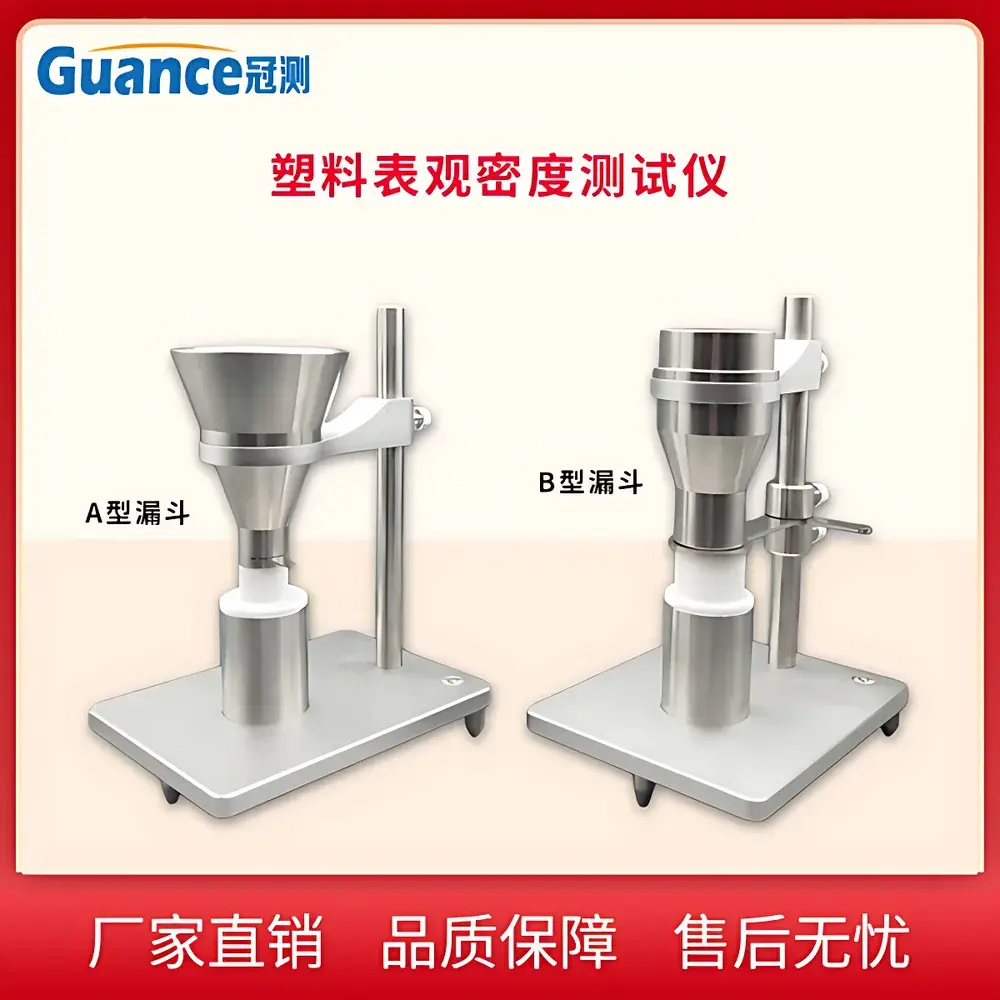
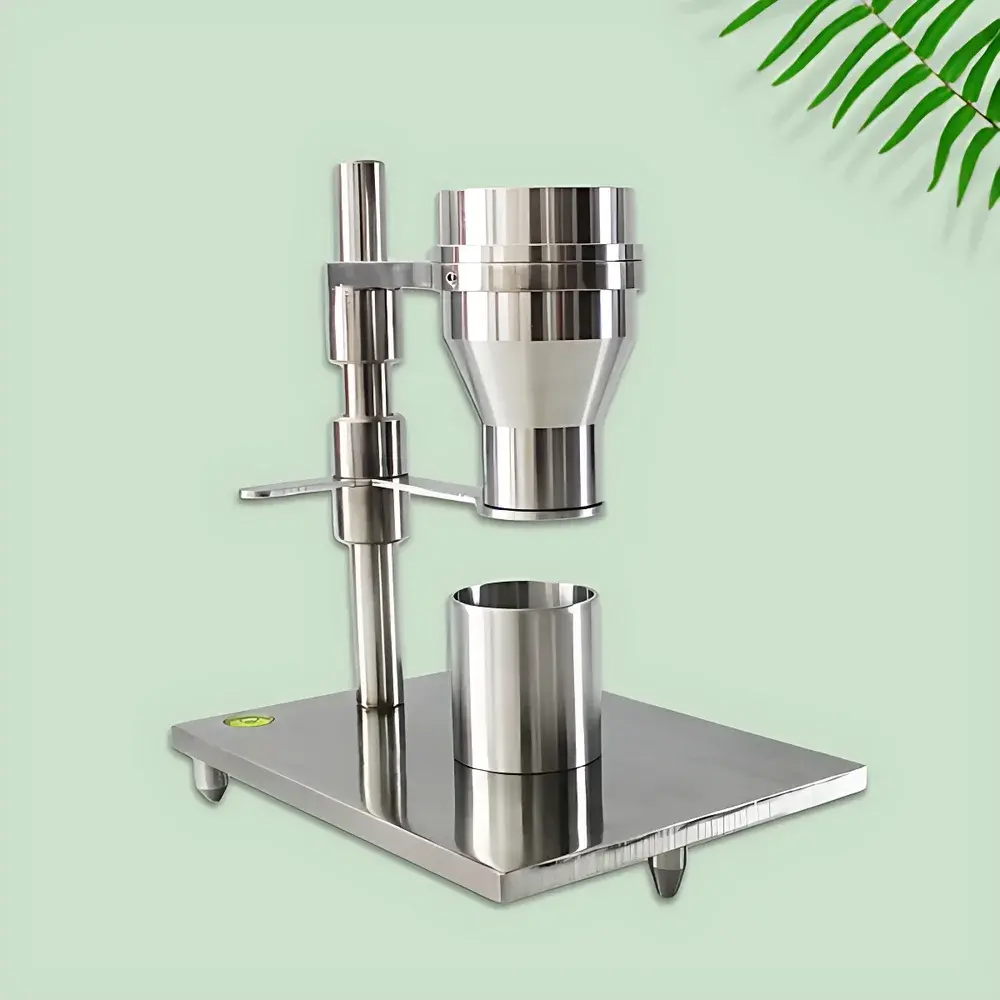
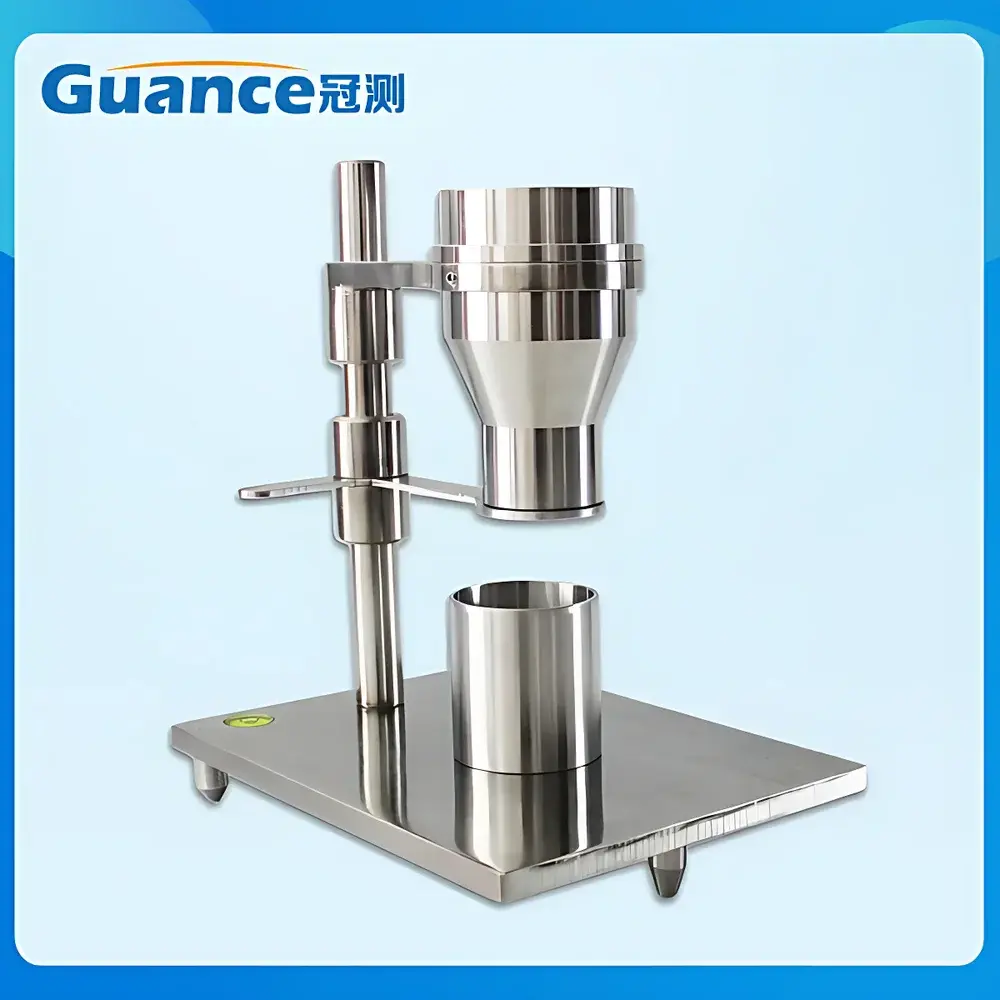
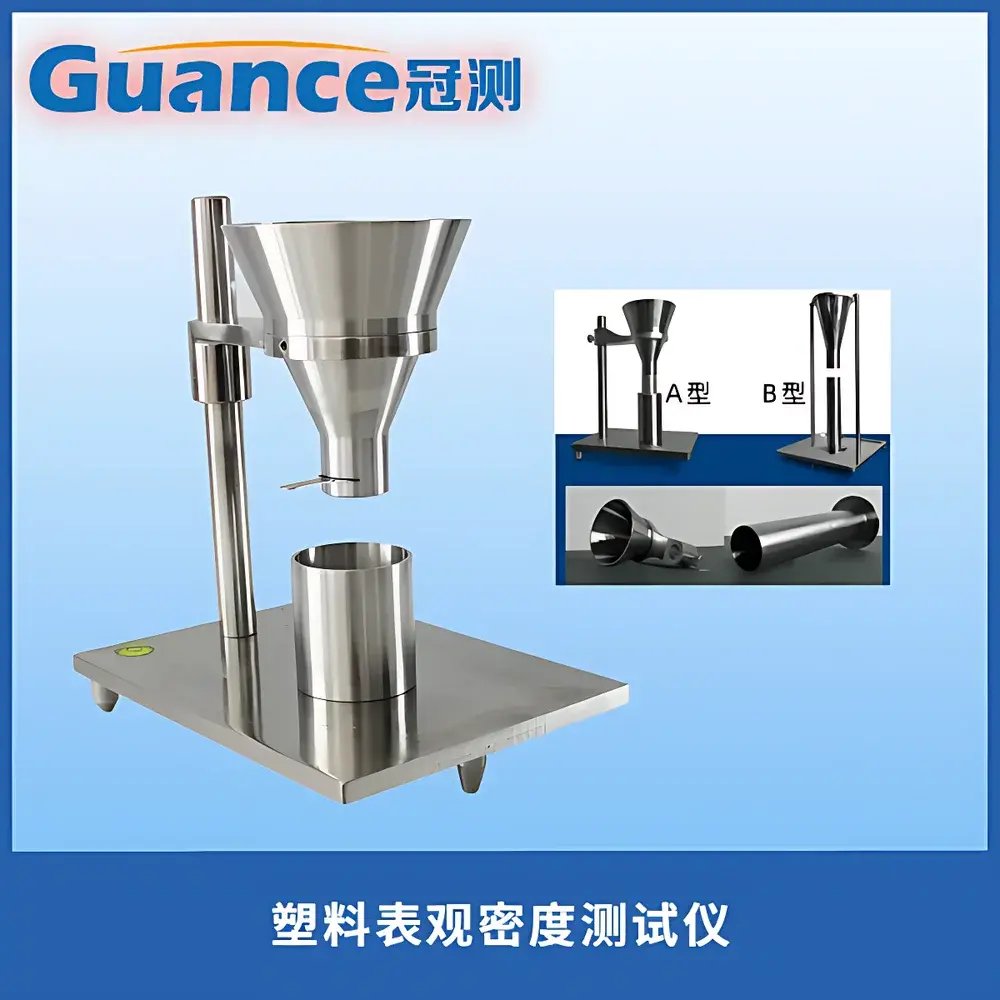
GuanCe Instruments Apparent Density Tester ZK-1895
| Brand | GuanCe Instruments |
|---|---|
| Origin | Beijing, China |
| Manufacturer Type | Authorized Distributor |
| Origin Category | Domestic (China) |
| Model | ZK-1895 |
| Price | USD 1,200 (FOB Beijing) |
| Application Field | General-purpose apparent density testing |
| Instrument Type | True Density Tester |
| Form Factor | Portable |
| Sample Type Support | Solid and Liquid |
| Density Measurement Range | 0–2 g/cm³ |
| Maximum Weighing Capacity | 20 g |
| Density Resolution | 0.1 g/cm³ |
| Display | Digital LCD |
| Operating Temperature Range | 0–40 °C |
| Repeatability | ±0.001 g/cm³ |
| Minimum Sample Volume | 1 mL (for liquids) / 1 g (for powders) |
| Funnel Outlet Diameter | 2.54 ± 0.16 cm |
| Funnel Top Diameter | 12.7 ± 1.0 cm |
| Funnel-to-Cup Vertical Gap | 3.8 cm |
| Cup Height | 24.0 ± 0.1 cm |
| Cup Internal Volume | 490 ± 2.0 mL |
| Funnel Angle | 24° |
| Construction Material | Stainless Steel (AISI 304) |
Overview
The GuanCe Instruments Apparent Density Tester ZK-1895 is a precision-engineered, portable instrument designed for standardized determination of apparent density (also known as bulk density) of free-flowing powders and granular solids—according to ASTM D1895 Method A (Funnel Flow Method) and ISO 697:2017. Unlike true density analyzers that rely on gas pycnometry or liquid displacement, the ZK-1895 implements a gravimetric volumetric method: a defined mass of powder is allowed to flow under gravity through a calibrated stainless-steel funnel into a fixed-volume cup; apparent density is calculated as mass divided by cup volume. This principle ensures high reproducibility for quality control in pharmaceutical excipient handling, metal powder sintering feedstock evaluation, catalyst manufacturing, and additive manufacturing (powder bed fusion) process validation. The device operates without consumables, external pressure sources, or vacuum systems—making it ideal for benchtop use in QC labs, production floors, and field deployment.
Key Features
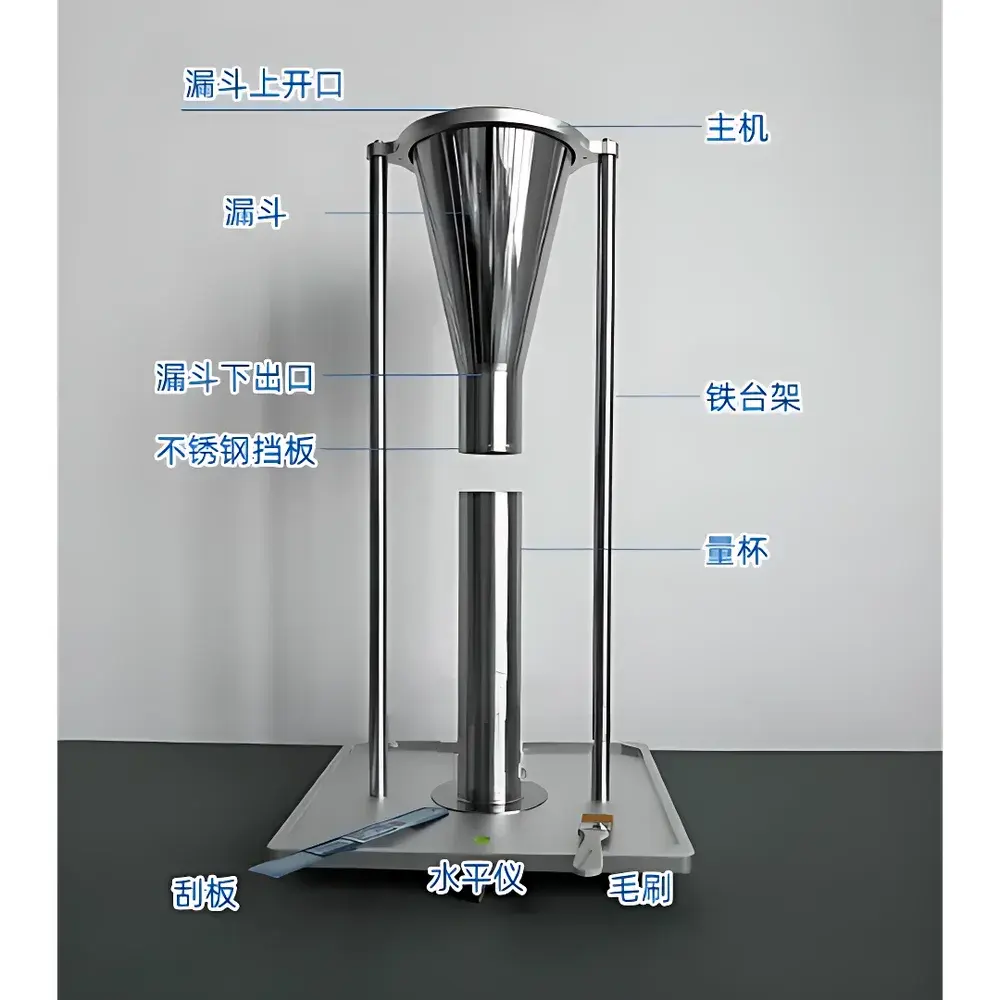
- Stainless steel (AISI 304) construction throughout—including funnel, cup, support stand, scraper, and baffle—ensuring corrosion resistance, mechanical rigidity, and long-term dimensional stability.
- Calibrated volumetric cup with nominal capacity of 490.0 ± 2.0 mL, manufactured to tight tolerances (height: 24.0 ± 0.1 cm; internal geometry verified via traceable metrology).
- Precision-machined funnel featuring a 24° included angle and controlled outlet diameter (2.54 ± 0.16 cm), optimized to minimize wall adhesion and promote laminar powder flow per ASTM D1895 specifications.
- Digital weighing interface with 0.1 g resolution and 20 g maximum capacity—integrated for direct mass input or compatible with external analytical balances meeting Class II or higher accuracy per OIML R76.
- Modular, tool-free assembly: funnel height above cup (3.8 cm) is fixed and non-adjustable to maintain compliance with standard test geometry.
- Portable form factor (net weight < 4.5 kg) with integrated leveling feet and anti-slip base—enabling stable operation on non-dedicated lab surfaces.
Sample Compatibility & Compliance
The ZK-1895 supports routine apparent density measurement of dry, free-flowing particulates including but not limited to: polymer powders (e.g., PA12, PEEK), ceramic precursors (Al₂O₃, ZrO₂), metal alloys (Ti-6Al-4V, Inconel 718), pharmaceutical blends, food-grade starches, and graphite anode materials. It is unsuitable for cohesive, hygroscopic, electrostatically charged, or fibrous materials without prior conditioning (e.g., drying, glidant addition). The instrument conforms to geometric and procedural requirements of ASTM D1895 (Method A), ISO 697:2017, and USP Powder Density and Aerated Density. While not a GLP/GMP-certified system out-of-the-box, its mechanical design permits full auditability: all critical dimensions are documented, traceable to NIST-traceable calipers and volumetric standards; calibration certificates for supporting balances must be maintained separately per laboratory SOPs.
Software & Data Management
The ZK-1895 is a hardware-only instrument with no embedded microprocessor or firmware. Density calculations are performed manually or via external spreadsheet templates (provided in English and metric units). Users record mass (g), enter cup volume (mL), and compute ρ = m/V (g/cm³). For regulated environments, laboratories may integrate the device into validated electronic lab notebooks (ELN) or LIMS platforms using standardized data entry protocols. All mechanical components are labeled with serial-numbered identification plates for asset tracking. No FDA 21 CFR Part 11 functionality is implemented—data integrity relies on documented operator training, controlled forms, and supervised review per ISO/IEC 17025 Clause 7.7.
Applications
- Pharmaceutical solid dosage development: monitoring batch-to-batch consistency of active pharmaceutical ingredient (API) and excipient blends prior to compression.
- Additive manufacturing qualification: screening metal and polymer powders for flowability and packing behavior in powder bed fusion systems.
- Catalyst manufacturing: assessing particle morphology effects on reactor bed density and pressure drop modeling.
- Quality assurance in battery material production: evaluating graphite and silicon anode powders for electrode slurry formulation stability.
- Academic research in powder rheology: serving as a primary reference method alongside dynamic flow testers (e.g., FT4) and shear cell analyzers.
FAQ
Is the ZK-1895 compliant with ASTM D1895 Method A?
Yes—the funnel geometry, cup volume, and vertical spacing fully satisfy the dimensional tolerances specified in ASTM D1895-18 (Reapproved 2023), including the 24° funnel angle and 3.8 cm funnel-to-cup gap.
Can it measure true (absolute) density?
No. The ZK-1895 measures apparent (bulk) density only. True density requires gas pycnometry (e.g., Micromeritics AccuPyc) or liquid displacement methods.
What is the minimum sample requirement for reliable results?
Minimum mass is 1 g for powders; minimum volume is 1 mL for low-viscosity liquids—but note that liquid testing is outside ASTM D1895 scope and intended only for comparative internal QC.
Does the instrument require annual recalibration?
No electronic calibration is needed. However, users must verify cup volume annually using certified water displacement or volumetric standard, and confirm funnel dimensions if subjected to mechanical impact.
Is technical support available in English?
Yes—GuanCe Instruments provides English-language user documentation, application notes, and remote troubleshooting via email and video call for international distributors and end-users.



