
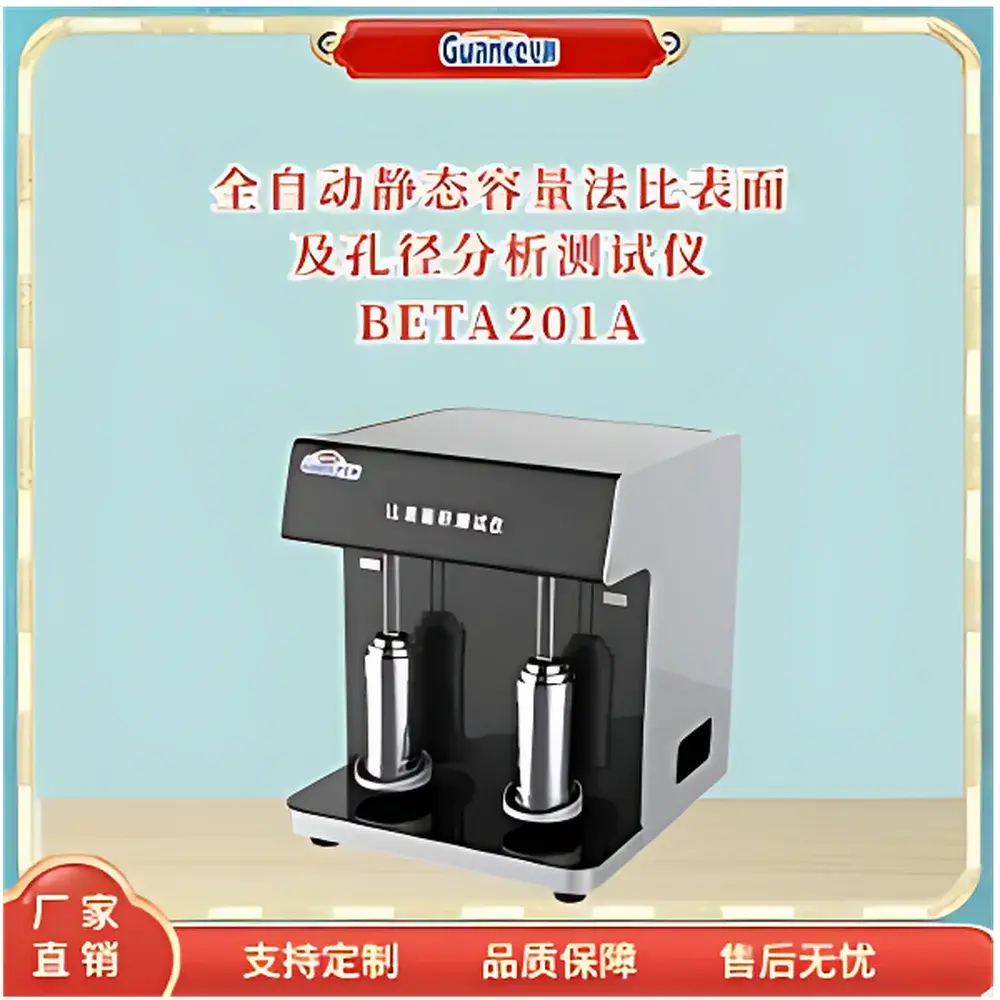
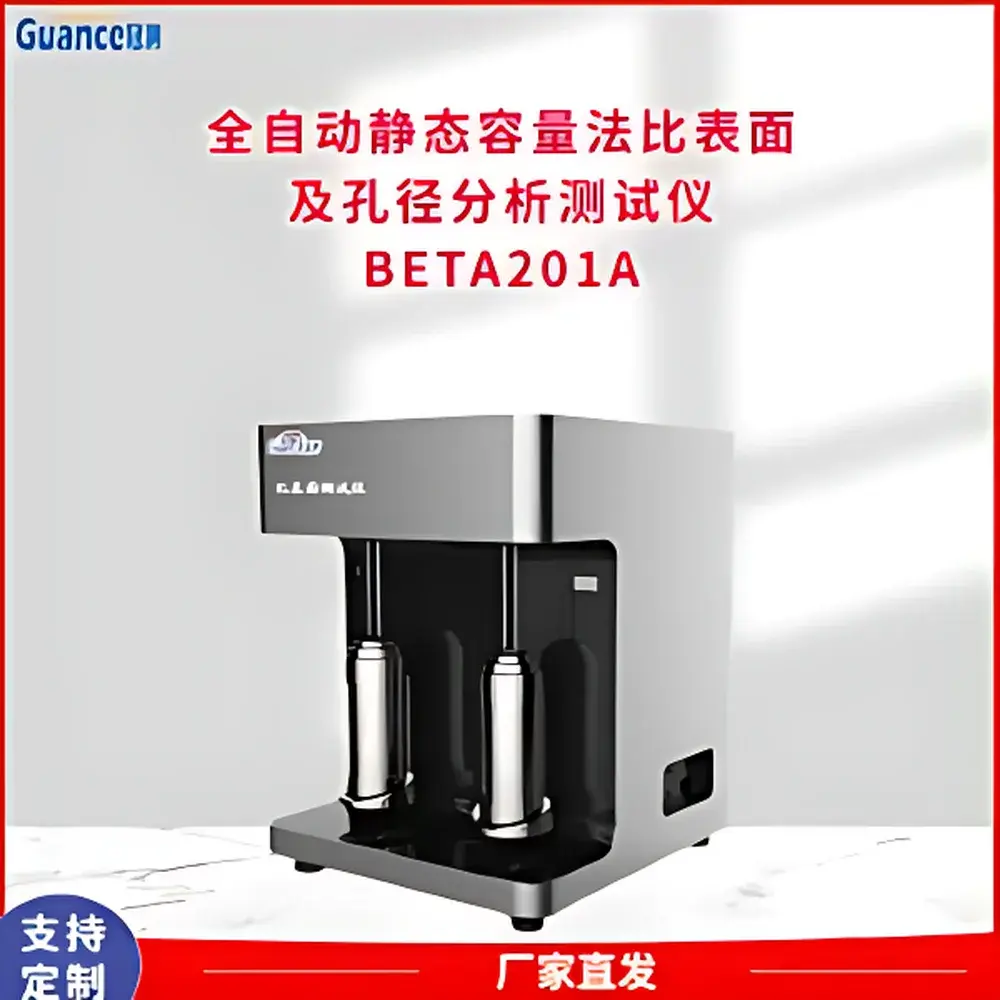
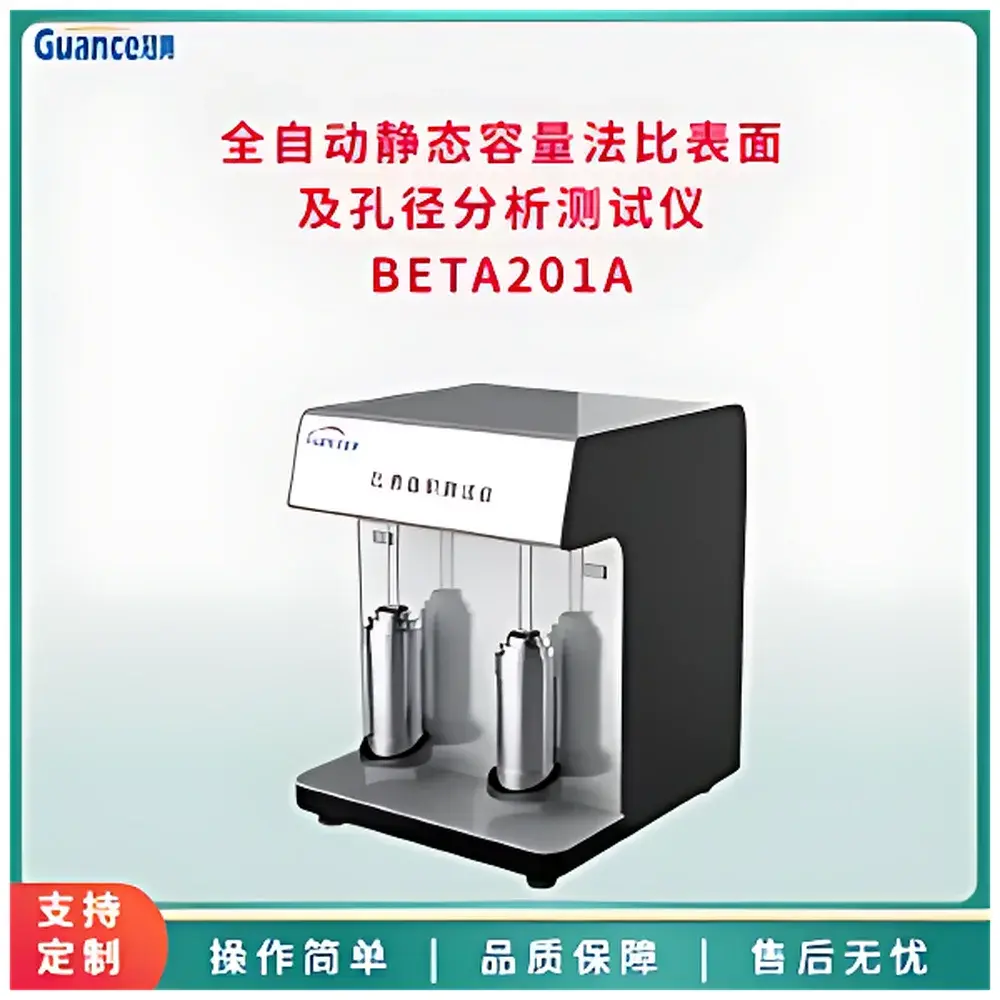
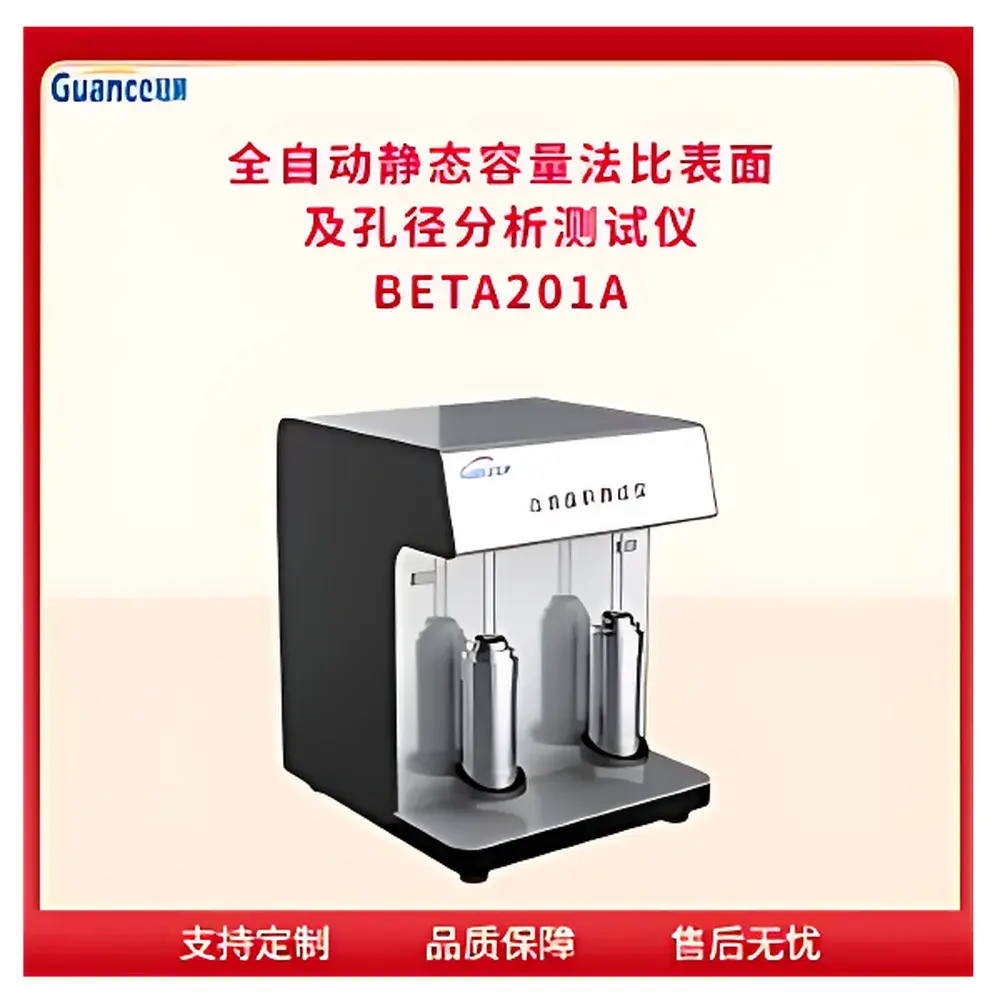
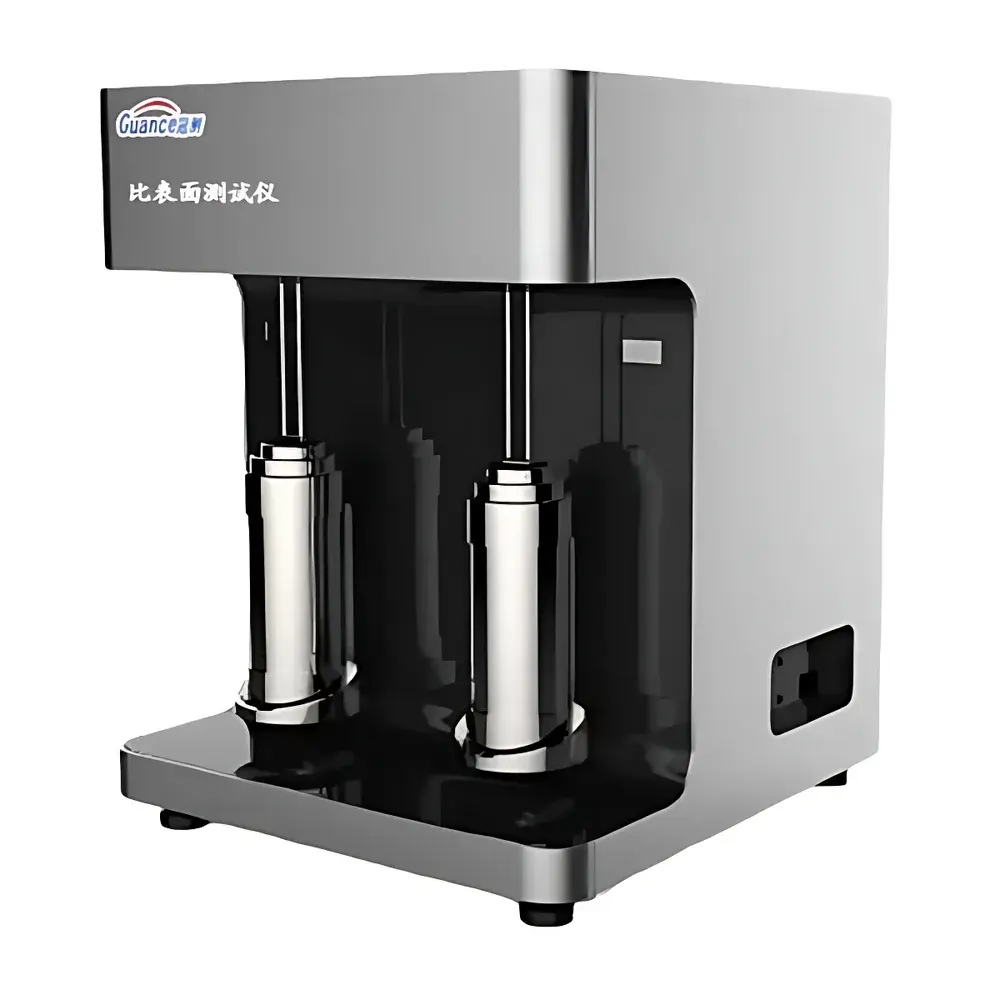
GuanCe BETA201A Multifunctional True Density and Porosity Analyzer
| Brand | GuanCe |
|---|---|
| Origin | Beijing, China |
| Manufacturer Type | Authorized Distributor |
| Country of Origin | China |
| Model | BETA201A |
| Instrument Type | Specific Surface Area and Pore Size Analyzer |
| Principle | Static Volumetric Method (Gas Adsorption) |
| Analysis Stations | 1 |
| Surface Area Range | 0.0001 m²/g (using Kr) to unlimited |
| Pressure Range | 0–133 kPa |
| P/P₀ Resolution | up to 10⁻⁷ |
| Vacuum Level | ≤1×10⁻⁸ Torr (with optional turbomolecular pump) |
| Detection Limit for Pore Volume | 0.0001 cm³/g (N₂) |
| Pore Diameter Range | 0.35 nm – 500 nm |
| Repeatability | <±1% |
| Analysis Time | ~25 min (BET), ~3.5 h (full pore distribution) |
| Gas Compatibility | N₂, Ar, Kr, CO₂, NH₃, H₂, CO, O₂, CH₄, C₄H₁₀ (non-corrosive only) |
| Interface | USB or Ethernet (RJ45) |
| Data Export | PDF, Excel, multi-curve overlay, bilingual (EN/CN) reporting |
| Safety Protections | Overpressure, overcurrent, short-circuit, leakage, and software operation lockout |
Overview
The GuanCe BETA201A Multifunctional True Density and Porosity Analyzer is an advanced static volumetric gas adsorption instrument engineered for high-precision characterization of specific surface area, pore size distribution, true density, and porosity across solid materials. It operates on the fundamental principles of gas adsorption thermodynamics and capillary condensation, adhering to ISO 9277 (BET surface area), ISO 15901 (pore size analysis), and ASTM D3663 (carbon black surface area). The system employs a dual-sensor architecture—one dedicated to real-time P₀ (saturation pressure) measurement and the other to sample analysis—ensuring thermodynamic consistency and eliminating drift-related errors in low-P/P₀ isotherm regions. Its fully automated vacuum manifold, constructed from electropolished stainless steel with metal-sealed joints and silver-plated internal surfaces, maintains ultra-high vacuum integrity (<1×10⁻⁸ Torr with optional turbomolecular pumping), critical for accurate micropore quantification and low-pressure Kr adsorption measurements down to 0.0001 m²/g.
Key Features
- Single-station configuration optimized for research-grade reproducibility and laboratory throughput.
- Integrated dual-capacitance pressure transducers (0–10 Torr and 0–1000 Torr ranges) with 24-bit ADC resolution and ±0.1% full-scale accuracy, enabling precise isotherm acquisition across 1,000+ data points.
- Patented dual-path vacuum routing: independent degas and analysis manifolds prevent cross-contamination during sample transfer; heating and analysis occur in situ without manual repositioning.
- Large-capacity liquid nitrogen Dewar (70-hour autonomy) with isothermal jacket and optional auto-refill capability for unattended long-duration analyses.
- Intelligent vacuum management: adaptive pump cycling reduces acoustic noise, extends pump service life, and minimizes thermal load on sensitive sensors.
- Automatic atmospheric re-equilibration and emergency recovery protocols safeguard sample integrity during power interruption or hardware fault events.
- True density module utilizing helium pycnometry principles (optional He-free mode available via N₂ calibration) compliant with ASTM D5550 and ISO 12154.
Sample Compatibility & Compliance
The BETA201A accommodates powders (e.g., battery cathodes, MOFs, activated carbons), granules, monoliths, fibers, and thin films—provided samples are non-volatile, thermally stable below 400 °C, and chemically inert toward selected adsorbates. It supports multi-gas analysis (N₂, Ar, Kr, CO₂, etc.) to address material-specific limitations: Kr for ultra-low-surface-area ceramics and geological samples; CO₂ for narrow micropore assessment per Dubinin–Astakhov modeling; Ar for enhanced resolution in the 0.35–2 nm range. All operational firmware and data handling comply with GLP audit requirements, including electronic signatures, time-stamped audit trails, and 21 CFR Part 11–ready export formats (PDF/A, encrypted Excel). Calibration traceability follows NIST SRM protocols for pressure and temperature inputs.
Software & Data Management
The proprietary GuanCe Analytical Suite v4.2 provides bilingual (English/Chinese) GUI, remote Ethernet control via standard TCP/IP, and centralized multi-instrument supervision through router-based network deployment. It embeds >30 standardized analysis models—including BET, Langmuir, t-plot, αs-method, BJH, DH, HK, and NLDFT—and allows user-defined model libraries with parameter constraints for proprietary material classes. Raw isotherm data, derivative curves (dV/dlogD), cumulative/micropore volume plots, and statistical thickness curves are stored in a relational database with version-controlled metadata (sample ID, operator, date/time, gas type, degas protocol). Export functions include batch PDF report generation with customizable templates, side-by-side comparative overlays of historical datasets, and CSV-compatible structured outputs for third-party statistical packages (e.g., Python Pandas, MATLAB).
Applications
This analyzer serves QC laboratories validating catalyst support surface uniformity (e.g., Pt/Al₂O₃), R&D teams optimizing lithium-ion battery anode porosity (Si/C composites), geotechnical engineers assessing shale matrix permeability via mercury-free pore network reconstruction, and pharmaceutical developers correlating mesoporous silica carrier surface heterogeneity with drug loading efficiency. It further enables regulatory submissions requiring ISO-compliant surface area verification for medical device coatings (ISO 10993-18) and EPA Method 9071A–aligned carbon black characterization in tire compounds.
FAQ
Does the BETA201A require helium for true density measurement?
No—helium-free operation is supported using nitrogen-based calibration against certified reference materials; however, He pycnometry remains available as an optional module for highest-density accuracy per ASTM D5550.
Can the instrument perform simultaneous degas and analysis?
Yes—the patented co-located degas/analysis station enables concurrent thermal treatment and adsorption measurement without sample relocation, minimizing atmospheric exposure and preserving surface reactivity.
What vacuum level is achievable without the optional molecular pump?
Standard configuration achieves ≤1×10⁻⁴ Torr (10⁻² Pa); the optional turbomolecular pump upgrades performance to ≤1×10⁻⁸ Torr for rigorous micropore analysis and Kr-based ultra-low-surface-area determination.
Is remote diagnostic support available?
Yes—Ethernet connectivity enables secure remote login for firmware diagnostics, parameter validation, and real-time sensor health monitoring via authenticated client access.
How is data integrity ensured during extended unattended runs?
The system logs all hardware states, pressure transients, and temperature profiles at 100 ms intervals; upon unexpected shutdown, it resumes from last validated isotherm point using checksum-verified buffer storage.



