
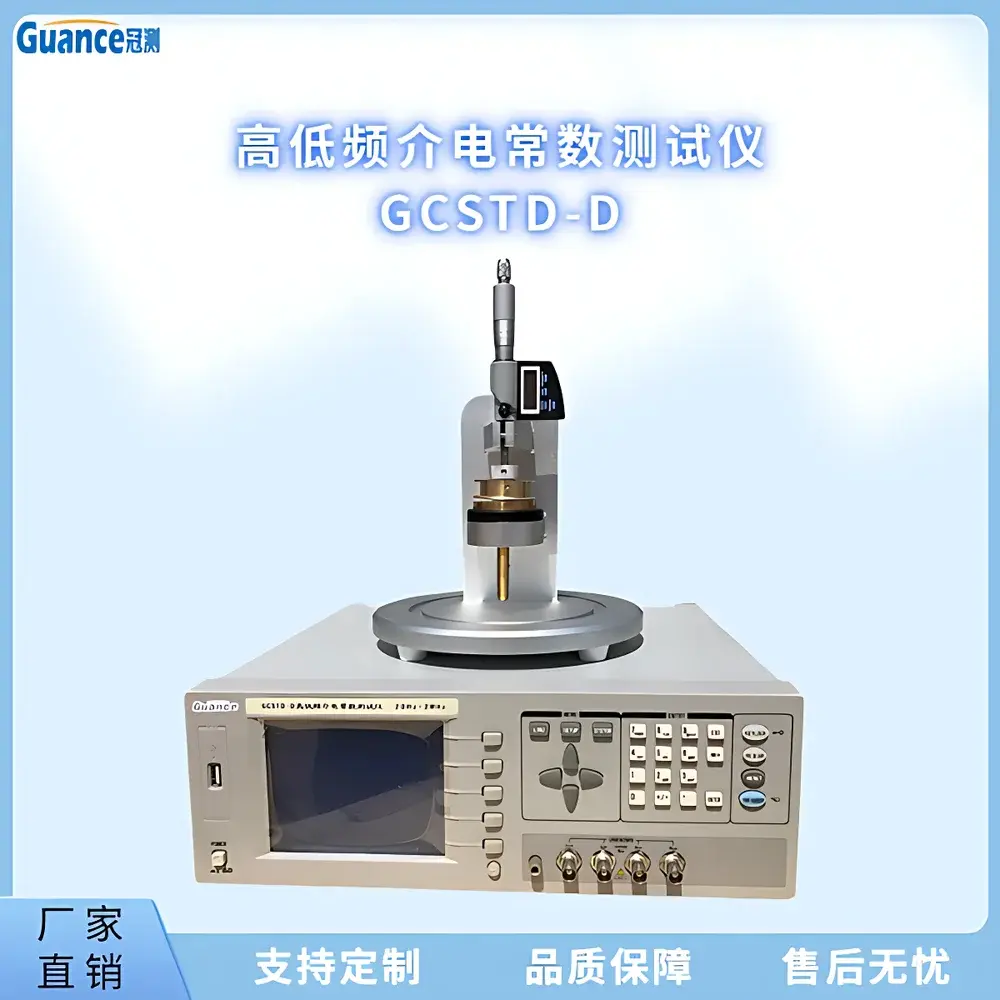
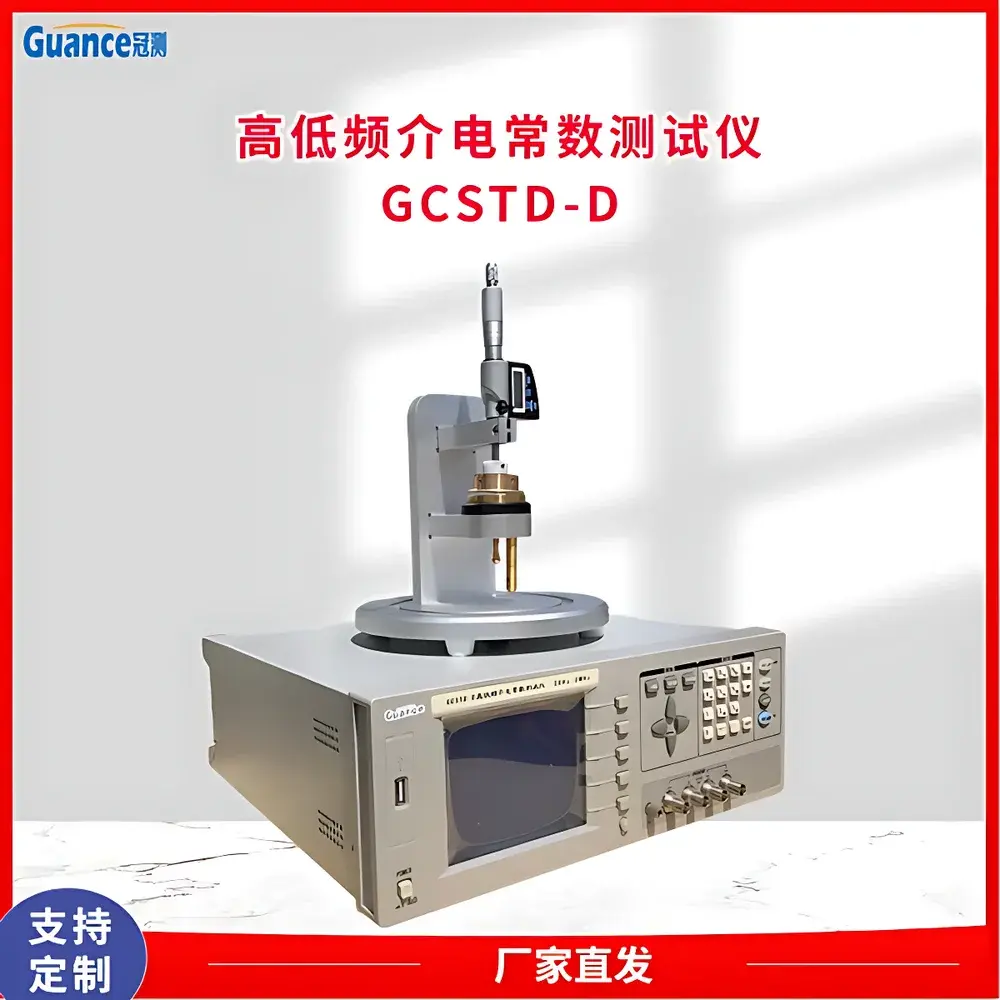
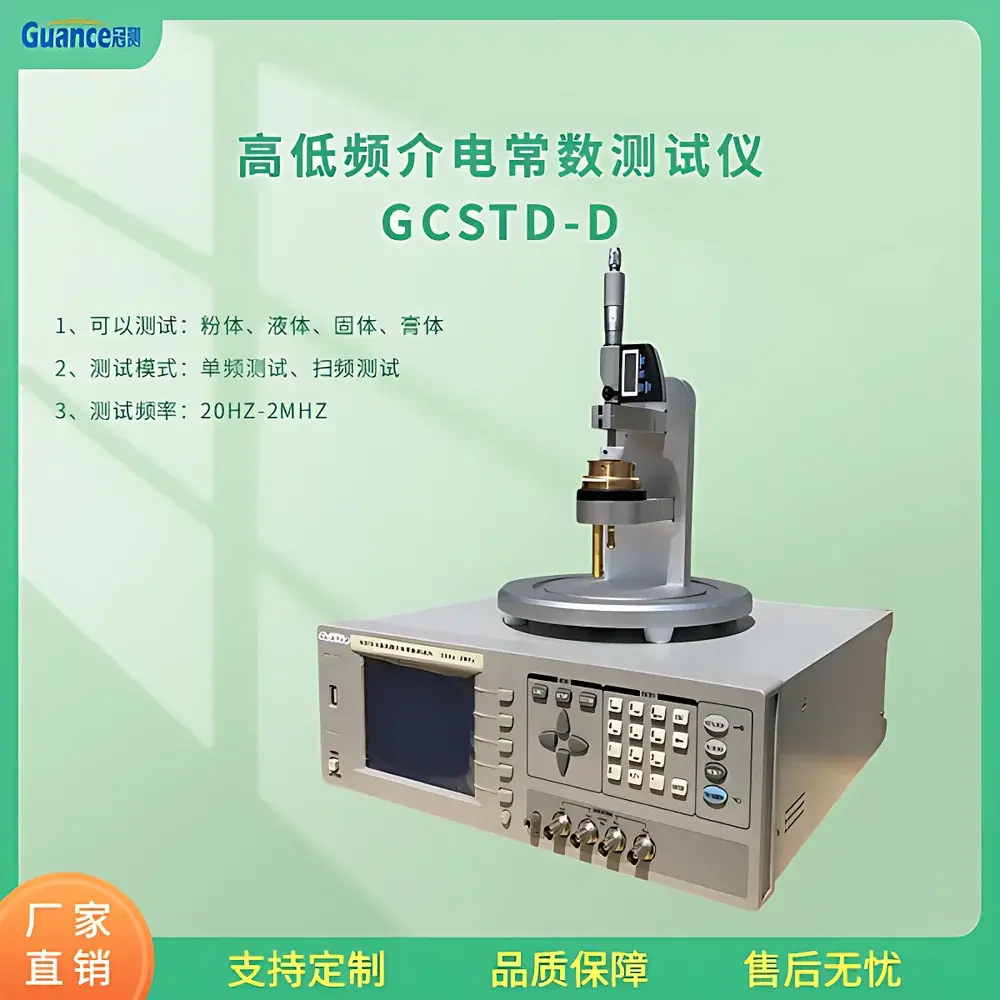
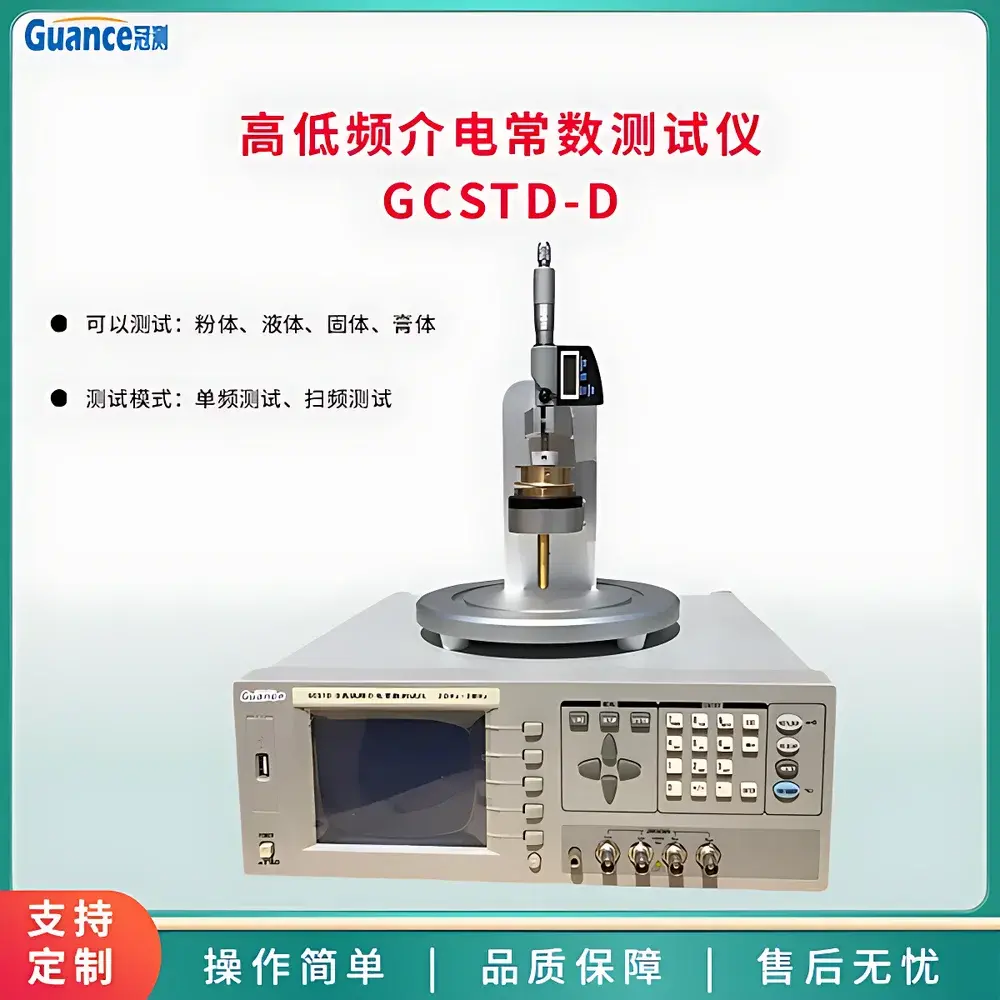
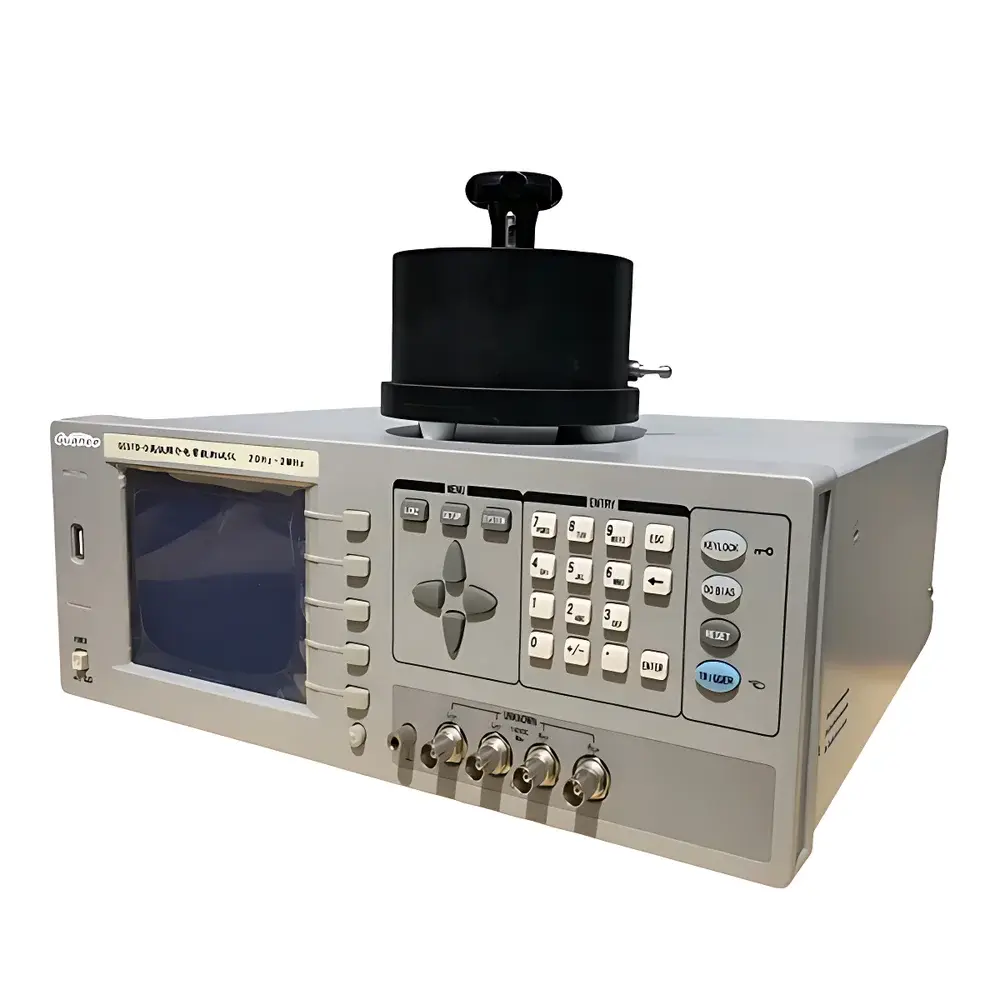
GCSTD-D4 Audio-Frequency Dielectric Constant and Loss Tangent Analyzer by Guance Instruments
| Brand | Guance Instruments |
|---|---|
| Origin | Beijing, China |
| Manufacturer Type | Authorized Distributor |
| Country of Origin | China |
| Model | GCSTD-D4 |
| Price | USD 2,600 (FOB Beijing) |
| Frequency Range | 20 Hz – 2 MHz (10 mHz resolution) |
| Test Signal Level | 10 mV – 5 Vrms (1 mV step) |
| Basic Accuracy | ±0.1% |
| Measurement Speed | Up to 200 readings/sec |
| Display | 320×240 dot-matrix graphical LCD |
| Resolution | 5-digit |
| Impedance Parameters | 22 configurable combinations (e.g., C–D, C–Q, L–Q, R–X, Z–θ) |
| Electrode Options | Fixed parallel-plate electrodes (Ø38 mm / Ø50 mm standard), liquid cell (15 mL capacity), powder-specific electrode kits |
| Sample Forms | Solid sheets, films, pellets, liquids, pastes, powders, irregular geometries |
| Test Methods | Contact (for flat, uniform-thickness specimens) and Non-contact (capacitive coupling for rough or curved surfaces) |
| Compliance | GB/T 1409–2006, GB/T 1693–2007, ASTM D150–18, IEC 60250:2015 |
| DC Bias | Internal ±10 V / 100 mA |
| ALA/ALC | Automatic Level Control with V/I monitoring |
| Scan Modes | 10-point frequency, voltage, or bias list sweep |
| Data Storage | 20 instrument setups |
| Interface | USB Host/Device, RS232, GPIB (optional), LAN (optional) |
| Firmware Update | Via USB flash drive |
| Language | English / Chinese switchable |
Overview
The GCSTD-D4 Audio-Frequency Dielectric Constant and Loss Tangent Analyzer is an impedance-based precision measurement system engineered for the characterization of dielectric properties across the audio-frequency spectrum (20 Hz to 2 MHz). It operates on the principle of AC bridge-based admittance spectroscopy, utilizing a four-terminal-pair (Kelvin) configuration to minimize parasitic effects and ensure high reproducibility in complex permittivity (ε* = ε′ − jε″) determination. Designed for laboratory-grade materials evaluation under controlled environmental conditions, the instrument delivers traceable measurements of relative permittivity (dielectric constant, ε′) and loss tangent (tan δ = ε″/ε′) — critical parameters for quality assurance, formulation development, and failure analysis in electrical insulation, polymer science, and advanced ceramics. Its architecture supports both contact and non-contact electrode configurations, enabling reliable data acquisition from rigid solids, viscous liquids, dispersive powders, and heterogeneous composites without destructive sample preparation.
Key Features
- Wide dynamic frequency coverage: 20 Hz–2 MHz with 10 mHz resolution, optimized for audio- and low-RF domain dielectric dispersion analysis
- High-stability signal source with programmable amplitude (10 mV–5 Vrms, 1 mV step) and automatic level control (ALC) to maintain consistent excitation across impedance ranges
- Dual-mode electrode compatibility: Standard fixed-plate electrodes (Ø38 mm, compliant with GB/T 1409–2006), liquid cell (15 mL volume, sealed design), and customizable powder electrodes for volumetric density control
- 22 selectable impedance parameter pairs—including C–D, L–Q, Z–θ, and G–B—enabling direct extraction of ε′ and tan δ via calibrated electrode geometry and thickness inputs
- Real-time graphical scanning: 10-point frequency, voltage, or DC bias sweeps with on-screen Bode, Cole–Cole, or Nyquist plots
- Internal DC bias generator (±10 V / 100 mA) and external bias interface supporting dual TH1776 current sources for high-current polarization studies (up to ±40 A)
- Comprehensive data handling: 20 onboard setup memories, USB Host firmware updates, and multi-protocol connectivity (RS232, USB Device, optional GPIB/LAN) for automated test sequencing
Sample Compatibility & Compliance
The GCSTD-D4 accommodates diverse physical states and geometries: flat solid dielectrics (films, wafers, molded parts), Newtonian and non-Newtonian liquids (oils, solvents, electrolytes), free-flowing or cohesive powders (ceramic precursors, ferrite blends), and semi-solid pastes (electrode slurries, polymer gels). Non-contact mode leverages fringing-field capacitance for rapid screening of irregular or coated samples where electrode contact is impractical. All measurement protocols align with internationally recognized standards: GB/T 1409–2006 (insulating materials), GB/T 1693–2007 (vulcanized rubber), ASTM D150–18 (solid insulators), and IEC 60250:2015 (dielectric constant and loss tangent at power and audio frequencies). The system supports GLP-compliant documentation through timestamped data export and optional audit-trail-enabled software modules.
Software & Data Management
While the GCSTD-D4 operates as a standalone analyzer with embedded firmware, its communication interfaces enable seamless integration into automated test environments. Raw impedance data (Z, θ, C, D, etc.) are exportable in CSV format via USB or RS232. Optional PC-based software provides extended functionality: batch processing of ε′ and tan δ using user-defined electrode constants; statistical trend analysis across temperature or humidity-controlled chambers; and report generation compliant with ISO/IEC 17025 documentation requirements. All firmware revisions undergo version-controlled validation per IEC 62304, and instrument calibration certificates reference NIST-traceable standards.
Applications
- Electrical insulation qualification: Tracking moisture ingress, thermal aging, or partial discharge damage in epoxy resins, polyimide films, and silicone rubbers
- Dielectric material R&D: Correlating ε′ dispersion with molecular relaxation mechanisms in ferroelectric polymers and relaxor ceramics
- Quality control of electronic components: Screening capacitor dielectrics (MLCCs, film caps), transformer oils, and PCB substrate laminates (FR-4, polyimide)
- Magnetic material characterization: Extracting complex permeability (μ* = μ′ − jμ″) from toroidal core impedance when combined with winding geometry models
- Semiconductor process monitoring: Measuring interlayer dielectric (ILD) constant drift during plasma etch or CMP steps
- Liquid electrolyte analysis: Quantifying ion mobility and solvent polarity effects in Li-ion battery formulations
FAQ
What standards does the GCSTD-D4 directly support for calibration and reporting?
It implements measurement algorithms aligned with GB/T 1409–2006, GB/T 1693–2007, ASTM D150–18, and IEC 60250:2015. Calibration verification follows manufacturer-specified procedures using certified reference capacitors traceable to national metrology institutes.
Can the GCSTD-D4 measure thin films (<100 µm) without vacuum or temperature control?
Yes—provided surface flatness and electrode contact uniformity are maintained. For sub-50 µm layers, non-contact mode or guarded electrode configurations are recommended to mitigate edge effects and stray capacitance.
Is FDA 21 CFR Part 11 compliance available?
The base instrument does not include electronic signature or audit trail features. However, optional software add-ons provide 21 CFR Part 11–compliant data archiving, user access control, and change history logging when deployed in regulated pharmaceutical or medical device QA labs.
How is electrode calibration performed for non-standard geometries?
Users input known dimensions (diameter, gap, area) and reference measurements from air/dielectric standards. The firmware applies geometric correction factors internally; no hardware recalibration is required for electrode swaps.
What is the minimum sample volume required for liquid testing?
The standard liquid cell holds 15 mL and requires full immersion of the electrode pair. For volumes <5 mL, custom micro-cell accessories (not included) can be configured upon request.



