
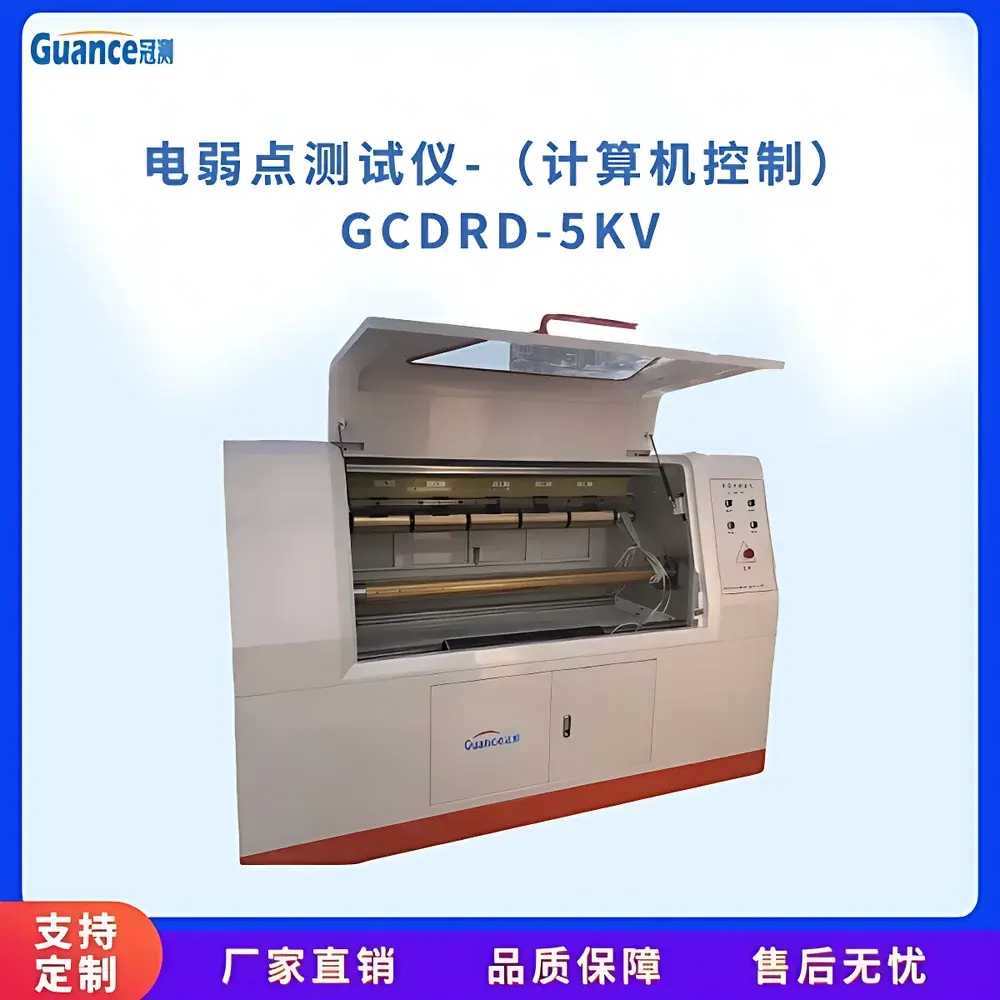
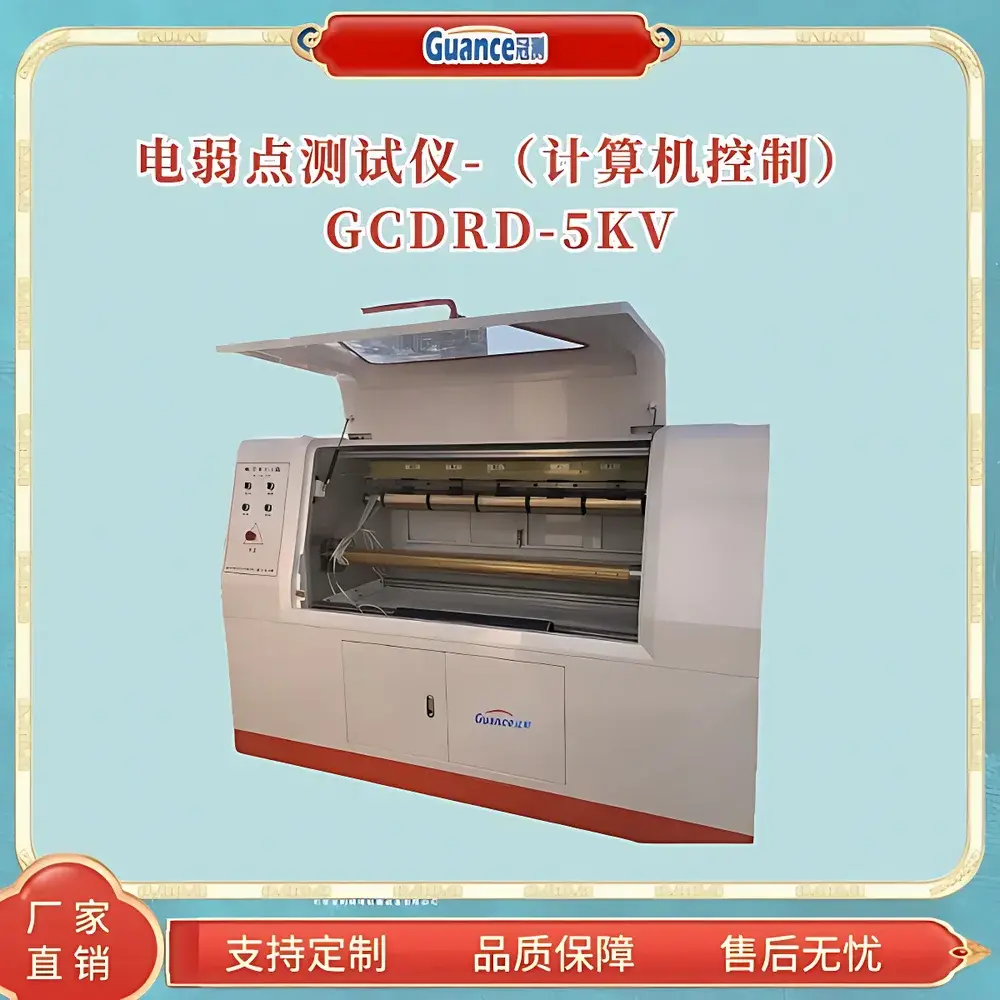
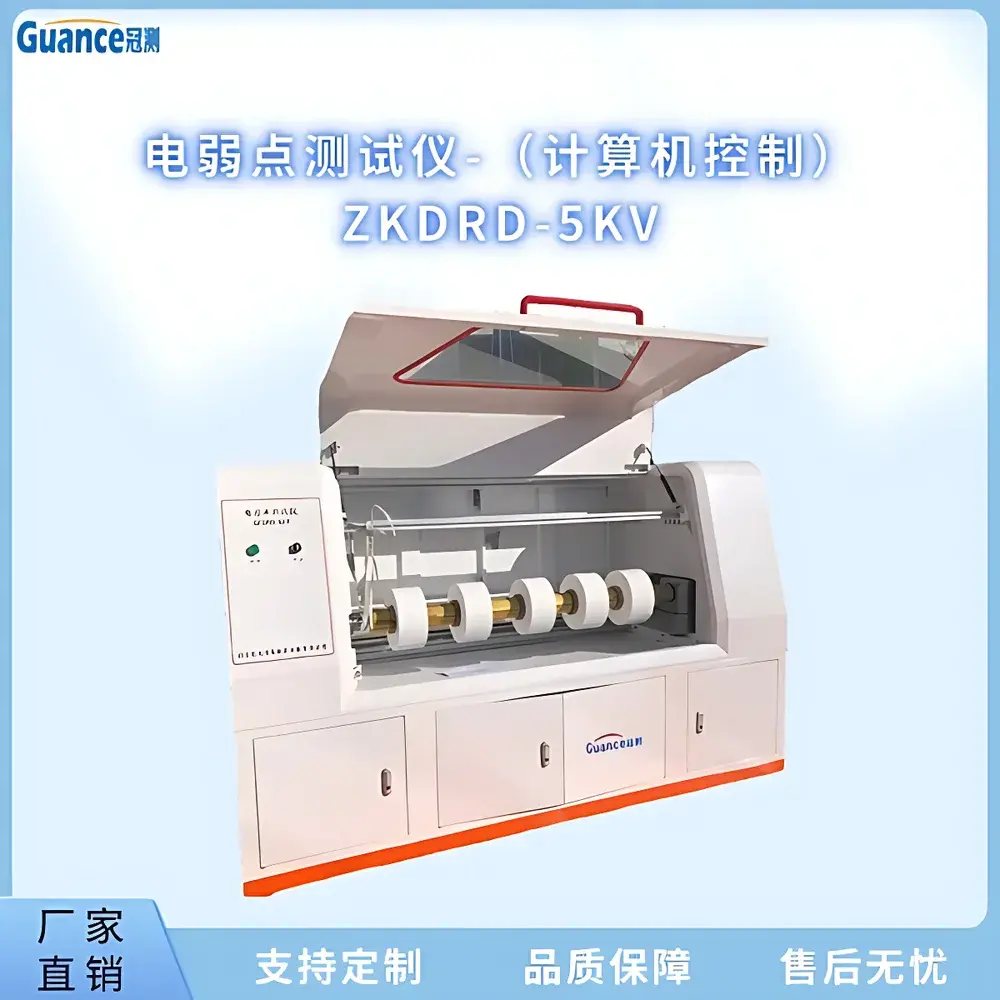
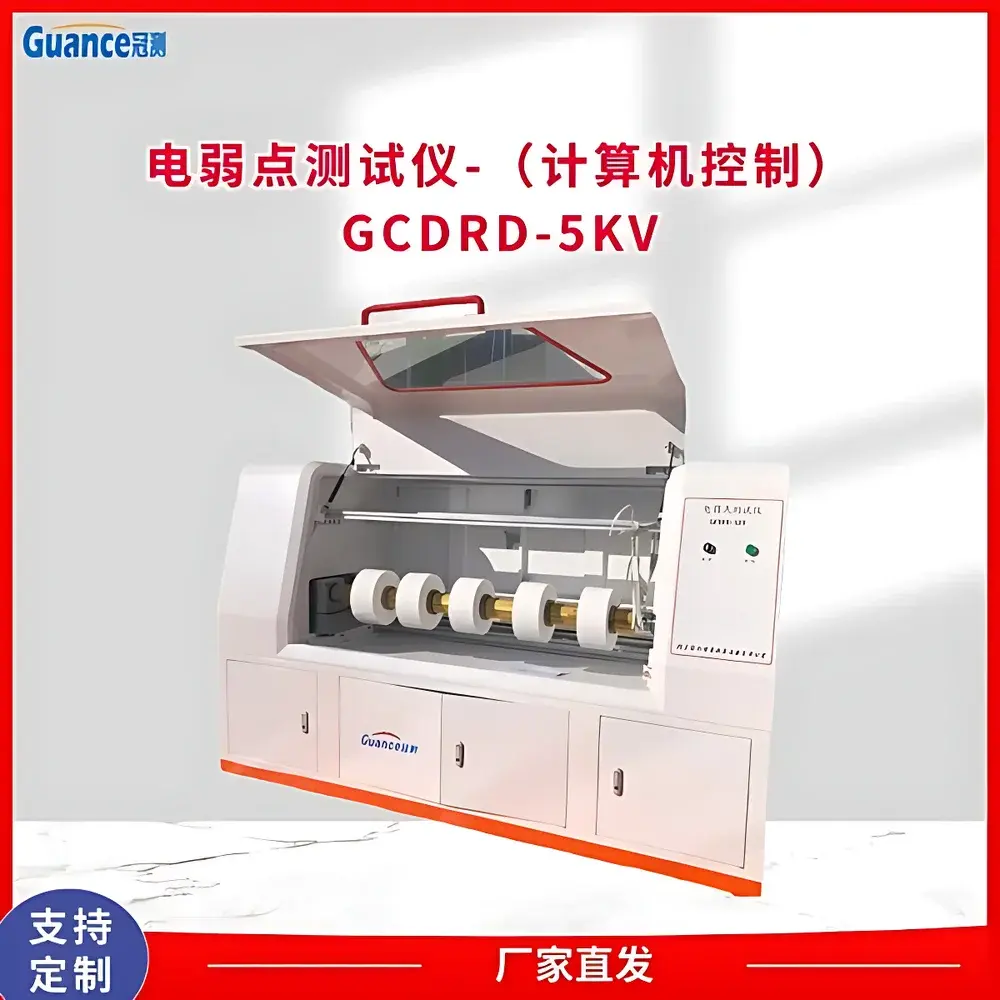
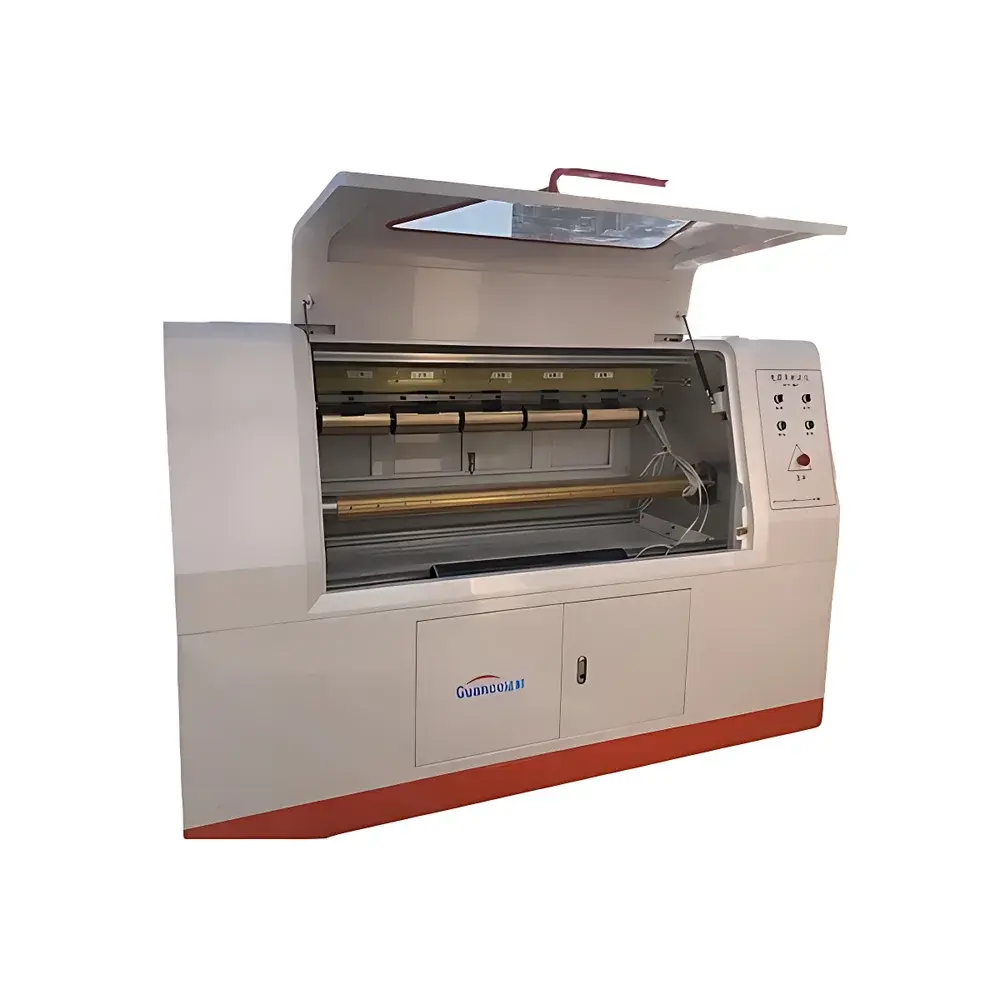
GuanCe Instruments GCDRD-5KV4 Electrical Weak Point Tester for Polymeric Insulating Films
| Brand | GuanCe Instruments |
|---|---|
| Origin | Beijing, China |
| Manufacturer Type | Authorized Distributor |
| Region Classification | Domestic (China) |
| Model | GCDRD-5KV4 |
| Price | USD 2,100 (FOB Beijing) |
Overview
The GuanCe Instruments GCDRD-5KV4 Electrical Weak Point Tester is a dedicated, microprocessor-controlled instrumentation system engineered for quantitative assessment of electrical defect density in thin polymeric insulating films—specifically designed to comply with GB/T 13542.2–2009 and IEC 60674-2:1988. It operates on the principle of controlled DC voltage ramping across a continuously moving film sample under standardized electrode geometry and environmental conditions. As voltage increases at a programmable linear rate (e.g., 0.5–5 kV/s), the system detects localized dielectric breakdown events—termed “electrical weak points”—which manifest as transient current spikes exceeding a user-defined threshold. Each event is spatially resolved via synchronized encoder-based position tracking, enabling precise localization along the film length. The instrument reports are traceable, repeatable, and directly quantifiable as weak points per square meter (WP/m²), a critical quality metric for manufacturers of capacitor-grade polypropylene (PP), polyester (PET), and polyurethane (PU) films used in high-reliability energy storage and power electronics applications.
Key Features
- Programmable DC voltage ramp: 0–5.0 kV range with adjustable ramp rate (0.1–10.0 kV/s) and precision ±1% full-scale linearity
- Motorized, servo-controlled film transport system with speed regulation from 0.1–5.0 m/min, ensuring consistent stress distribution during testing
- Real-time acquisition of breakdown voltage (kV), leakage current (µA), and spatial coordinates (mm) for each detected weak point
- Integrated encoder feedback loop synchronizes positional data with electrical transients, enabling accurate linear density calculation (WP/m)
- Automated post-test analysis: calculates total weak points, weak lines (clusters ≥3 adjacent points within 10 mm), and normalized WP/m² based on measured film width and travel distance
- Robust grounded chassis design with interlocked safety enclosure, conforming to IEC 61010-1:2010 Class I protection requirements
- Front-panel tactile interface with LCD status display and emergency stop; optional Ethernet/RS-232 for remote control and data export
Sample Compatibility & Compliance
The GCDRD-5KV4 accommodates roll-fed films with thicknesses from 6 µm to 250 µm and widths up to 300 mm. Compatible substrates include biaxially oriented polypropylene (BOPP), polyethylene terephthalate (PET), polyimide (PI), and solvent-cast polyurethane (PU) films—provided surface resistivity exceeds 10¹² Ω·cm and moisture content remains below 0.1 wt%. Test methodology aligns with Clause 5.3 of GB/T 13542.2–2009 (“Determination of electrical weak points”) and Annex B of IEC 60674-2:1988. While not certified to ISO/IEC 17025, the system supports GLP-compliant operation when paired with validated software protocols, audit-trail-enabled data logging, and user-access controls—facilitating internal QA documentation and supplier qualification processes.
Software & Data Management
The embedded Windows-based control software (v3.2+) provides real-time oscillographic visualization of V–t and I–t waveforms during ramping. All raw acquisition data—including timestamp, encoder count, voltage, current, and trigger flags—are stored in .CSV and binary .DAT formats with metadata headers (operator ID, test ID, ambient T/RH, calibration date). Software features include configurable pass/fail limits, statistical summary reports (mean WP/m², standard deviation, max cluster size), and export compatibility with LIMS platforms via ODBC drivers. Audit trail functionality records all parameter changes, test initiations, and result modifications with user login stamps—supporting alignment with FDA 21 CFR Part 11 requirements when deployed in regulated manufacturing environments.
Applications
- Quality assurance of metallized film capacitors: screening incoming BOPP rolls for defect density prior to vacuum metallization
- R&D evaluation of new polymer formulations: correlating additive dispersion homogeneity with weak point suppression efficacy
- Process validation of corona treatment or plasma surface modification: quantifying reduction in WP/m² after surface activation
- Failure analysis of field-failed capacitor windings: retrospective mapping of weak point distribution patterns versus aging conditions
- Supplier qualification audits: objective benchmarking of film suppliers against internal WP/m² specifications (e.g., ≤5 WP/m² for Class X2 AC film)
FAQ
What electrode configuration does the GCDRD-5KV4 use?
It employs a standardized 25 mm diameter cylindrical stainless-steel electrode with guarded edge geometry, per GB/T 13542.2–2009 Fig. 2, mounted in fixed parallel-plate arrangement.
Can the system test non-rolled samples such as cut sheets?
No—it is exclusively designed for continuous web testing; discrete sheet evaluation requires manual positioning systems not included in this model.
Is calibration traceable to national standards?
Voltage calibration is performed using a NIST-traceable high-voltage divider (±0.5% uncertainty); current measurement is verified with a calibrated shunt resistor (±0.25% uncertainty).
Does the software support multi-user permission levels?
Yes—administrator, operator, and viewer roles are configurable, with password protection and activity logs for all privileged actions.
What maintenance is required for long-term accuracy?
Annual verification of ramp linearity and encoder resolution is recommended; electrode cleaning with isopropyl alcohol after every 50 test hours prevents carbon tracking buildup.



