
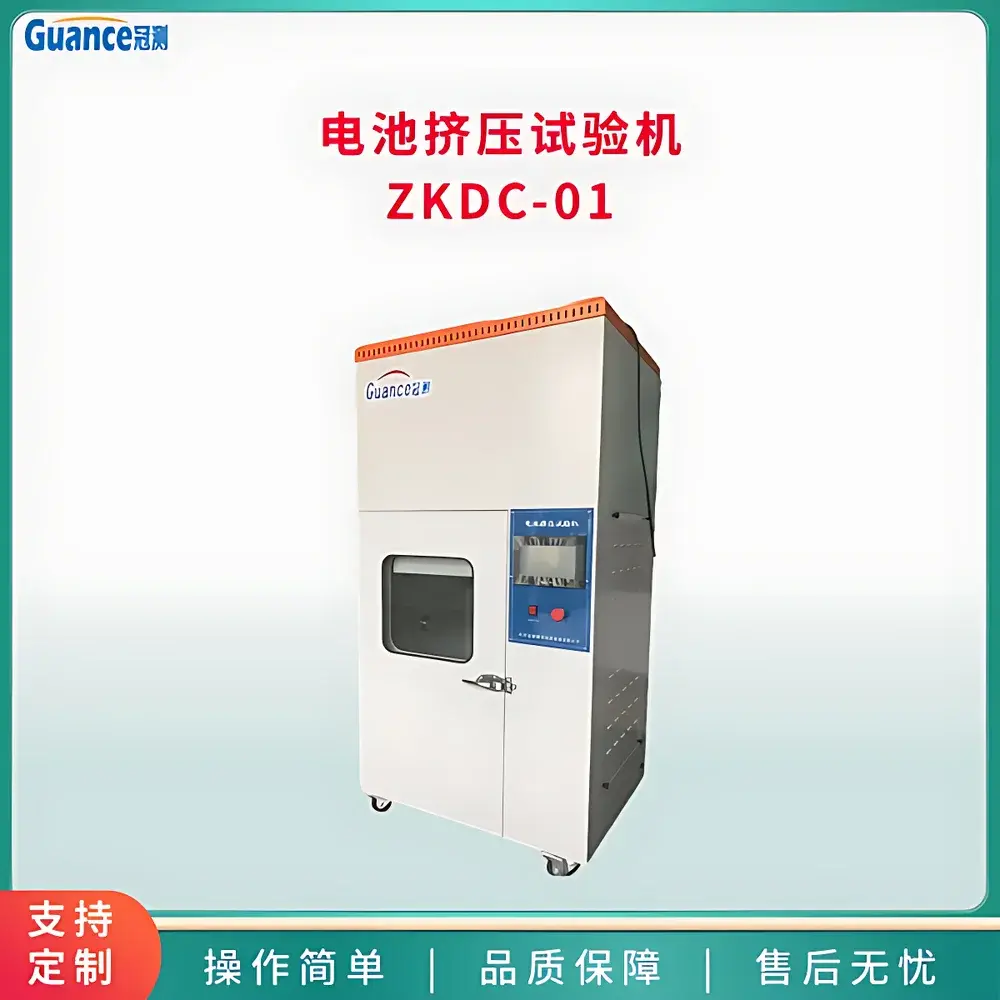
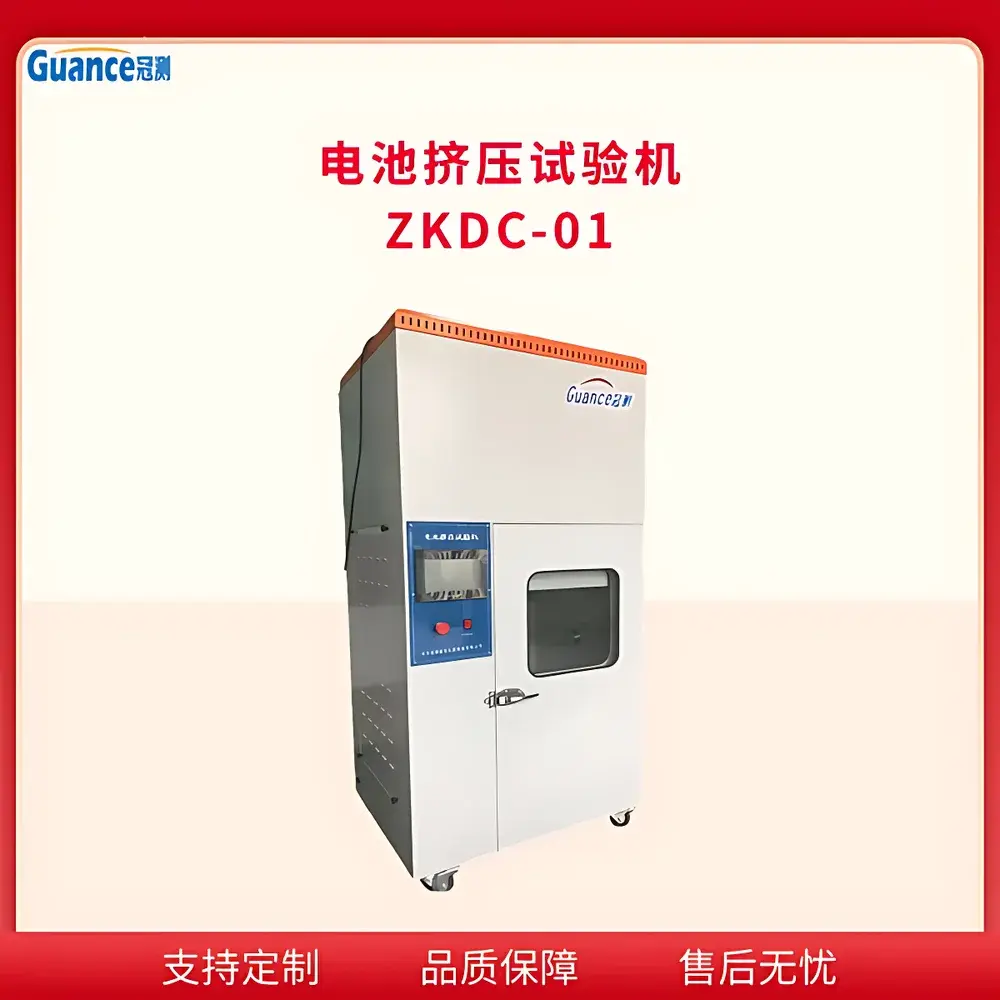
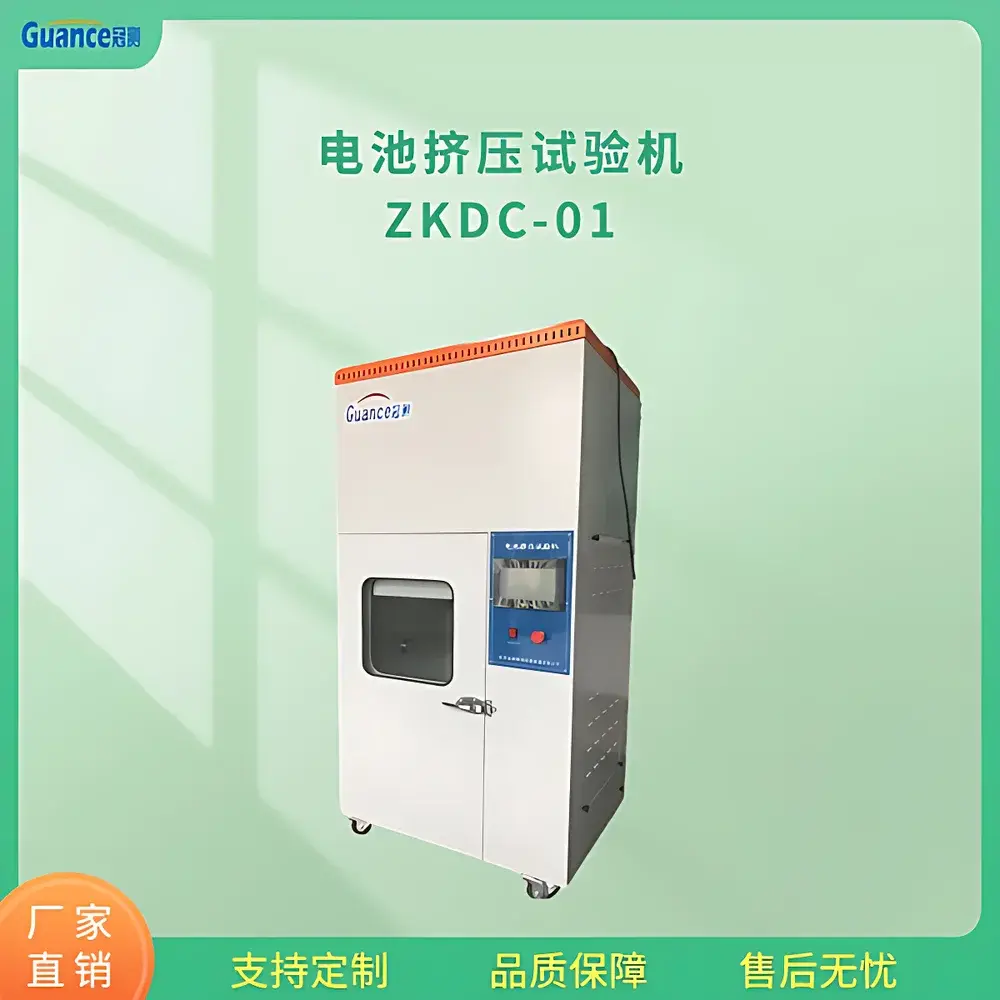
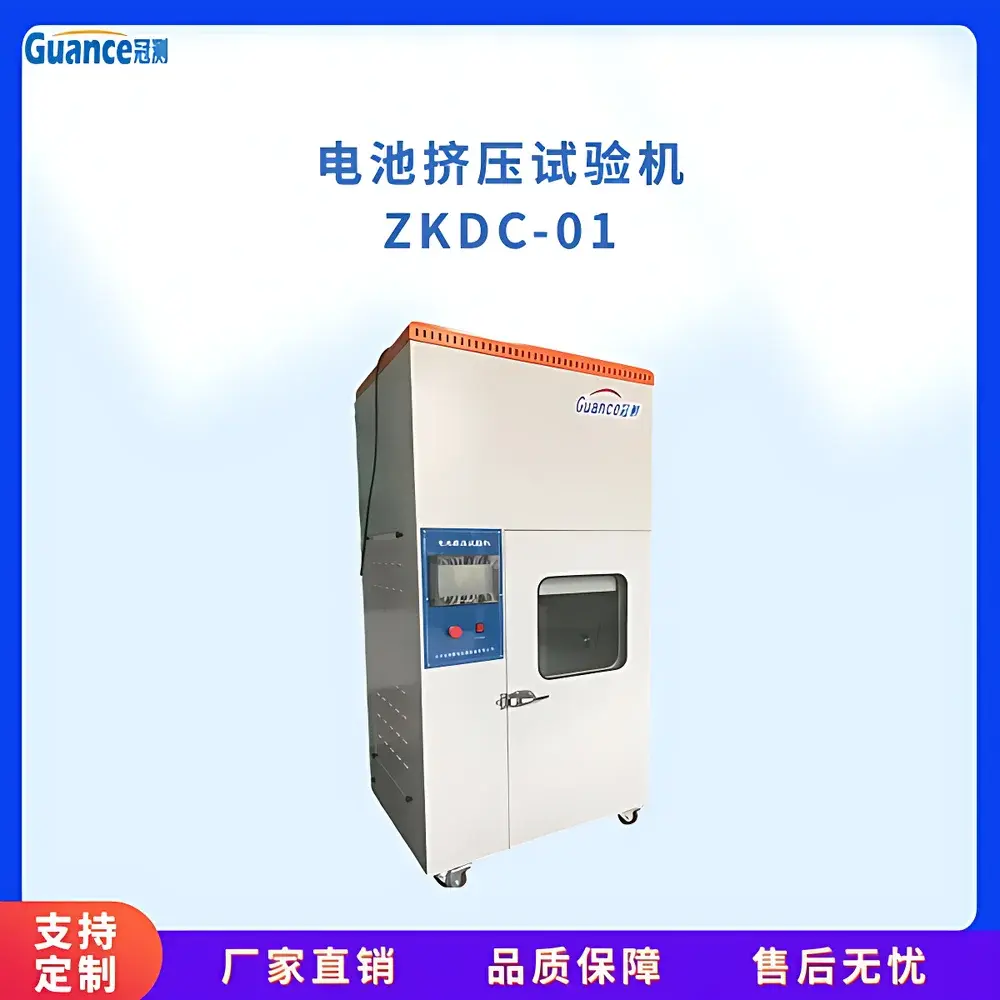
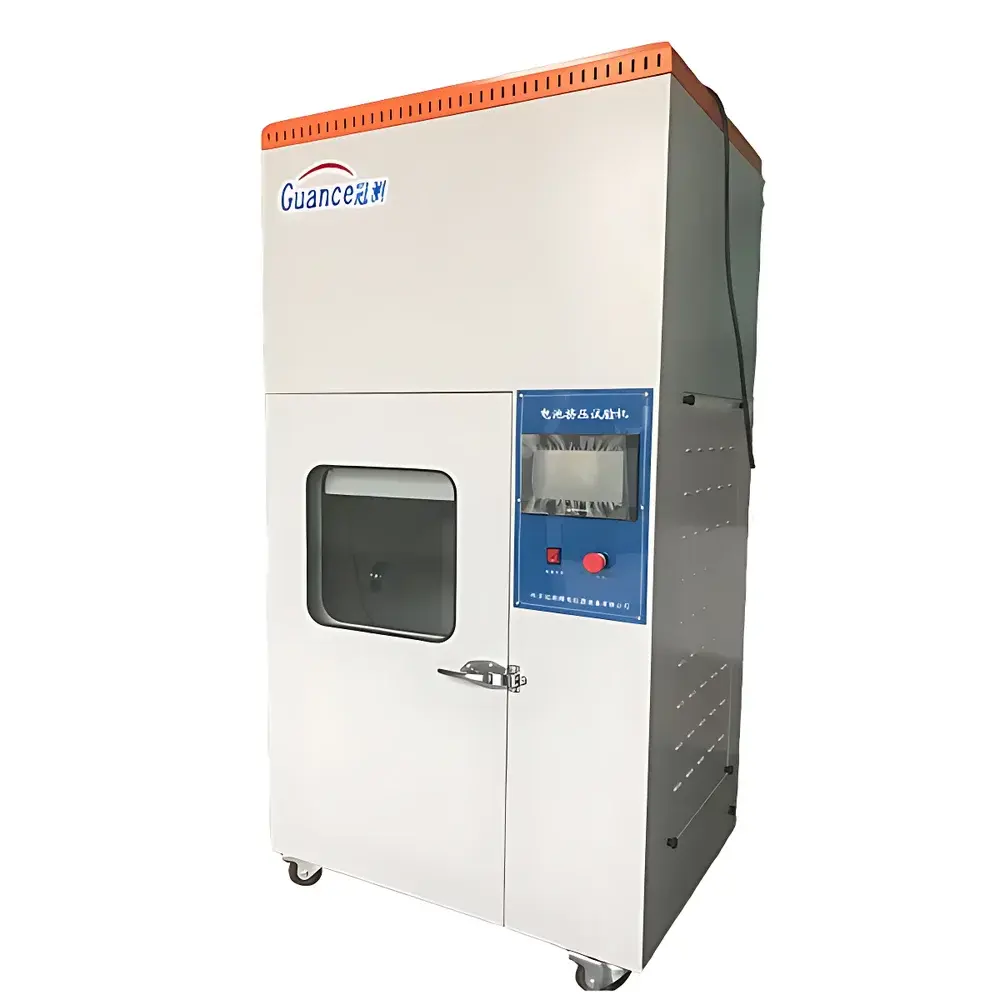
GuanCe Instruments ZKDC-01 Battery Crush Testing Machine
| Brand | GuanCe Instruments |
|---|---|
| Origin | Beijing, China |
| Manufacturer Type | Authorized Distributor |
| Regional Classification | Domestic (PRC) |
| Model | ZKDC-01 |
| Instrument Type | Electromechanical Universal Testing Machine |
| Compliance Standards | MT/T 1051–2007, UL 1642–2005, UL 2054–2005, SJ/T 11169–1998, YD 1268–2003, SJ/T 11170–1998, GB/T 8897.4–2002 |
Overview
The GuanCe Instruments ZKDC-01 Battery Crush Testing Machine is a purpose-built electromechanical universal testing system engineered for controlled mechanical compression evaluation of primary and rechargeable lithium-based batteries. It operates on the principle of quasi-static uniaxial force application via a hydraulically actuated platen, enabling precise simulation of mechanical abuse conditions—specifically crush events—that may occur during transportation, packaging, or accidental impact in end-use environments. The system conforms to internationally recognized safety evaluation protocols defined in multiple battery-specific standards, including UL 1642, UL 2054, and GB/T 8897.4, where pass/fail criteria are strictly defined by thermal and structural response: post-test samples must exhibit no ignition, flame propagation, electrolyte ejection, or catastrophic rupture. Designed for laboratory-scale validation rather than production-line throughput, the ZKDC-01 delivers repeatable load control and documented force–displacement profiles essential for regulatory submission and internal safety qualification workflows.
Key Features
- Hydraulic loading system with 32 mm diameter piston head, ensuring uniform pressure distribution across planar battery surfaces.
- Programmable peak force termination at 13 kN (equivalent to 17.2 MPa nominal contact pressure), with automatic pressure hold and controlled unload sequence.
- Adjustable parallel platens with precision-machined flatness (< ±5 µm) to minimize eccentric loading and ensure axial alignment during compression.
- Dedicated orientation fixtures for cylindrical, prismatic, and coin-cell configurations—supporting standardized positioning per UL and GB requirements (e.g., longitudinal axis alignment, 90° rotational repositioning for dual-side evaluation).
- Integrated force transducer calibrated to ISO 376 Class 1 accuracy, traceable to national metrology institutes.
- Stainless-steel test chamber with viewing window and optional thermal imaging port for real-time surface temperature monitoring during crush events.
Sample Compatibility & Compliance
The ZKDC-01 accommodates a full spectrum of commercial battery formats: cylindrical cells (e.g., 18650, 21700), prismatic pouch and hard-case Li-ion/LiPo units (up to 200 mm × 150 mm footprint), and coin-type cells (CR2032, BR2032, etc.). Sample mounting follows exact dimensional and orientation mandates from referenced standards—such as MT/T 1051–2007 for mining lamp batteries and YD 1268–2003 for mobile handset power sources. All test procedures are fully compliant with GLP-aligned documentation practices; raw force–time data, event timestamps, and operator annotations are stored in audit-ready binary logs. The instrument satisfies functional requirements for ISO/IEC 17025-accredited laboratories conducting battery safety certification under IEC 62133, UN 38.3, and regional regulatory frameworks requiring mechanical abuse verification.
Software & Data Management
The ZKDC-01 operates via embedded firmware with local touchscreen interface for parameter setup (target force, ramp rate, dwell time) and real-time display of load, displacement, and elapsed time. Raw sensor outputs are streamed at ≥100 Hz to an external PC running proprietary Windows-based acquisition software. This software supports automated report generation in PDF format, including annotated force–displacement curves, statistical summaries (mean, max, standard deviation across replicate tests), and metadata tagging (operator ID, sample lot, environmental conditions). Data files conform to ASTM E1434–21 archival guidelines and include cryptographic hash signatures to prevent post-acquisition tampering—meeting FDA 21 CFR Part 11 requirements for electronic records in regulated battery development environments.
Applications
- Pre-certification safety validation of lithium-ion, lithium-metal, and solid-state prototype cells prior to UN 38.3 submission.
- Root-cause analysis of cell failure modes under compressive stress—including separator deformation, anode/cathode delamination, and internal short-circuit initiation.
- Material-level evaluation of mechanical robustness in novel electrode architectures, polymer electrolytes, and reinforced cell casings.
- Quality assurance testing for battery pack integrators verifying module-level crush resistance before automotive or energy storage system integration.
- Academic research into mechanical-electrochemical coupling phenomena during quasi-static deformation of electrochemical energy storage devices.
FAQ
What is the maximum allowable sample thickness for compression testing on the ZKDC-01?
The effective stroke between platens is 120 mm, permitting samples up to 110 mm thick with sufficient clearance for fixture mounting and thermal expansion margin.
Does the system support dynamic or cyclic compression testing?
No—the ZKDC-01 is configured exclusively for single-cycle, constant-rate quasi-static compression per UL and GB standard methodologies; it does not implement servo-controlled oscillatory or fatigue protocols.
Is third-party calibration certification included with delivery?
Yes—each unit ships with a factory-issued calibration certificate traceable to CNAS-accredited reference standards, valid for 12 months under normal operating conditions.
Can test data be exported in CSV or ASCII format for external analysis?
Yes—acquisition software provides direct export of time-synchronized force, displacement, and temperature channels in comma-separated values (CSV) format compatible with MATLAB, Python (NumPy/Pandas), and Excel.
What safety interlocks are implemented during operation?
The system features dual-channel light curtain protection, emergency stop circuitry meeting IEC 60204-1 Category 3, and automatic hydraulic pressure cutoff if platen separation exceeds 125 mm or force deviates >±3% from setpoint for >2 seconds.
Related Products



