
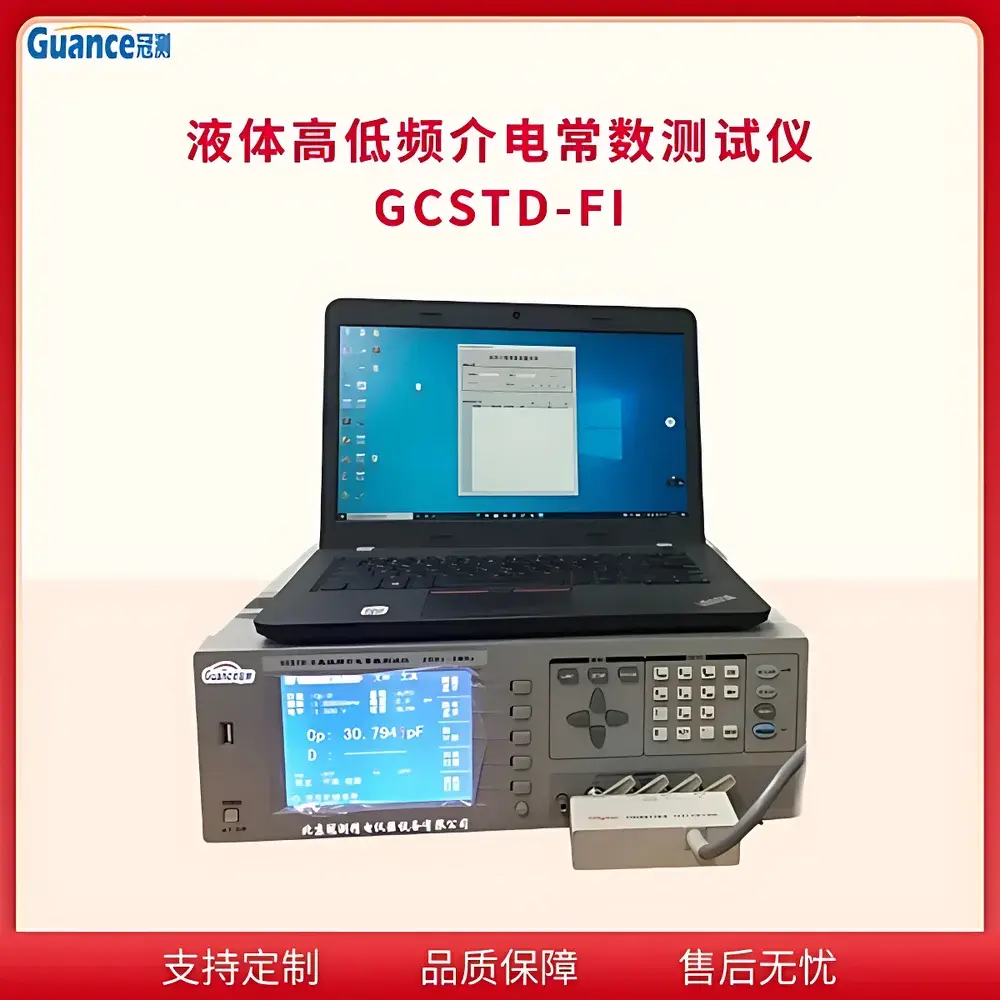
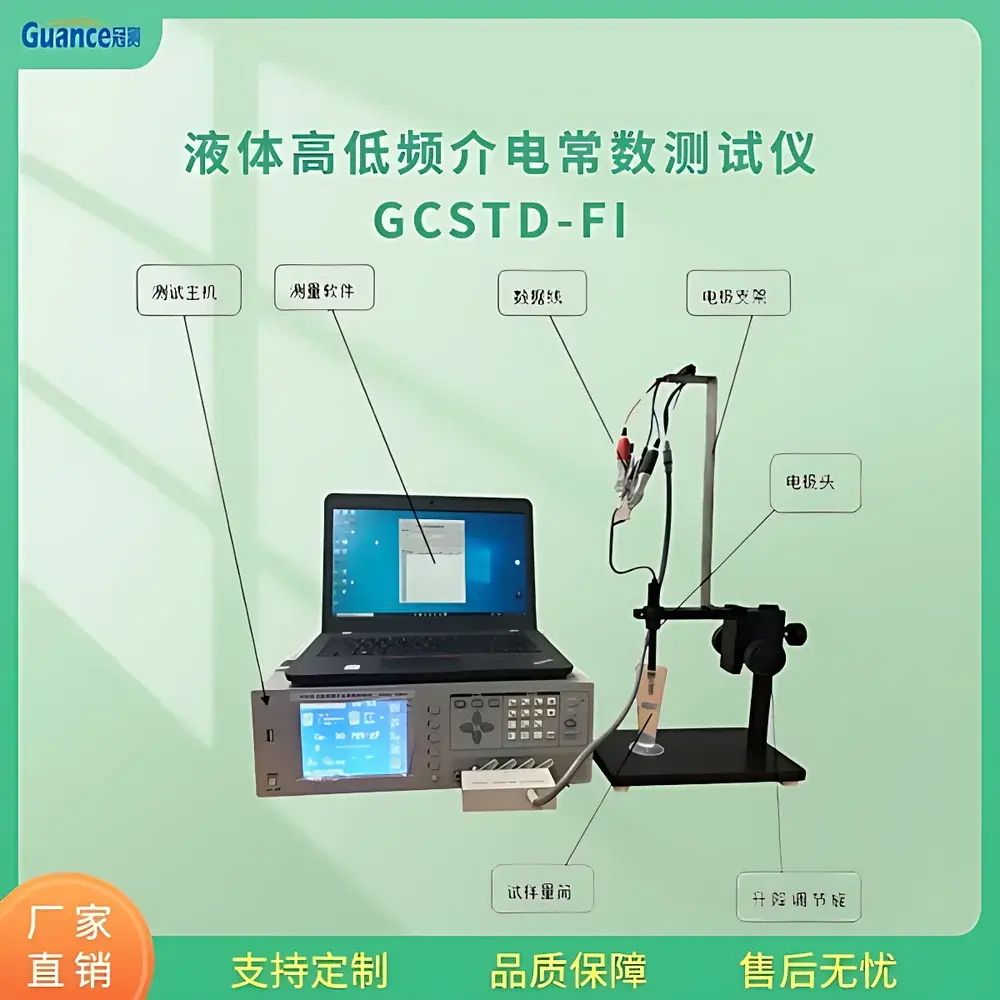
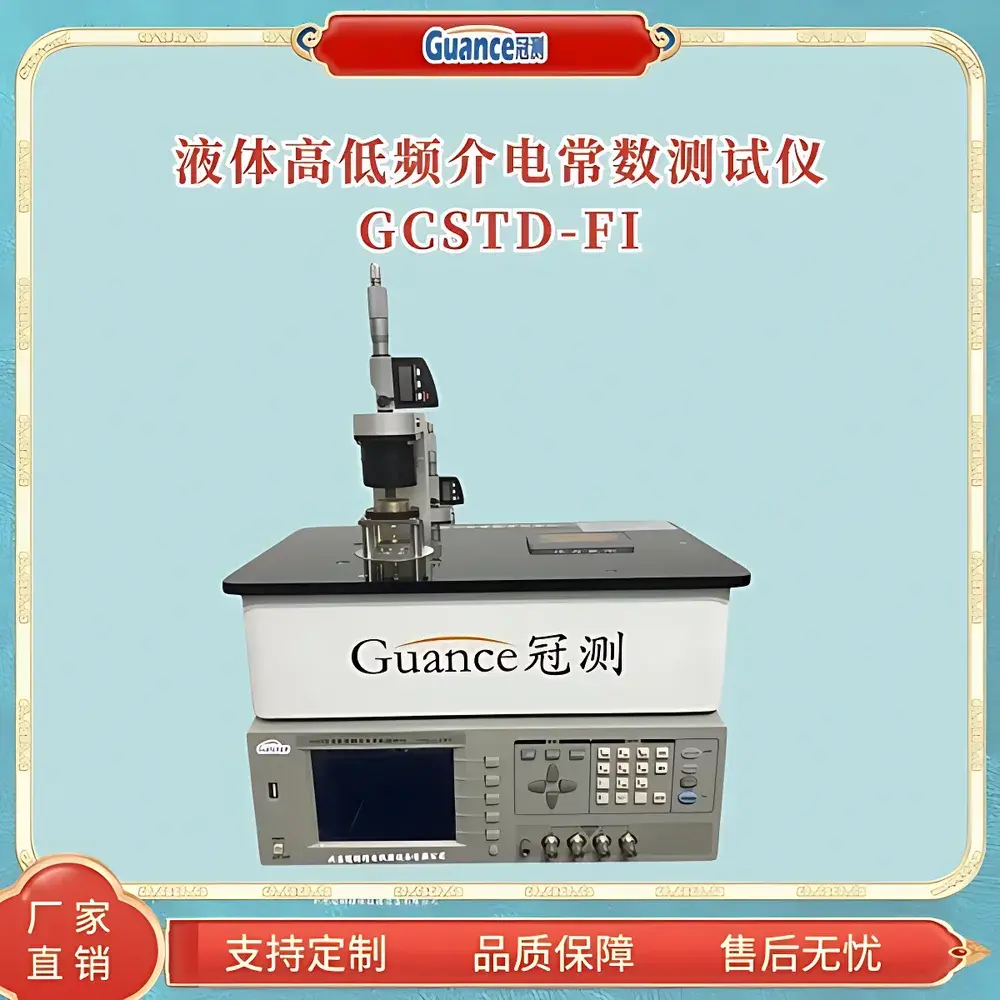
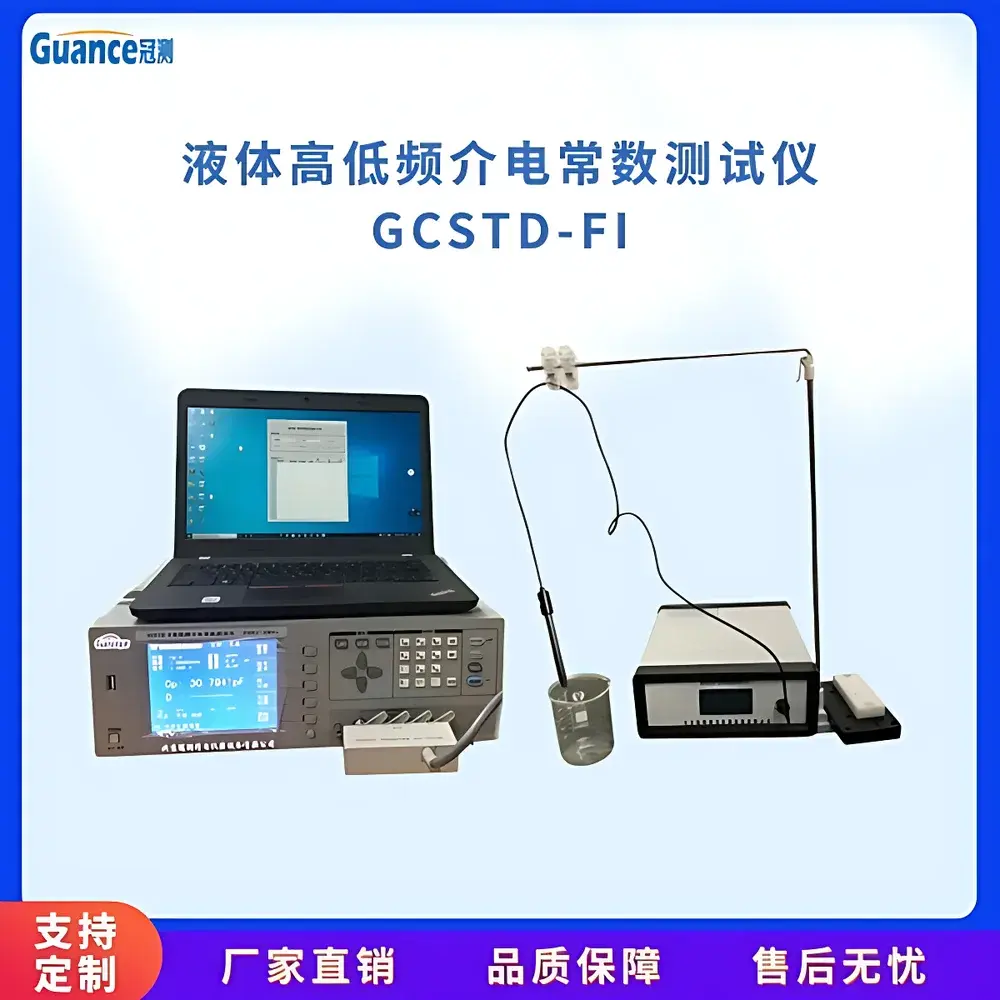
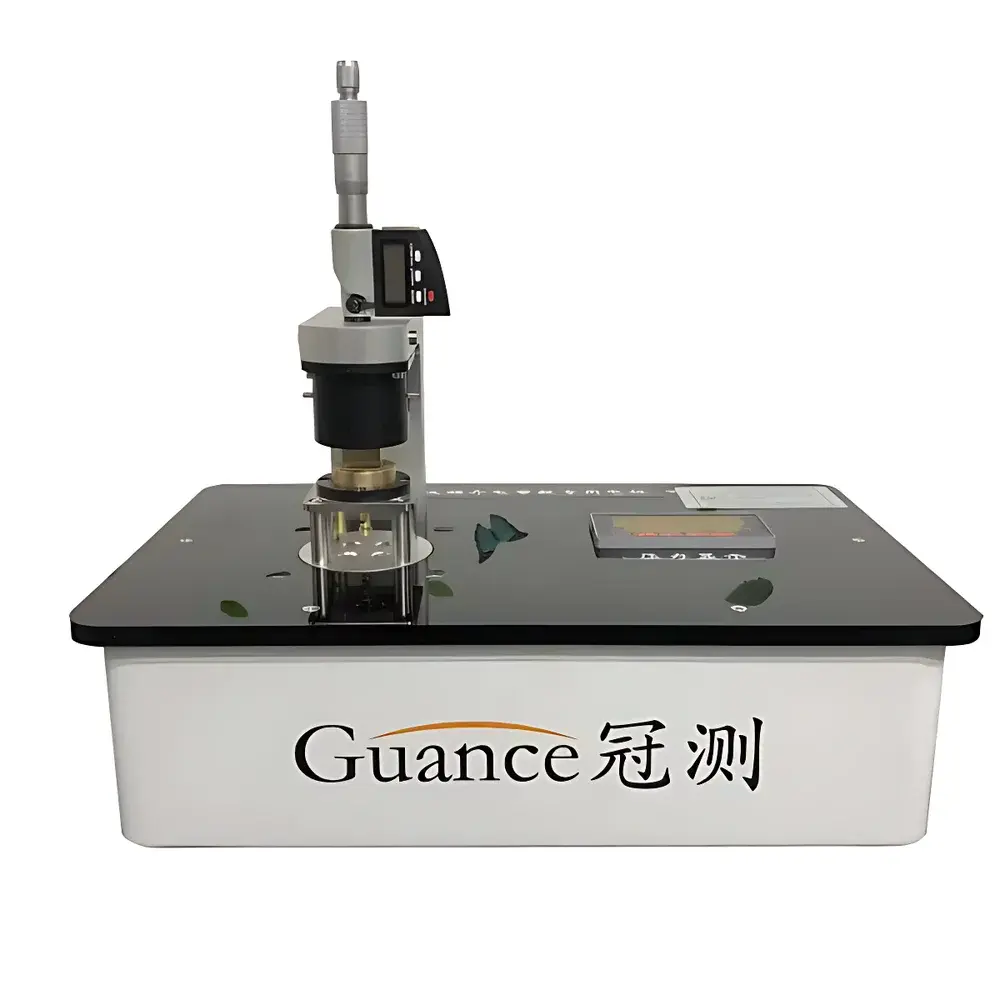
GuanCe Instruments GCSTD-FI.7 Automated Liquid Dielectric Constant Analyzer (Low- to High-Frequency)
| Brand | GuanCe Instruments |
|---|---|
| Origin | Beijing, China |
| Manufacturer Type | Authorized Distributor |
| Country of Origin | China |
| Model | GCSTD-FI.7 |
| Frequency Range | 10 kHz sinusoidal excitation |
| Measurement Ranges | 1–20 and 1–200 (dimensionless relative permittivity scale) |
| Accuracy | ±2% |
| Repeatability & Linearity | ±0.2% RMS |
| Electrode Type | External coaxial cylindrical probe (316 stainless steel outer/inner cylinders, nylon spacers, PTFE-insulated) |
| Excitation Amplitude | ~7 V RMS (range 1–20), 0.7 V RMS (range 1–200) |
| Compliance | GB/T 1409–2006, GB/T 5654–2007, GB/T 21216–2007, GB/T 1693–2007, GB/T 5594.4–1985 |
Overview
The GuanCe Instruments GCSTD-FI.7 Automated Liquid Dielectric Constant Analyzer is a precision impedance-based measurement system engineered for the determination of relative permittivity (εr) and dissipation factor (tan δ) of liquid dielectrics across a defined low-frequency regime. Operating at a fixed 10 kHz sinusoidal excitation frequency, the instrument employs a calibrated coaxial cylindrical electrode configuration grounded in classical capacitance bridge principles. This architecture enables stable, geometry-dependent capacitance measurement under controlled field conditions—consistent with the physical foundations outlined in IEC 60250 and ASTM D150. Unlike broadband spectrometers, the GCSTD-FI.7 is purpose-built for routine QC/QA and materials screening where traceable, repeatable εr values at power-audio frequencies are required—particularly for insulating oils, transformer fluids, silicone dielectrics, polar solvents, and polymer precursor liquids.
Key Features
- Fixed-frequency 10 kHz excitation source with dual-range voltage output (7 VRMS for εr = 1–20; 0.7 VRMS for εr = 1–200), optimized to maintain signal-to-noise ratio across wide permittivity spans.
- Removable coaxial cylindrical electrode assembly fabricated from 316 stainless steel, with precision-machined concentric geometry maintained by six non-conductive nylon spacers and PTFE insulation—ensuring dimensional stability critical for geometric capacitance calibration.
- Open-structure electrode design facilitating rapid solvent-based cleaning without disassembly; compatible with acetone, ethanol, isopropanol, and other common organic solvents—provided no mechanical stress or thermal cycling is applied to the spacer system.
- Integrated digital signal processing unit delivering real-time εr and tan δ calculations per GB/T 5654–2007 methodology, with automatic range switching and self-consistency checks against internal reference standards.
- Robust mechanical housing rated for laboratory benchtop operation; designed for long-term stability in ambient temperature environments (23 ± 2 °C) with humidity control recommended per ISO 291.
Sample Compatibility & Compliance
The GCSTD-FI.7 supports analysis of homogeneous, non-aqueous, low-conductivity liquids—including mineral insulating oils, synthetic esters, silicone fluids, hydrocarbon solvents, and low-viscosity polymer solutions. It is not intended for conductive aqueous electrolytes, suspensions, or highly viscous media (>500 cSt) due to electrode polarization and field distortion effects. All measurement protocols align with national standards referenced in its technical documentation: GB/T 1409–2006 (capacitance and loss measurement methods), GB/T 5654–2007 (liquid dielectric testing procedures), and GB/T 21216–2007 (conductivity-corrected dielectric loss evaluation). While not certified to ISO/IEC 17025, the system supports GLP-compliant recordkeeping when paired with external audit-trail-enabled data loggers.
Software & Data Management
The analyzer operates via embedded firmware with front-panel LCD interface; no proprietary PC software is included. Measurement results (εr, tan δ, range status, date/time stamp) are displayed locally and may be manually recorded or exported via RS-232 serial interface (optional cable required) to third-party spreadsheet or LIMS platforms. Raw analog outputs (0–5 V DC proportional to εr) are available for integration into automated test stations. For regulatory environments requiring electronic records integrity, users must implement external validation of data capture workflows per FDA 21 CFR Part 11 guidelines—particularly concerning user access control, audit trail generation, and electronic signature capability.
Applications
- Quality assurance of transformer and switchgear insulating oils per IEC 60429 and DL/T 429.6.
- Batch consistency verification of silicone dielectric fluids used in high-voltage encapsulation.
- Screening of polar solvent purity (e.g., DMF, NMP, ethylene glycol) where water content alters εr predictably.
- Research on ion-conducting liquid electrolytes for battery development—when combined with complementary conductivity measurements.
- Evaluation of aging effects in dielectric coolants exposed to thermal-oxidative stress (paired with FTIR or acid number testing).
FAQ
Can the GCSTD-FI.7 measure aqueous solutions?
No. High ionic conductivity induces electrode polarization errors that invalidate εr readings per GB/T 5654–2007 scope limitations.
Is electrode disassembly permitted for cleaning?
No. Mechanical separation compromises inter-cylinder spacing and nullifies factory calibration; only solvent immersion and ultrasonic agitation are approved.
What is the recommended temperature control protocol?
Measurements must be performed at stabilized ambient temperature (23 ± 2 °C); samples should equilibrate for ≥30 min prior to insertion.
Does the instrument support automatic temperature compensation?
No. Temperature correction must be applied externally using published εr(T) coefficients for each fluid.
How often does the system require recalibration?
Annual verification against NIST-traceable dielectric standards (e.g., air, cyclohexane, chlorobenzene) is recommended per ISO/IEC 17025 guidance for in-house reference instruments.
Related Products



