
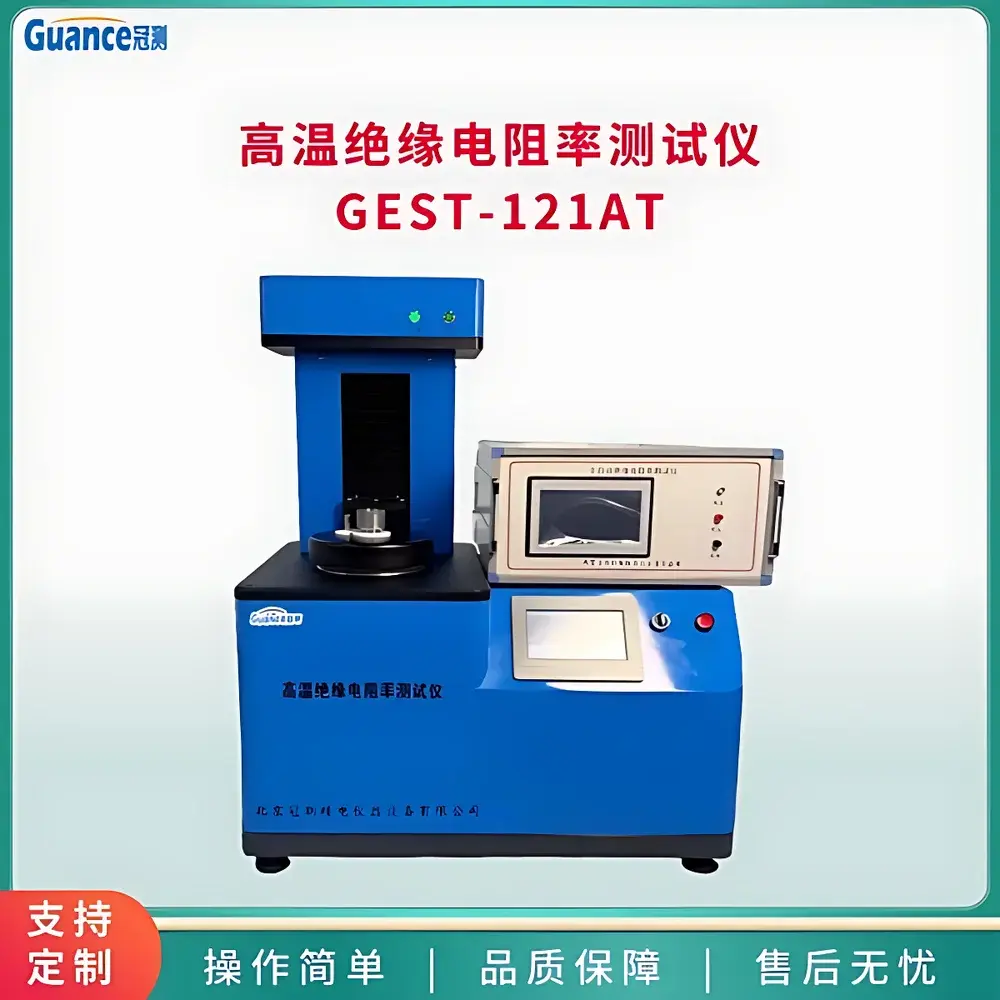
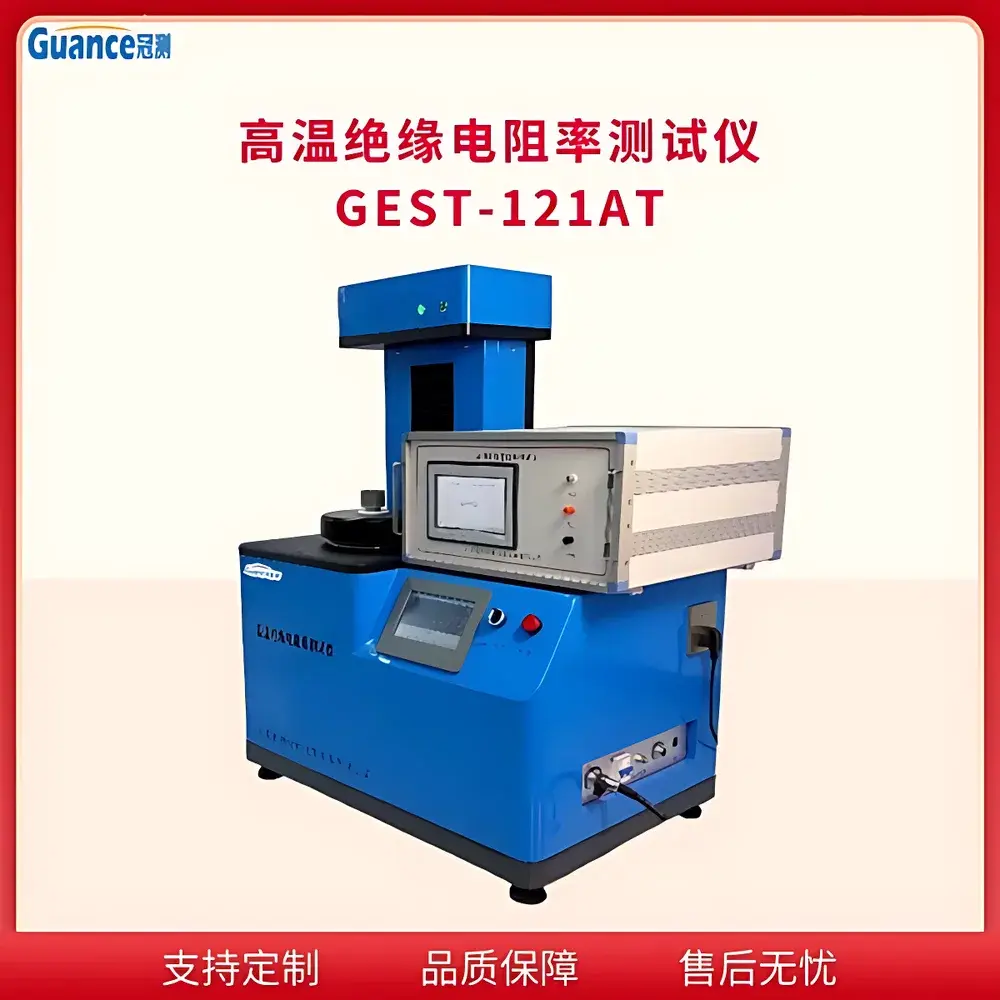
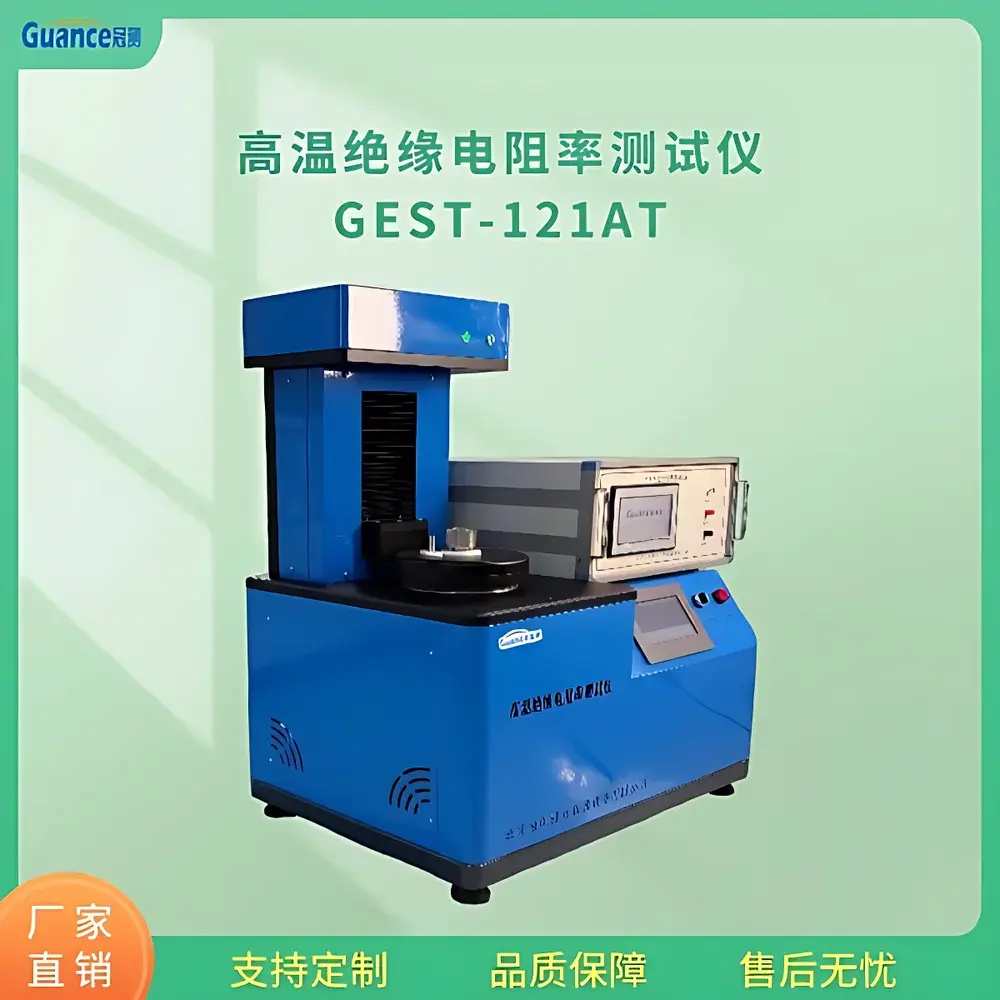
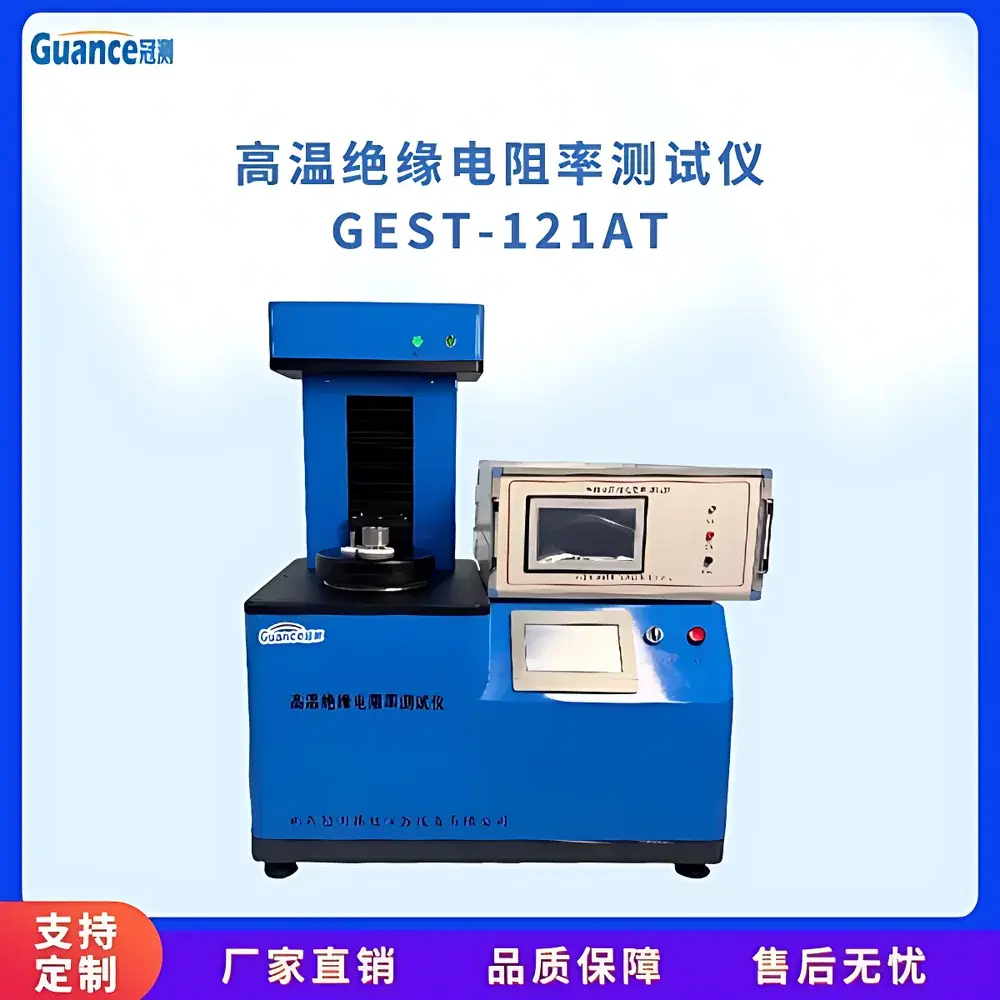
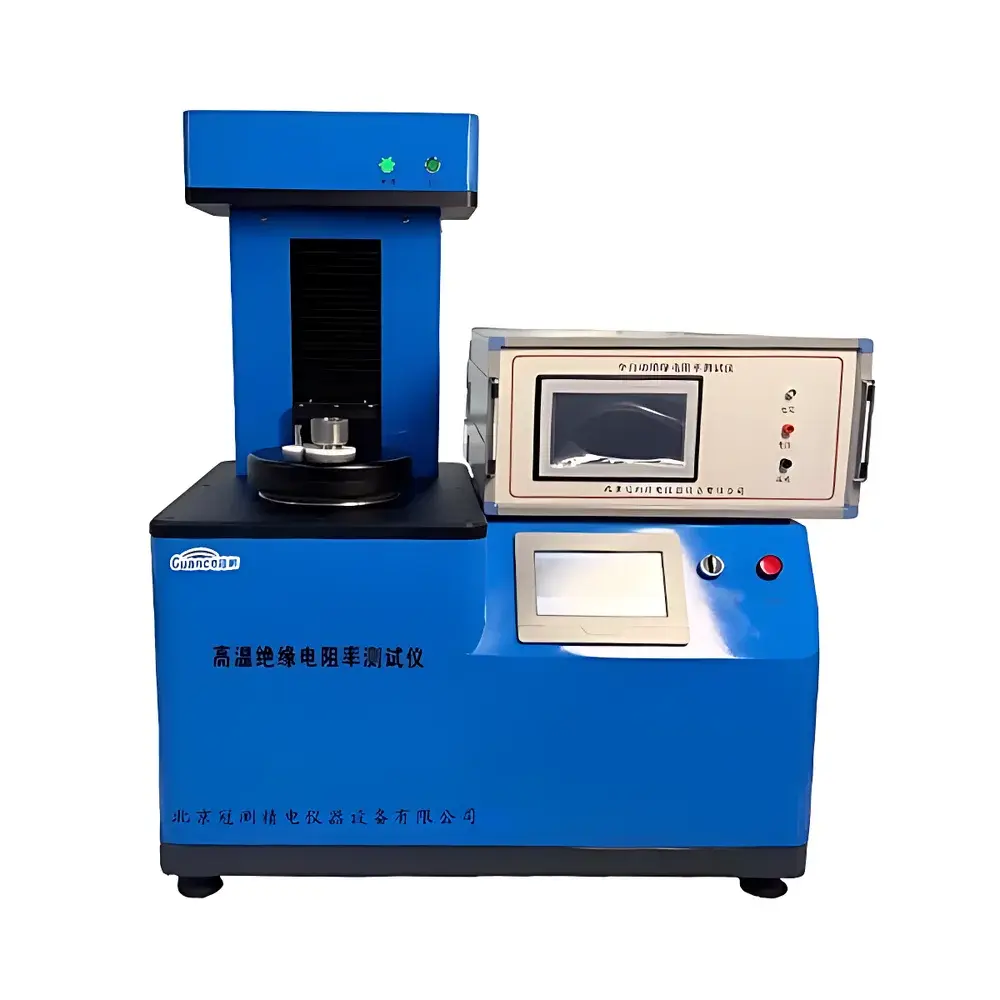
GuanCe GEST-121AT High-Temperature Insulation Resistivity Tester
| Brand | GuanCe |
|---|---|
| Model | GEST-121AT |
| Origin | Beijing, China |
| Heating Method | Electric heating |
| Heating Power | 2 kW |
| Cooling Method | Natural convection via fan |
| Cryogenic Cooling | Liquid nitrogen (≈1000 mL capacity) |
| Temperature Range | −100 °C to +1000 °C (configurable) |
| Electrode Configuration | Three-electrode system |
| Measuring Electrode Diameter | 25 mm (customizable per sample geometry) |
| Temperature Control Accuracy | ±0.5 °C |
| Sample Mounting Size | 50 mm |
| Display Interface | 7-inch touch screen |
| Power Supply | 220 V / 50 Hz |
| Dimensions | Standard benchtop footprint |
| Weight | ≈50 kg |
Overview
The GuanCe GEST-121AT High-Temperature Insulation Resistivity Tester is a precision-engineered system designed for the quantitative characterization of volume and surface resistivity of insulating materials under controlled thermal conditions. It operates on the principle of direct current (DC) voltage application across a standardized electrode configuration—specifically a three-electrode arrangement compliant with ASTM D257 and IEC 60093—to eliminate surface leakage errors and isolate bulk material response. The instrument integrates a programmable high-temperature furnace with cryogenic capability, enabling continuous resistivity measurements across an exceptionally wide thermal range (−100 °C to +1000 °C), making it suitable for evaluating thermally stable polymers, ceramic substrates, glass composites, and advanced dielectric coatings used in aerospace, power electronics, and nuclear instrumentation applications.
Key Features
- Wide operational temperature span: −100 °C (via liquid nitrogen cooling) to +1000 °C (electrically heated chamber), with real-time PID-controlled stabilization at ±0.5 °C accuracy
- Three-electrode measurement architecture per ASTM D257, minimizing edge effects and surface conduction artifacts during high-resistance (>1012 Ω·cm) evaluation
- Modular test platform: Compatible with interchangeable fixtures for flat sheets, rods, and bulk specimens (standard mounting dimension: 50 mm); measuring electrode diameter configurable from 25 mm upward
- Integrated 7-inch industrial-grade touch interface for local setup, real-time monitoring of temperature ramp profiles, and simultaneous display of resistance, resistivity, and derived conductivity values
- Benchtop design with robust thermal shielding and electrical isolation; total mass ≈50 kg; footprint optimized for standard laboratory fume hoods or climate-controlled testing rooms
- Compliant power architecture: 220 V / 50 Hz input with internal overcurrent and overtemperature protection circuits
Sample Compatibility & Compliance
The GEST-121AT accommodates solid dielectric samples including polymer films (e.g., polyimide, PTFE), sintered ceramics (Al2O3, SiO2), glass-ceramic composites, and high-purity graphite-based insulators. Its three-electrode geometry supports both volume resistivity (ρv) and surface resistivity (ρs) calculations per ISO 3915 and GB/T 1410. The system’s thermal environment permits testing under inert gas purging or vacuum-compatible configurations (optional accessories). Data acquisition meets traceability requirements for GLP-compliant laboratories, and temperature calibration procedures align with ISO/IEC 17025 metrological guidelines. While not inherently FDA 21 CFR Part 11–certified, audit-ready data logs (timestamped, user-ID tagged, non-editable) can be exported in CSV format for integration into validated QA/QC workflows.
Software & Data Management
The embedded firmware supports multi-step temperature ramps (linear, step-isothermal, dwell-hold) synchronized with resistivity sampling intervals ranging from 1 second to 60 minutes. All raw data—including applied voltage, measured current, calculated resistance, derived resistivity, and chamber temperature—are timestamped and stored locally on internal flash memory. Export is supported via USB 2.0 to external drives in ASCII-delimited format for post-processing in MATLAB, Python (NumPy/Pandas), or statistical analysis suites. Optional PC-based control software (Windows 10/11 compatible) provides remote operation, automated report generation (PDF/Excel), and trend visualization of ρ(T) curves—including Arrhenius fitting for activation energy estimation. Firmware updates are delivered via signed binary packages to ensure integrity and version control.
Applications
- Evaluation of thermal degradation thresholds in high-k polymer gate dielectrics for semiconductor packaging
- Quality assurance of alumina insulators in high-voltage switchgear under simulated operating temperatures
- Development of radiation-resistant insulating coatings for nuclear reactor instrumentation cables
- Validation of space-grade thermal control materials (e.g., MLI blankets, ceramic foams) under cryogenic-to-ambient cycling
- Research into ionic conduction mechanisms in solid-state electrolytes for next-generation batteries
- Calibration reference testing for national metrology institutes verifying high-resistance standards across temperature gradients
FAQ
What electrode configurations does the GEST-121AT support?
It uses a standardized three-electrode setup (guard, measuring, and high-voltage electrodes) as defined in ASTM D257. Electrode diameters and spacing are customizable based on specimen geometry and applicable standard requirements.
Can the system operate under vacuum or controlled atmosphere?
Yes—the high-temperature chamber is compatible with optional vacuum flanges and gas inlet/outlet ports for N2, Ar, or forming gas environments. Vacuum-rated versions require separate quotation.
Is liquid nitrogen handling integrated or external?
The unit includes a dedicated Dewar port and level sensor for on-board liquid nitrogen injection; users supply LN2 from external dewars. Safety interlocks prevent heater activation during active cryogenic cooldown.
How is temperature uniformity verified across the sample zone?
A calibrated Pt100 sensor is embedded adjacent to the sample stage, and optional secondary calibration probes can be inserted into designated ports for NIST-traceable mapping per ISO/IEC 17025 Annex A.3.
Does the system support automated compliance reporting for ISO/IEC 17025 labs?
While the hardware enables full data traceability, formal accreditation requires lab-specific validation of the entire measurement chain—including electrode calibration, voltage source uncertainty, and environmental monitoring—which must be performed by the end-user’s quality team.



