
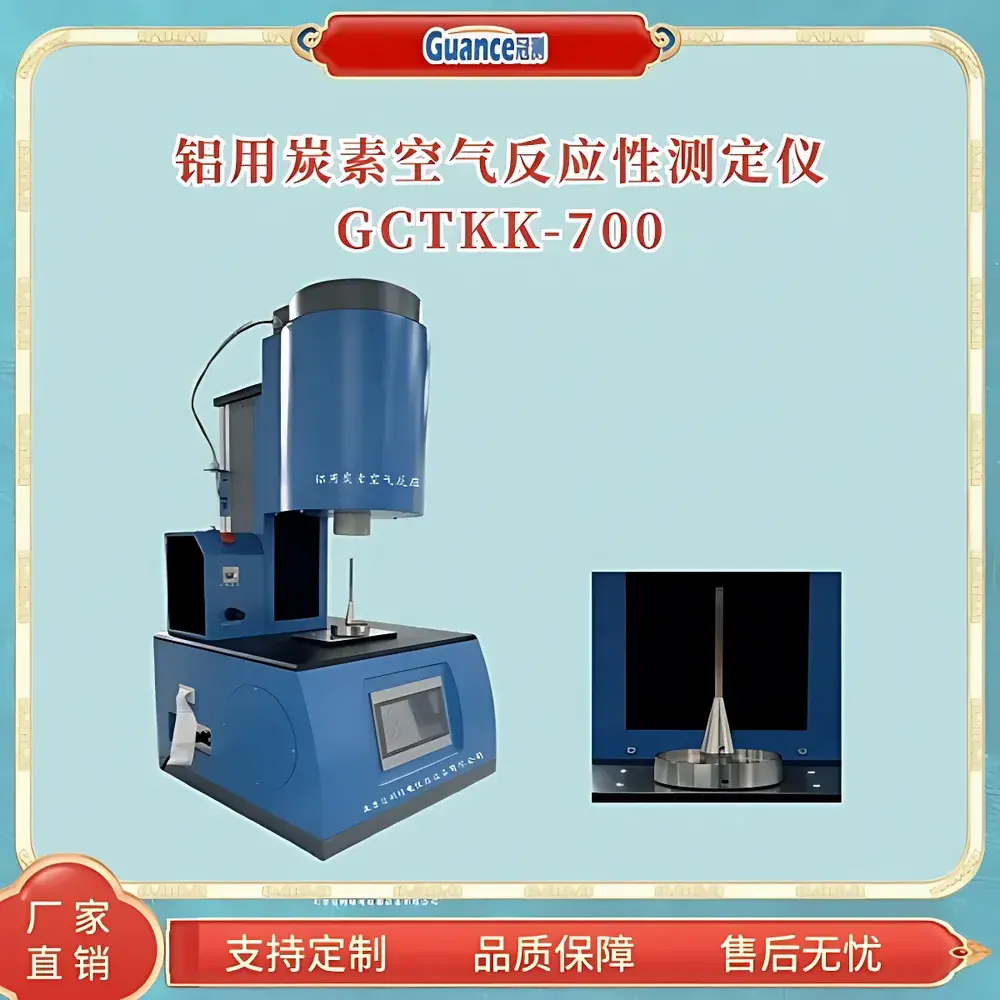
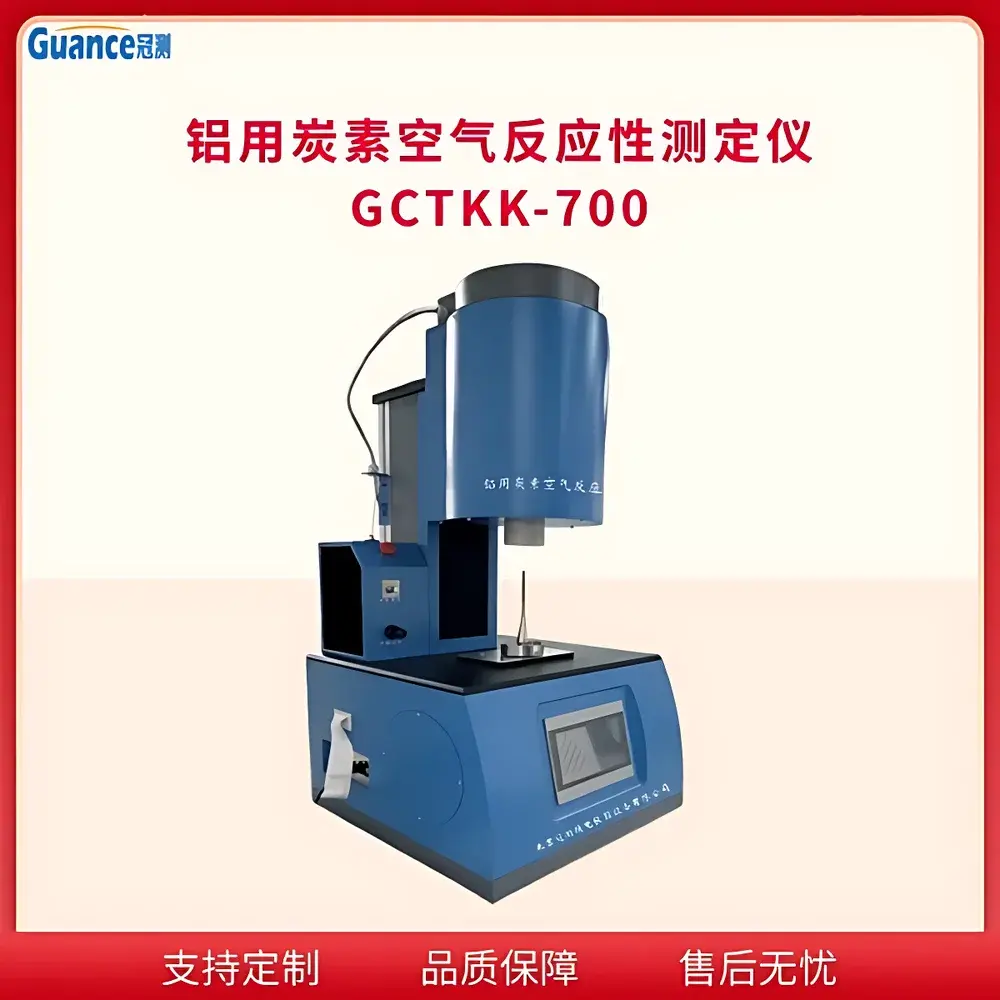
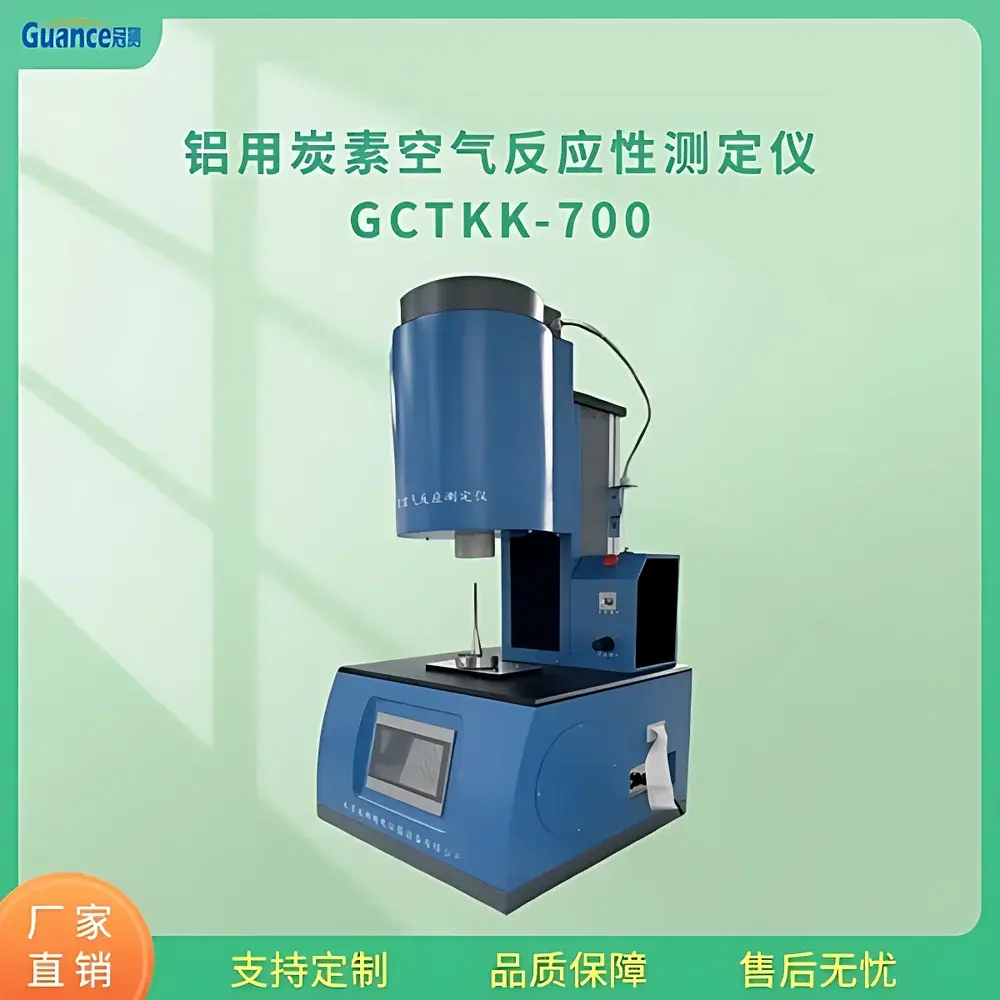
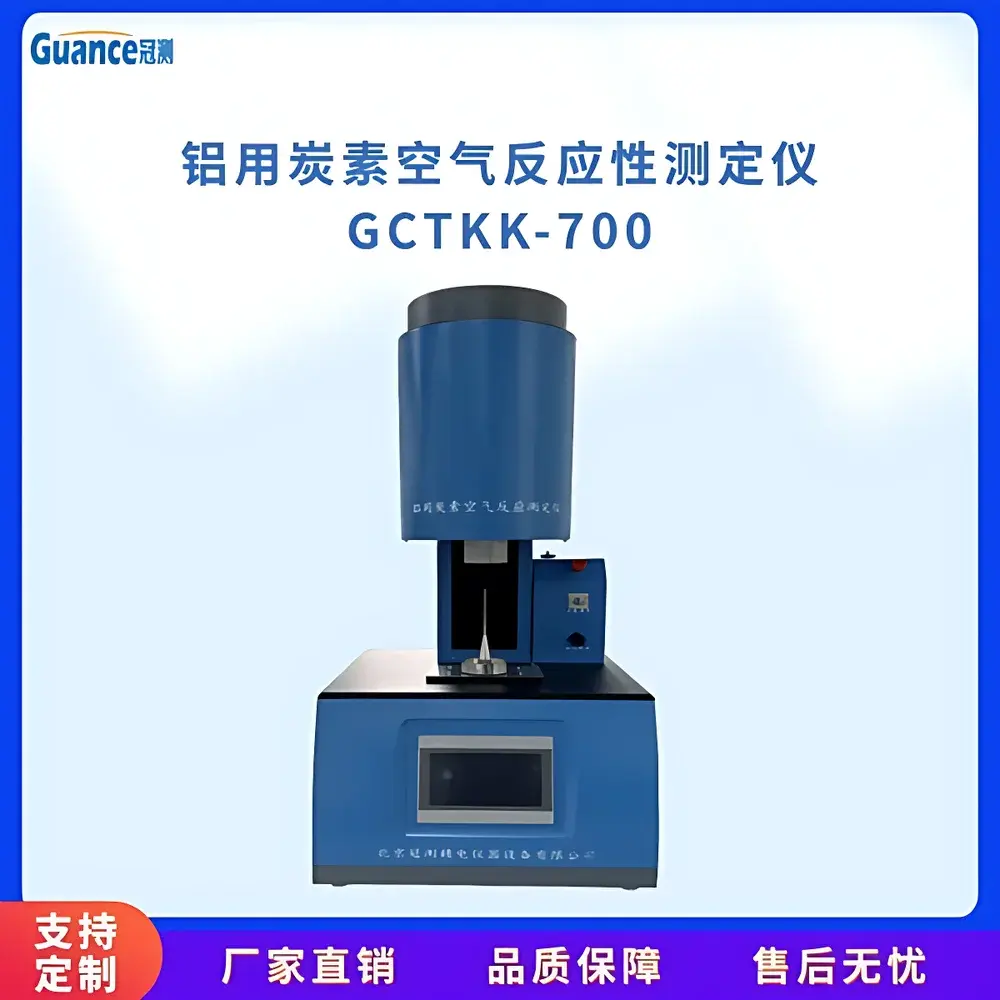
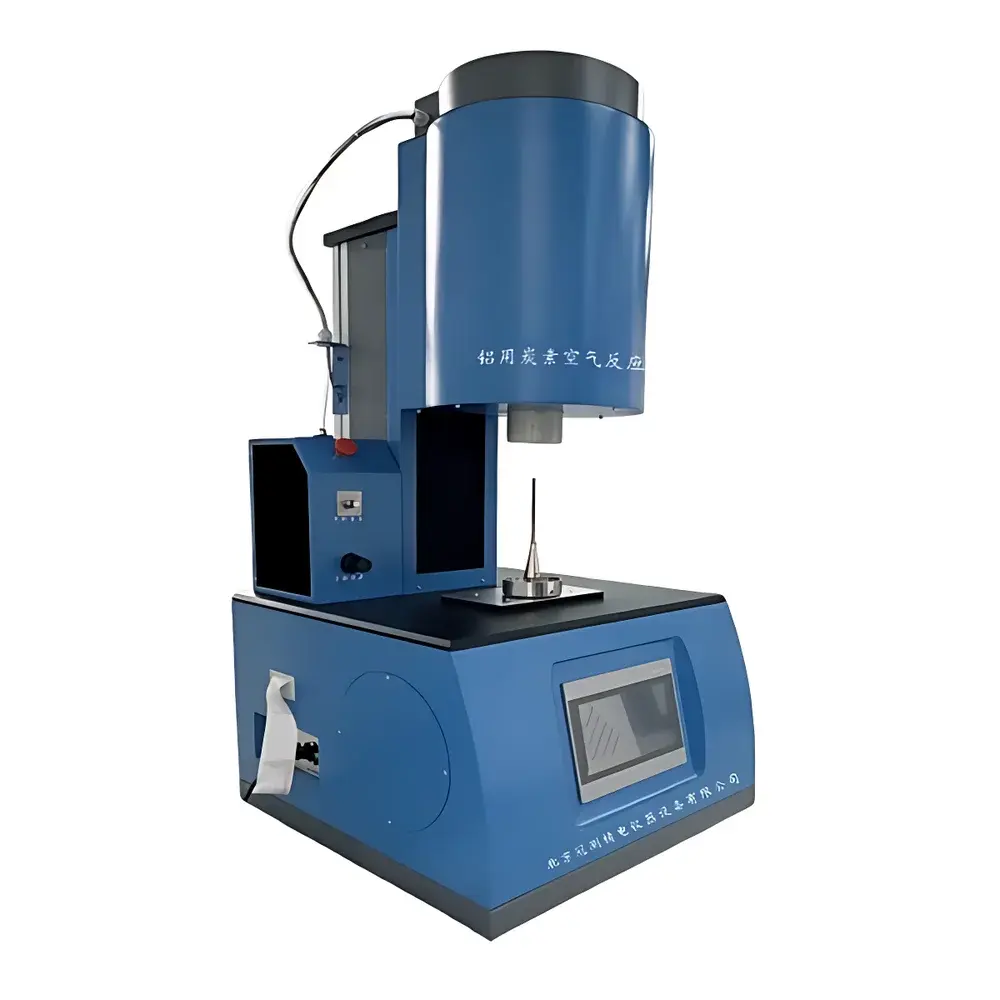
GuanCe Instruments GCTKK-700b Air Reactivity Tester for Anode and Sidewall Carbon Blocks
| Brand | GuanCe Instruments |
|---|---|
| Origin | Beijing, China |
| Manufacturer Type | Authorized Distributor |
| Origin Category | Domestic (China) |
| Model | GCTKK-700b |
| Price | USD 450 (FOB Beijing) |
| Rated Power | 1.5 kW |
| Rated Voltage | 220 V / 50 Hz |
| Maximum Operating Temperature | 700 °C |
| Thermocouple Type | K-type (0–800 °C) |
| Gas Flow Range | 0–250 L/h (Accuracy: ±4%) |
| Pressure Sensor Range | 0–1 MPa (Accuracy Class ≥1.5) |
| Sample Vibration Frequency | 1 rpm |
| Sample Dimensions | Ø50 mm ±1 mm × 60 mm ±1 mm |
| Chamber Uniformity Zone | ≥100 mm (±1 °C at 700 °C) |
| Equipment Dimensions (L×W×H) | 750 × 700 × 1600 mm |
| Net Weight | 150 kg |
Overview
The GuanCe Instruments GCTKK-700b Air Reactivity Tester is a precision-controlled thermal gravimetric system engineered for the standardized determination of air reactivity in carbonaceous materials used in aluminum smelting—specifically baked anodes and sidewall blocks. It operates on the principle of controlled oxidative mass loss under regulated airflow and isothermal conditions, directly implementing the gravimetric method specified in ISO 12989-1:2000 (MOD), YS/T 63.11–2006, and YS/T 964–2014. The instrument maintains a stable isothermal zone (≥100 mm) at 700 °C with thermal uniformity within ±1 °C, achieved via a high-efficiency heating assembly integrating resistance wire embedded in vacuum-formed high-purity ceramic fiber insulation. This architecture ensures minimal thermal gradient across the sample chamber, critical for reproducible reaction kinetics assessment. Unlike generic muffle furnaces, the GCTKK-700b integrates real-time gas conditioning, dynamic vibration control, and synchronized mass-loss acquisition—enabling compliance with industrial QC protocols requiring traceable, auditable, and repeatable air reactivity data.
Key Features
- Integrated PLC-based control architecture with dual-mode operation: local HMI via 7-inch resistive touchscreen and remote supervision via Windows-compatible PC software with Ethernet interface.
- High-stability temperature regulation using adaptive PID algorithm; achieves and sustains 700 °C with long-term stability ≤±1 °C (measured per ISO 12989-1 Annex B).
- Dual-stage gas delivery system: compressed air passes through a coalescing filter, pressure regulator (0–1 MPa, Class ≥1.5), and calibrated rotameter (0–250 L/h, ±4% FS), ensuring consistent oxidant composition, pressure, and flow rate throughout the test cycle.
- Sample holder mechanism with programmable orbital vibration at precisely 1 rpm—mimicking natural convection effects during industrial furnace exposure and preventing localized ash accumulation or channeling.
- Robust mechanical construction: cold-rolled steel enclosure with electrostatic epoxy-polyester powder coating (ISO 2808-compliant thickness, salt-spray resistant per ASTM B117 ≥500 h).
- Full data logging: time-stamped mass loss (%), temperature (°C), airflow (L/h), and chamber pressure (MPa) recorded at user-defined intervals (1–60 s) and exportable as CSV/Excel for statistical process control (SPC) integration.
Sample Compatibility & Compliance
The GCTKK-700b accommodates cylindrical specimens conforming to YS/T 62.2–2005 (sidewall blocks) and YS/T 62.3–2005 (prebaked anodes): Ø50 mm ±1 mm × 60 mm ±1 mm. Specimen preparation follows standardized core drilling and surface conditioning procedures to minimize edge effects and ensure representative bulk reactivity. The system meets the functional requirements of ISO/IEC 17025:2017 for testing laboratories, supporting GLP-aligned documentation including calibration certificates for thermocouples (traceable to NIM, China), flow meters (calibrated per ISO 6789), and pressure transducers. Test reports generated by the software include full metadata: operator ID, ambient conditions, calibration dates, and raw measurement timestamps—facilitating FDA 21 CFR Part 11 readiness when deployed with audit-trail-enabled software configuration.
Software & Data Management
The proprietary GuanCe AirReac™ software (v3.2+) provides real-time visualization of mass loss curves, derivative d(m)/dt plots, and comparative overlay of up to eight test runs. All data files are stored in encrypted SQLite format with SHA-256 checksums. The software supports configurable pass/fail thresholds based on maximum allowable mass loss (e.g., ≤12.5% per ISO 12989-1), automatic report generation (PDF/HTML), and direct export to LIMS platforms via ODBC drivers. Audit trail functionality logs all user actions—including parameter edits, calibration events, and report exports—with immutable timestamps and operator credentials. Data backups are scheduled automatically to network drives or cloud storage (AWS S3 or Azure Blob compatible).
Applications
- Quality assurance of prebaked anodes prior to electrolytic cell installation, verifying compliance with ISO 12989-1 acceptance criteria (mass loss ≤12.5% after 3 h at 700 °C).
- Routine monitoring of sidewall block oxidation resistance during carbon material batch release in alumina reduction plants.
- Research into coke-to-coke variability, binder carbonization effects, and graphitization degree correlations with air reactivity profiles.
- Validation of raw material substitutions (e.g., alternative calcined petroleum coke sources) against baseline reactivity benchmarks.
- Supporting root-cause analysis of premature anode consumption or sidewall degradation in potline operations.
FAQ
What standards does the GCTKK-700b fully support?
It implements ISO 12989-1:2000 (MOD), YS/T 63.11–2006, YS/T 964–2014, and YS/T 62.2–2005/YS/T 62.3–2005 for sample preparation and test execution.
Is the system suitable for GLP or GMP environments?
Yes—when configured with enabled audit trail, electronic signatures, and calibrated instrument records, it satisfies key elements of OECD GLP Principles and FDA 21 CFR Part 11 for electronic records.
Can the vibration frequency be adjusted beyond 1 rpm?
No—the 1 rpm setting is fixed per YS/T 964–2014 and ISO 12989-1 Annex C to ensure inter-laboratory comparability.
What maintenance is required for long-term accuracy?
Annual recalibration of thermocouple, flow meter, and pressure sensor is recommended; ceramic fiber insulation should be inspected for cracking every 500 operating hours.
Does the system include validation documentation?
Yes—each unit ships with Factory Acceptance Test (FAT) report, IQ/OQ protocol templates, and metrological traceability statements for all critical sensors.



