
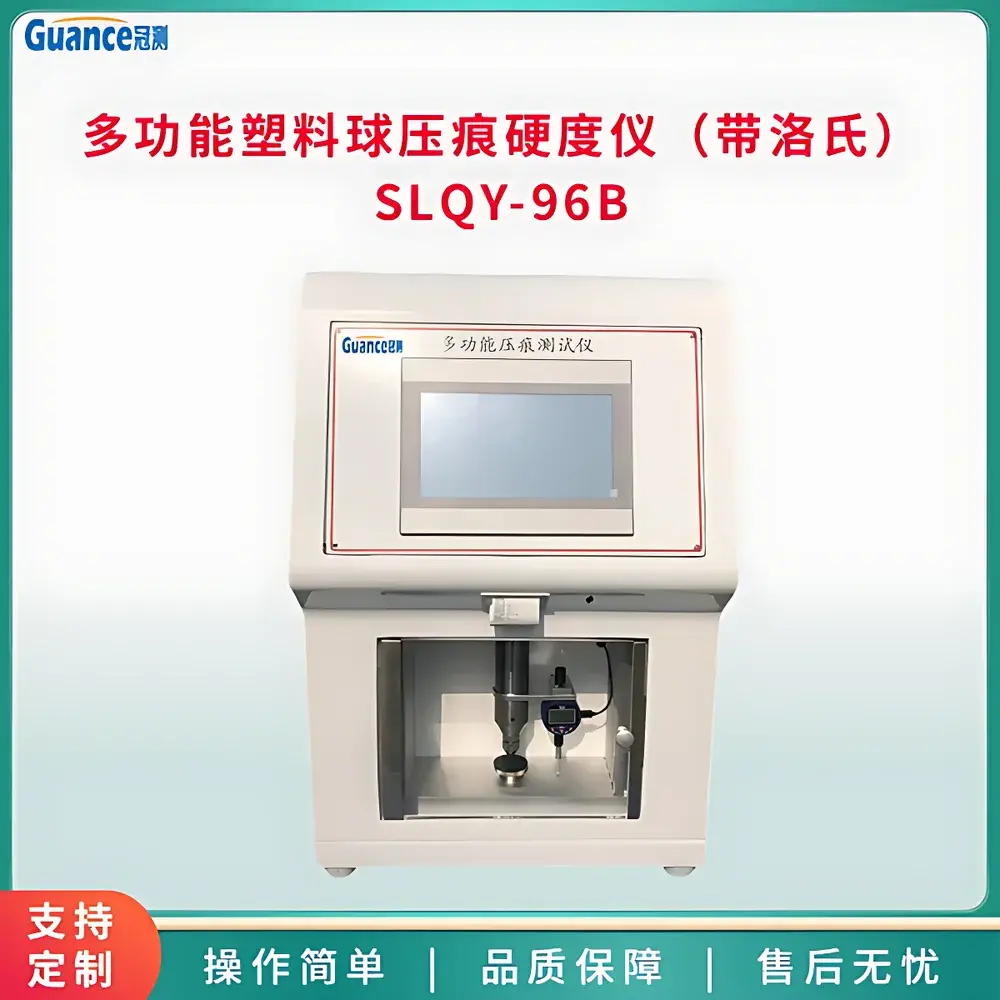
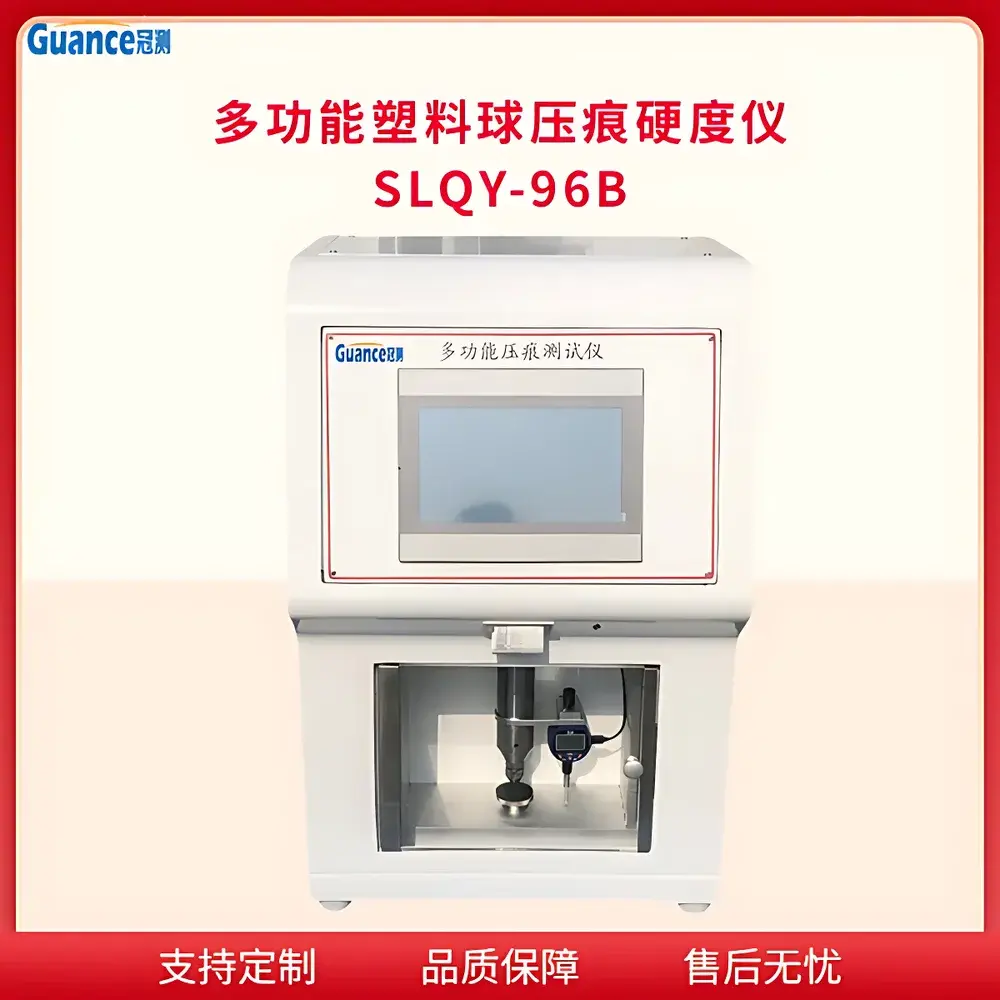
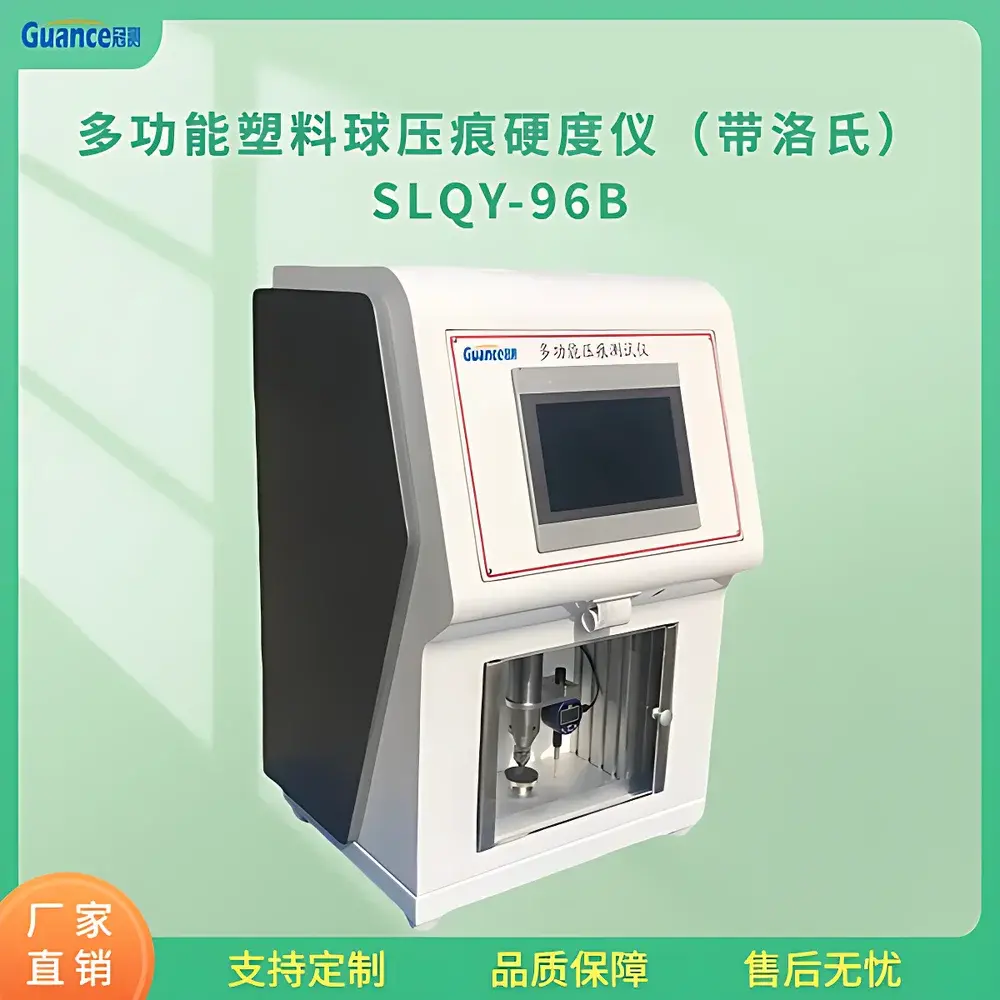
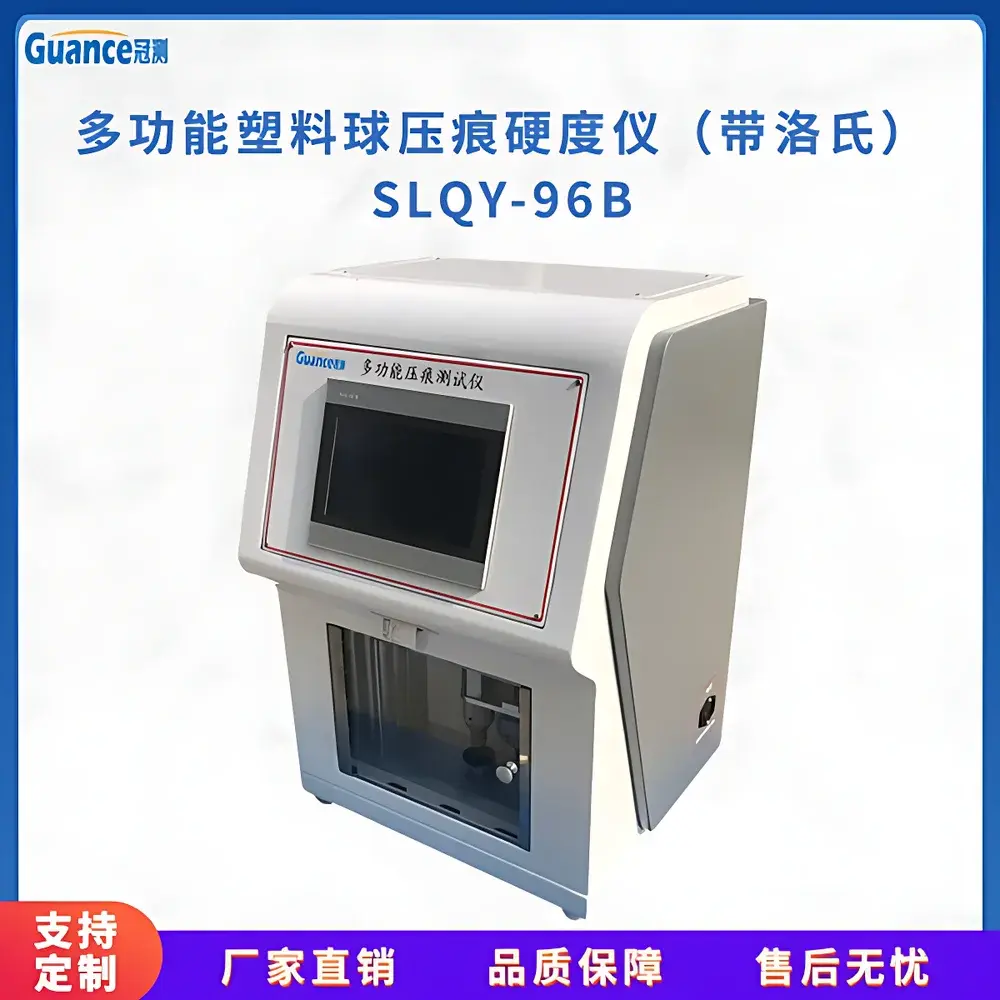
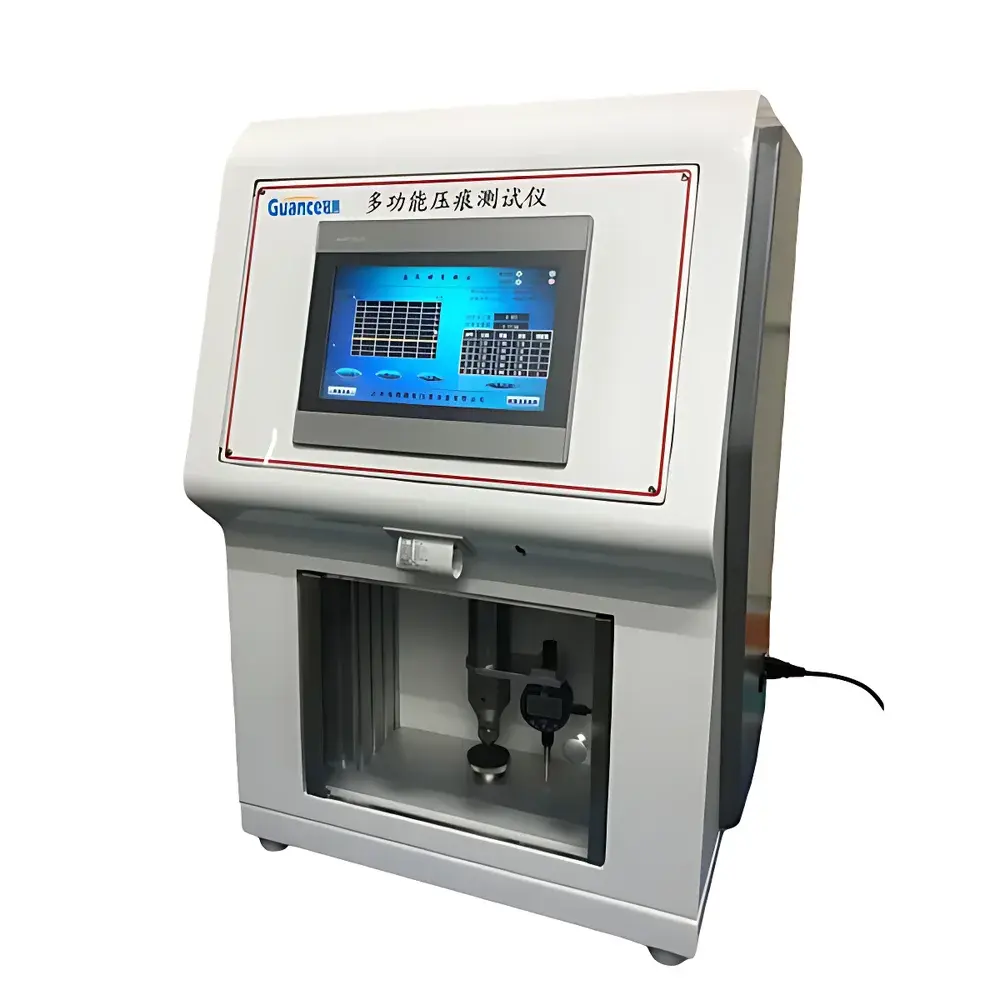
GuanCe SLQY-96B Multi-Function Plastic Ball Indentation & Rockwell Hardness Tester
| Brand | GuanCe Instruments |
|---|---|
| Origin | Beijing, China |
| Manufacturer Type | Authorized Distributor |
| Country of Origin | China |
| Model | SLQY-96B |
| Instrument Type | Rockwell & Ball Indentation Hardness Tester |
| Hardness Range | 20–88 HR |
| Total Test Force | 60 kgf (588.4 N) |
| Maximum Specimen Space | 260 mm × 150 mm |
| Initial Load (Ball Indentation) | 9.8 N |
| Initial Load (Rockwell) | 98.07 N |
| Main Loads (Ball Indentation) | 49 N, 132 N, 358 N, 612 N, 961 N |
| Main Loads (Rockwell) | 588.4 N, 980.7 N, 1471 N |
| Indenter Diameters | 5 mm & 10 mm steel spheres (ball indentation) |
| Specimen Height Limit | 4 mm |
| Indentation Depth Resolution | 0.001 mm |
| Timer Range | Programmable |
| Timer Accuracy | ±1% |
| Indication Accuracy | ±1% |
| Frame Deformation Under Load | ≤0.025 mm |
Overview
The GuanCe SLQY-96B Multi-Function Plastic Ball Indentation & Rockwell Hardness Tester is a dual-mode mechanical hardness measurement system engineered for standardized evaluation of thermoplastics, thermosets, elastomers, and polymer composites. It operates on two internationally recognized principles: ball indentation hardness per ISO 2039-1 (equivalent to GB/T 3398.1–2008) and Rockwell hardness for plastics per ISO 2039-2 (equivalent to GB/T 3398.2–2008). In ball indentation mode, a hardened steel sphere—typically 5 mm or 10 mm in diameter—is applied under controlled static load for a defined dwell time (standardized at 30 s), and the resulting indentation depth is measured with high-resolution displacement sensing. The instrument calculates hardness as the ratio of applied force to projected spherical cap area. In Rockwell mode, it follows the incremental loading sequence (preliminary + major load) using standardized spherical indenters and evaluates hardness from the permanent depth recovery after major load removal. Designed for laboratory and QC environments, the SLQY-96B integrates metrological traceability, mechanical stability, and repeatable test execution to support material qualification, incoming inspection, and process validation.
Key Features
- 10-inch industrial-grade capacitive touchscreen interface enabling intuitive parameter configuration, real-time test monitoring, and direct method selection (ball indentation, Rockwell, or compression resistance)
- High-precision miniature linear displacement sensor with 0.001 mm resolution and ±1% linearity, calibrated against NIST-traceable reference standards
- Fully automated test cycle: motorized load application, dwell timing, unloading, depth acquisition, hardness calculation, and automatic indenter retraction to home position
- Modular indenter turret supporting five interchangeable spherical indenters: 3.175 mm, 6.35 mm, and 12.7 mm for Rockwell; 5 mm and 10 mm for ball indentation—each pre-aligned and secured via precision collet mount
- Integrated thermal-stabilized load train with hydraulic-pneumatic hybrid actuation, ensuring force stability within ±0.5% over full range (9.8 N to 1471 N)
- Onboard thermal printer (80 mm width) compliant with ISO/IEC 17025 documentation requirements for immediate hard-copy output of test ID, load profile, depth value, hardness result, date/time stamp, and operator ID
- Rigid cast-iron base with vibration-damping feet and ≤0.025 mm frame deflection under maximum load, minimizing environmental influence on measurement integrity
Sample Compatibility & Compliance
The SLQY-96B accommodates flat, rigid specimens up to 4 mm in thickness and 260 mm × 150 mm in planar dimensions. It is validated for use with polyethylene (PE), polypropylene (PP), PVC, ABS, polycarbonate (PC), PMMA, and cross-linked polyethylene (PEX) — including ASTM D1525-compliant formulations and ISO 1043-1 coded resins. All test protocols align with national and international regulatory frameworks: GB/T 3398.1–2008 and GB/T 3398.2–2008 (China); ISO 2039-1:2019 and ISO 2039-2:2019; and ASTM D785 for Rockwell hardness of plastics. For pipeline coating applications, it supports verification per GB/T 23257–2009 (polyethylene anticorrosive coatings for buried steel pipelines), where ball indentation hardness serves as a critical indicator of long-term creep resistance and environmental stress cracking performance. The instrument’s mechanical design conforms to IEC 61000-6-2 (immunity) and IEC 61000-6-4 (emission) standards.
Software & Data Management
While the SLQY-96B operates autonomously via embedded firmware, optional PC-based software (GuanCe TestSuite v3.2) enables advanced data handling: batch test sequencing, statistical analysis (mean, SD, CV%, min/max), trend charting across time or lot number, and export to CSV, PDF, or XML formats. Audit trail functionality logs all user actions—including method changes, calibration events, and result modifications—with timestamps and operator credentials. When deployed in GLP- or GMP-regulated facilities, the system supports 21 CFR Part 11-compliant electronic signatures and role-based access control (administrator, technician, reviewer) through optional license activation. Raw depth measurements and load-time curves are retained internally for ≥10,000 tests and can be retrieved via USB 2.0 port for third-party analysis.
Applications
- Quality control of injection-molded plastic components (e.g., automotive interior trim, medical device housings, consumer electronics enclosures)
- Comparative hardness profiling across polymer batches to detect resin degradation, filler dispersion inconsistency, or moisture absorption effects
- Evaluation of PE pipe and geomembrane coatings per GB/T 23257–2009 for field-installation readiness and service-life prediction
- Material development labs assessing heat aging, UV exposure, or chemical resistance via hardness drift over accelerated aging cycles
- Third-party testing laboratories performing accredited hardness certification under CNAS (China National Accreditation Service) scope
- Academic research on structure–property relationships in semi-crystalline polymers and filled composites
FAQ
What standards does the SLQY-96B directly support?
It is factory-configured and verified for GB/T 3398.1–2008 (ball indentation), GB/T 3398.2–2008 (Rockwell), and GB/T 23257–2009 (PE pipeline coatings). Equivalent ISO and ASTM methods are supported via user-defined parameter sets.
Can the instrument perform both ball indentation and Rockwell tests without hardware modification?
Yes—indenter exchange is tool-free and takes <30 seconds; the control system auto-detects indenter type via RFID tags embedded in each collet assembly.
Is calibration traceable to national metrology institutes?
Standard calibration includes certificate issued by CNAS-accredited lab, referencing SI-traceable force and displacement standards; optional NIST-traceable calibration kit available upon request.
What maintenance is required for long-term accuracy?
Biannual verification of load cell linearity and displacement sensor zero drift is recommended; annual full recalibration is advised for GLP/GMP environments.
Does the system meet electromagnetic compatibility (EMC) requirements for laboratory deployment?
Yes—certified to IEC 61000-6-2 and IEC 61000-6-4, with conducted/radiated emission limits suitable for shared analytical lab spaces adjacent to HPLC, FTIR, or SEM systems.



