
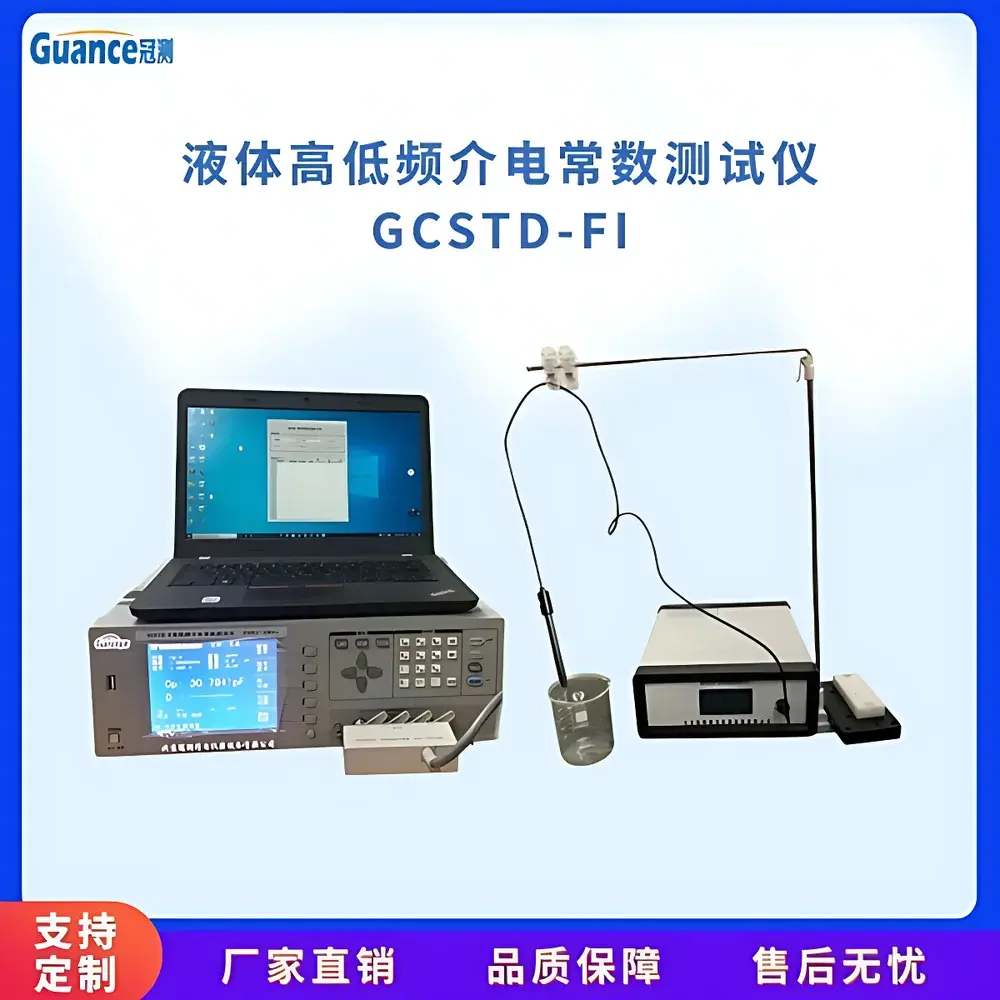
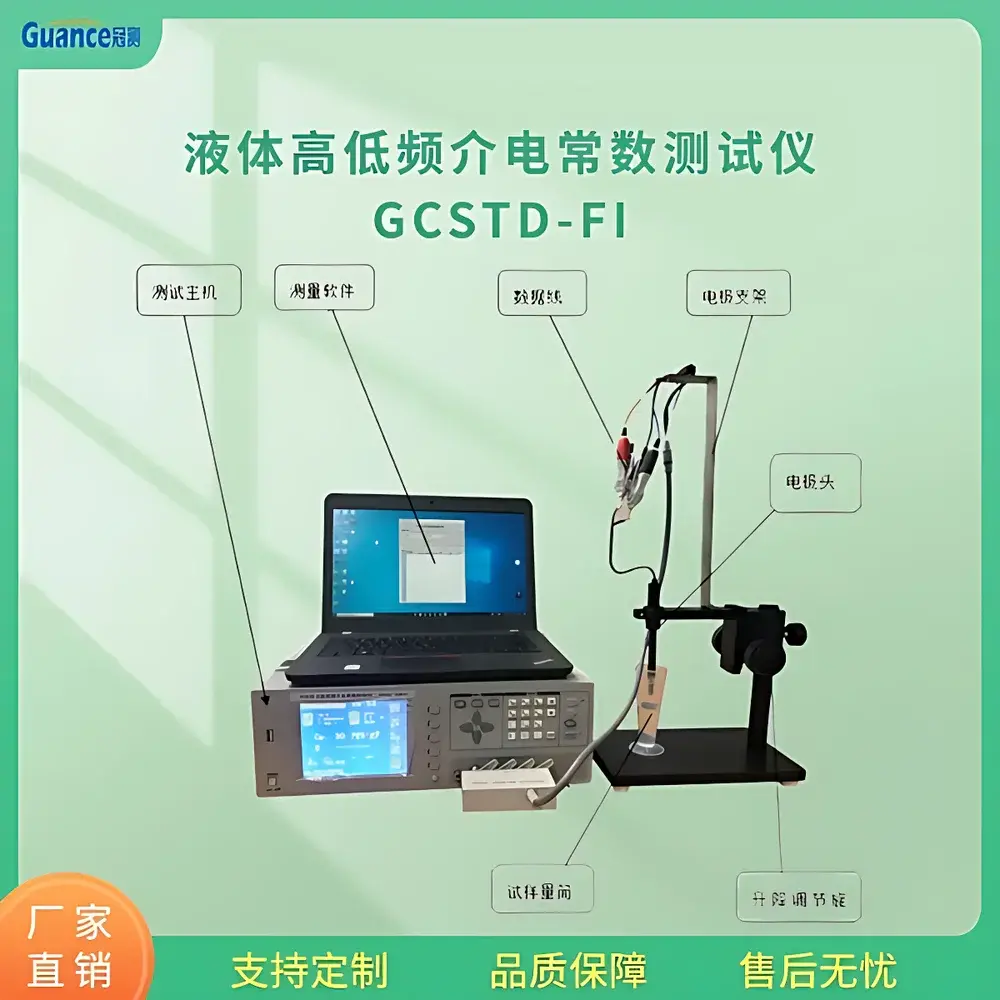
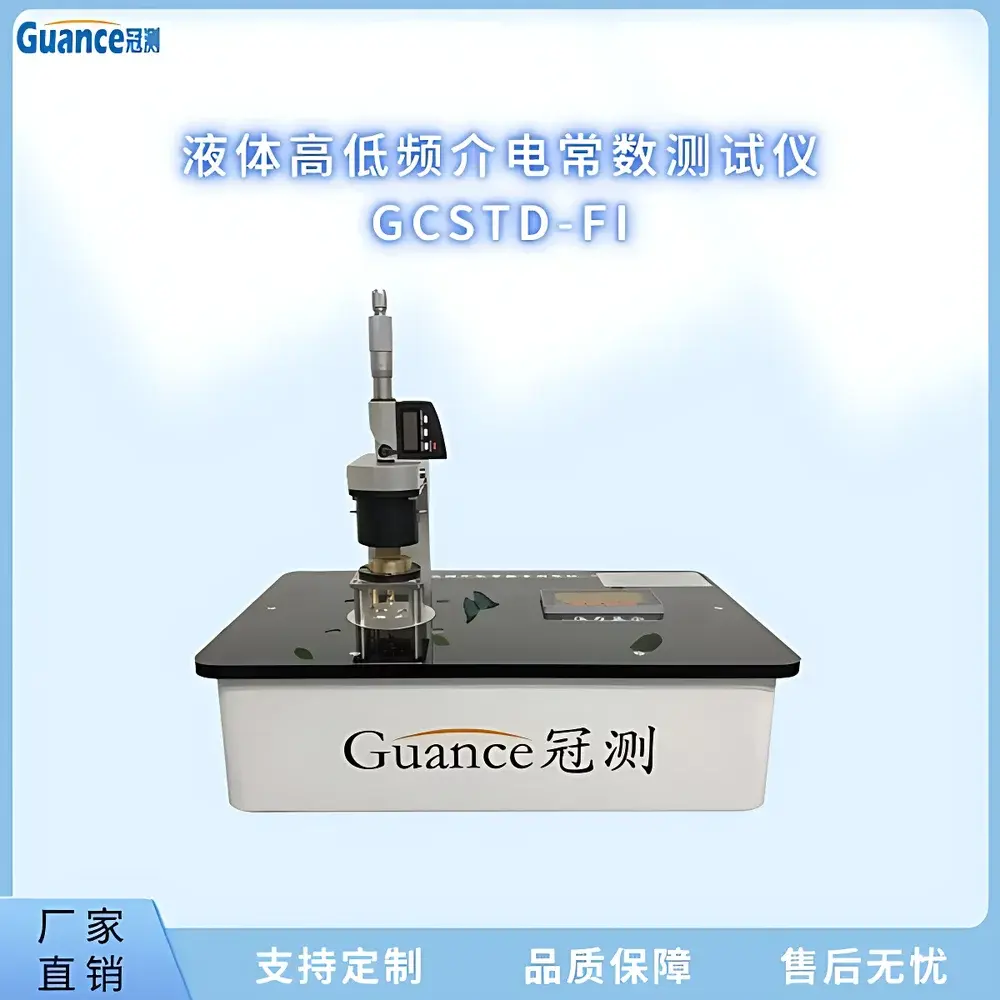
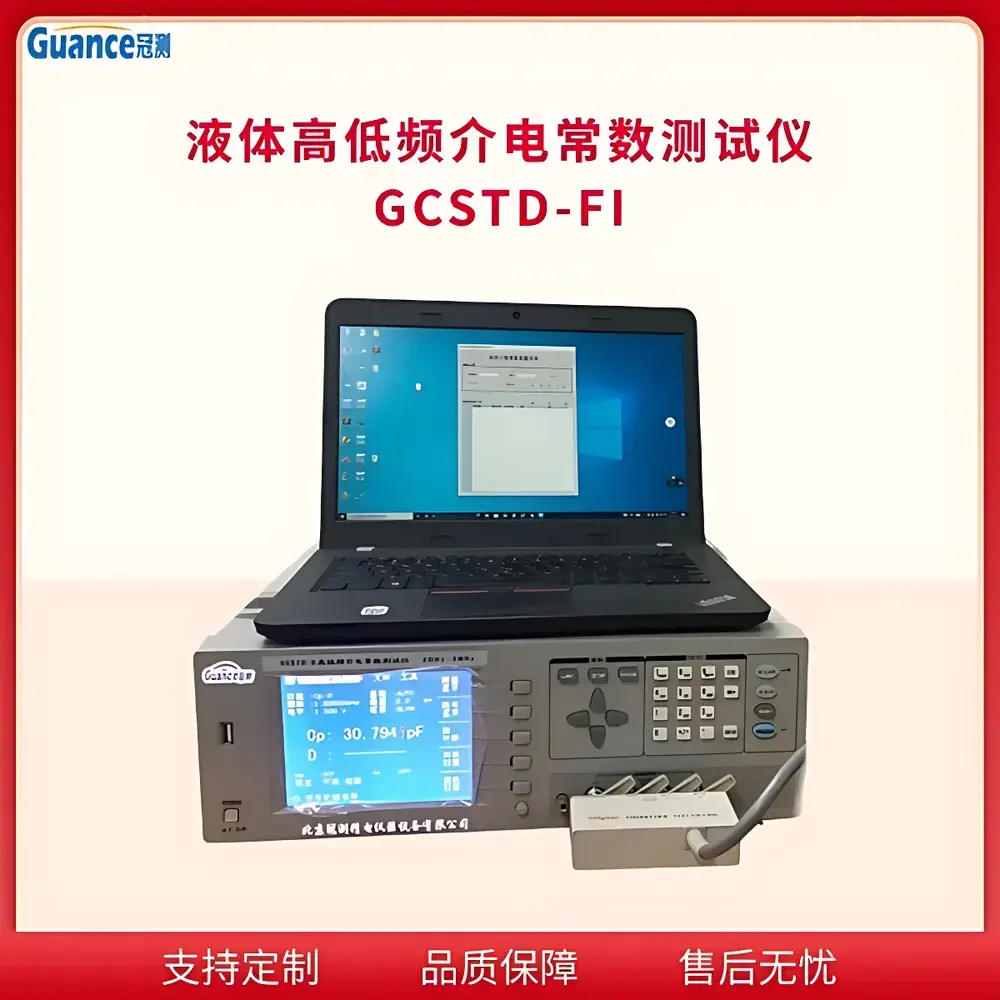
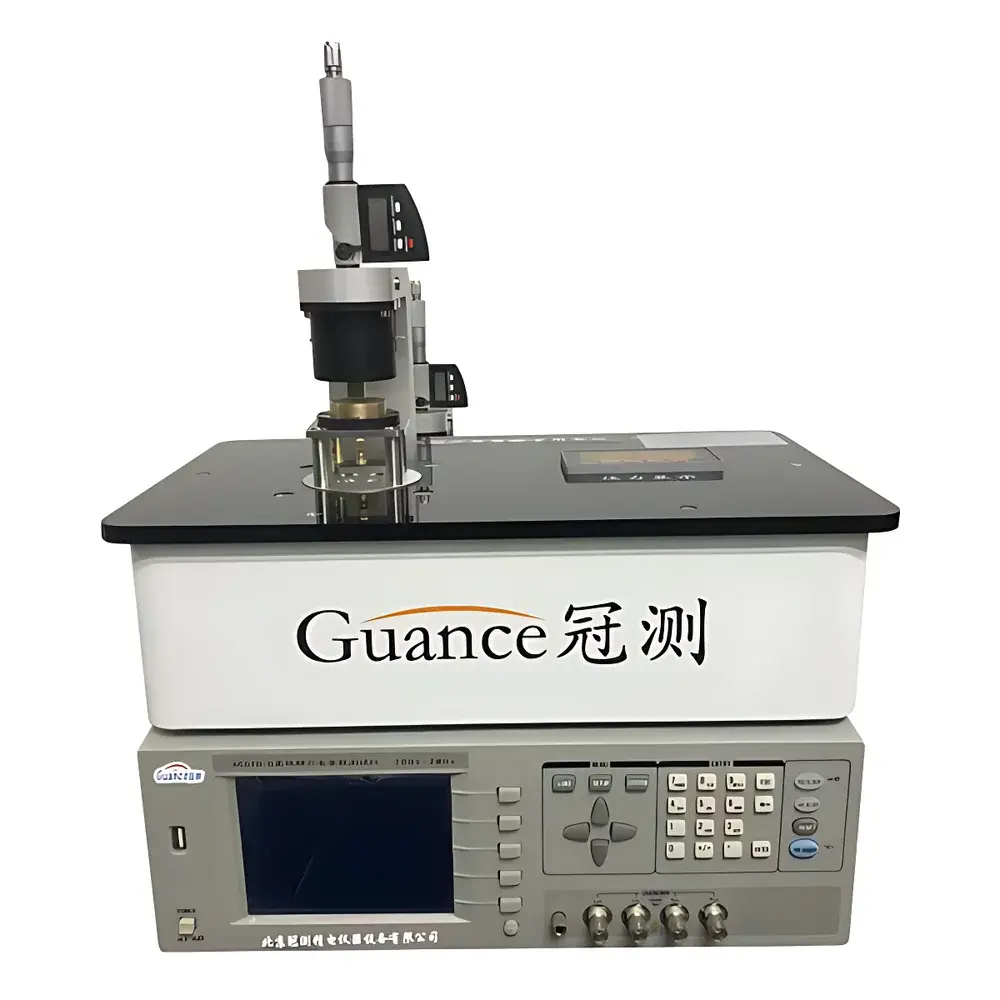
GuanCe Instruments GCSTD-FI.2 High-Frequency Liquid Dielectric Constant Analyzer
| Brand | GuanCe Instruments |
|---|---|
| Origin | Beijing, China |
| Manufacturer Type | Authorized Distributor |
| Country of Origin | China |
| Model | GCSTD-FI.2 |
| Test Frequency | 10 kHz Sinusoidal Signal |
| Measurement Ranges | 1–20 and 1–200 (dimensionless relative permittivity scale) |
| Accuracy | ±2% |
| Repeatability & Linearity | ±0.2% RMS |
| Electrode Type | External coaxial cylindrical probe (316 stainless steel outer/inner cylinders, nylon spacers, PTFE-insulated) |
| Excitation Voltage | ~7 V RMS (range 1–20), ~0.7 V RMS (range 1–200) |
| Compliance | GB/T 1409–2006, GB/T 5654–2007, GB/T 21216–2007, GB/T 1693–2007, GB/T 5594.4–1985 |
Overview
The GuanCe Instruments GCSTD-FI.2 High-Frequency Liquid Dielectric Constant Analyzer is a precision impedance-based measurement system engineered for the quantitative determination of relative permittivity (εr) and dissipation factor (tan δ) of liquid dielectrics at a fixed high-frequency excitation of 10 kHz. It operates on the principle of capacitance-to-dielectric conversion using a calibrated coaxial cylindrical electrode geometry, where the sample’s complex permittivity is derived from measured admittance under controlled sinusoidal voltage excitation. Unlike broadband dielectric spectrometers, the GCSTD-FI.2 delivers optimized stability and reproducibility for routine QC/QA applications in insulating fluid manufacturing, transformer oil monitoring, lubricant formulation, and electronic material development—where standardized single-frequency evaluation per national test methods is required.
Key Features
- Coaxial cylindrical electrode assembly fabricated from 316 stainless steel with precision-machined concentric geometry, ensuring consistent electric field distribution and minimal fringing effects.
- Two selectable measurement ranges (1–20 and 1–200 εr) with automatic range-switching logic and corresponding RMS excitation voltages (7 V and 0.7 V) to maintain signal-to-noise integrity across low- and high-permittivity samples.
- Non-disassemblable electrode design—mechanical integrity of the 6-point nylon spacer system is critical to geometric accuracy; disassembly voids calibration traceability and invalidates measurement uncertainty budgets.
- Chemically resistant construction (316 SS, PTFE, nylon) enabling compatibility with aggressive solvents including acetone, ethanol, chlorinated hydrocarbons, and aromatic fluids during cleaning protocols.
- Integrated signal conditioning circuitry with temperature-stabilized oscillator and low-drift analog front-end, supporting long-term repeatability better than ±0.2% RMS over 8-hour operational cycles.
Sample Compatibility & Compliance
The GCSTD-FI.2 is validated for use with non-conductive and weakly conductive liquids including mineral oils, synthetic esters, silicone fluids, alcohols, ketones, and halogenated solvents. It conforms to multiple Chinese national standards governing dielectric characterization: GB/T 1409–2006 (capacitance and loss measurement at power/audio/high frequencies), GB/T 5654–2007 (liquid insulation materials), GB/T 21216–2007 (conductivity and capacitance-derived tan δ), GB/T 1693–2007 (vulcanized rubber), and GB/T 5594.4–1985 (ceramic dielectrics). While not certified to IEC 60247 or ASTM D924, its measurement methodology aligns with the underlying physical principles of those standards and supports internal method validation per GLP-compliant laboratory practices.
Software & Data Management
The analyzer outputs analog DC voltage signals proportional to εr and tan δ, compatible with standard data acquisition systems (e.g., National Instruments DAQ, Keysight U2300A) or optional RS-232/USB interface modules (sold separately). Raw output supports integration into LIMS environments and automated reporting workflows. For audit readiness, users are advised to implement manual logbook entries or timestamped CSV exports that record operator ID, sample ID, electrode cleaning status, ambient temperature/humidity, and calibration verification date—consistent with ISO/IEC 17025 documentation requirements for accredited testing laboratories.
Applications
- Quality control of transformer and switchgear insulating oils per IEC 60422 and DL/T 429.6 guidelines.
- Formulation screening of dielectric coolants for high-voltage electronics and EV battery thermal management systems.
- Stability assessment of functional fluids undergoing oxidative aging or moisture ingress.
- Batch release testing of silicone-based encapsulants and potting compounds.
- Research into polar/non-polar solvent interactions in electrochemical cell electrolytes.
FAQ
What is the recommended cleaning protocol for the electrode before measuring hydrocarbon-based samples?
Immerse the intact electrode in analytical-grade acetone or ethanol, then subject it to ultrasonic agitation for 5 minutes. Rinse briefly with fresh solvent and dry with filtered compressed air—do not wipe or disassemble.
Can the GCSTD-FI.2 measure aqueous solutions?
No. Due to high ionic conductivity, water and aqueous electrolytes exceed the instrument’s impedance measurement envelope and may damage the electrode or produce non-physical εr readings.
Is NIST-traceable calibration available?
GuanCe Instruments provides factory calibration using certified reference liquids (e.g., cyclohexane εr = 2.023, methanol εr = 32.6 at 20°C, 10 kHz); full NIST-traceable calibration requires third-party metrology lab services.
How often should electrode geometry verification be performed?
Verify mechanical integrity (cylinder concentricity, spacer torque, surface finish) prior to each daily use via visual inspection and baseline measurement in a known reference fluid; full recalibration is recommended every 6 months or after 200 sample measurements.
Does the instrument support temperature-controlled measurements?
No. The GCSTD-FI.2 operates at ambient temperature only. For temperature-dependent studies, external thermostatic baths with immersion-compatible electrode fixtures must be used—and temperature must be recorded manually for data annotation.



