
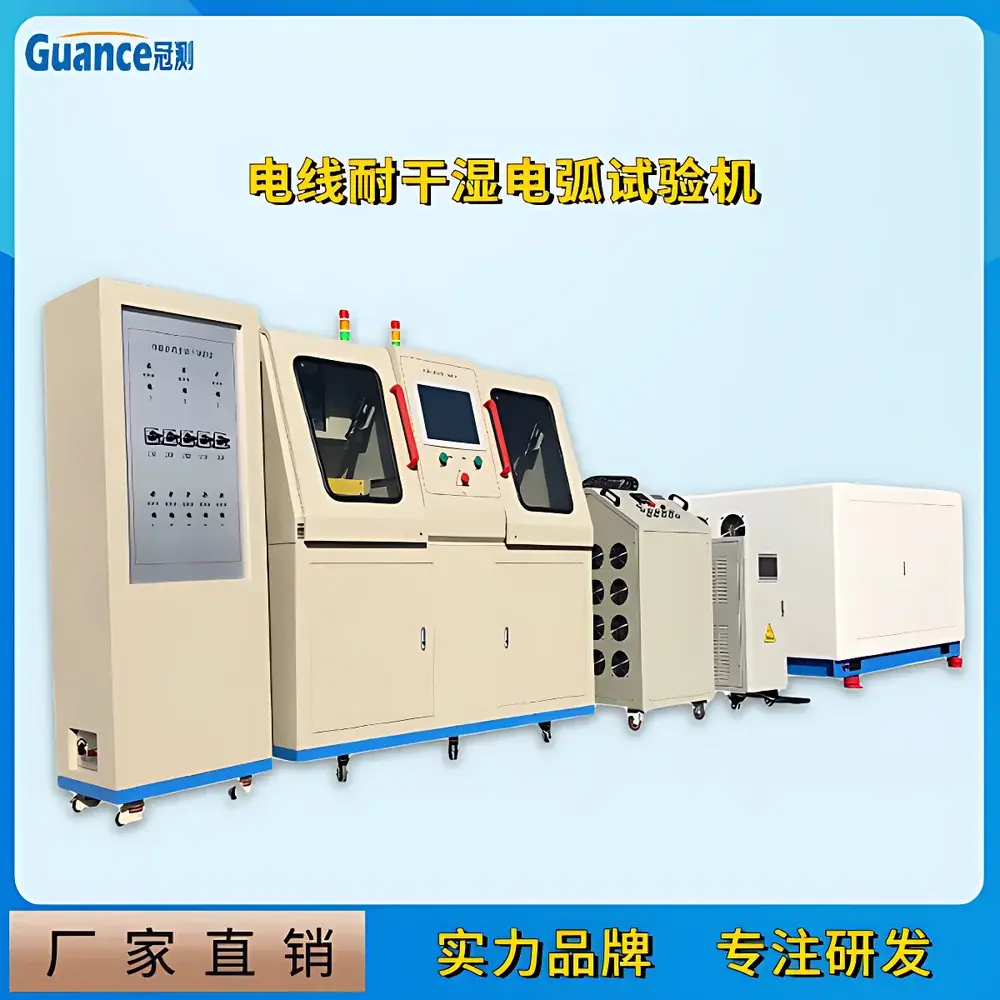
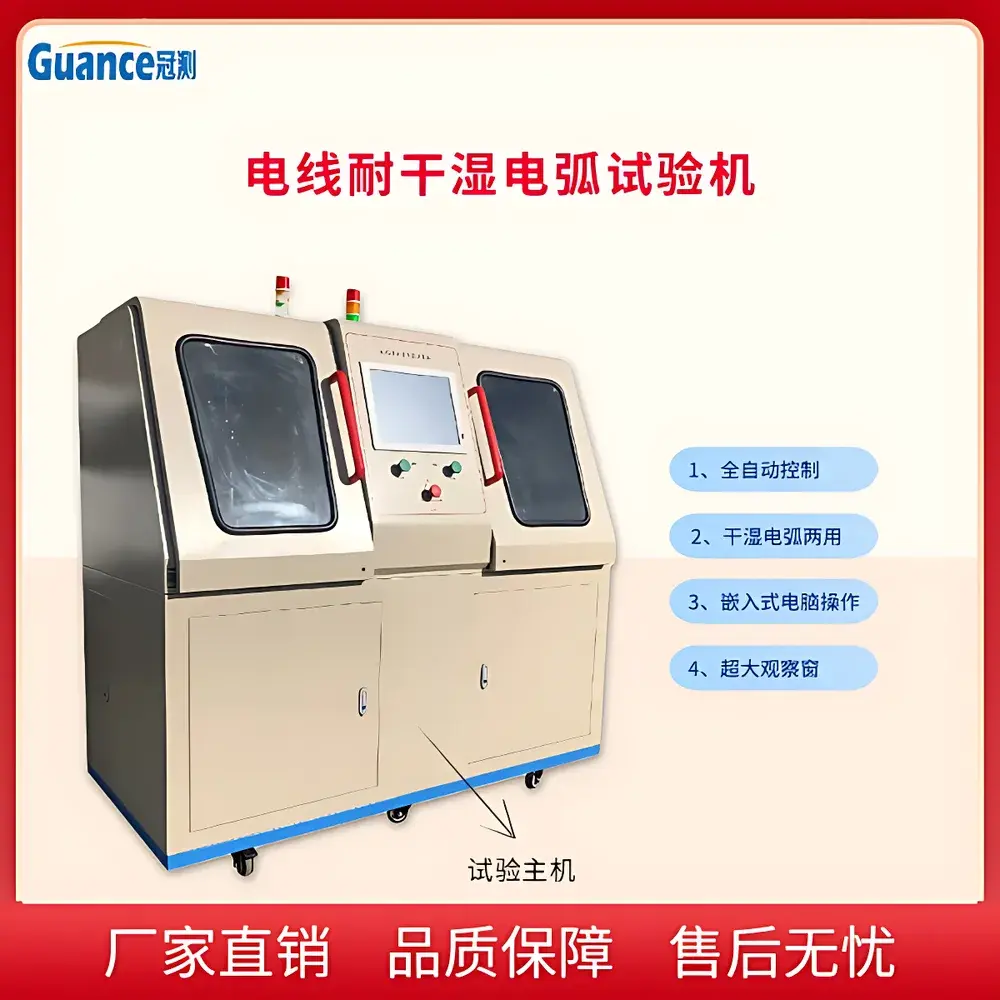
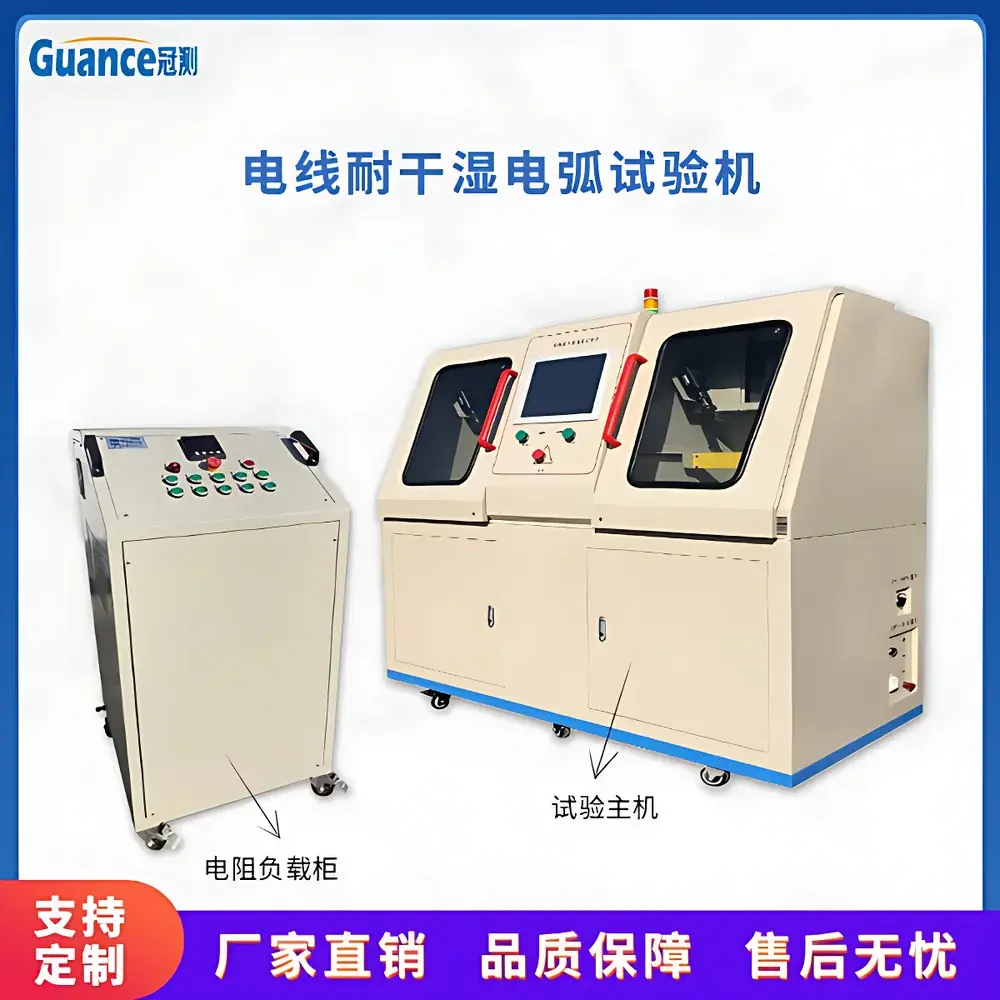
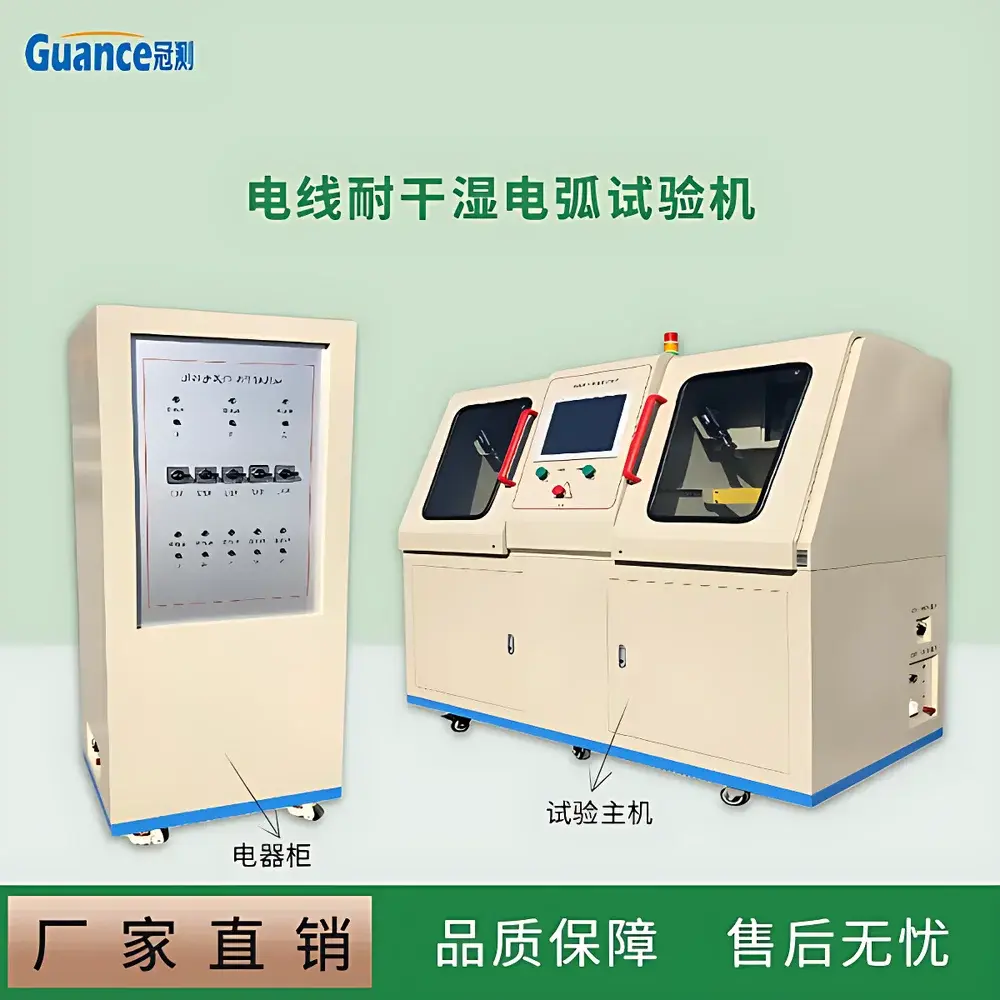
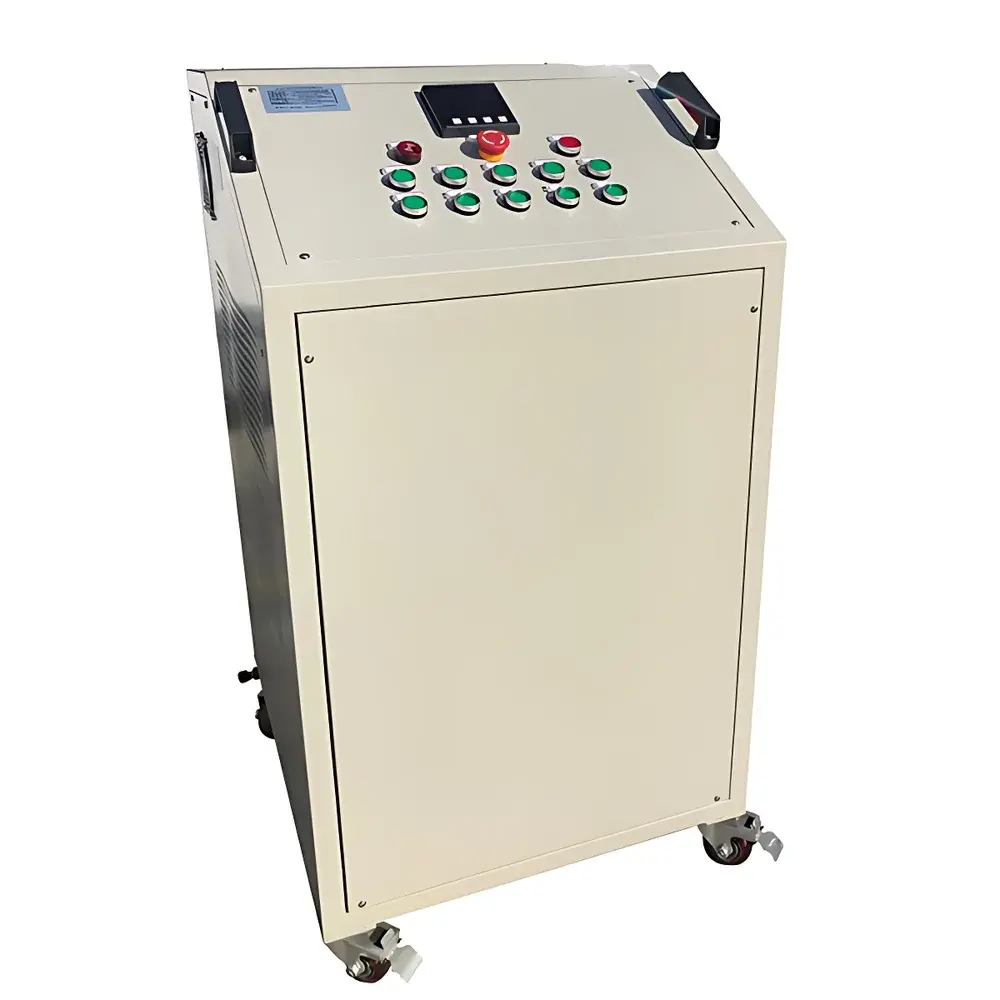
GuanCe YHT-RC100.3 Aerospace-Grade Wire Arc Resistance Universal Testing Machine
| Brand | GuanCe Instruments |
|---|---|
| Origin | Beijing, China |
| Manufacturer Type | Authorized Distributor |
| Regional Classification | Domestic (China) |
| Model | YHT-RC100.3 |
| Instrument Type | Electromechanical Universal Testing Machine |
| Power Input | AC 220 V ±10%, 50 Hz ±0.5 Hz, 2 kW |
| Test Voltage Accuracy | ±1% (0.1 V resolution) |
| Test Current Accuracy | ±1% (0.01 A resolution) |
| Arc Exposure Duration | 1–99,999,999 s (programmable) |
| Dry/Wet Mode Switching | Yes |
| Electrode Travel Range | 1–10 cm (standard 3.81 ±0.3 cm) |
| Electrode Stroke Speed | 0.5 ±0.05 cycles per second (full reciprocation) |
| Electrode Load Mass | 250 ±25 g |
| Dropping Rate (Wet Mode) | 100 ±10 mg/min (8–10 drops/min, via Lead Fluid peristaltic pump) |
| Control System | Siemens original PLC (S7 series) |
| HMI | Kunlun Tongtai 10-inch capacitive touchscreen |
| Compliance Standards | AS4373D, GJB773A, ASD-STAN PRF-6059-502, EN 6059-502 (PrEN) |
| Operating Altitude | ≤1000 m |
| Ambient Temperature | −30 °C to +40 °C |
| Relative Humidity | ≤85 % RH |
| Grounding Resistance | <1 Ω |
| Dimensions (L×W×H) | 1400 × 830 × 1500 mm |
| Weight | 300 kg |
Overview
The GuanCe YHT-RC100.3 Aerospace-Grade Wire Arc Resistance Universal Testing Machine is a precision-engineered electromechanical system designed specifically for evaluating the arc resistance performance of insulated aerospace wiring under standardized dry and wet conditions. Unlike general-purpose tensile or compression testers, this instrument implements a controlled high-frequency arcing protocol—based on the physical principle of dielectric breakdown initiation and carbon tracking propagation—under rigorously defined electrical, mechanical, and environmental parameters. It replicates real-world in-flight arc fault scenarios by combining synchronized electrode motion, calibrated current/voltage delivery (at 400 Hz), and programmable electrolyte droplet application. The system integrates generator-powered 400 Hz excitation (via dedicated 20 kVA generator + frequency converter), real-time analog signal acquisition (voltage/current transducers outputting 4–20 mA), and closed-loop servo control of electrode kinematics—all coordinated through a Siemens S7-series PLC. Its architecture meets the stringent mechanical stability, grounding, and electromagnetic compatibility (EMC) requirements specified for aerospace ground test equipment per MIL-STD-461G and DO-160G Section 20.
Key Features
- Multi-mode arc exposure capability: Independent dry-mode (electrode-to-wire arcing) and wet-mode (electrolyte-dripped arc tracking) testing per AS4373D Clause 6.3 and GJB773A Method 3016.
- High-fidelity parameter control: Programmable arc duration (1–99,999,999 s), electrode stroke (1–10 cm), stroke frequency (0.5 ±0.05 cps), and load mass (250 ±25 g) with traceable calibration certificates available upon request.
- Dual-path electrical monitoring: Isolated voltage transducers (±1% accuracy, 0.1 V resolution) and current transducers (±1% accuracy, 0.01 A resolution) feed analog signals directly into the PLC for real-time logging and trigger-based event capture.
- Regulated electrolyte delivery: Lead Fluid-brand peristaltic pump delivers test solution at 100 ±10 mg/min (8–10 drops/min), with integrated conductivity verification via inline conductometer to ensure compliance with AS4373D-specified 0.1% NaCl solution resistivity (≈1000 µS/cm).
- Ruggedized mechanical actuation: Servo-driven linear motion system using ball-screw translation and precision linear guide rails ensures repeatable electrode positioning and minimal hysteresis across >10⁵ operational cycles.
- Full-system safety interlocks: Five 7.5 A circuit breakers (per-phase protection), one 30 A short-circuit breaker, emergency stop with hardware-decoupled relay logic, and active fume extraction via ducted exhaust fan meeting OSHA 1910.1200 ventilation guidelines.
Sample Compatibility & Compliance
The YHT-RC100.3 accommodates insulated wire specimens up to 6.5 mm outer diameter and supports standardized sample configurations per AS4373D: seven-wire bundles (five loaded, two floating) mounted on dedicated dry/wet fixtures with adjustable clamping force. All mechanical interfaces—including electrode holders, drip nozzles, and solution containment trays—are constructed from non-conductive, arc-resistant polymer composites (UL94 V-0 rated) to prevent parasitic tracking. The system complies fully with AS4373D (2022), GJB773A–2020 (Method 3016), ASD-STAN PRF-6059-502 (2019), and EN 6059-502 (2021). Traceable calibration documentation aligns with ISO/IEC 17025:2017 requirements for accredited testing laboratories. Electrical safety certification conforms to IEC 61000-4-2 (ESD immunity) and IEC 61000-4-4 (EFT/burst immunity).
Software & Data Management
Operation and data acquisition are managed exclusively through the embedded Kunlun Tongtai 10-inch capacitive HMI, which provides real-time visualization of voltage, current, droplet count, elapsed time, and system status (via tri-color tower lamp). All test parameters—including electrode position, current ramp profiles, and solution flow rate—are stored in non-volatile memory with timestamped audit trails. Raw analog inputs (4–20 mA) are sampled at ≥1 kHz and logged at user-selectable intervals (10 ms to 10 s). Export formats include CSV and PDF test reports compliant with GLP documentation standards; optional RS-485 Modbus RTU interface enables integration with LIMS or MES platforms. No proprietary software installation is required—data files are accessible via standard USB mass storage mode.
Applications
This instrument serves as a primary qualification tool for aerospace wire manufacturers, Tier-1 harness suppliers, and airframe OEMs validating insulation systems against arc-induced failure modes including surface carbonization, insulation puncture, and thermal runaway propagation. Typical use cases include: comparative evaluation of fluoropolymer (e.g., ETFE, FEP) vs. polyimide-based insulations; qualification of new wire designs per SAE AS50881 and MIL-W-22759; root-cause analysis of field-reported arc faults; and process validation of plasma-treated or nano-filled insulation coatings. It is routinely deployed in certified test labs supporting FAA PMA applications, EASA Part 21G submissions, and NASA-STD-6002 compliance verification.
FAQ
Does the YHT-RC100.3 support automated pass/fail judgment per AS4373D criteria?
Yes—the PLC executes real-time logic based on voltage collapse duration, current surge magnitude, and time-to-trip thresholds defined in AS4373D Table 3; results are auto-flagged and recorded.
Can the system be configured for custom test protocols outside published standards?
Yes—user-defined sequences (e.g., stepped voltage ramps, variable droplet intervals) can be programmed via the HMI’s script editor without firmware modification.
Is third-party calibration and IQ/OQ/PQ documentation available?
Yes—factory-certified calibration kits and full GMP-aligned qualification packages (including traceable NIST references) are offered as optional add-ons.
What maintenance intervals are recommended for the peristaltic pump and servo drive?
Pump tubing replacement every 500 hours of wet-mode operation; servo motor encoder recalibration every 2,000 operating hours or annually—whichever occurs first.
Does the unit meet EMC requirements for installation in shared laboratory environments?
Yes—it satisfies CISPR 11 Group 2 Class B emissions limits and IEC 61326-1 immunity requirements for industrial test equipment, verified per EN 61326-2-1.



