
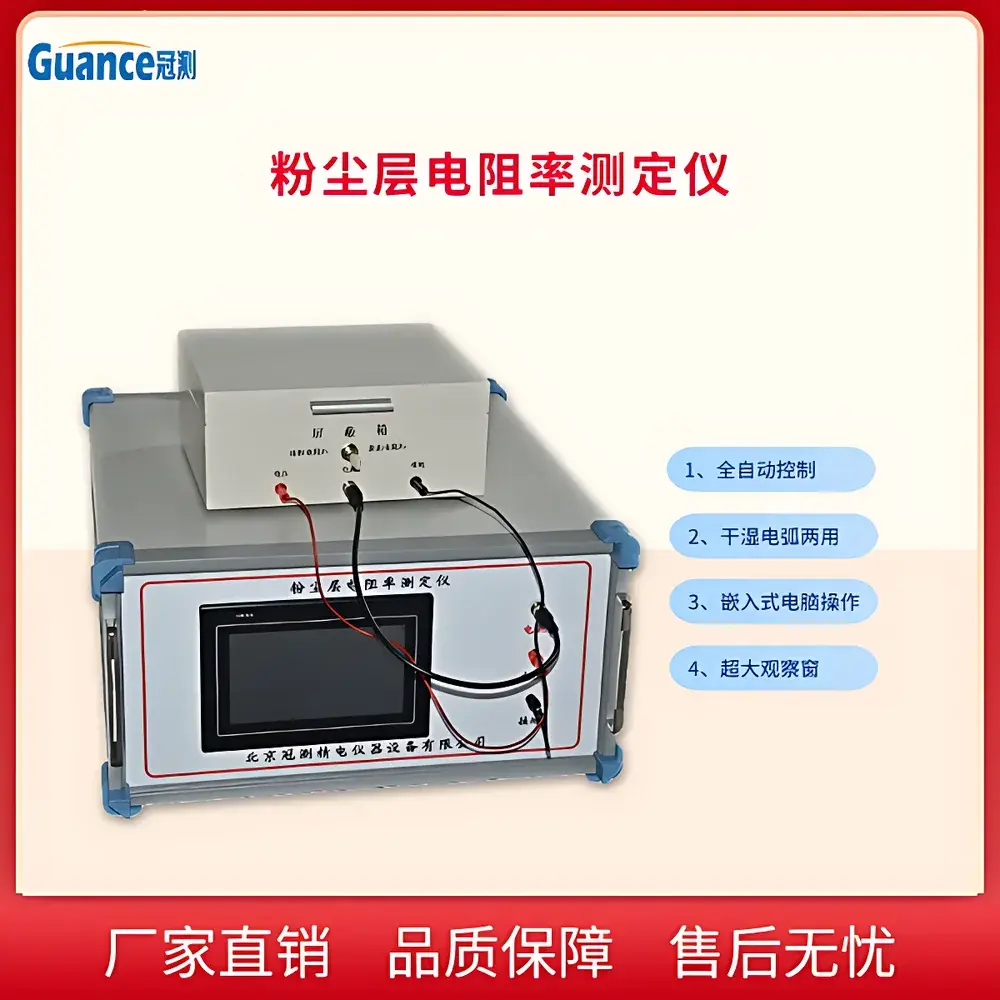
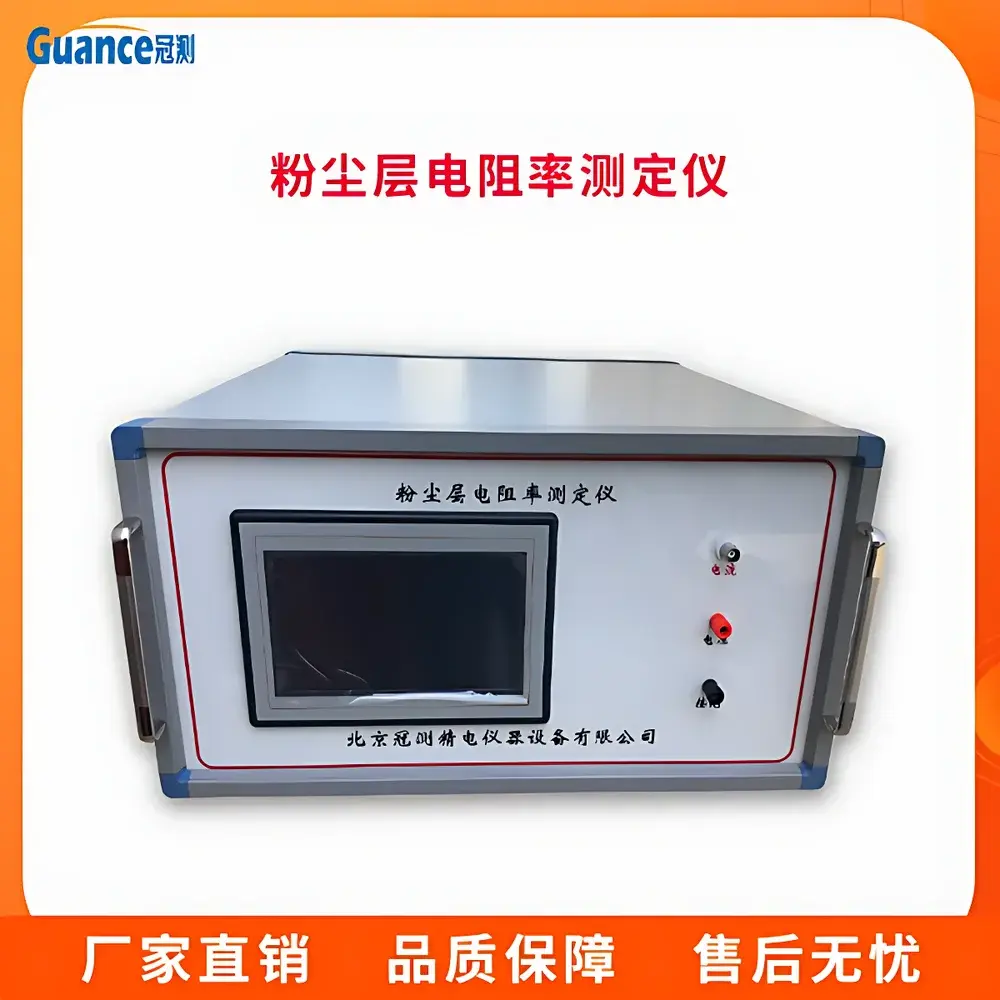
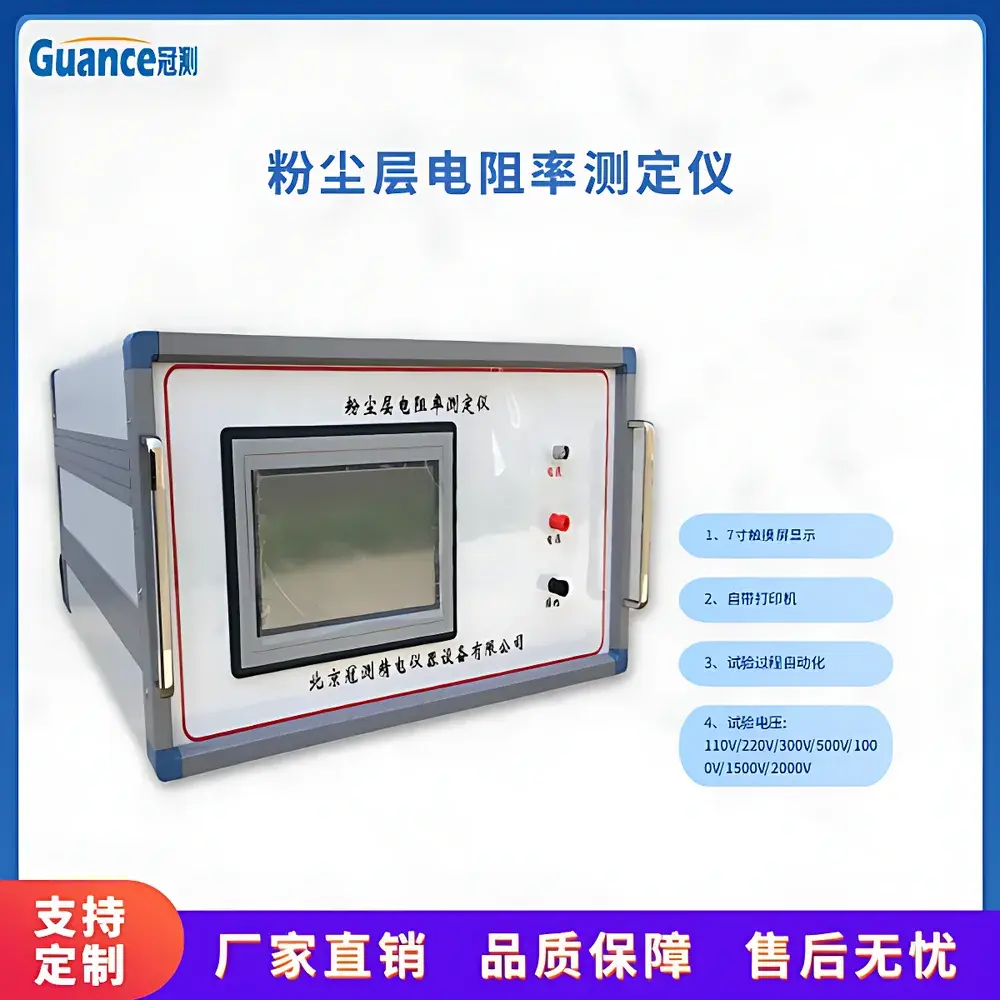
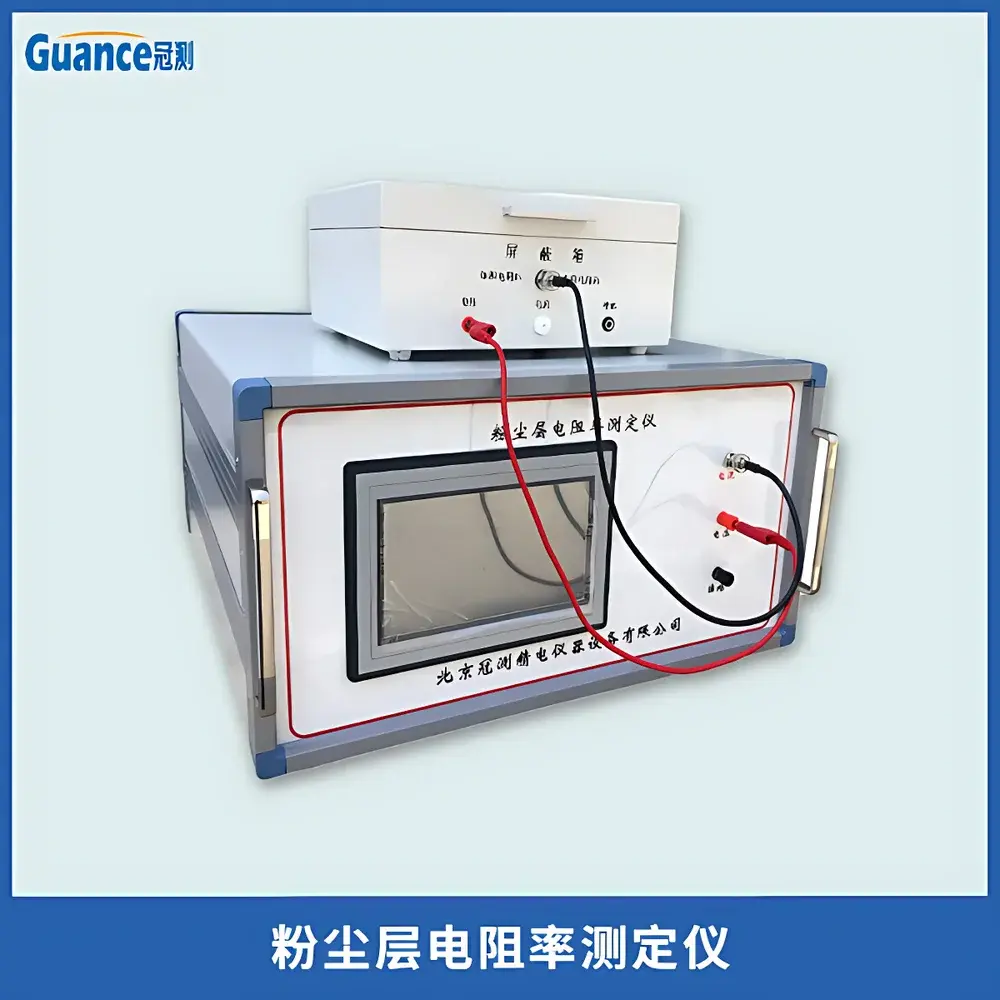
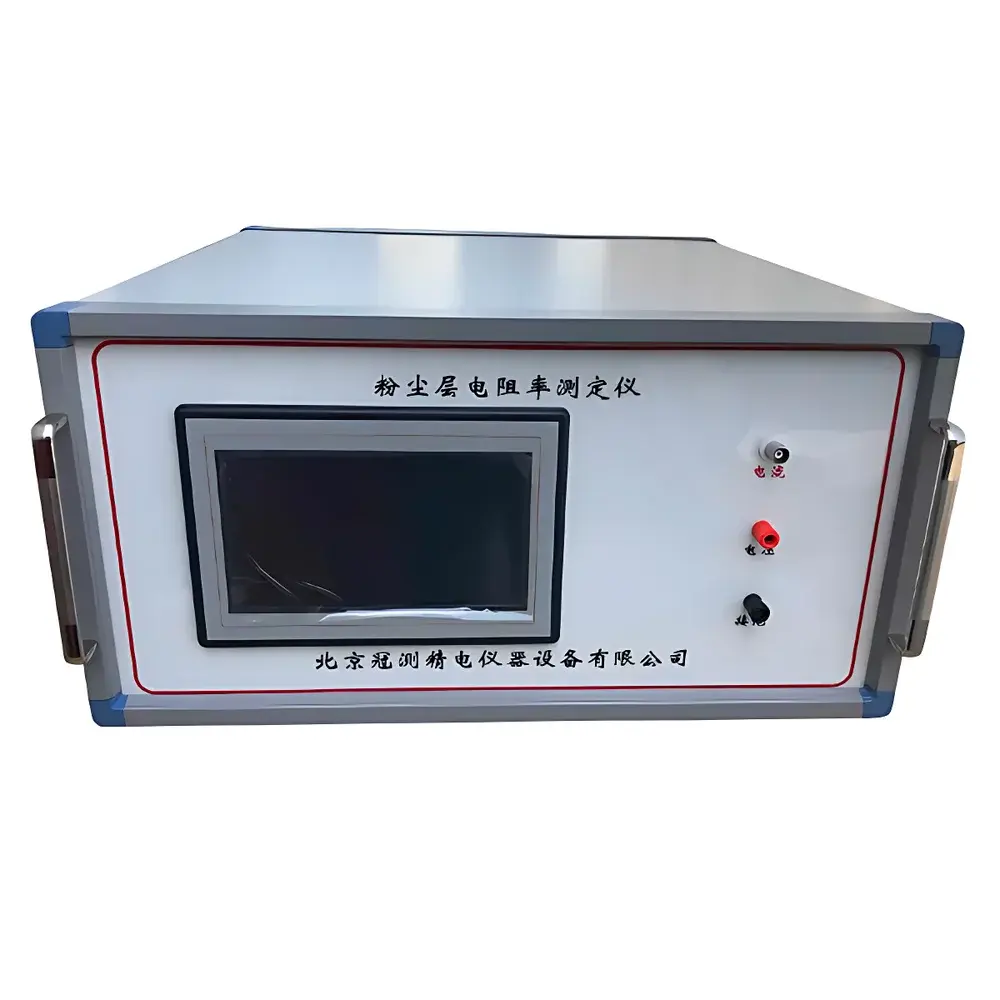
GuanCe GEST-126T Fully Automated Dust Layer Resistivity Tester
| Brand | GuanCe Instruments |
|---|---|
| Origin | Beijing, China |
| Manufacturer Type | Authorized Distributor |
| Country of Origin | China |
| Model | GEST-126T |
| Test Voltages | DC 110 V, 220 V, 300 V, 500 V, 1000 V, 1500 V, 2000 V |
| Series Resistor | 10 kΩ |
| Maximum Breakdown Current | 200 mA |
| Electrode Material | Stainless Steel |
| Measurement Accuracy | ±1% |
| Compliance | GB/T 12476.9–2010, GB/T 16427–2018 |
Overview
The GuanCe GEST-126T Fully Automated Dust Layer Resistivity Tester is a precision-engineered instrument designed for the standardized determination of electrical resistivity in compacted layers of combustible dusts. It operates on the principle of direct-current (DC) two-electrode resistivity measurement under controlled compaction and environmental conditions. The system applies calibrated DC voltage across a defined cross-sectional area of a dust layer confined between parallel stainless-steel electrodes, measuring the resulting current to compute resistivity (ρ) using the fundamental relation ρ = R × (A / d), where R is measured resistance, A is electrode contact area, and d is inter-electrode spacing. This methodology aligns with internationally recognized test protocols for hazard classification in industrial dust handling environments—specifically supporting the differentiation between conductive dusts (ρ ≤ 10³ Ω·m) and non-conductive dusts (ρ > 10³ Ω·m)—a critical parameter for explosion protection engineering, grounding system design, and ATEX/IECEx zone classification.
Key Features
- Seven programmable DC test voltages (110 V to 2000 V) enable graded assessment across diverse dust conductivity ranges, supporting both low-resistivity screening and high-voltage breakdown threshold evaluation.
- Integrated 10 kΩ series current-limiting resistor ensures compliance with safety requirements during high-voltage testing while maintaining stable current delivery for accurate resistivity calculation.
- Stainless-steel parallel-plate electrodes provide corrosion resistance, dimensional stability, and repeatable surface contact geometry—essential for minimizing interfacial contact resistance artifacts.
- Automated measurement sequence includes electrode positioning verification, dust layer compaction control (via standardized manual tamping protocol), voltage ramping, real-time current monitoring, and auto-zeroed resistance acquisition.
- ±1% measurement accuracy is validated per GB/T 16427–2018 Annex B, traceable to national metrological standards; system linearity is confirmed across full voltage range using certified reference resistors.
- Compact benchtop architecture with CE-compliant electrical isolation, reinforced insulation barriers, and emergency stop circuitry meets IEC 61010-1 safety requirements for laboratory use.
Sample Compatibility & Compliance
The GEST-126T accommodates dry, free-flowing, non-agglomerated combustible dusts—including metal powders (Al, Mg, Fe), organic particulates (wood, sugar, flour), and polymer granules—with particle size distributions typically ranging from 10 µm to 500 µm. Sample preparation follows strict procedural controls: dust is sieved (≤250 µm), dried (≤50 °C, <5% RH), and uniformly layered within the electrode cavity to a nominal thickness of 10 mm ± 0.2 mm. The instrument is fully compliant with GB/T 12476.9–2010 (equivalent to IEC 60079-20-2 Ed. 2.0) and GB/T 16427–2018, which define test chamber dimensions, electrode specifications, environmental conditioning (23 °C ± 2 °C, 50% ± 5% RH), and reporting requirements for resistivity values—including minimum recorded resistivity at each applied voltage. Data outputs satisfy documentation needs for HAZOP studies, DSEAR assessments, and process safety management (PSM) audits under OSHA 1910.119.
Software & Data Management
While the GEST-126T operates in standalone mode with front-panel digital display and manual data logging, it supports optional RS-232 or USB-to-serial interface for integration with external data acquisition systems. Raw voltage, current, and calculated resistivity values are output in ASCII format with timestamping. When used in regulated environments (e.g., pharmaceutical excipient handling or battery material QC labs), the instrument can be operated under documented SOPs aligned with GLP principles. Audit trails—including operator ID, sample ID, test date/time, voltage setting, and final resistivity value—are maintained manually or via linked LIMS. Though not natively 21 CFR Part 11 compliant, its deterministic measurement logic and fixed calibration parameters support validation protocols for IQ/OQ/PQ execution.
Applications
- Hazardous area classification for silos, mixers, pneumatic conveyors, and dust collectors in chemical, food, and metallurgical plants.
- Grounding system design verification for powder processing equipment per NFPA 77 and IEC 60079-14.
- Material qualification of conductive additives (e.g., carbon black, graphite) in composite formulations.
- Research into electrostatic charge dissipation kinetics in layered particulate systems.
- Quality control of recycled metal powders for additive manufacturing feedstock certification.
- Supporting technical documentation for ATEX Category 2G/3D equipment certification submissions.
FAQ
What dust moisture content is permissible for valid testing?
Samples must be conditioned to ≤5% relative humidity prior to testing; excess moisture alters conduction mechanisms and invalidates classification per GB/T 16427–2018 Section 6.2.
Can the GEST-126T measure volume resistivity of bulk powder beds?
No—it measures *dust layer* resistivity only, as defined by standardized electrode geometry and compaction. Bulk or surface resistivity requires alternative fixtures per ASTM D257.
Is calibration traceable to national standards?
Yes—factory calibration uses NIM-traceable high-voltage dividers and precision shunt resistors; users receive a calibration certificate with uncertainty budget.
Does the system include temperature or humidity monitoring?
No—ambient lab conditions must be independently verified and logged per test; optional external hygrothermograph integration is supported.
How often is recalibration recommended?
Annually or after 500 operational cycles—whichever occurs first—as specified in the maintenance schedule aligned with ISO/IEC 17025 clause 6.5.



