
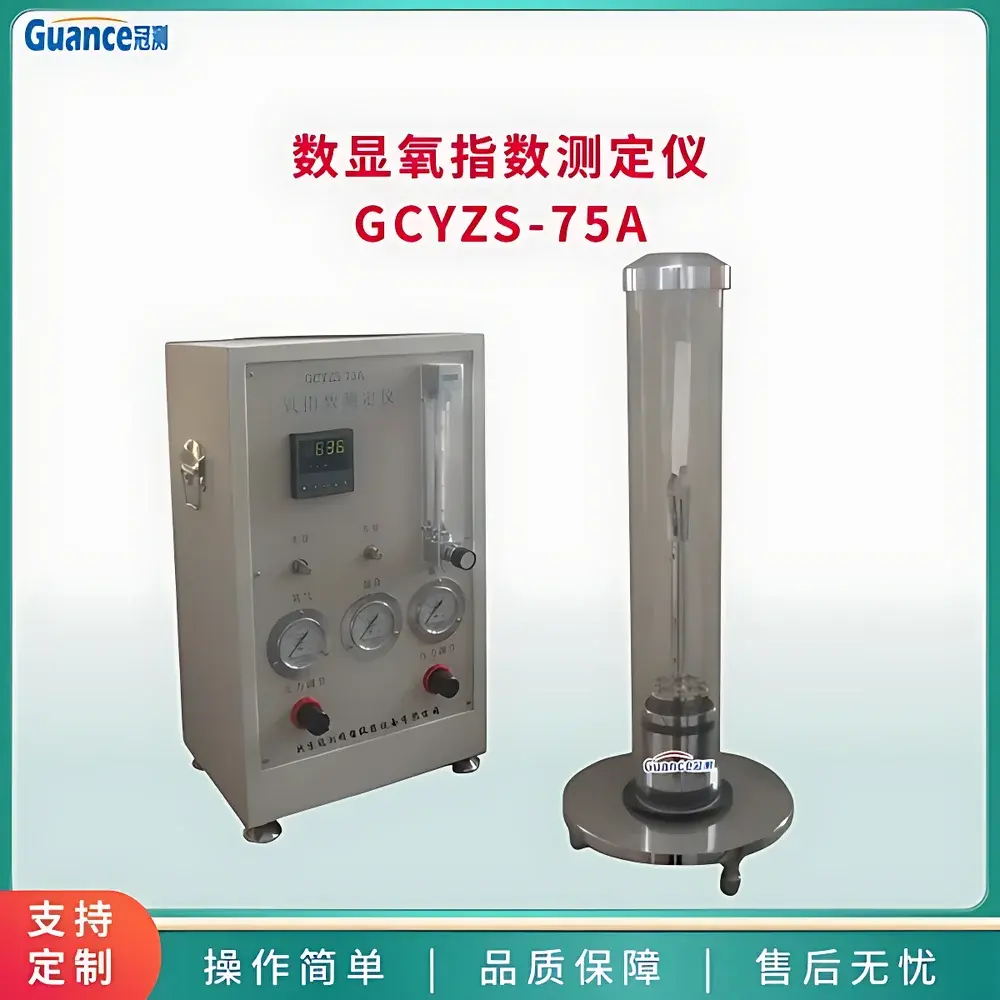
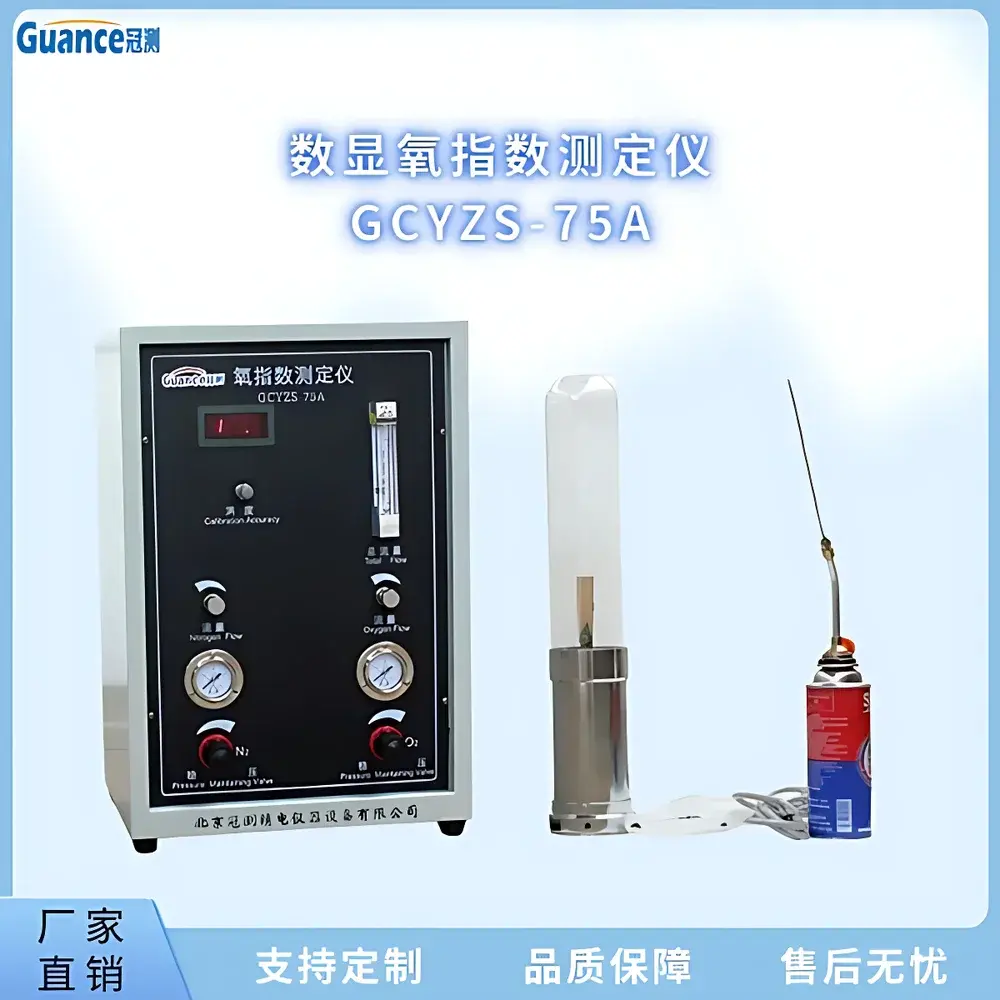
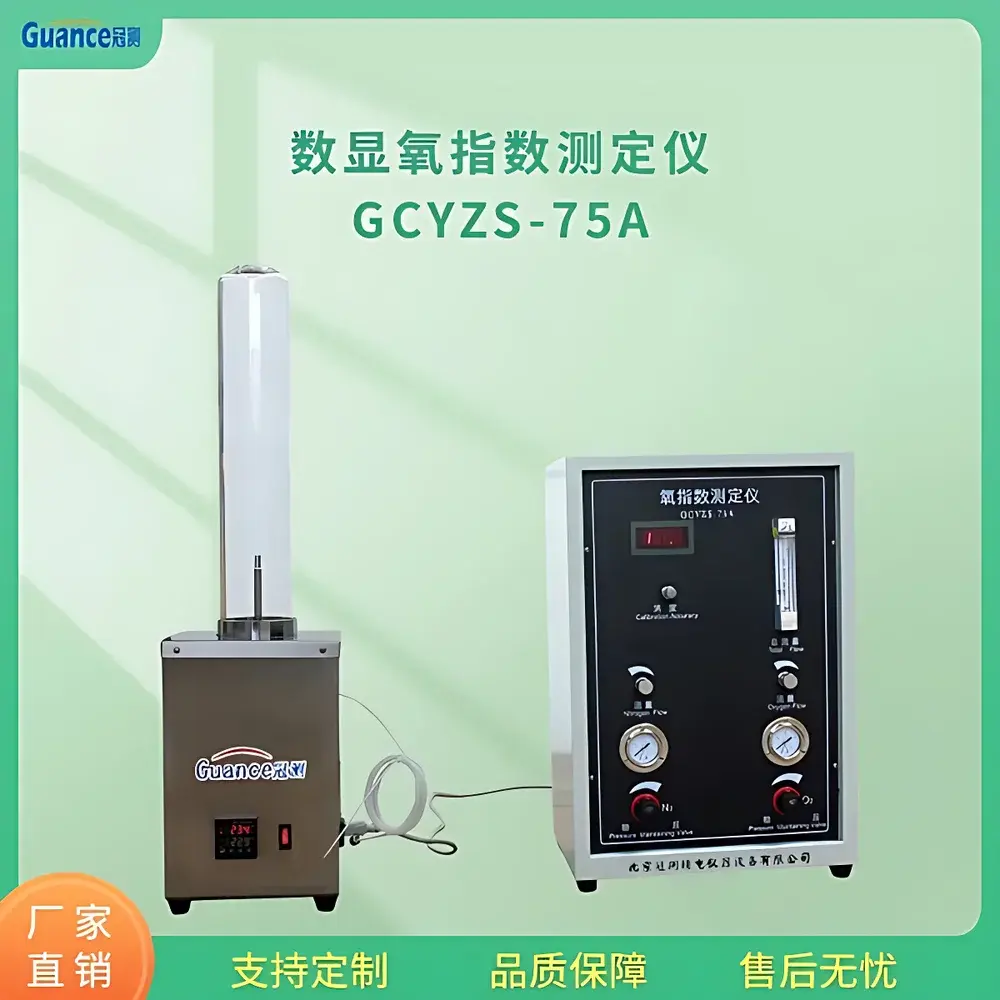
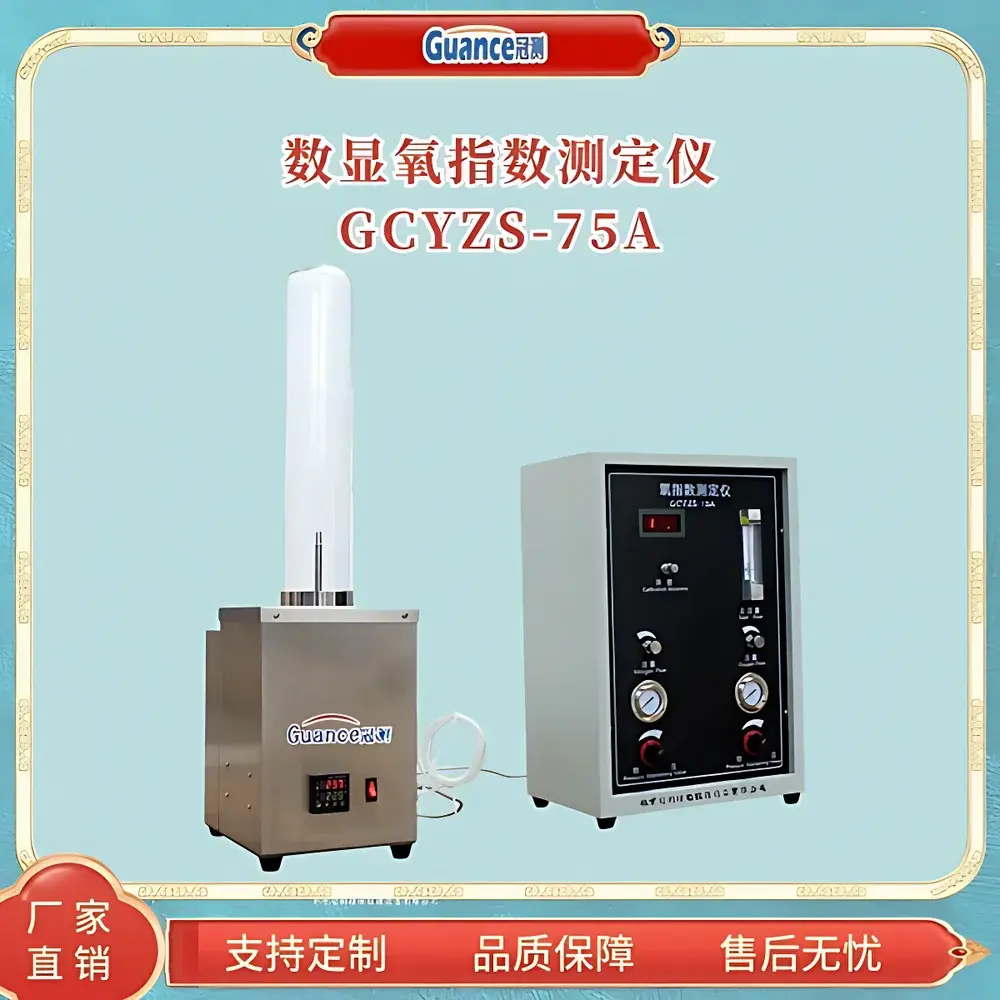
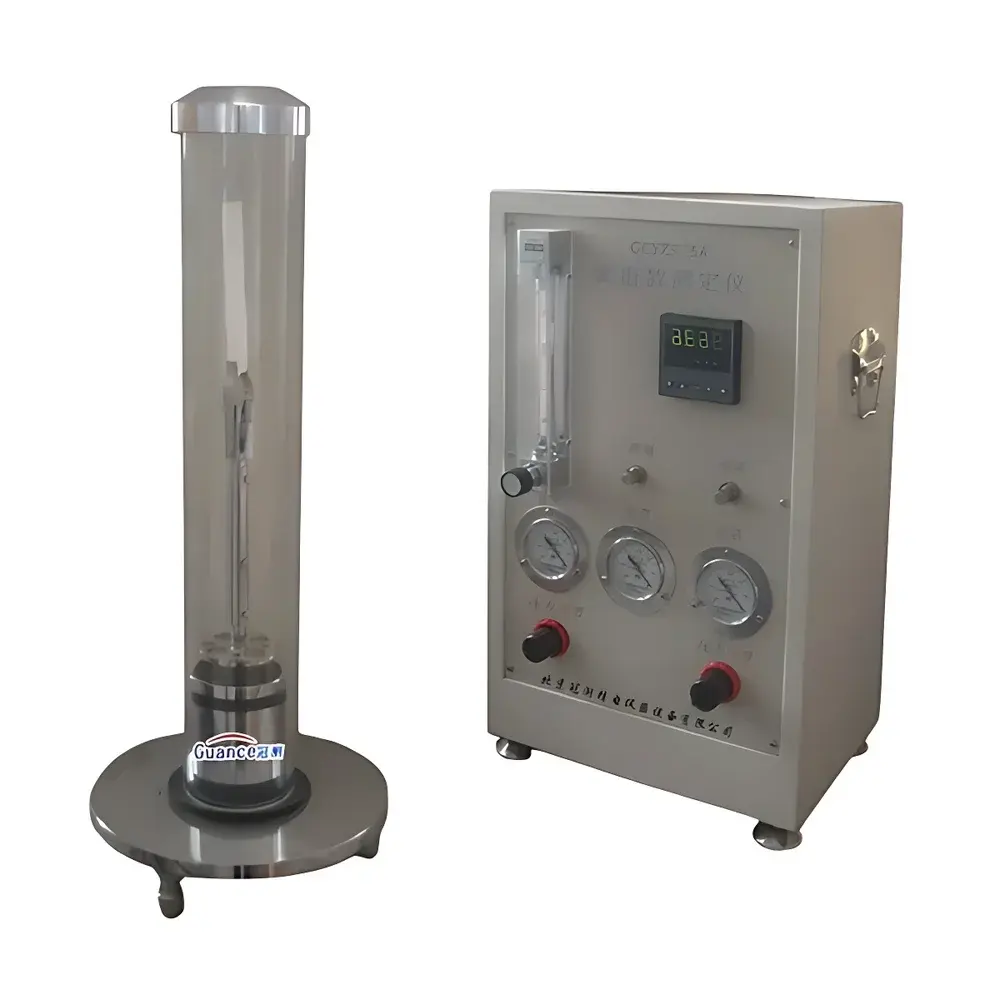
Guance GCYZS-75A Digital Oxygen Index Tester
| Brand | Guance |
|---|---|
| Origin | Beijing, China |
| Model | GCYZS-75A |
| Measurement Range | 0–100% O₂ |
| Resolution | 0.1% O₂ |
| Accuracy | ±0.4% O₂ |
| Response Time | <10 s |
| Display Precision | 0.1% ±1 digit |
| Drift | <3% per year |
| Combustion Tube ID | 90 mm, Length: 480 mm |
| Gas Flow Velocity in Tube | 40 ±10 mm/s |
| Chamber Temperature Control | 23 ±2 °C |
| Ignition Flame Length | 5–50 mm (adjustable) |
| Power Supply | 220 V ±15%, 50 Hz, 100 W |
| Operating Pressure | 0.1 MPa |
| Input Pressure Range | 0.25–0.4 MPa |
| Gas Requirements | Industrial-grade O₂ (GB/T 3863) and N₂ (GB/T 3864), each with pressure regulator (user-supplied) |
Overview
The Guance GCYZS-75A Digital Oxygen Index Tester is a precision instrument engineered for the quantitative determination of the limiting oxygen index (LOI) of polymeric materials in accordance with ISO 4589-2 and GB/T 2406.1–2008 — the internationally harmonized standard for measuring the minimum oxygen concentration (by volume %) in an O₂/N₂ mixture required to support candle-like combustion of a vertically oriented specimen under specified laboratory conditions. The instrument operates on the principle of controlled gas dilution: high-purity oxygen and nitrogen are metered through calibrated flow control valves, mixed in precise proportions, and delivered at a regulated linear velocity into a standardized vertical combustion tube (90 mm ID × 480 mm length). A pre-conditioned specimen is ignited at its upper edge; the LOI value is defined as the lowest oxygen concentration at which the flame propagates downward for at least 50 mm or sustains combustion for 180 seconds. This gravimetrically traceable, diffusion-controlled test provides a reproducible, comparative metric for relative flame retardancy — essential for material screening in wire & cable, automotive interiors, construction composites, and electronics enclosures.
Key Features
- High-stability dual-gas delivery system with independent O₂ and N₂ pressure regulators (0.25–0.4 MPa input) and fine-tuning needle valves for precise flow modulation
- Imported electrochemical oxygen sensor with digital readout, delivering resolution of 0.1% O₂ and measurement accuracy of ±0.4% O₂ (traceable to NIST-traceable calibration gases)
- Thermally stabilized combustion chamber maintained at 23 ±2 °C via constant-temperature cross-flow air system, minimizing convective interference during flame propagation
- Standardized combustion tube geometry (90 mm internal diameter, 480 mm height) conforming to ISO 4589-2 dimensional tolerances
- Adjustable ignition source: stainless-steel burner with flame length controllable from 5 mm to 50 mm, calibrated against reference thermocouple profiles
- Digital timing module with 0.01 s resolution, synchronized with ignition initiation and flame extinction detection
- Integrated gas monitoring: real-time verification of O₂/N₂ mixture composition, flow velocity (40 ±10 mm/s), and pressure stability prior to test initiation
- Robust mechanical design with corrosion-resistant brass fittings, borosilicate glass combustion column (2 units supplied), and heat-resistant ceramic insulation
Sample Compatibility & Compliance
The GCYZS-75A accommodates rigid and semi-rigid polymer specimens (e.g., PVC, PE, PP, ABS, PC, FR-phenolics) in standardized dimensions: 150 mm × 10 mm × 4 mm (or thickness ≤13 mm per ISO 4589-2). Specimens must be conditioned at 23 ±2 °C and 50 ±5% RH for ≥48 h prior to testing. The system supports both self-extinguishing and afterglow evaluation modes. All operational parameters—including gas flow rate, temperature stabilization, ignition energy, and observation criteria—are fully aligned with ISO 4589-2:2017, ASTM D2863–22, GB/T 2406.1–2008, and IEC 60695-2-12. For quality-critical environments, the instrument’s digital logging capability enables compliance with GLP audit requirements; data integrity is preserved through non-volatile memory storage and timestamped event records (ignition, flame front position, extinction).
Software & Data Management
The GCYZS-75A features embedded firmware with local digital display only—no proprietary software or USB/RS-232 interface is included, ensuring long-term operational reliability and eliminating driver compatibility dependencies. All test parameters (O₂ concentration, elapsed time, flame behavior classification) are manually recorded by the operator using the integrated digital timer and front-panel display. For laboratories requiring electronic data capture, the instrument’s analog-compatible output signals (0–5 V DC proportional to O₂ %) permit integration with third-party DAQ systems or LIMS platforms. Calibration logs, maintenance records, and test reports may be archived in accordance with ISO/IEC 17025 documentation requirements. Annual sensor verification using certified 18.0% and 21.0% O₂/N₂ reference gases is recommended to maintain metrological traceability.
Applications
- Comparative flame retardancy ranking of halogen-free vs. brominated flame-retarded polymers
- QC release testing for wire jacketing compounds per UL 1581 and CSA C22.2 No. 0.3
- R&D screening of intumescent additives in thermoplastic elastomers
- Regulatory submission support for EN 45545-2 (railway applications) and FAR 25.853 (aviation)
- Failure analysis of thermally degraded insulation materials exhibiting reduced LOI post-aging
- Validation of fire-safe composite formulations for building façade panels (EN 13501-1)
FAQ
What gases are required for operation?
Industrial-grade oxygen (GB/T 3863, ≥99.5% purity) and nitrogen (GB/T 3864, ≥99.999% purity), each equipped with a dedicated pressure regulator (0.25–0.4 MPa input range).
Is the instrument compliant with international standards?
Yes — fully conforms to ISO 4589-2:2017, ASTM D2863–22, GB/T 2406.1–2008, and IEC 60695-2-12 dimensional and procedural requirements.
Can test data be exported electronically?
The base model provides digital display only; however, analog voltage output (0–5 V DC) allows connection to external data acquisition systems for automated logging.
What is the recommended calibration frequency?
Annual verification using two-point certified reference gases (e.g., 18.0% and 21.0% O₂ in N₂) is advised to ensure continued accuracy and regulatory acceptability.
Does the system include temperature control for ambient fluctuations?
Yes — the combustion chamber incorporates a thermostatically regulated cross-flow air system maintaining 23 ±2 °C, independent of laboratory ambient variations.



