
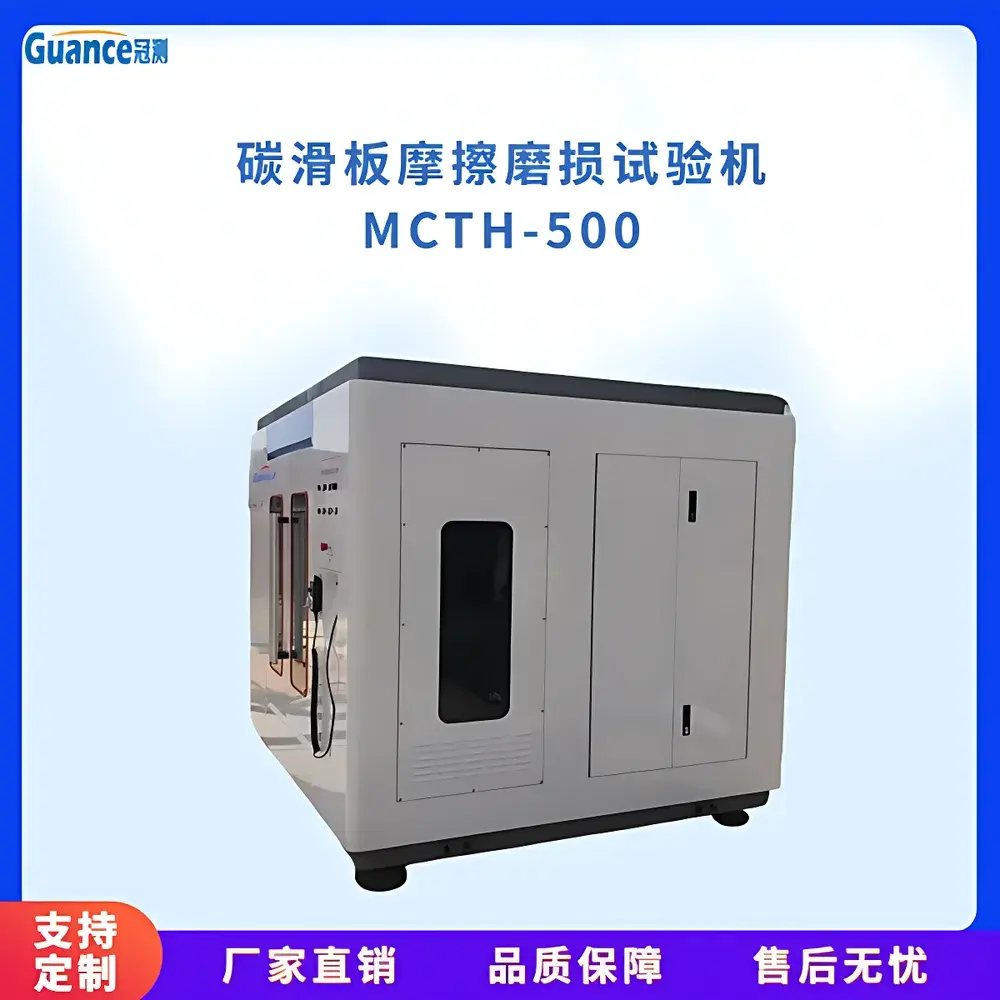
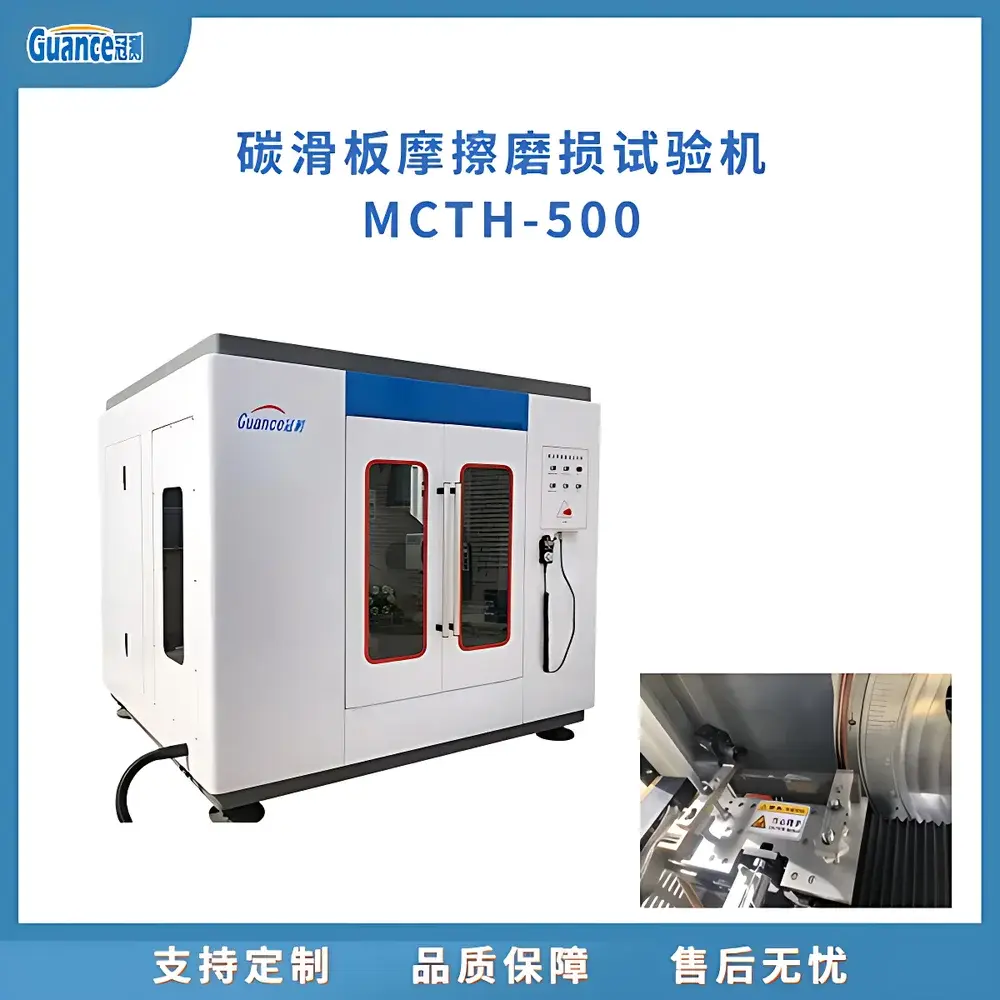
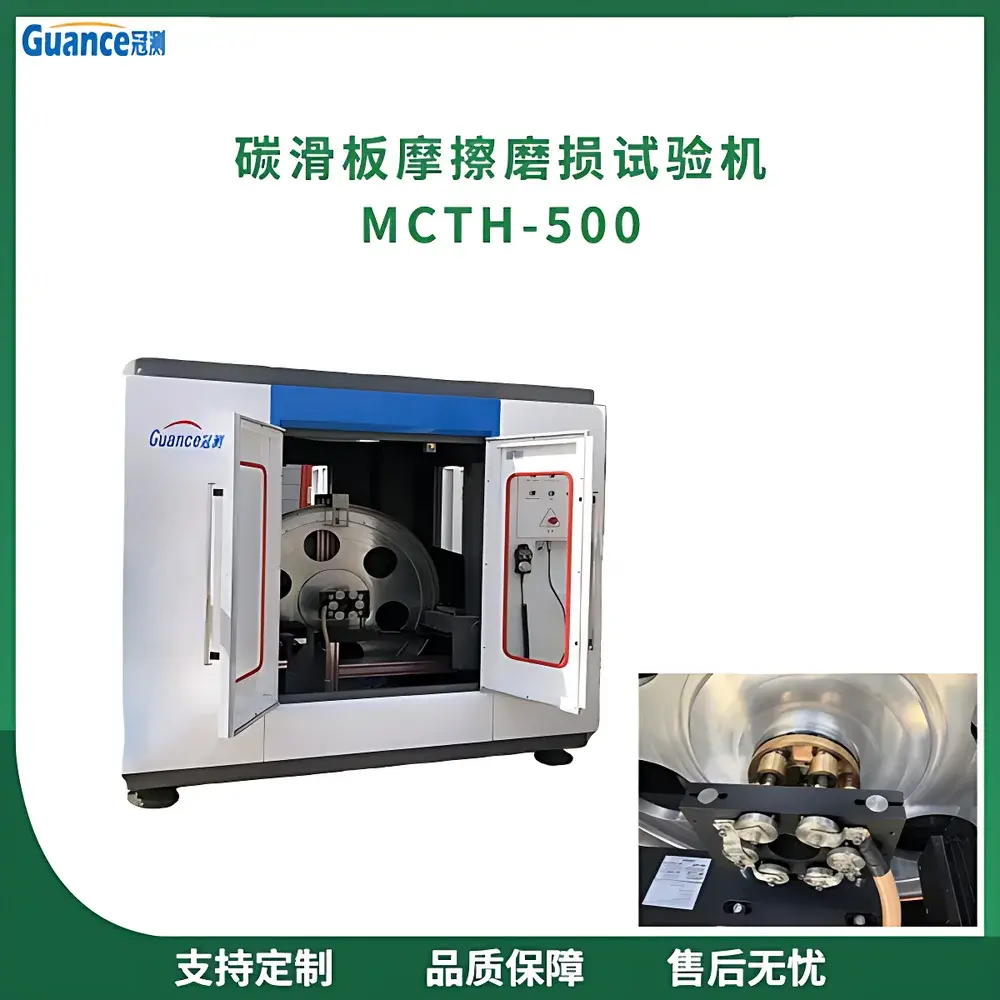
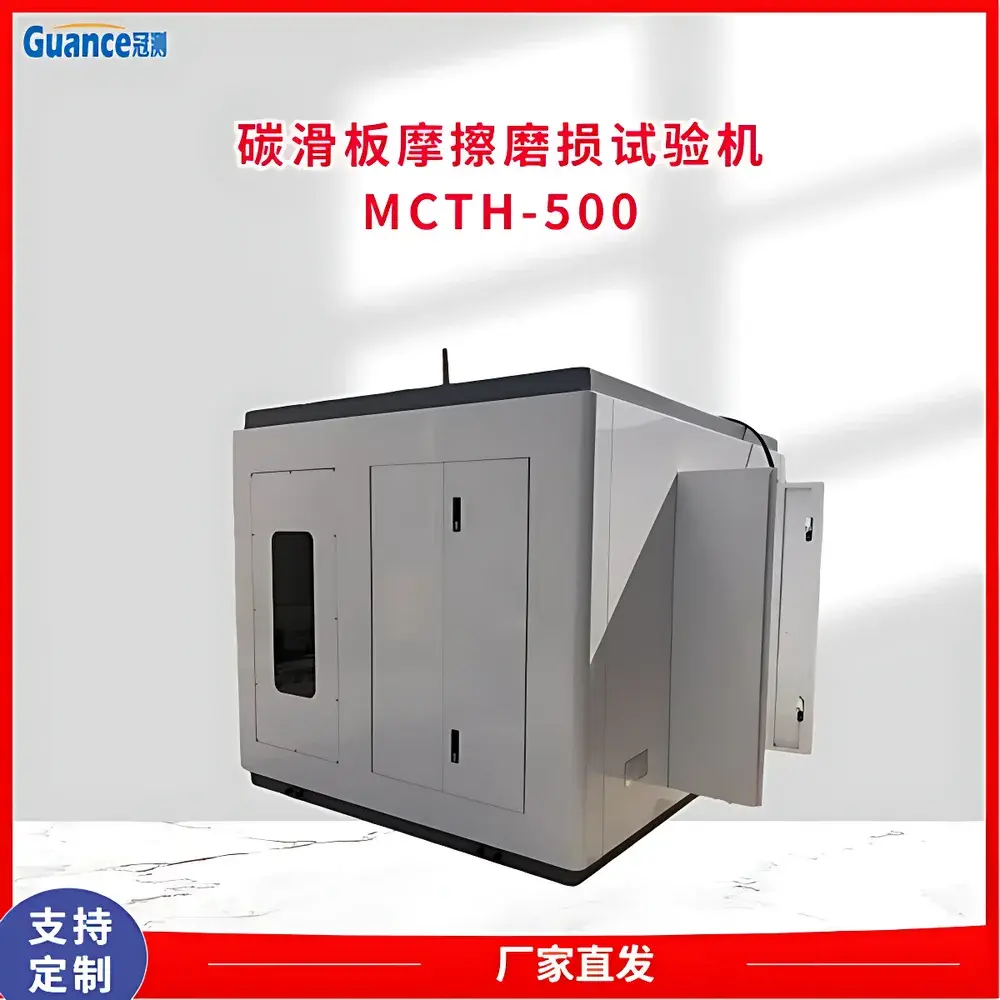
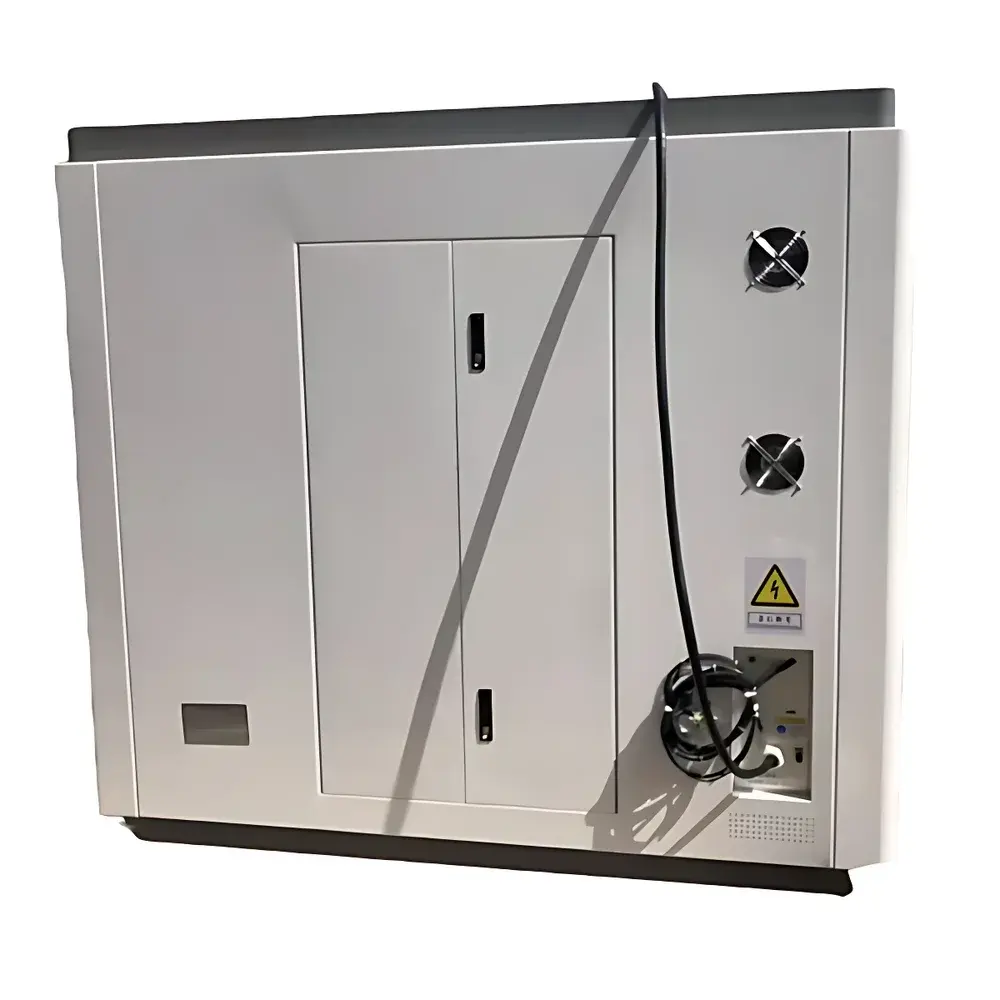
GuanCe MCTH-500b High-Current Carbon Pantograph Strip Tribological Tester
| Brand | GuanCe |
|---|---|
| Origin | Beijing, China |
| Model | MCTH-500b |
| Instrument Type | Multi-Functional Tribological Tester |
| Max Friction Force Range | 30–150 N (via calibrated deadweight loading) |
| Operating Ambient Temperature | −30 to +40 °C |
| Relative Humidity | ≤85 % RH |
| Atmospheric Pressure | 80–120 kPa |
| Supply Voltage | 220 ±10 % VAC, 50 ±0.5 Hz |
| Total Power Consumption | 20 kW |
| Rotating Disc Diameter | 420 mm |
| Disc Rotational Speed | 2600 rpm |
| Carbon Strip Vertical Stroke | 100 mm |
| Stroke Frequency | 90 cycles/min |
| Test Current Output | 0–500 A AC (5 V output) |
| Radial Runout Measurement | Dial Indicator with 0.001 mm resolution |
| Data Acquisition | Real-time voltage, current, and rotational speed logging with Excel export |
| Dust Extraction | Integrated 3 kW vacuum system |
| Dimensions (L×W×H) | 1500 × 1000 × 1700 mm |
| Weight | 600 kg |
Overview
The GuanCe MCTH-500b High-Current Carbon Pantograph Strip Tribological Tester is an engineered test platform designed specifically for evaluating the wear behavior and electrical–mechanical interaction of carbon-based current-collecting strips under simulated railway catenary operating conditions. It operates on the principle of controlled sliding contact between a stationary carbon strip and a rotating copper or copper-alloy conductor disc, while simultaneously imposing high-magnitude alternating current (up to 500 A at 5 V) across the interface. This configuration replicates the dynamic electro-tribological environment experienced by pantograph carbon strips in electrified rail systems—where resistive heating, arc-induced surface degradation, mechanical abrasion, and oxidation synergistically govern service life. The system integrates precision motion control, regulated current delivery, real-time multi-parameter monitoring, and automated data acquisition to support standardized wear quantification, failure mode analysis, and material qualification per international railway component testing protocols.
Key Features
- Electro-tribological simulation: Simultaneous application of high-current load (0–500 A AC) and controlled mechanical sliding under programmable normal force (30–150 N via calibrated deadweights).
- Dynamic contact configuration: Fixed carbon strip mounted on an aluminum fixture; rotating conductor disc (Ø420 mm) driven by a 10 kW servo motor at up to 2600 rpm, enabling linear velocities up to ~5.7 m/s at disc periphery.
- Vertical reciprocating motion: Carbon strip actuated by servo-driven mechanism with adjustable stroke (100 mm) and frequency (90 cycles/min), mimicking vertical vibration and dynamic contact pressure variation during train operation.
- Precision radial runout assessment: Integrated dial indicator (0.001 mm resolution) mounted on calibrated 360° angular scale enables quantitative measurement of conductor disc eccentricity and surface deviation—critical for evaluating contact stability and arcing propensity.
- Conductor surface conditioning: Pneumatically actuated abrasive pad module allows in-situ cleaning and profiling of the rotating conductor surface between test cycles, ensuring consistent initial surface roughness and minimizing test-to-test variability.
- Real-time electrical and kinematic monitoring: Synchronized acquisition of voltage, current, and rotational speed with millisecond-level timestamping; automatic generation of time-series plots and exportable Excel datasets compliant with ISO/IEC 17025 documentation requirements.
- Dust management: Integrated 3 kW industrial vacuum system continuously extracts conductive carbon debris generated during wear, maintaining test chamber cleanliness and preventing secondary contamination or electrical shorting.
Sample Compatibility & Compliance
The MCTH-500b accommodates standard carbon pantograph strip specimens (typical dimensions: 100 × 60 × 20 mm) secured in a rigid aluminum mounting frame. It supports comparative evaluation of resin-bonded graphite, metal-impregnated carbon, and hybrid composite formulations used in EN 50317, GB/T 21563, and IEC 62196-3 compliant applications. While not certified to any single regulatory standard out-of-the-box, its architecture aligns with functional requirements for EN 50367 Annex C (pantograph–catenary interaction testing), ASTM G99 (pin-on-disk wear testing under electrical load), and UIC 801-1 (testing of current collectors). All electrical subsystems meet IP2X enclosure protection and grounding resistance <1 Ω per IEC 61000-6-4 for conducted emissions control. Seismic survivability is validated for horizontal/vertical accelerations of 3 m/s² and 1.5 m/s² respectively—suitable for installation in non-seismically reinforced laboratory environments.
Software & Data Management
Control and data acquisition are managed via a Windows-based HMI interface linked to an industrial PLC controller. The software provides intuitive setup of test parameters—including target mileage (calculated from stroke count and velocity), current ramp profiles, dwell times, and stop conditions. All measured signals (voltage, current, rpm, temperature at bearing housings) are logged at ≥10 Hz sampling rate. Curve overlays, statistical summaries (mean, std dev, max/min), and derivative calculations (e.g., instantaneous power dissipation, wear rate per km) are supported. Export formats include .xlsx (with metadata headers), .csv, and .pdf reports. Audit trails, user access levels, and electronic signatures comply with basic GLP documentation practices; optional 21 CFR Part 11 compliance modules are available upon request for regulated QA/QC laboratories.
Applications
- Quantitative wear rate determination of carbon collector strips under high-current sliding conditions.
- Correlation of electrical contact resistance evolution with surface morphology changes (post-test SEM/EDS recommended).
- Evaluation of arc erosion resistance and groove formation tendency in carbon–copper interfaces.
- Validation of lubricant or coating efficacy on conductor surfaces under electrified tribological stress.
- Development testing of next-generation low-wear, high-conductivity carbon composites for high-speed rail applications.
- Root cause analysis of field failures related to premature carbon strip consumption or inconsistent current transfer.
FAQ
What is the maximum continuous current rating of the MCTH-500b?
The system delivers up to 500 A AC at 5 V output, with thermal management designed for sustained operation at rated load for ≥30 minutes without derating.
Can the test current be ramped or modulated during a test cycle?
Yes—current amplitude and waveform profile (e.g., sinusoidal, pulsed DC superimposed on AC) can be programmed via the servo-controlled variac interface.
Is the rotating conductor disc replaceable, and what materials are supported?
Standard discs are fabricated from oxygen-free copper (C10200); custom discs in CuCrZr, silver-plated copper, or stainless steel are available as optional accessories.
Does the system support automated pass/fail evaluation based on wear threshold?
While no embedded decision logic is included, the exported Excel dataset enables post-processing against predefined wear depth or mass loss thresholds using external scripts or LIMS integration.
What safety interlocks are implemented?
Hardware-enforced interlocks include emergency stop circuitry, door-open detection, overtemperature cutoff on motor windings and current busbars, and ground-fault monitoring on all high-current paths.



