
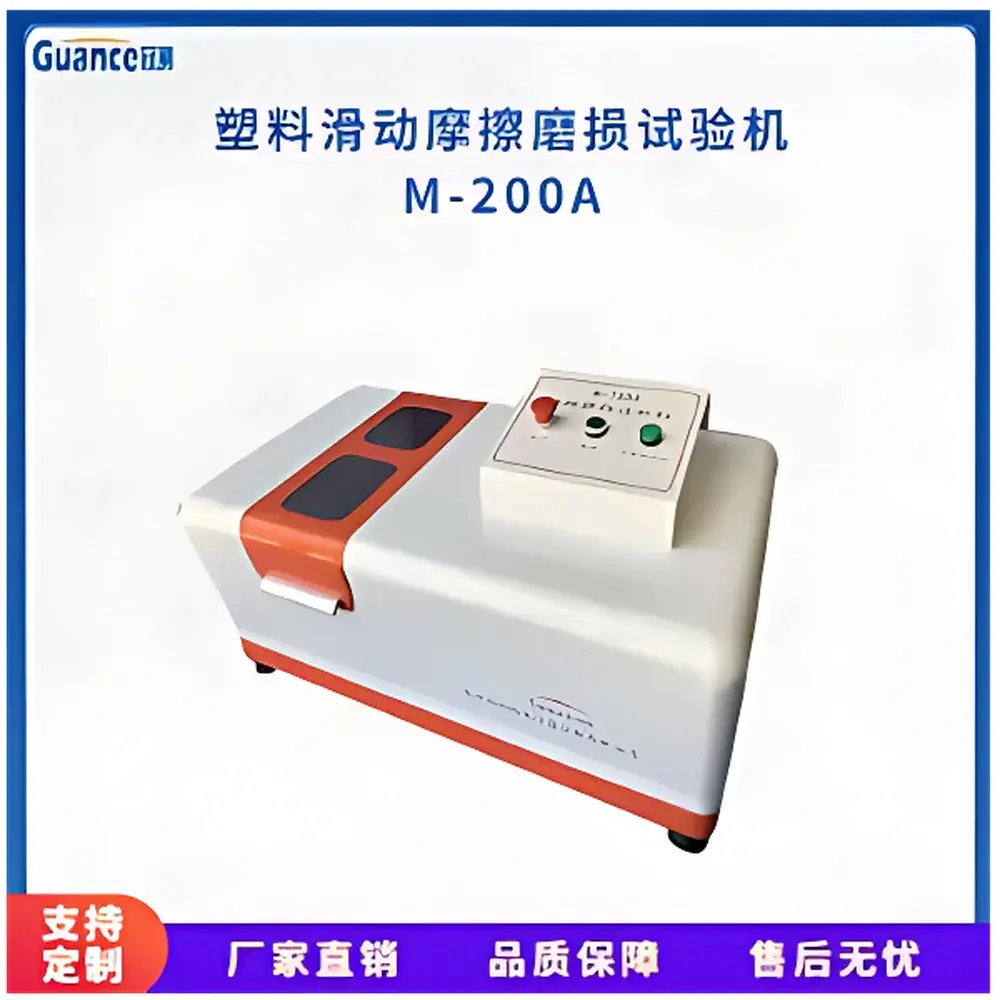
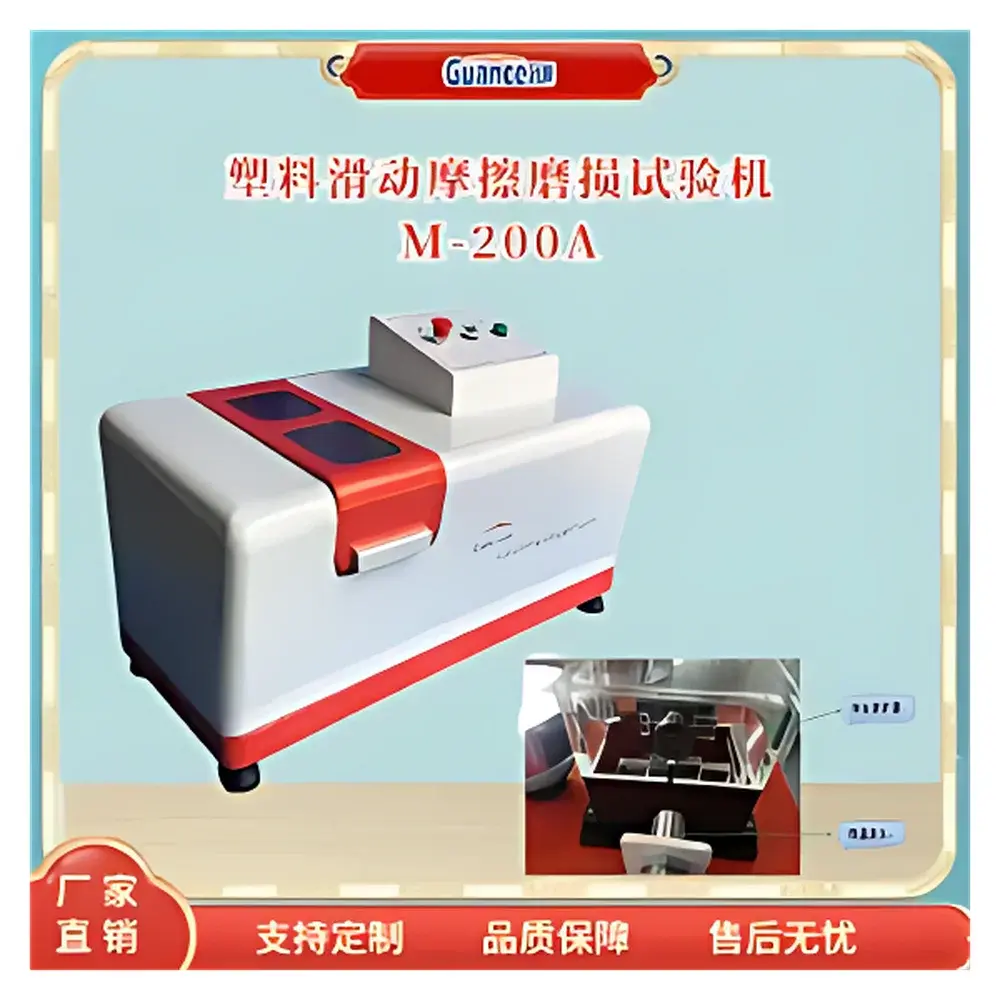
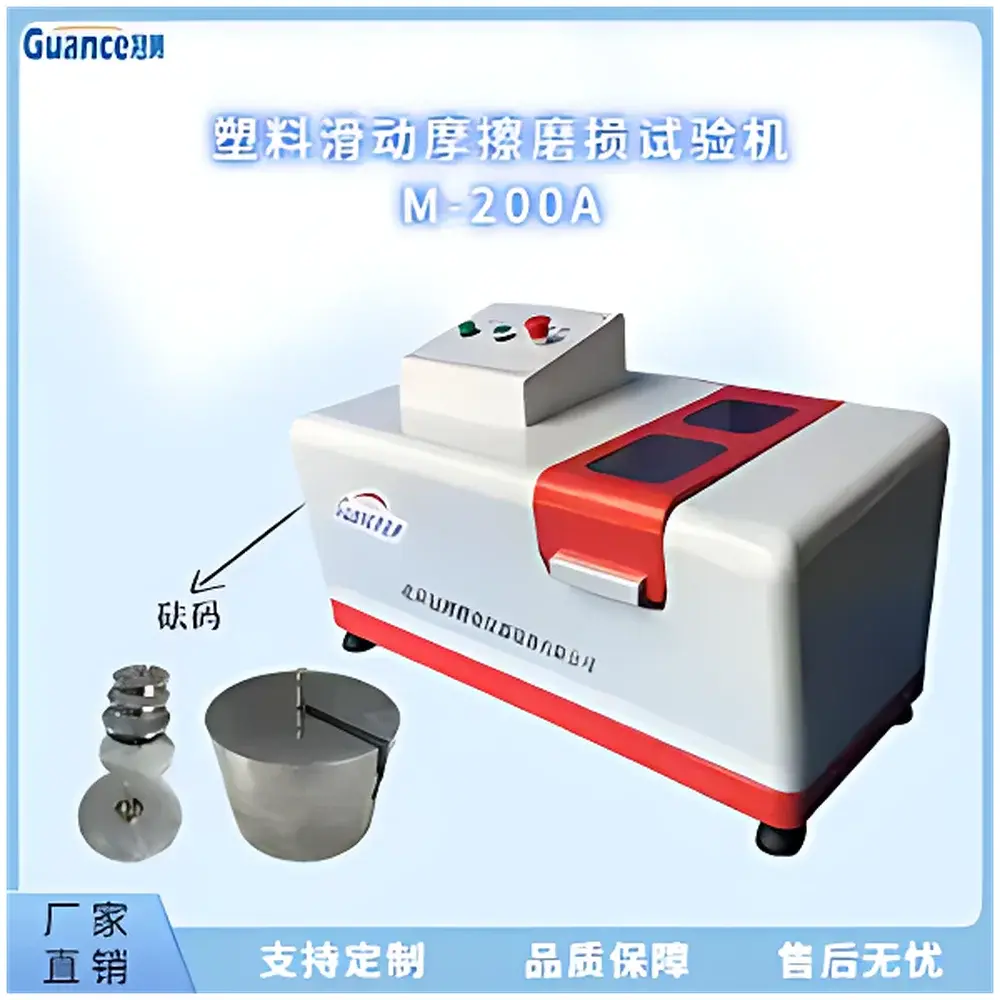
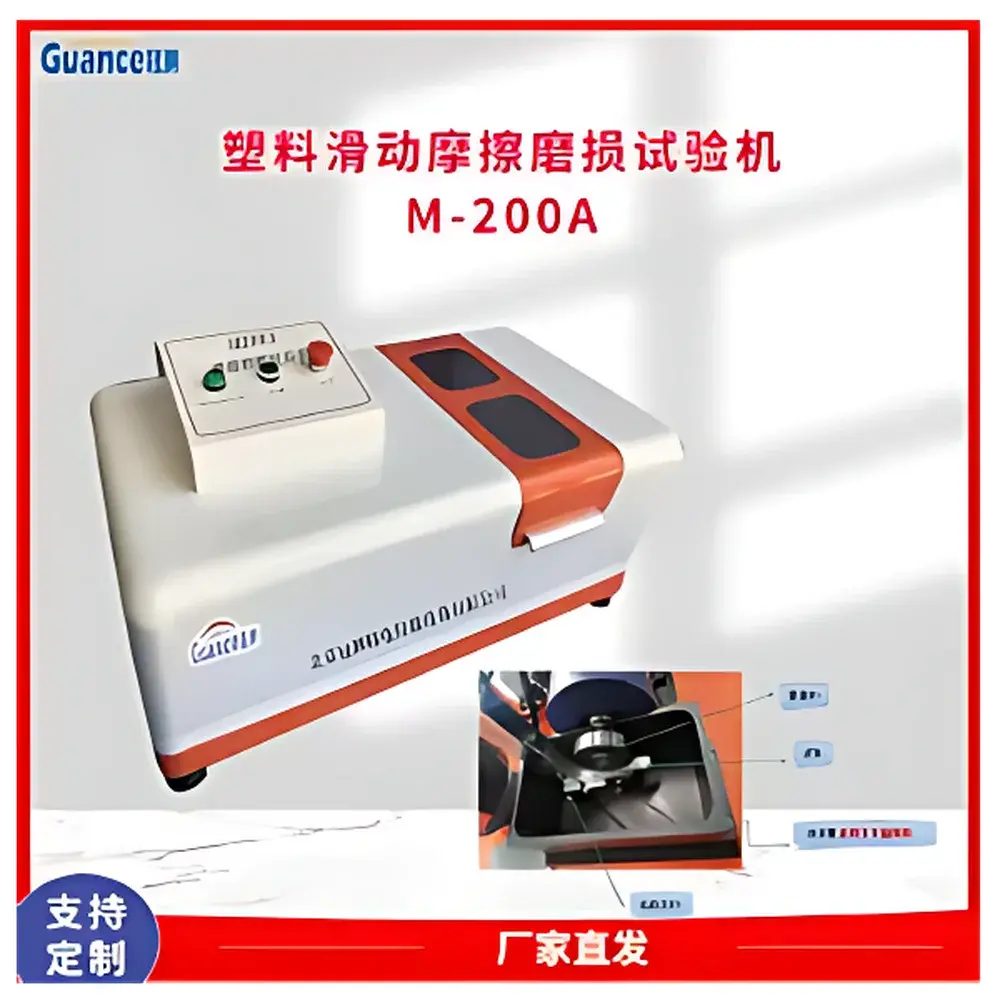
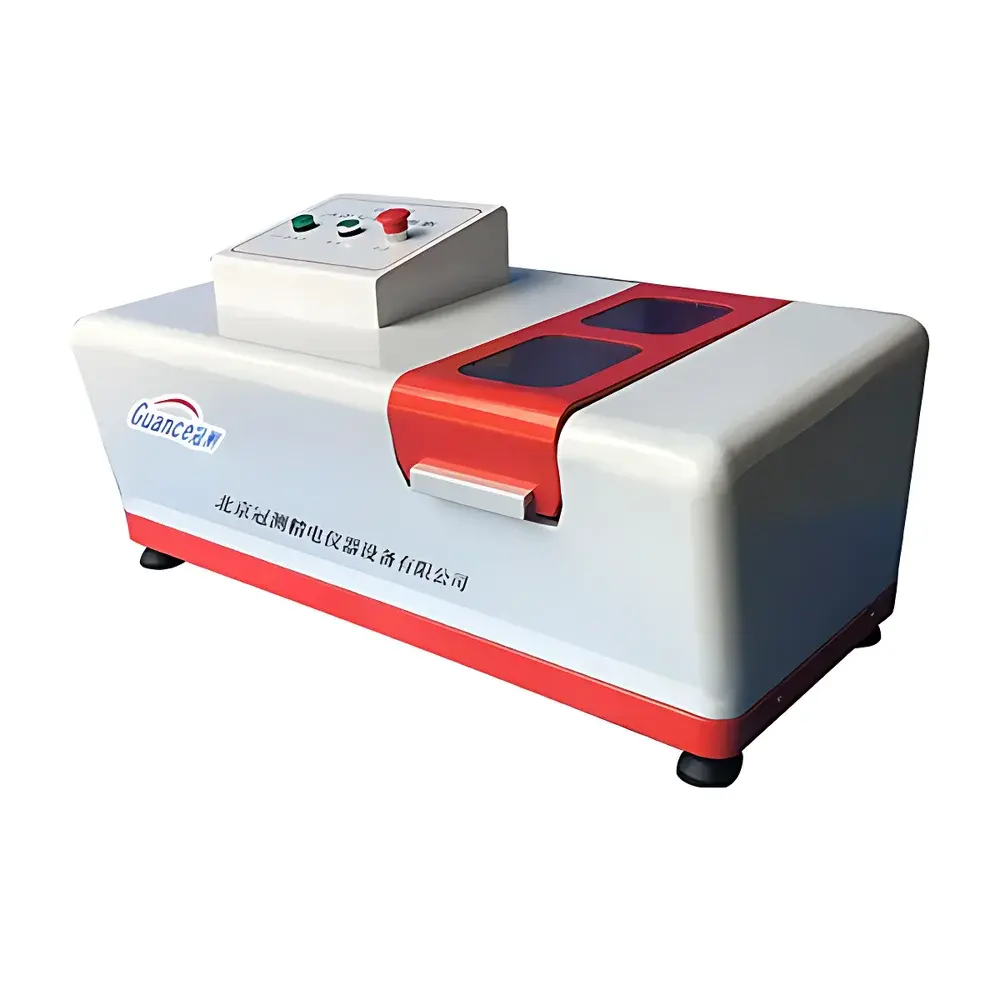
Guance Instruments M-200A2 Reciprocating Tribological Tester for Plastics and Polymers
| Brand | Guance Instruments |
|---|---|
| Origin | Beijing, China |
| Model | M-200A2 |
| Instrument Type | Reciprocating Friction and Wear Tester |
| Maximum Friction Load | 392 N |
| Friction Torque Range | 0–4 N·m |
| Operating Temperature | Up to 100 °C |
| Specimen Dimensions | 30 mm × 7 mm × 6 mm |
| Rotational Speed | 0–200 rpm (adjustable) |
| Load Accuracy | ±0.5% FS |
| Torque Measurement Accuracy | ±1% FS |
| Speed Accuracy | ±1% |
| Counter Resolution | 1 s |
| Surface Finish of Counterface Ring | Ra ≤ 0.8 µm (▽8) |
| Counterface Material | 45# steel, quenched & tempered to HRC 40–45 |
| Counterface Geometry | Ø40 mm × 10 mm, 0.5 × 45° chamfer, concentricity < 0.01 mm |
Overview
The Guance Instruments M-200A2 Reciprocating Tribological Tester is a microcomputer-controlled benchtop instrument engineered for standardized evaluation of sliding friction behavior and wear resistance in polymeric, elastomeric, and composite materials under controlled load, speed, and thermal conditions. It operates on the principle of linear reciprocating motion between a stationary flat specimen and a rotating cylindrical counterface (friction ring), enabling quantification of dynamic friction torque, coefficient of friction (COF), and volumetric or mass-based wear loss over defined test durations. Designed in strict compliance with GB/T 3960–1983 (Plastic Sliding Friction and Wear Test Method) and GB/T 9141.8–1999 (Sliding Friction Coefficient Test for Flexible Graphite Sheets), the M-200A2 supports methodologically traceable tribological characterization required for R&D validation, quality assurance, and regulatory documentation in polymer manufacturing, automotive component development, and biomedical material screening.
Key Features
- Microprocessor-based closed-loop control system with real-time data acquisition and synchronized display of torque, time, rotational speed, and cumulative cycle count
- Adjustable normal load range from 196 N (standard configuration) up to 392 N via modular weight stack (1 × 4 kg + 4 × 1 kg calibrated masses), ensuring precise mechanical loading per ISO 20808 and ASTM D3702 guidelines
- High-stiffness precision-machined friction ring (Ø40 mm × 10 mm, 45# steel, HRC 40–45, surface roughness Ra ≤ 0.8 µm) with certified concentricity (< 0.01 mm) to minimize parasitic moment errors
- Digital torque sensor with 0–4 N·m full-scale range and ±1% FS accuracy, integrated with temperature-compensated signal conditioning
- Programmable test protocols: user-defined cycle count, dwell time, velocity ramp profiles, and automatic termination triggers based on torque threshold or elapsed time
- Built-in color thermal printer supporting direct output of ASTM/ISO-compliant reports—including time-torque curves, COF vs. cycle plots, wear volume calculations, and metadata stamps (operator ID, date/time, calibration status)
Sample Compatibility & Compliance
The M-200A2 accommodates standard rectangular specimens measuring 30 mm × 7 mm × 6 mm—compatible with common polymer injection-molded test bars, compression-molded composites, and sheet-cut elastomer samples. Its mechanical architecture allows substitution of alternative counterfaces (e.g., hardened stainless steel, WC-Co, or ceramic rings) for comparative tribo-pair studies. The system meets essential requirements for GLP-compliant testing environments: all critical parameters (load, speed, torque, time) are digitally logged with timestamped audit trails; calibration certificates for weights and torque sensors are retained in instrument firmware; and firmware revision history is accessible for 21 CFR Part 11 readiness assessment. While not inherently FDA-certified, its operational traceability aligns with ISO/IEC 17025 laboratory accreditation criteria for mechanical property testing.
Software & Data Management
Control and analysis are executed via proprietary Windows-based software featuring dual-mode operation: manual real-time adjustment (for method development) and automated script execution (for routine QA/QC). Raw data streams (torque, RPM, temperature, cycle count) are saved in CSV and binary formats with millisecond-level timestamp resolution. Post-test processing includes automatic COF derivation (µ = T / (r × Fn)), wear rate calculation (mm³/N·m), statistical reporting (mean ± SD across replicates), and export to LIMS-compatible XML schemas. All data files include embedded metadata—system serial number, operator login, environmental log (optional external humidity/temperature input), and electronic signature fields—supporting ALCOA+ data integrity principles.
Applications
- Quantitative comparison of anti-wear additive efficacy in engineering thermoplastics (e.g., POM, PA66, PEEK)
- Screening of filler-reinforced composites (glass fiber, carbon nanotube, MoS₂) for low-friction bearing applications
- Validation of lubricant performance in plastic-on-metal interfaces under elevated temperature (≤100 °C)
- Accelerated wear life estimation for medical device polymers (UHMWPE, PTFE) per ISO 14243-1
- Root-cause analysis of premature failure in automotive trim components subjected to cyclic abrasion
- Supporting technical documentation for ISO 9001:2015 clause 8.5.1 (control of production and service provision)
FAQ
What standards does the M-200A2 directly support?
It is configured and validated for GB/T 3960–1983 and GB/T 9141.8–1999; equivalent test protocols can be implemented for ASTM D3702, ISO 683-17, and DIN 53371 with appropriate counterface selection and calibration.
Can the system operate above ambient temperature?
Yes—the chamber-integrated heating module maintains stable temperatures up to 100 °C with ±2 °C uniformity across the specimen interface, verified by embedded Pt100 sensor feedback.
Is third-party calibration available?
Guance Instruments provides NIST-traceable calibration certificates for load cells and torque transducers; annual recalibration services are offered through authorized metrology partners in APAC and EMEA regions.
How is wear volume calculated?
By gravimetric measurement pre- and post-test (using analytical balance ≥0.1 mg resolution), or via profilometric scanning of wear scars (requires optional surface profiler integration); software applies Archard’s law approximations for comparative ranking.
Does the software support multi-user access control?
Yes—role-based permissions (administrator, technician, reviewer) govern method editing, test initiation, report approval, and data deletion, satisfying basic 21 CFR Part 11 audit requirements.



