
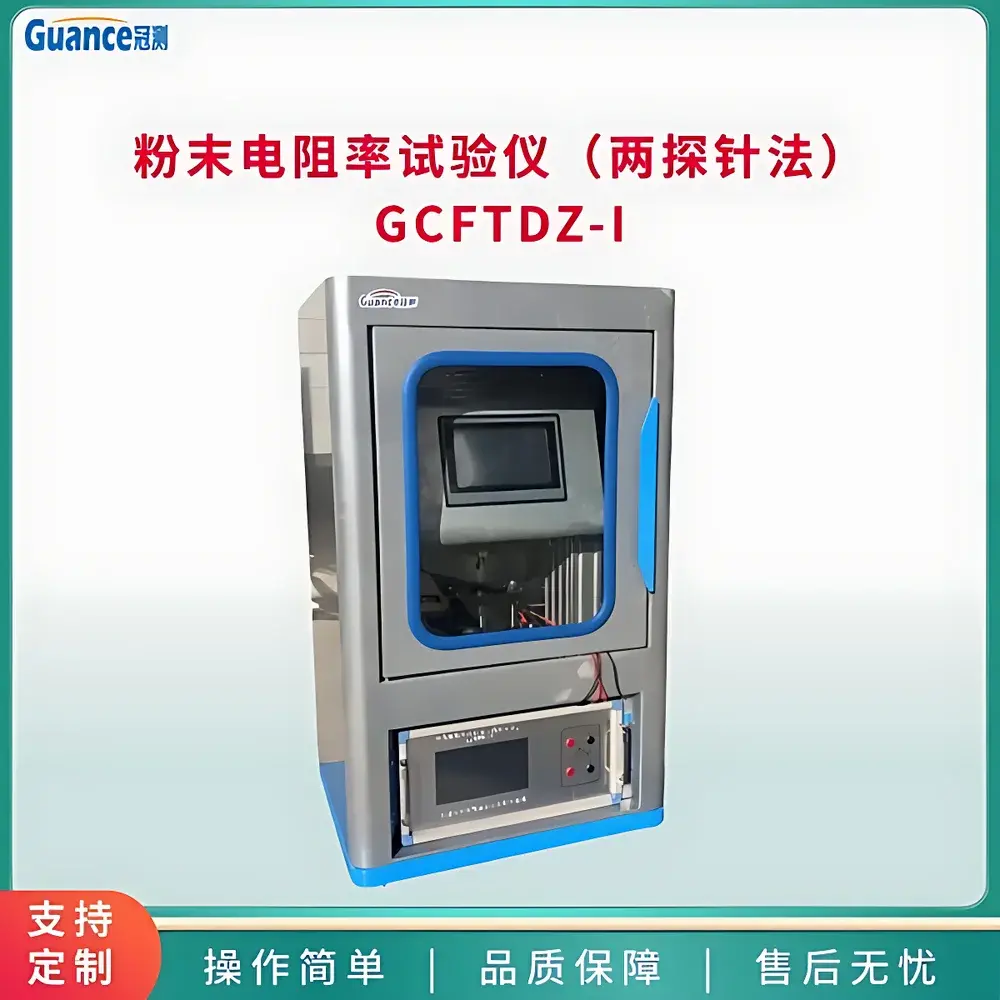
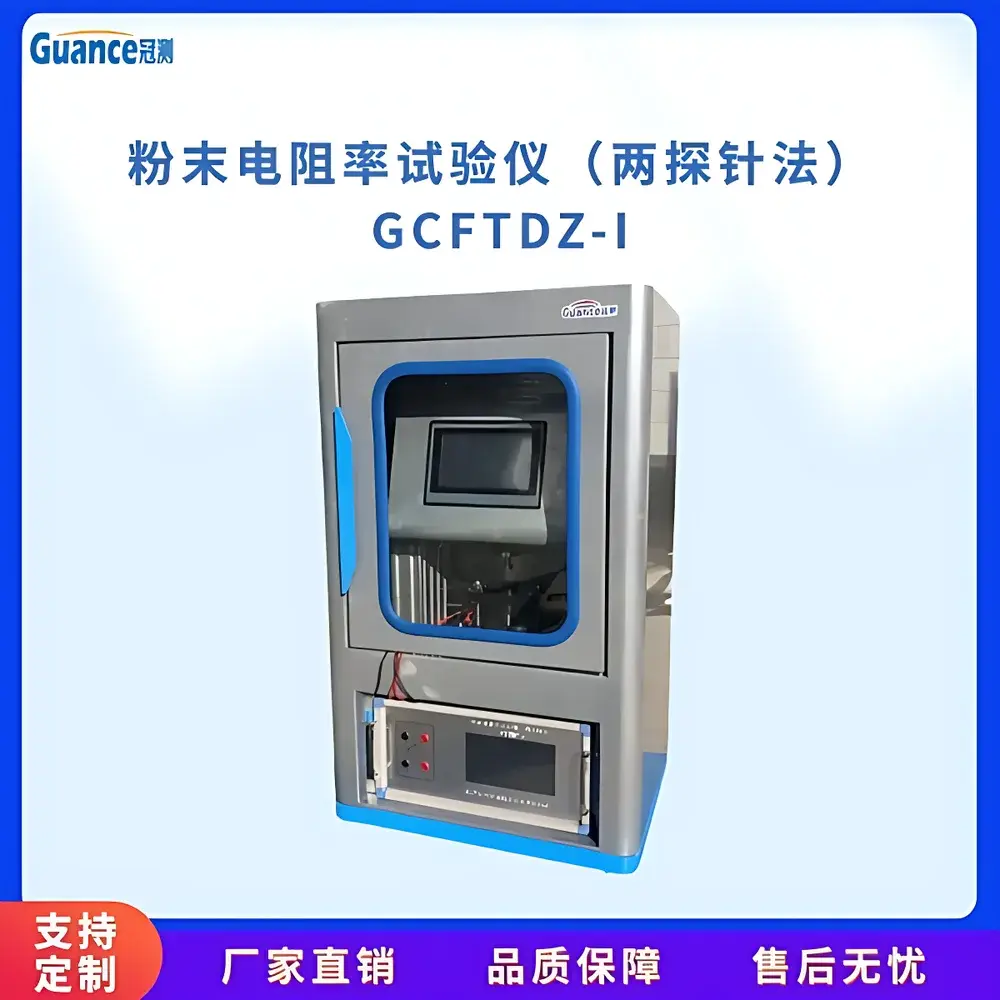
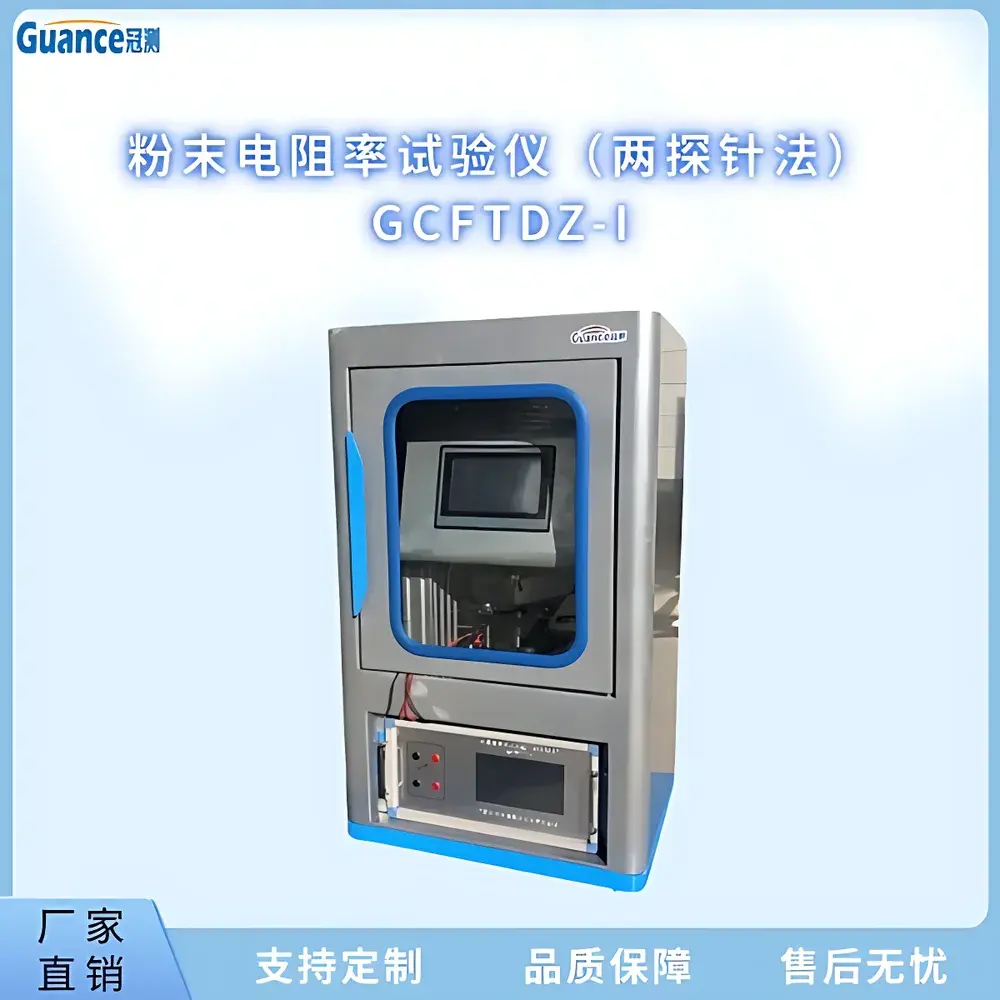
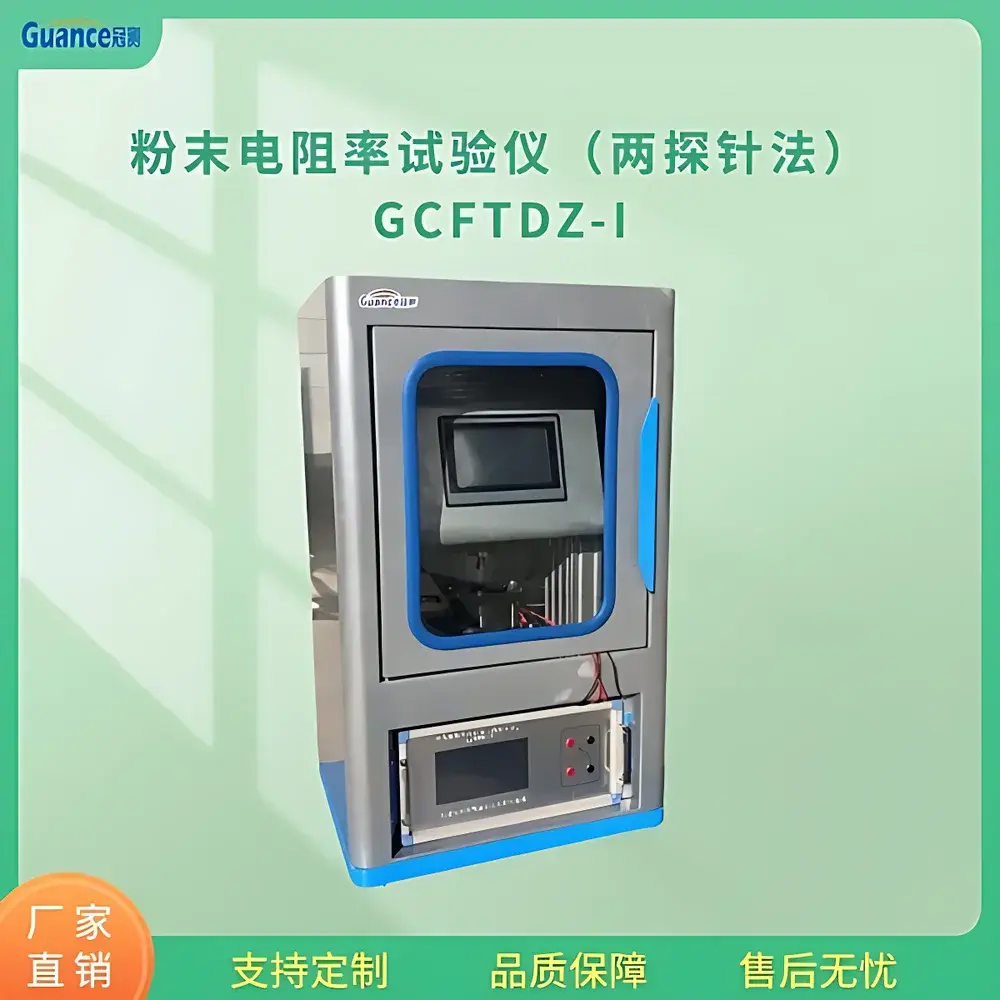
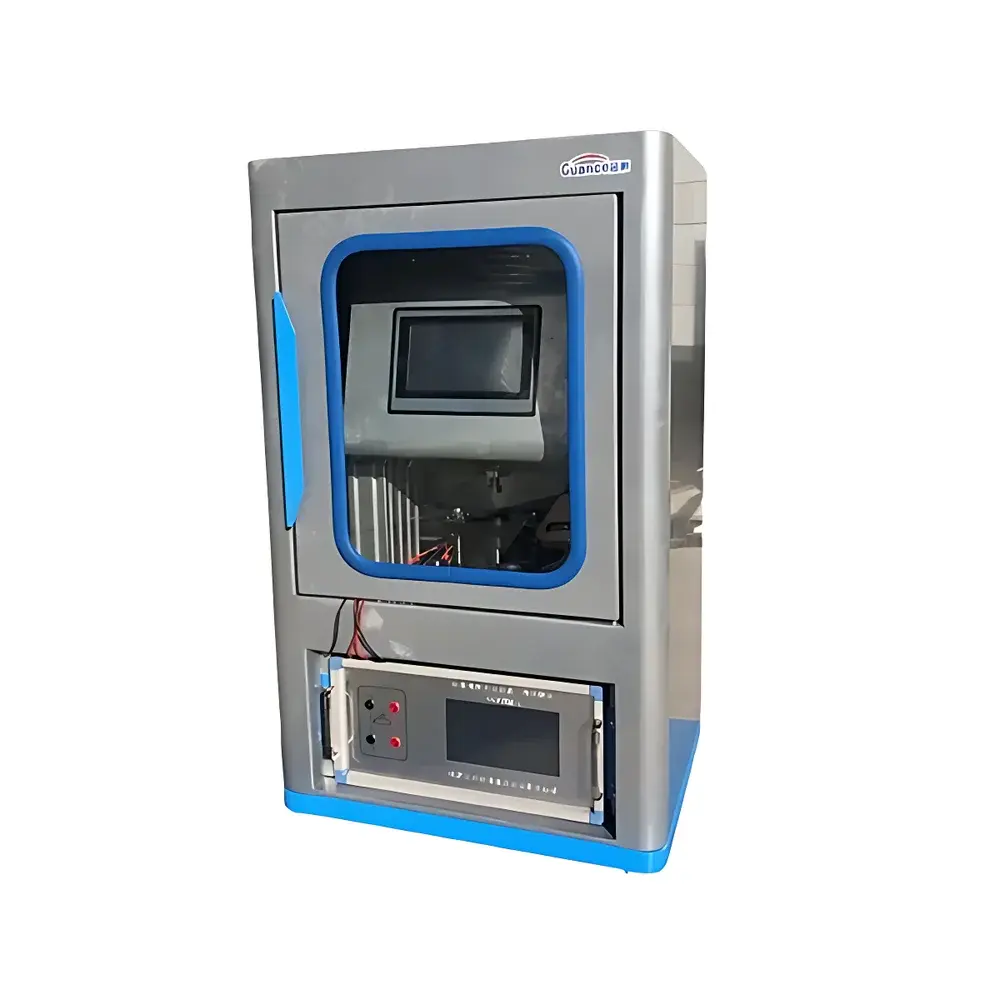
GuanCe GCFTDZ-I Powder Resistivity Tester (Two-Point Probe Method)
| Brand | GuanCe Instruments |
|---|---|
| Origin | Hebei, China |
| Manufacturer Type | Authorized Distributor |
| Origin Category | Domestic (China) |
| Model | GCFTDZ-I |
| Price | USD 2,100 (approx.) |
| Max Applied Force | 5 kN (equivalent to 3.9 MPa at φ30 mm electrode) |
| Force Accuracy | ±0.5% FS |
| Current Source Range | 10 μA – 10 A (8 ranges) |
| Voltage Measurement Range | 2 mV – 2 V |
| Resistance Measurement Range | 10⁻⁶ – 10⁵ Ω |
| Resolution | 10⁻⁸ Ω |
| Voltage Accuracy | ±0.1% |
| Current Source Accuracy | ±0.5% |
| Electrode Diameters | φ16.0 mm & φ30.0 mm |
| Height Resolution | ±1 μm |
| Test Modes | Constant Force, Constant Pressure, Gradient Force, Gradient Pressure, Compression Ratio |
| Data Output | USB export, thermal printer integration |
| Power Supply | 220 V / 50 Hz |
| Power Consumption | 1 kW |
| Dimensions (L×W×H) | 550 × 450 × 960 mm |
| Weight | ~75 kg |
Overview
The GuanCe GCFTDZ-I Powder Resistivity Tester is a precision-engineered instrument designed for the standardized measurement of electrical resistivity in granular carbonaceous materials using the two-point probe (collinear electrode) method. It operates in strict accordance with GB/T 24521–2018, the Chinese national standard for resistivity determination of carbon raw materials and coke—methodologically aligned with ASTM D3418 and ISO 11713 for powder conductivity assessment under controlled compaction. The system applies uniaxial compressive force to a dried, sieved powder sample within a cylindrical die cavity, establishing reproducible particle-to-particle contact geometry. A programmable constant current is injected across two parallel, coaxial stainless-steel electrodes while voltage drop is measured simultaneously; resistivity (ρ) is then calculated using ρ = R × A / L, where R is measured resistance, A is electrode cross-sectional area, and L is the compressed sample height. This approach eliminates interfacial contact resistance artifacts common in four-probe methods for low-conductivity powders and ensures traceability to volumetric bulk properties required in carbon anode manufacturing, metallurgical coke QC, and battery-grade graphite qualification.
Key Features
- Integrated servo-driven loading system delivering precise, noiseless, and repeatable force application up to 5 kN (3.9 MPa at φ30 mm), with real-time closed-loop control and adjustable loading speed (0.01–10 mm/s).
- Dual interchangeable electrode sets: φ16.0 mm (optimized for fine powders, 0.315–0.5 mm particle size) and φ30.0 mm (for coarser fractions, 0.5–1.0 mm), each calibrated for geometric factor consistency.
- High-fidelity electrical measurement subsystem featuring eight-step programmable constant-current sourcing (10 μA to 10 A), auto-ranging 4-digit voltage acquisition (2 mV–2 V, ±0.1% accuracy), and resistance resolution down to 10⁻⁸ Ω.
- 10-inch industrial-grade capacitive touchscreen HMI powered by Siemens S7-1200 PLC, supporting intuitive test configuration, live parameter monitoring (force, pressure, height, density, voltage, current, resistance, resistivity, conductivity), and on-screen data review.
- Seven configurable test modes: constant-force, constant-pressure, gradient-force, gradient-pressure, compression-ratio-based displacement control, dwell-time sequencing, and multi-step cyclic compaction—all fully automated with pre-programmed hold times and automatic return-to-home upon completion.
- Onboard thermal printer and USB mass-storage interface for GLP-compliant data capture: timestamped reports include raw measurements, derived values (resistivity in Ω·m or μΩ·m; conductivity in S/m or % IACS), statistical summaries (mean, SD, CV%), and operator ID logging.
Sample Compatibility & Compliance
The GCFTDZ-I is validated for use with industrially relevant carbonaceous powders including calcined anthracite, petroleum coke (green and calcined), needle coke, graphite flakes, carbon black agglomerates, and baked anode crumbs. Sample preparation follows GB/T 24521–2018 protocols: particles are dried at 105 °C ± 2 °C for 2 h, sieved to target size fractions, and weighed to ±0.001 g prior to die filling. The instrument’s mechanical and electrical architecture meets CE safety directives (2014/30/EU EMC, 2014/35/EU LVD) and supports audit-ready documentation for ISO/IEC 17025-accredited laboratories. All calibration certificates (force transducer, voltage reference, current shunt) are NIST-traceable, and firmware supports user-defined calibration offsets per electrode set.
Software & Data Management
Firmware v3.2+ enables secure data integrity through local password-protected user roles (Operator, Technician, Administrator), automatic zero-point compensation before each test cycle, and full audit trail logging compliant with FDA 21 CFR Part 11 principles (electronic signatures, immutable records, change history). Exported CSV files contain columnar metadata: test ID, date/time, operator, electrode ID, applied force (kN), pressure (MPa), compressed height (mm), apparent density (g/cm³), measured R (Ω), calculated ρ (Ω·m), σ (S/m), and environmental temperature/humidity (if external sensor integrated). No cloud dependency—the system operates offline with local data retention ≥10,000 test records.
Applications
- Quality control of carbon raw materials in aluminum smelting anode production lines.
- Batch-to-batch consistency verification of calcined coke prior to graphitization.
- R&D screening of novel conductive fillers (e.g., graphene-enhanced carbon composites) under variable compaction stress.
- Correlation studies between green density, sintering shrinkage, and final bulk resistivity in refractory carbon bodies.
- Teaching laboratories demonstrating the effect of porosity, particle size distribution, and binder content on powder conductivity.
FAQ
What standards does the GCFTDZ-I comply with?
It implements GB/T 24521–2018 as primary reference, with technical equivalence to ASTM D3418 (Standard Test Method for Transition Temperatures of Electrical Insulating Materials) and ISO 11713 (Carbonaceous materials — Determination of resistivity of coke and coal).
Can the instrument measure anisotropic samples?
No—it assumes isotropic bulk behavior under uniaxial compression. For directional conductivity analysis (e.g., pressed pellets with preferred orientation), a four-probe van der Pauw system is recommended.
Is calibration required before each test?
Automatic zero-point compensation occurs at system startup and before every test cycle; full metrological calibration (force, voltage, current) is recommended annually or after mechanical impact, using certified reference standards.
Does it support custom reporting templates?
Yes—CSV output structure is fixed, but post-processing via Excel or Python pandas allows custom formatting, statistical aggregation, and integration into LIMS or MES platforms.
What maintenance is needed for long-term stability?
Monthly cleaning of electrode surfaces with isopropyl alcohol; annual lubrication of lead screw and verification of encoder linearity; biannual inspection of current shunt thermal drift under 10 A load.



