
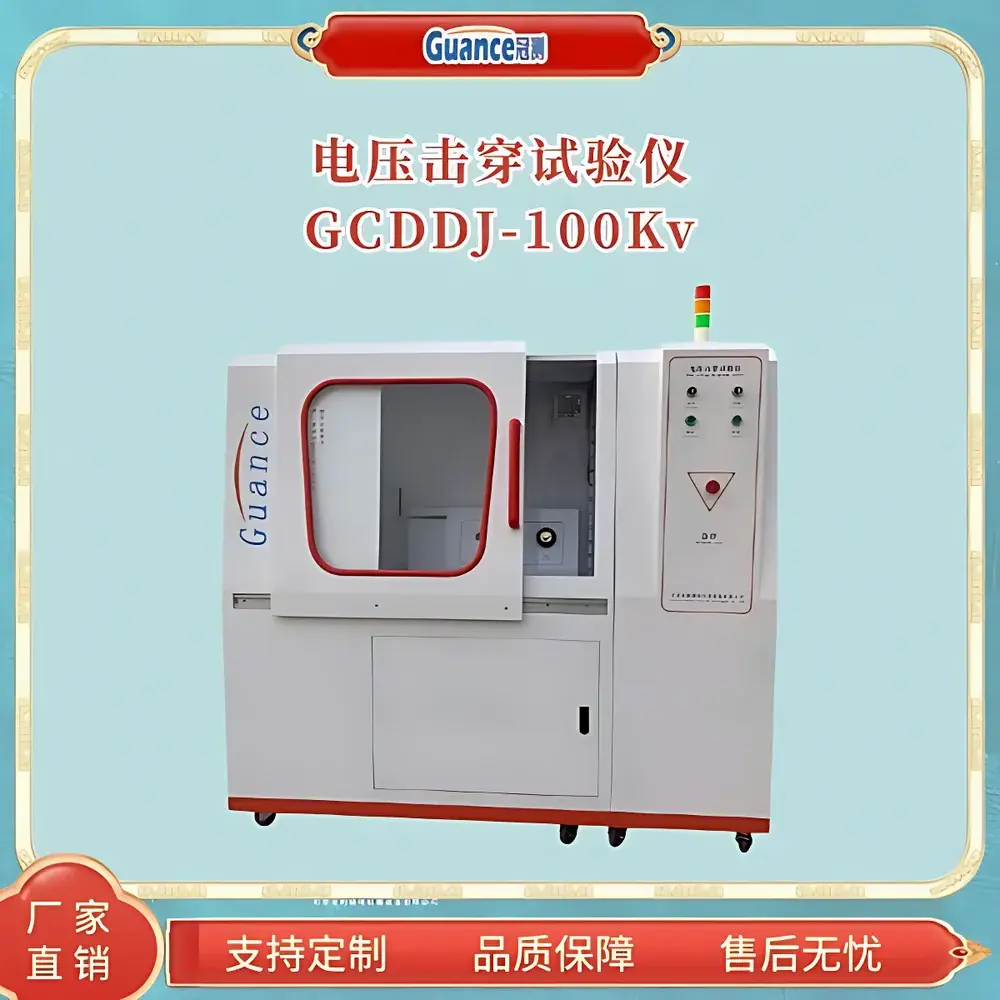
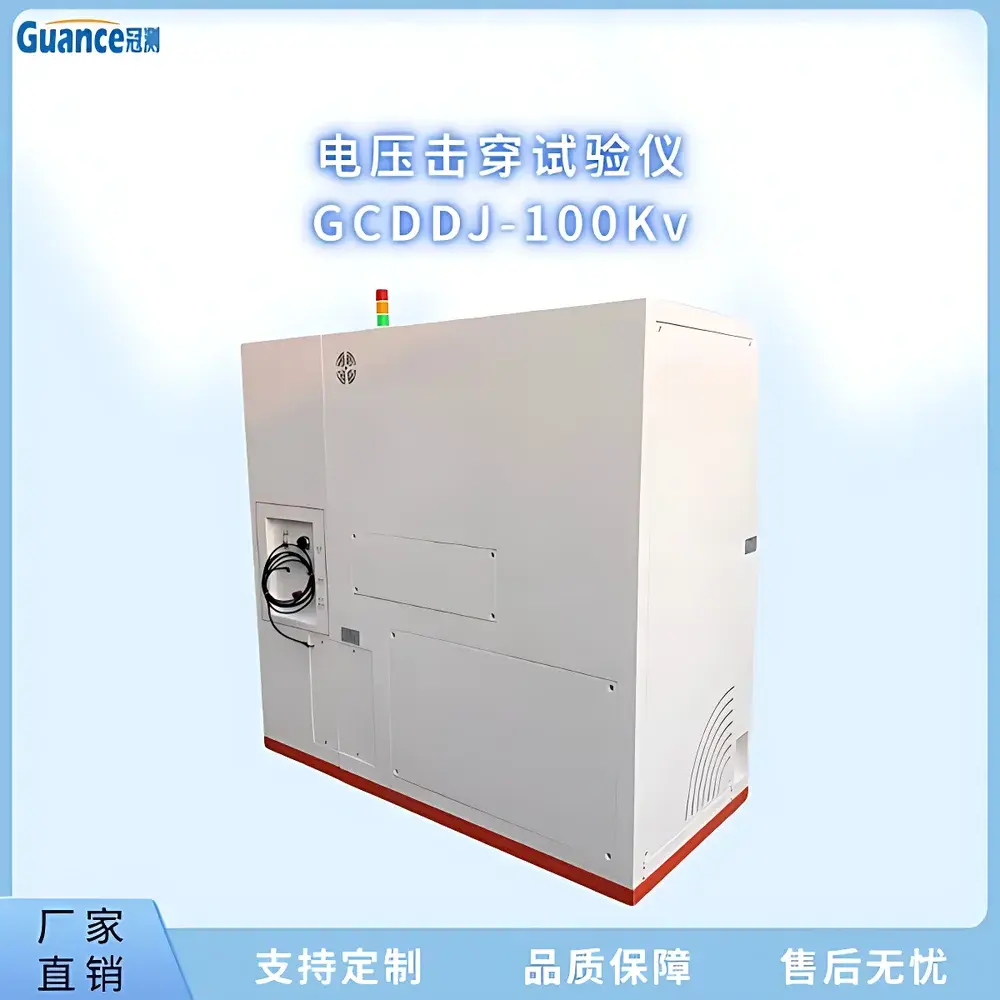
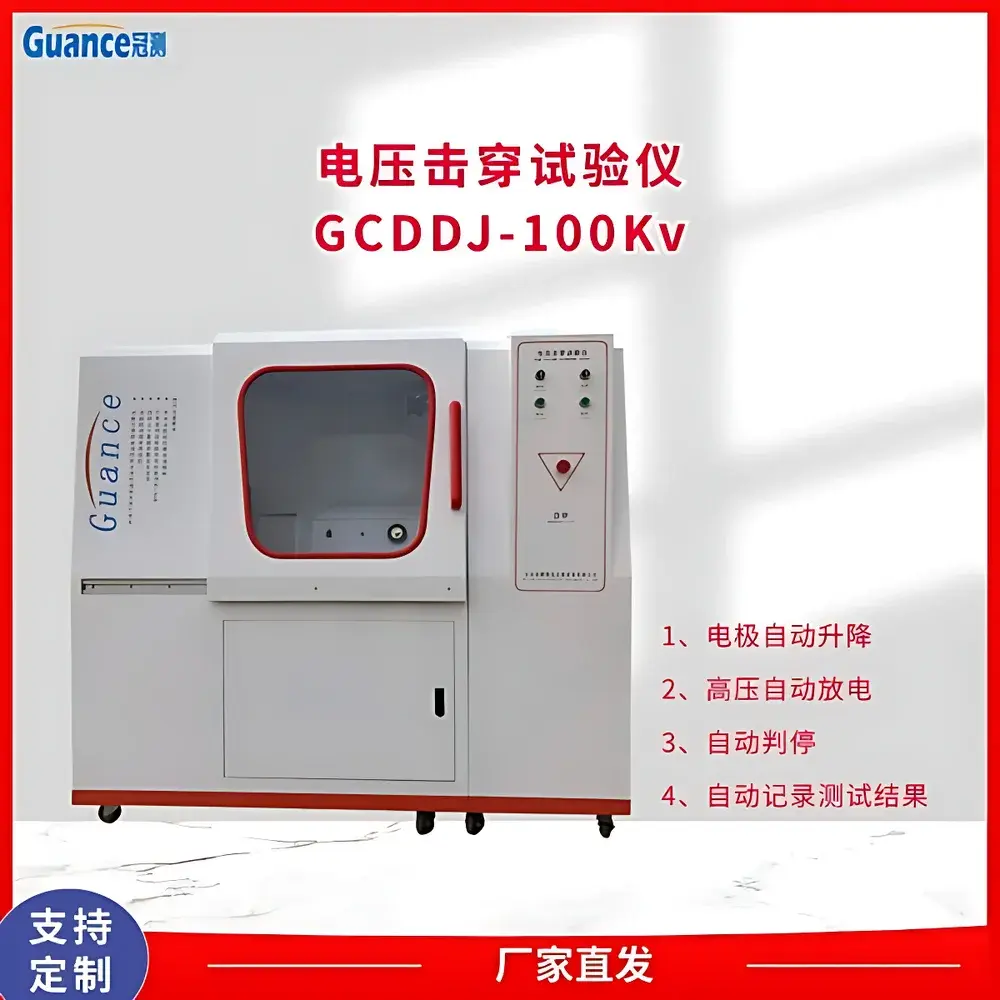
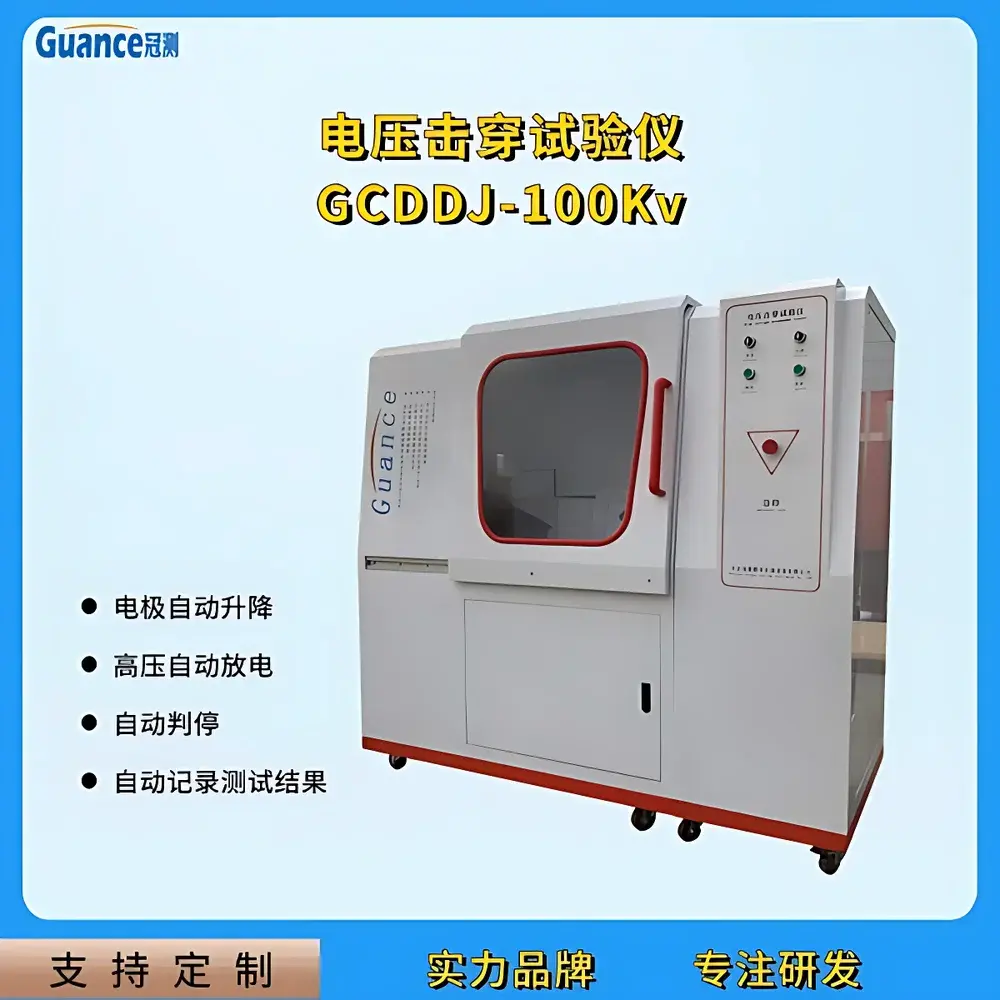
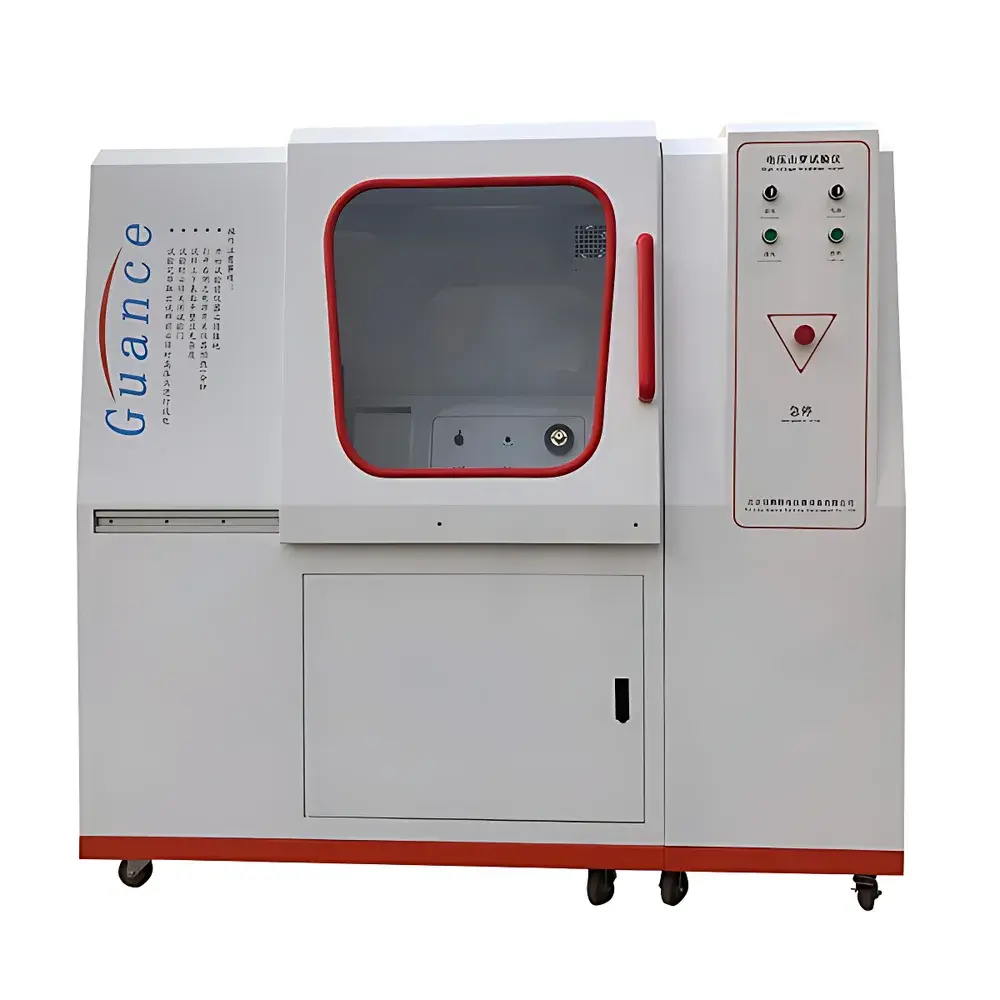
Guance Instruments GCDDJ-100kV2 Industrial-Frequency Dielectric Breakdown Tester
| Brand | Guance Instruments |
|---|---|
| Origin | Beijing, China |
| Model | GCDDJ-100kV2 |
| Maximum Output Voltage | 100 kV AC/DC |
| Electrical Capacity | 5 kVA |
| Input Voltage | AC 220 V / 50 Hz |
| Voltage Ramp Rate | 0.1–5 kV/s (adjustable) |
| Voltage Accuracy | ≤ ±1.5% |
| Leakage Current Range | 0–100 mA |
| Voltage Sensor Range | 0–100 V |
| Electrode Options | φ25 mm (×2), φ75 mm (×1), customizable |
| Test Chamber Dimensions | 750 × 600 × 800 mm |
| Overall Dimensions | 1500 × 850 × 1700 mm |
| Weight | ~250 kg |
| Safety Protections | Overvoltage, overcurrent, short-circuit, and leakage current protection |
| Environmental Operating Conditions | Ambient temperature, RH ≤ 65% |
Overview
The Guance Instruments GCDDJ-100kV2 Industrial-Frequency Dielectric Breakdown Tester is a precision-engineered high-voltage testing system designed for evaluating the dielectric strength and voltage withstand capability of solid insulating materials under standardized AC (50 Hz) or DC conditions. Based on the fundamental principle of controlled voltage ramping until electrical breakdown occurs—defined as the point at which insulation resistance collapses and conduction current surges—the instrument complies with core international test methodologies including ASTM D149, IEC 60243-1, GB/T 1408.1, and ISO 60243-1. It employs a dual-path measurement architecture: high-fidelity voltage acquisition via calibrated high-voltage sensors and real-time leakage current monitoring through isolated 0–100 mA transducers. The system’s core control logic resides in a Siemens S7-series PLC, ensuring deterministic timing, immunity to electromagnetic interference (EMI), and deterministic event triggering—critical for reproducible breakdown detection across diverse material classes.
Key Features
- Full AC/DC dual-mode operation up to 100 kV output, with selectable ramp profiles: linear (constant rate), stepwise gradient, or fixed-voltage hold (dielectric withstand test)
- Siemens PLC-based closed-loop control with optically isolated data transmission between test chamber and host PC—eliminating ground-loop noise and EMI-induced false triggers
- Real-time synchronized visualization of voltage ramp curve and leakage current waveform during test execution
- Automated breakdown detection using dual criteria: voltage collapse threshold and programmable current trip level (e.g., 10 mA, 20 mA, or user-defined)
- Integrated safety architecture: hardware-level overvoltage cutoff, electronic overcurrent limiting, automatic post-test discharge (motor-driven resistor bank), and interlocked pneumatic door with status feedback
- Modular electrode configuration support—including standard disc electrodes (φ25 mm × 2, φ75 mm × 1) and custom geometries for specialized standards (e.g., needle-plane per IEC 60112)
- Optional high-temperature test module (up to 200 °C) with insulated oil bath (300 × 150 × 200 mm) and suspended sample holder for thermal stability during voltage stress
Sample Compatibility & Compliance
The GCDDJ-100kV2 accommodates rigid and semi-rigid dielectric specimens—including thermoplastics (e.g., PE, PP), elastomers (silicone rubber, EPDM), laminates (G10/FR4), ceramic substrates, glass plates, varnish-coated windings, and molded insulators. Testing may be performed in ambient air, transformer oil immersion (ASTM D877/D1816), or elevated-temperature oil environments. All mechanical and electrical design elements conform to IEC 61010-1 (safety requirements for electrical equipment for measurement, control, and laboratory use) and EN 61326-1 (EMC compliance). The system supports audit-ready documentation workflows aligned with GLP and GMP practices, including timestamped test logs, operator ID tagging, and immutable result archives—facilitating FDA 21 CFR Part 11 readiness when deployed with validated software configurations.
Software & Data Management
The Windows-based control interface provides intuitive parameter configuration, live graphical monitoring, and structured data export. Key software capabilities include: dynamic curve overlay of voltage vs. time and current vs. time; customizable report templates with embedded test parameters, environmental metadata, and pass/fail annotations; direct export to CSV or Excel-compatible formats; multi-user access control with role-based permissions; and full traceability of all test events—including door open/close states, zero-reset confirmation, ramp initiation, and automatic stop timestamps. Raw acquisition data is stored in binary format with checksum validation to prevent corruption, while summary results are archived in relational database structures supporting SQL queries for QA trend analysis.
Applications
This tester serves quality assurance laboratories in cable manufacturing (jacket and insulation validation), capacitor film producers (PET, PP metallized films), aerospace composites (polyimide laminates), power electronics (DC-link film capacitors), and academic research on nanodielectrics and polymer nanocomposites. It enables comparative studies of aging effects (thermal, UV, humidity preconditioning), formulation optimization (filler dispersion impact on breakdown strength), and qualification of new biobased insulators against legacy materials. Routine use includes incoming raw material screening, in-process lot verification, and final product certification prior to UL/CSA listing.
FAQ
What standards does the GCDDJ-100kV2 support?
It is configured to execute tests per ASTM D149 (AC dielectric breakdown), IEC 60243-1 (electric strength of solid insulating materials), GB/T 1408.1 (Chinese national standard), and ISO 60243-1.
Can the system perform both AC and DC tests without hardware modification?
Yes—dual-mode high-voltage generation is implemented via internal solid-state polarity switching and RMS-synchronized AC output, requiring only software selection.
Is the software compliant with 21 CFR Part 11 for regulated industries?
Out-of-the-box functionality meets foundational requirements (audit trail, electronic signatures, data integrity); formal validation documentation and IQ/OQ protocols are available upon request for pharmaceutical or medical device clients.
What maintenance is required for long-term calibration stability?
Annual verification of voltage sensor linearity and current transducer offset is recommended using NIST-traceable reference calibrators; no routine oil replacement is needed unless operating in extended high-temperature oil-bath mode.
How is operator safety ensured during high-voltage operation?
Five-layer protection: (1) interlocked observation door with microswitch feedback, (2) redundant hardware overvoltage cutoff at 105% rated output, (3) automatic discharge within 3 seconds post-test, (4) illuminated tower light with color-coded status (green=ready, amber=running, red=fault), and (5) emergency stop with hardwired cut-off to HV transformer primary winding.



