
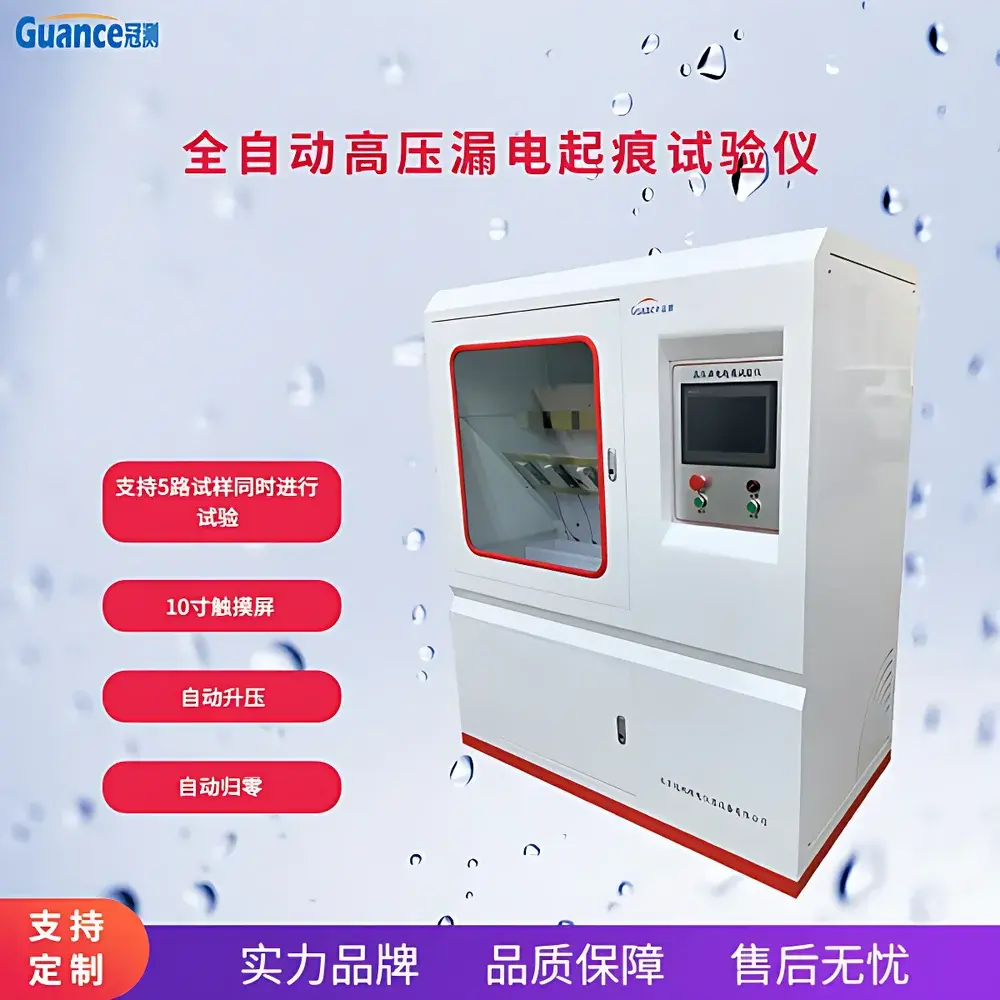
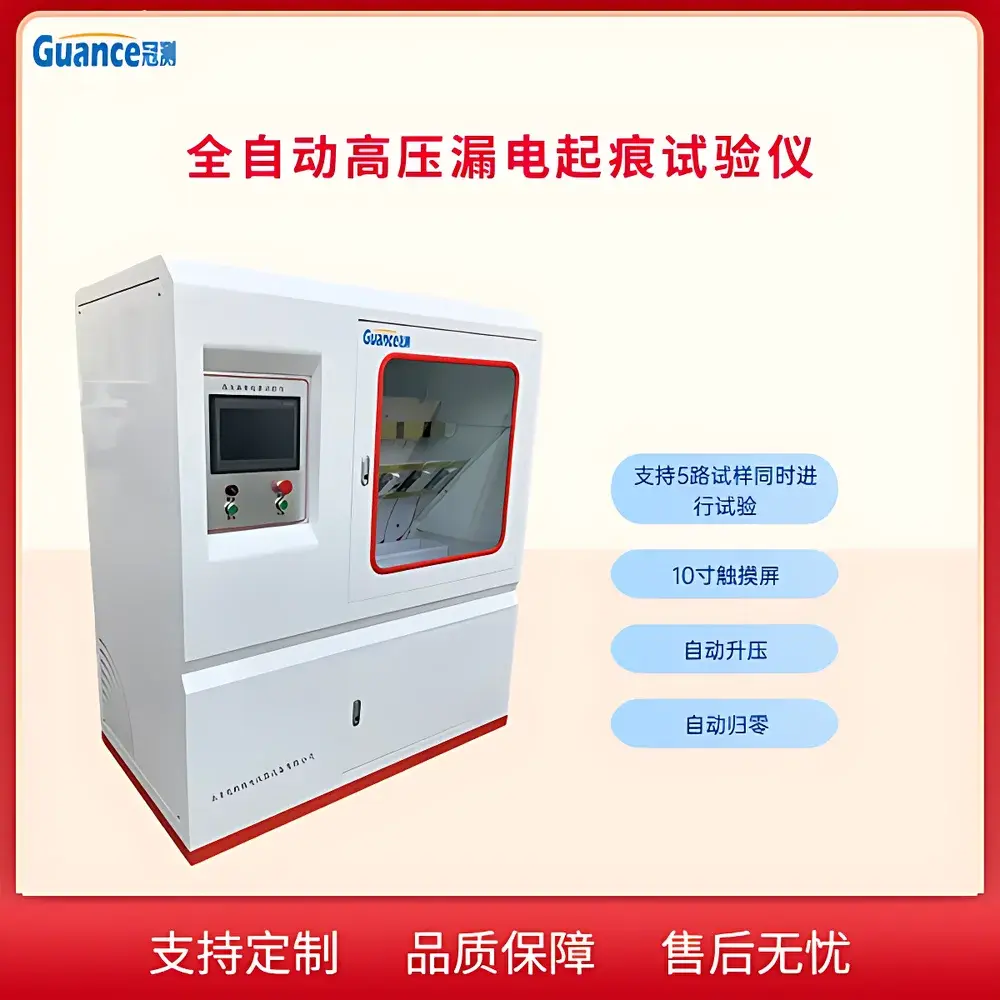
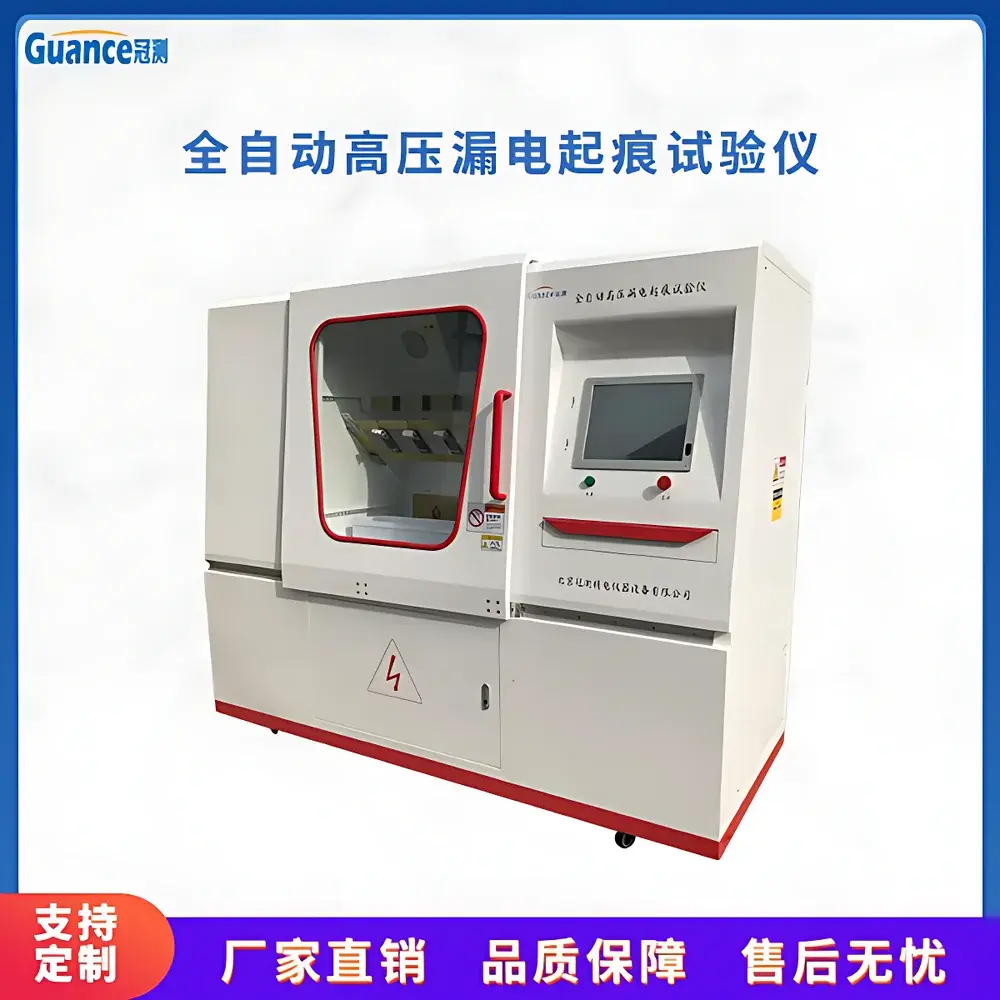
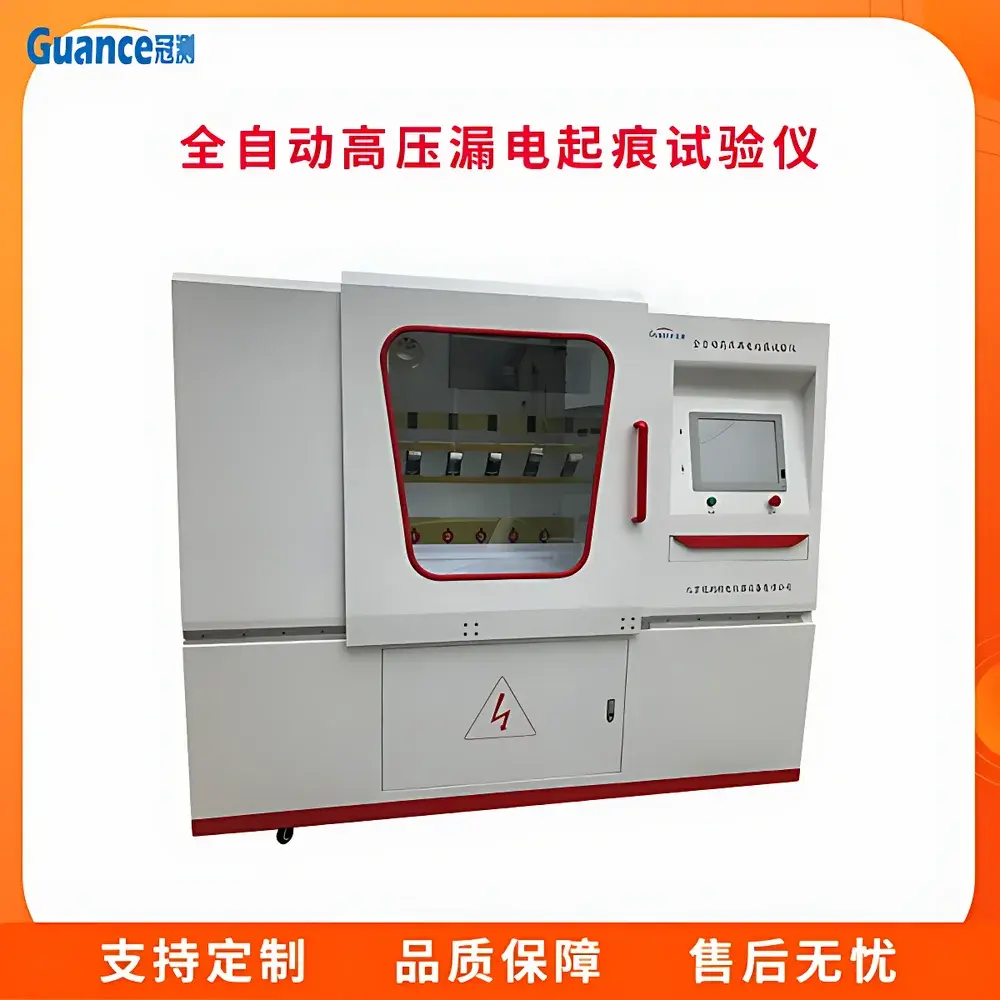
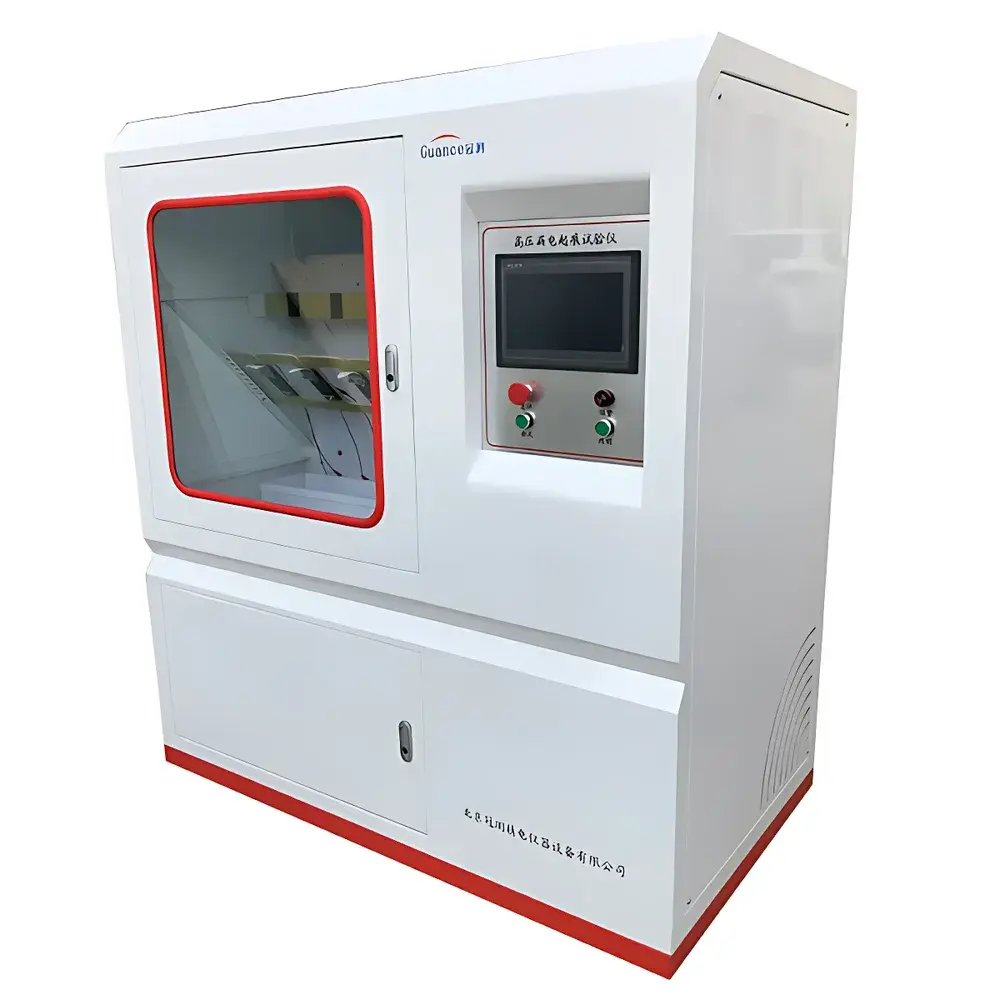
GuanCe Instruments NLD-AI7 Universal High-Voltage Tracking and Erosion Tester
| Brand | GuanCe Instruments |
|---|---|
| Origin | Beijing, China |
| Manufacturer Type | Authorized Distributor |
| Origin Category | Domestic (China) |
| Model | NLD-AI7 |
| Instrument Type | Electronic Universal Testing Machine |
| Voltage Output | AC 100–8000 V / DC 100–8400 V |
| Electrical Capacity | 7 kVA |
| Input Power | AC 220 V, 50 Hz |
| Electrode Spacing | (50 ± 0.5) mm |
| Electrode Material | 304 Stainless Steel |
| Electrode Mounting | Dual independent high-insulation, high-strength composite支架 |
| Test Specimens | Up to 5 simultaneous samples |
| Test Methods | Constant Voltage Method & Stepwise Voltage Method |
| Drip Rate Control | Programmable per-channel via precision peristaltic pump |
| Leakage Current Alarm Range | 0–100 mA (user-configurable per channel) |
| Voltage Drop | ≤5% under load |
| Safety Interlock | Automatic HV cutoff upon door opening |
| Data Calibration | Onboard voltage/current recalibration function |
| Ventilation System | Dedicated exhaust duct with external venting capability |
| Illumination | Integrated LED interior lighting |
| Voltage Stabilization | Oil-immersed transformer + autotransformer regulation |
Overview
The GuanCe Instruments NLD-AI7 Universal High-Voltage Tracking and Erosion Tester is an engineered solution for evaluating the comparative resistance of solid electrical insulating materials—including silicone rubber, epoxy resins, polymeric composites, and ceramic-polymer hybrids—to electrical tracking and surface erosion under contaminated, humid conditions. Designed in strict accordance with GB/T 6553–2003 and IEC 60587:1984, this instrument replicates real-world stress scenarios where insulating surfaces are exposed to conductive electrolyte droplets (e.g., ammonium chloride solution) under sustained AC or DC high voltage. The test principle relies on controlled dielectric breakdown initiation at the electrode–specimen interface, followed by progressive carbonized track formation and material ablation—quantified through leakage current monitoring, time-to-failure recording, and post-test visual/gravimetric assessment of erosion depth and track length. Unlike general-purpose universal testers, the NLD-AI7 integrates high-voltage power delivery, multi-channel electrochemical monitoring, and environmental control into a single platform optimized for comparative ranking of insulation performance under standardized severity levels.
Key Features
- Five-Channel Parallel Testing: Supports concurrent evaluation of up to five specimens under identical environmental and electrical conditions—enabling statistically robust inter-material comparisons while maintaining individual circuit isolation.
- Industrial-Grade PLC Control Architecture: Siemens S7-series PLC core with opto-isolated analog input modules ensures immunity to electromagnetic interference during high-voltage transients, preserving measurement fidelity across long-duration tests (up to 6 hours per run).
- Real-Time Multi-Parameter Display: 10-inch capacitive touchscreen interface continuously renders per-channel data: instantaneous leakage current, peak current since test initiation, applied voltage (AC/DC), cumulative test time (minutes), and drip rate (mL/min)—all timestamped and logged internally.
- Configurable Per-Channel Fault Response: User-definable current threshold (0–100 mA) triggers automatic disconnection of the affected high-voltage channel without interrupting operation of remaining channels—critical for reliability benchmarking across heterogeneous sample sets.
- Precision Drip Delivery System: Digital peristaltic pump with closed-loop flow feedback enables repeatable, adjustable droplet volume (0.01–1.0 mL per drop) and interval (10–30 s), compliant with IEC 60587’s specified contamination application protocol.
- Dual-Compartment Fluid Management: Separated reservoirs for fresh electrolyte supply and spent fluid collection prevent cross-contamination and ensure consistent conductivity throughout testing—essential for reproducible surface wetting behavior.
- Integrated Safety Engineering: Mechanical door interlock cuts HV output within <50 ms of access panel opening; oil-immersed transformer design limits voltage sag to ≤5% under full 7 kVA load; auto-zero discharge circuit returns output to ground potential within 3 seconds post-test.
Sample Compatibility & Compliance
The NLD-AI7 accommodates flat or slightly curved specimens measuring up to 100 mm × 100 mm × 12 mm, with standardized electrode contact geometry defined by IEC 60587. Compatible materials include thermoset laminates (e.g., FR-4), silicone elastomers (HTV/RTV), polyurethane coatings, and filled polymer composites used in outdoor insulators, cable terminations, and EV battery enclosures. All operational parameters—including voltage ramp rate, dwell time per step, and current trip logic—can be configured to align with ASTM D2303 (for accelerated aging) or UL 746A (polymeric material recognition). The system supports audit-ready documentation for GLP-compliant laboratories, with timestamped event logs covering HV activation, alarm triggers, manual interventions, and calibration events—facilitating traceability under ISO/IEC 17025 requirements.
Software & Data Management
Data acquisition occurs at 10 Hz per channel and is stored locally in non-volatile memory with CSV export capability via USB 2.0 port. No proprietary software installation is required: raw datasets include absolute timestamps, channel ID, voltage polarity (AC/DC), RMS voltage, instantaneous current, and pump status flags. For regulated environments, optional firmware upgrade enables 21 CFR Part 11–compliant user authentication, electronic signatures, and immutable audit trails—including operator ID, parameter change history, and calibration certificate linkage. Exported files retain metadata necessary for third-party statistical analysis (e.g., Weibull distribution fitting for time-to-tracking failure).
Applications
- Evaluation of arc-tracking resistance in high-voltage switchgear housings and busbar insulation
- Qualification of silicone rubber formulations for composite insulators in coastal or industrial pollution zones
- Comparative screening of flame-retardant additives’ impact on surface degradation kinetics
- Verification of coating integrity on printed circuit board conformal coatings (IPC-CC-830B Annex B)
- Supporting technical documentation for IEC 60695-2-10/11/12 fire hazard assessments
- Research into nanofiller dispersion effects on electrical treeing suppression in polymeric nanocomposites
FAQ
What standards does the NLD-AI7 fully comply with?
It meets all functional and procedural requirements of GB/T 6553–2003 and IEC 60587:1984, including electrode geometry, contamination solution composition, voltage application sequence, and pass/fail criteria definitions.
Can the instrument perform both AC and DC tests without hardware modification?
Yes—the integrated dual-mode high-voltage generator delivers either AC (48–62 Hz) or DC output within the same test sequence, with programmable polarity reversal for DC protocols.
Is calibration traceable to national metrology institutes?
Voltage and current sensors are factory-calibrated against CNAS-accredited reference standards (certificate included); field recalibration uses onboard shunt resistors and precision dividers with documented uncertainty budgets.
How is test repeatability ensured across multiple operators?
All critical parameters—drip interval, voltage ramp rate, alarm thresholds, and dwell times—are stored as named test templates, eliminating manual entry errors and enabling SOP-driven execution.
Does the system support remote monitoring or network integration?
Standard configuration includes isolated RS-485 serial interface for PLC-level integration into lab-wide SCADA systems; Ethernet module (optional) enables Modbus TCP communication and HTTP-based status polling.



