
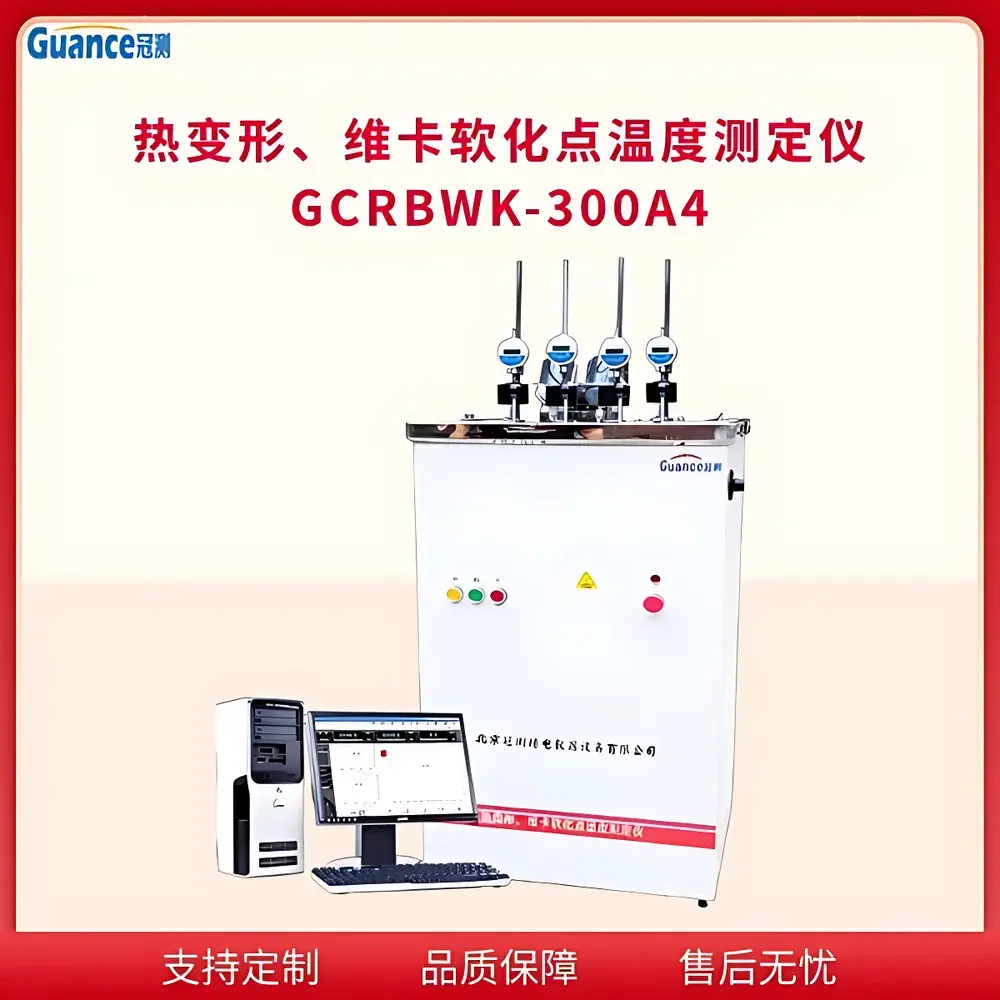
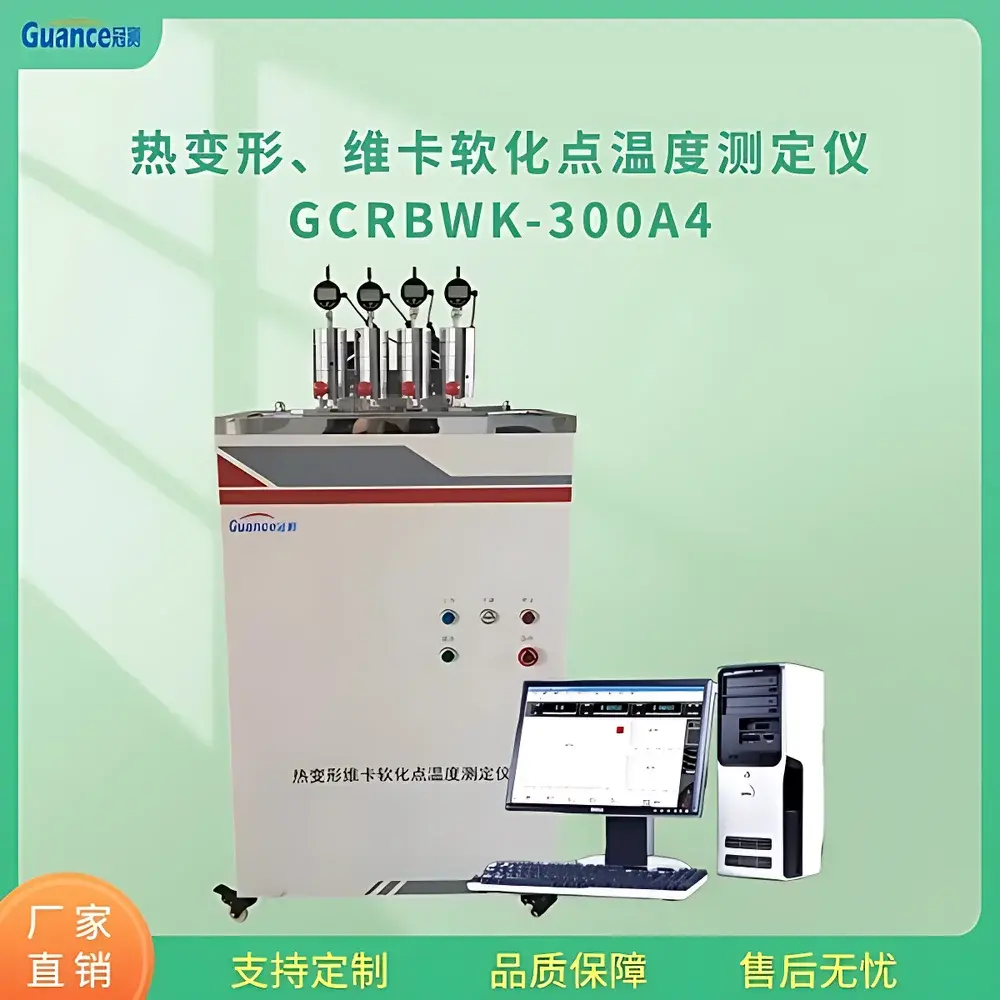
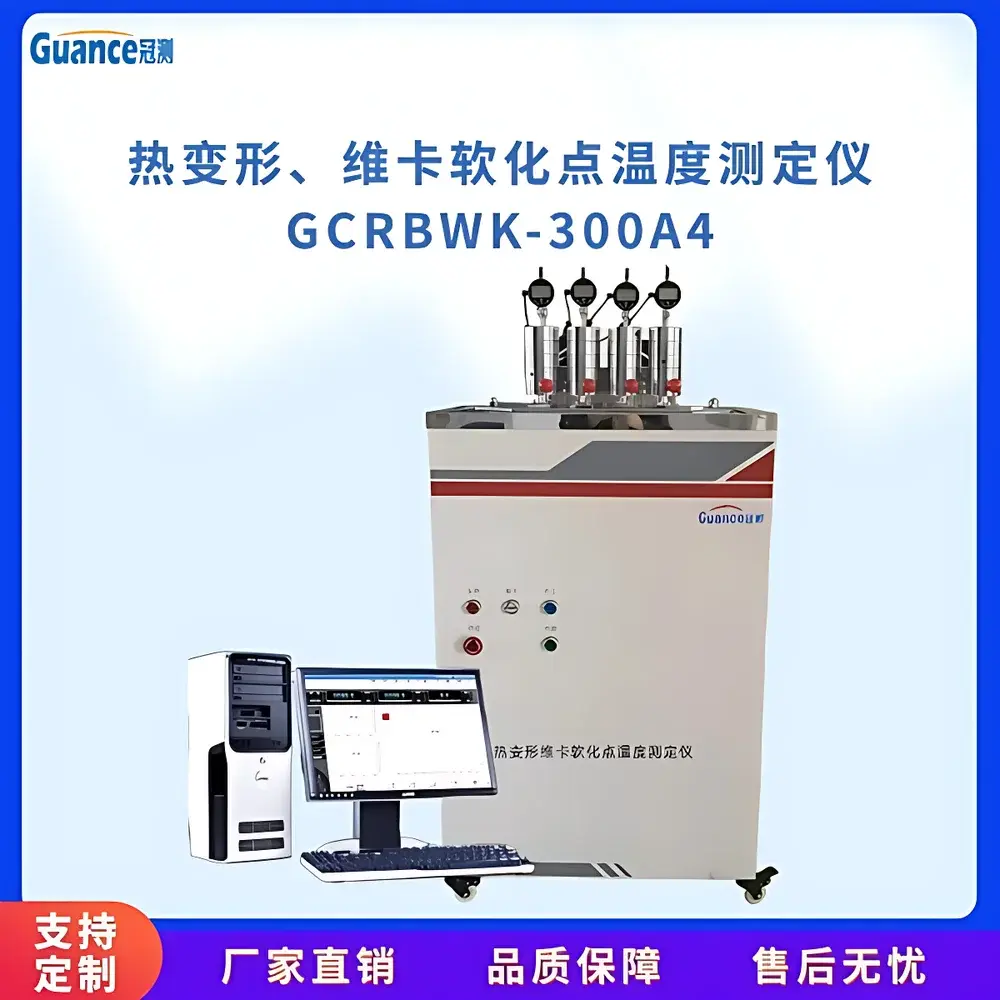
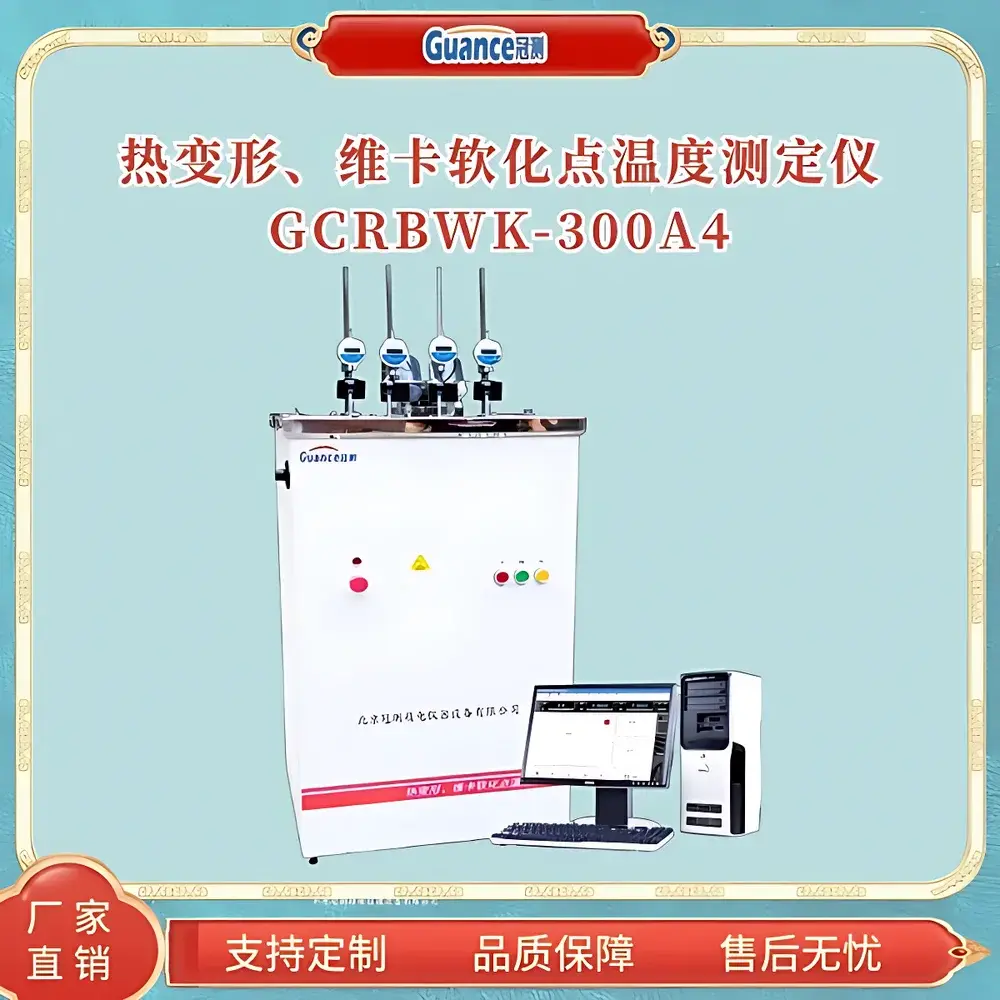
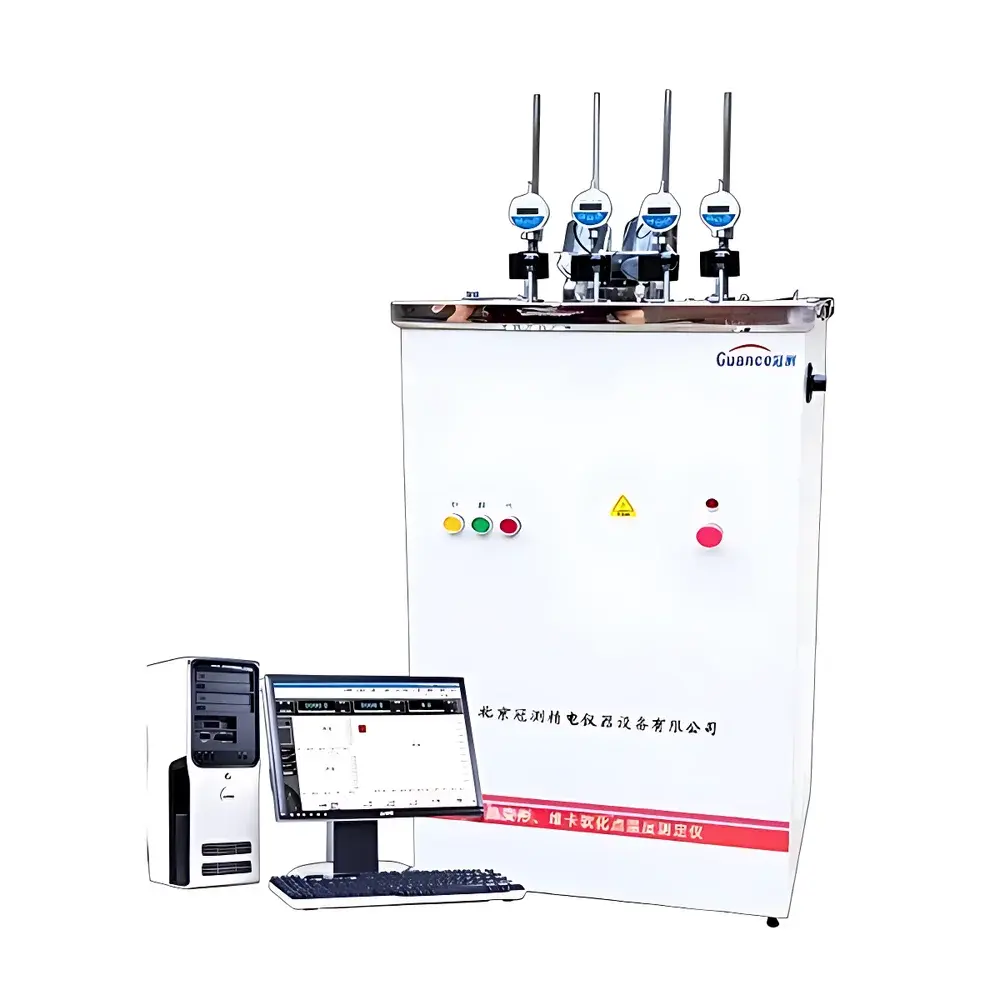
GuanCe GCRBWK-300A Heat Deflection Temperature (HDT) and Vicat Softening Temperature (VST) Tester
| Brand | GuanCe |
|---|---|
| Origin | Beijing, China |
| Manufacturer Type | Authorized Distributor |
| Country of Origin | China |
| Model | GCRBWK-300A |
| Price | USD 2,800 (FOB Beijing) |
| Temperature Control Range | Ambient to 300 °C |
| Max. Temp. Deviation | ±0.5 °C |
| Heating Rates | 50 °C/h, 120 °C/h, or adjustable between 50–120 °C/h |
| Temp. Measurement Points | 4 |
| Test Stations | 4 |
| Deflection Measurement Range | 0–10 mm |
| Max. Deflection Error | ±0.005 mm |
| Resolution | 0.001 mm |
| Support Span Options | 64 mm or 100 mm |
| Thermal Expansion Coefficient of Test Frame | <0.005 /100 °C |
| Heating Power | 4000 W |
| Safety Protection | Dual hardware/software temperature cutoff, automatic test termination, admin password lock |
| Cooling Method | Natural cooling above 150 °C |
| Bath Medium | Methyl silicone oil or transformer oil |
| Control Architecture | Distributed MCU + PC system |
| Displacement Sensor | Taiwan EEE digital dial indicator (0–10 mm) |
Overview
The GuanCe GCRBWK-300A Heat Deflection Temperature (HDT) and Vicat Softening Temperature (VST) Tester is a precision-engineered thermal-mechanical testing platform designed for standardized determination of thermomechanical behavior in rigid polymeric and composite materials. It operates on two internationally recognized principles: (1) HDT measurement per ASTM D648 / ISO 75 / GB/T 1634, where a defined flexural load is applied to a simply supported beam specimen while immersed in a thermally controlled fluid bath; the temperature at which the specimen deflects by 0.25 mm or 0.32 mm (depending on standard) is recorded as the HDT; and (2) VST measurement per ISO 306 / ASTM D1525 / GB/T 1633, wherein a needle of specified geometry and cross-sectional area penetrates a flat specimen under constant axial force (10 N or 50 N), and the temperature at which penetration reaches 1 mm depth defines the VST. The instrument integrates high-stability PID-controlled heating, optical-grade displacement metrology, and thermally compensated mechanical frames to ensure traceable, repeatable results across multi-sample parallel testing.
Key Features
- Four independent test stations with synchronized temperature control and individual displacement monitoring—enabling concurrent HDT and VST determinations under identical thermal profiles.
- Automated test frame lifting mechanism reduces operator intervention, minimizes thermal disturbance during specimen loading/unloading, and eliminates manual handling risks near elevated-temperature baths.
- Dual-layer thermal protection architecture: hardware-based high-limit thermal switch (Korean-sourced, 30 A rated) plus software-enforced upper temperature threshold—both independently validated and interlocked with heater power modulation.
- Thermally stable test frame fabricated from low-expansion alloy (<0.005 /100 °C), critical for eliminating parasitic frame expansion artifacts that compromise sub-micron deflection accuracy at high temperatures.
- Precision displacement sensing via four Taiwan EEE digital dial indicators (0–10 mm range, 1 µm resolution, ±5 µm linearity error), coupled with full-optical isolation phase-control heating modules for ±0.5 °C temperature uniformity and <±0.5 °C/h rate deviation.
- Distributed control system: embedded MCU handles real-time sensor acquisition, closed-loop heating regulation, and safety logic; PC host manages data logging, curve visualization, report generation, and user authentication.
Sample Compatibility & Compliance
The GCRBWK-300A accommodates standard-compliant specimens per ISO 75-2, ISO 306, ASTM D648, and GB/T 1634—supporting rectangular bars (e.g., 80 × 10 × 4 mm), discs, and molded plaques up to 10 mm thick. It accepts both 64 mm and 100 mm support spans to satisfy material-specific stiffness requirements. Compatible bath media include methyl silicone oil (flash point >300 °C) and transformer oil (for lower-temperature applications). All operational parameters—including heating ramp selection, load application timing, and endpoint criteria—are configurable to align with method-specific clauses in ISO 2507 (thermoplastics), ISO 10350 (data sheet reporting), and ASTM D4067 (reinforced composites). The system supports audit-ready operation under GLP environments, with timestamped raw data export, user access logs, and calibration traceability documentation.
Software & Data Management
The Windows-based control software provides real-time dual-axis plotting (temperature vs. time; deflection vs. time), with selectable coordinate scaling, overlay capability for comparative analysis, and automated pass/fail flagging against standard-defined thresholds. Raw data files (.csv and .txt) contain millisecond-synchronized temperature, displacement, and status flags (e.g., “heating active”, “test complete”, “safety trigger”). Reporting templates comply with ISO/IEC 17025 documentation requirements, including instrument ID, calibration dates, operator ID, environmental conditions, and uncertainty estimates per GUM guidelines. Exported reports embed digital signatures and are compatible with LIMS integration via ODBC drivers. Software enforces role-based access control (admin/operator modes), supports electronic signature workflows compliant with FDA 21 CFR Part 11 Annex 11 principles, and maintains immutable audit trails of all parameter changes and test executions.
Applications
- Quality assurance of engineering thermoplastics (e.g., PEEK, PEI, PPS) and thermosets (epoxy, phenolic laminates) used in aerospace, automotive, and electrical insulation applications.
- R&D screening of novel polymer blends and fiber-reinforced composites—quantifying heat resistance degradation due to plasticizer migration, filler dispersion, or crosslink density variation.
- Regulatory submission support for UL 746B (polymeric materials for electrical equipment), IEC 60695-10-2 (fire hazard testing), and EN 13501-1 (construction product classification).
- Educational laboratories requiring robust, standards-aligned instrumentation for teaching polymer physics, viscoelastic transition phenomena, and ISO/ASTM test methodology.
- Third-party certification labs performing accredited HDT/VST testing under CNAS, UKAS, or A2LA scopes.
FAQ
What standards does the GCRBWK-300A fully support?
It complies with ISO 75-1/2/3 (HDT), ISO 306 (VST), ASTM D648, ASTM D1525, GB/T 1633, GB/T 1634, GB/T 8802, and ISO 2507-1/2—covering method definition, apparatus specification, and reporting requirements.
Can the instrument perform HDT and VST tests simultaneously?
Yes—each of the four test stations can be independently configured for either HDT (flexural loading) or VST (needle penetration), allowing mixed-mode operation within a single thermal cycle.
Is calibration documentation provided with shipment?
Yes—NIST-traceable calibration certificates for temperature sensors (Pt100 class A) and displacement transducers (with linearity verification at 0.25, 5.0, and 10.0 mm points) are included, along with as-found/as-left records.
What maintenance is required for long-term accuracy?
Annual verification of thermal uniformity across bath volume (per ISO 75-3 Annex B), periodic cleaning of oil bath contaminants, and biannual validation of displacement sensor zero drift using certified gauge blocks are recommended.
Does the system support remote monitoring or network integration?
The PC controller includes Ethernet port and Modbus TCP protocol support, enabling integration into plant-wide SCADA systems or centralized lab monitoring platforms without proprietary middleware.
Related Products



