
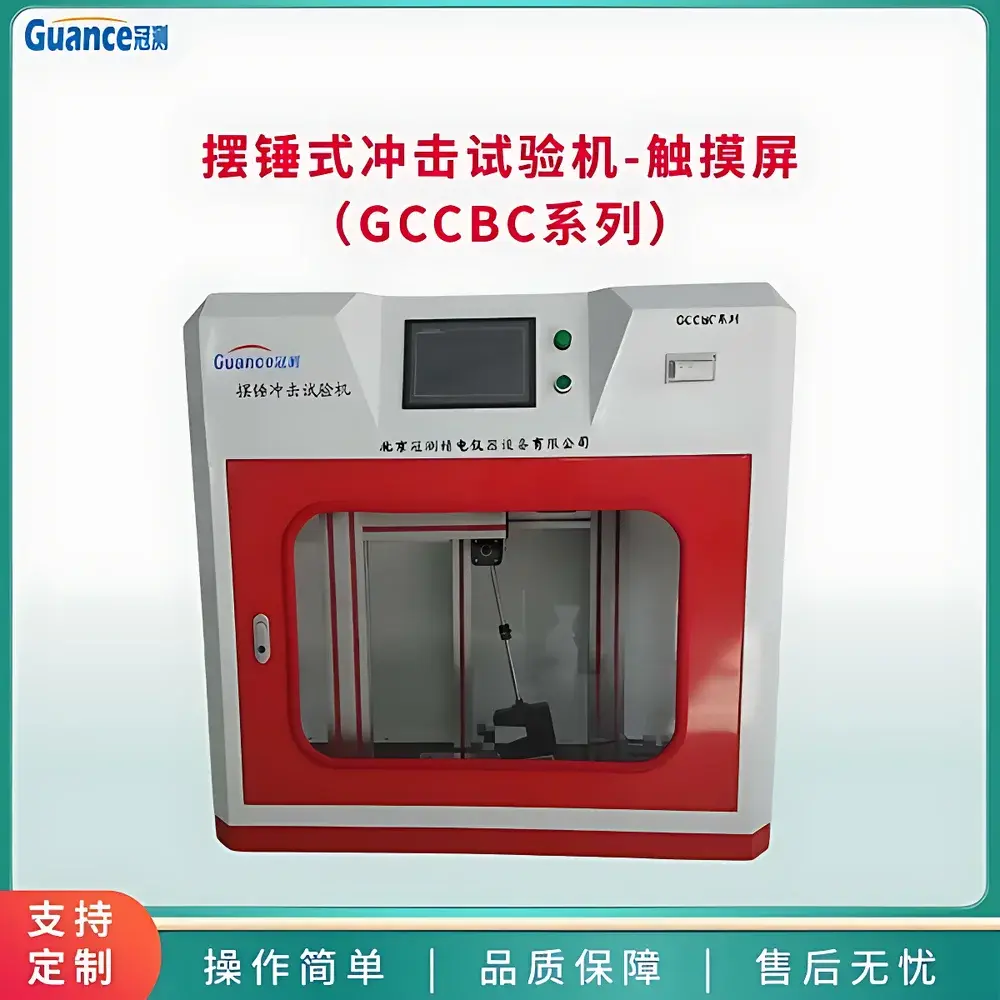
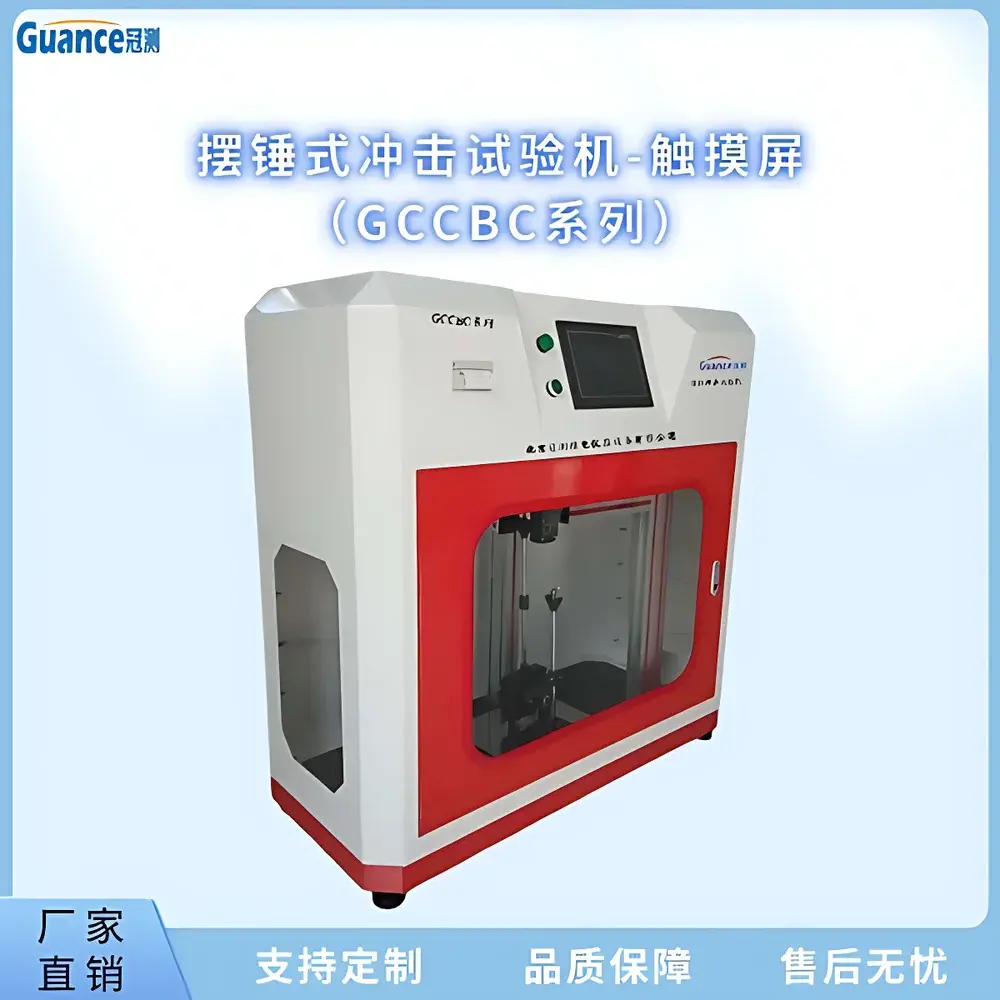
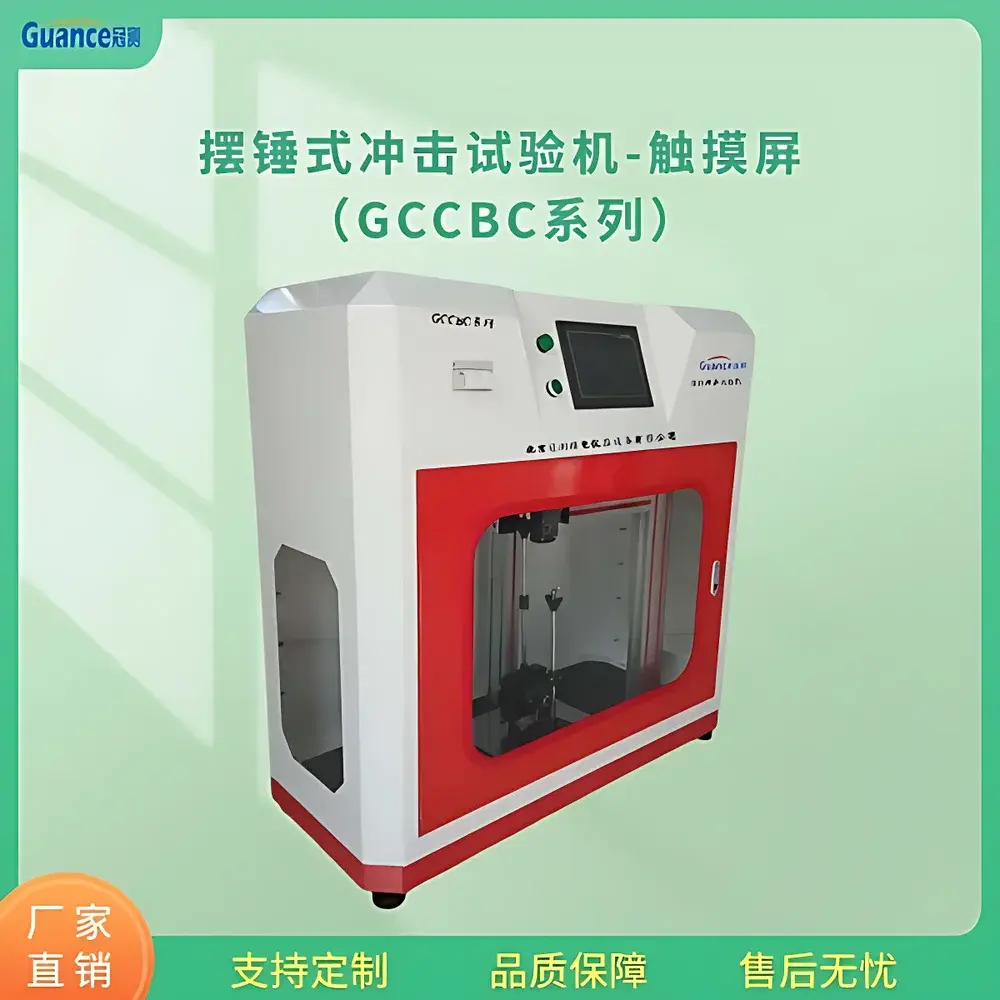
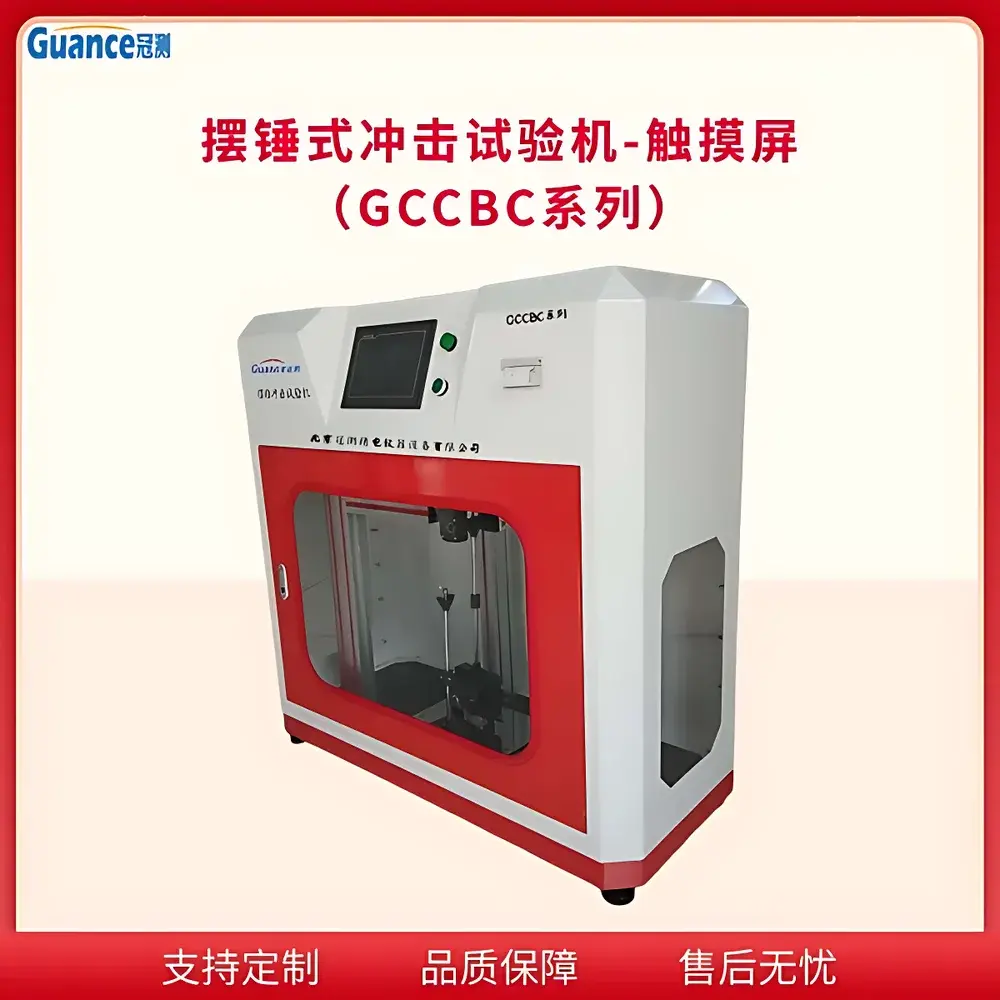
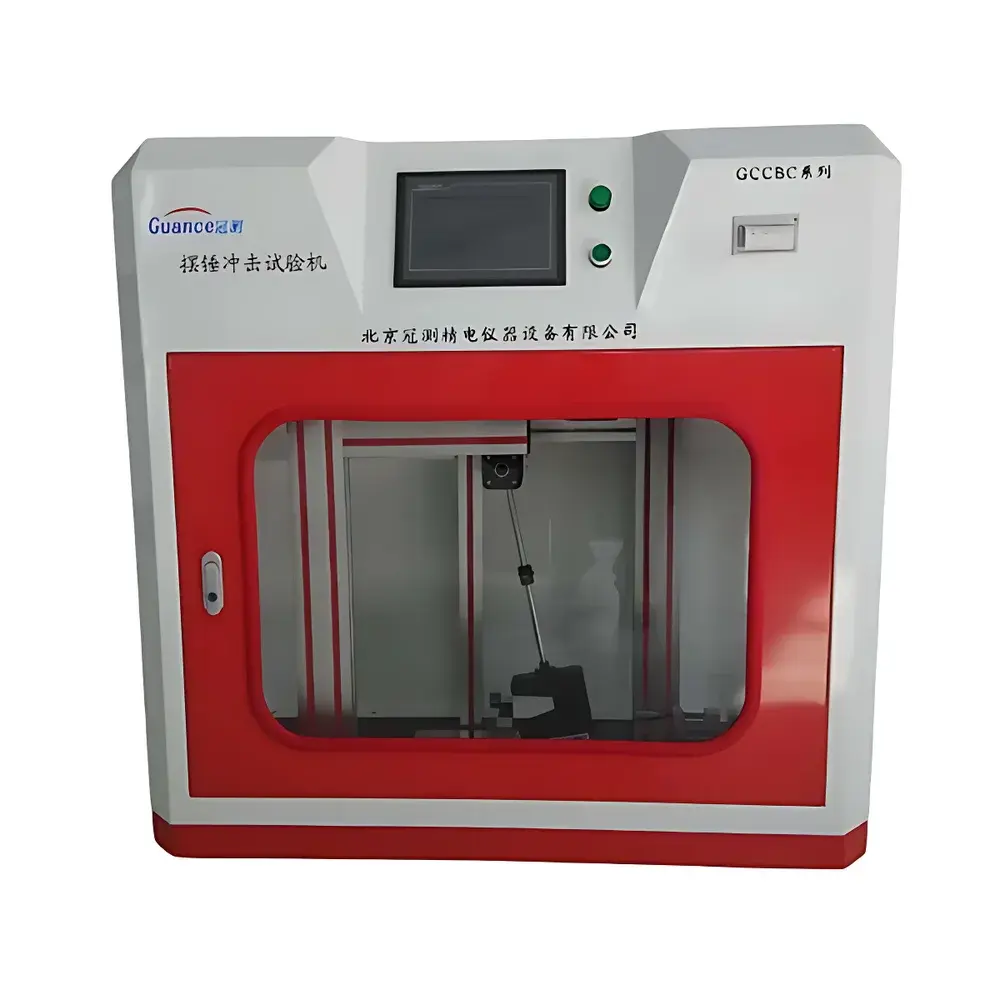
GuanCe Instruments GCCBC Series Touchscreen Pendulum Impact Tester
| Brand | GuanCe Instruments |
|---|---|
| Origin | Beijing, China |
| Manufacturer Type | Authorized Distributor |
| Country of Origin | China |
| Model | GCCBC Series |
| Instrument Type | Pendulum Impact Tester |
| Impact Energy Options | 0.5 J / 1 J / 2 J / 4 J / 7.5 J / 15 J / 25 J / 50 J (simply supported beam) |
| Impact Velocity | ≤4 J: 2.9 m/s |
| ≥7.5 J | 3.8 m/s (simply supported) |
| Pendulum Moment (Impact Constant) | 18 N·m/rad |
| Load Cell Range | 1–20 kN |
| Maximum Lifting Height | 1550 mm |
| Support Span | 230 mm (simply supported), 335 mm (cantilever) |
| Specimen Dimensions (simply supported) | Length: 40–95 mm |
| Width | 4–15 mm |
| Thickness | 3–10 mm |
| Specimen Dimensions (cantilever) | Length: 63.5±2 mm or 80±2 mm |
| Width | 12.7±0.2 mm or 10±0.2 mm (max 50 mm) |
| Thickness | 3.2–40 mm |
| Anvil Radius | R = 1 mm (simply supported), R = 0.8 mm (cantilever) |
| Striking Edge Angle | 30° |
| Striking Edge Radius | R = 2 mm |
| Power Supply | 220 V AC, 200 W |
| Release Mechanism | Electromechanical (motor-driven) |
Overview
The GuanCe Instruments GCCBC Series Touchscreen Pendulum Impact Tester is a precision-engineered mechanical testing system designed for standardized determination of impact resistance and toughness in non-metallic materials—including thermoplastics, thermosets, elastomers, fiber-reinforced composites, PVC and PE pipe materials, and electrical insulating polymers. Operating on the principle of gravitational potential energy conversion, the instrument utilizes a calibrated pendulum with interchangeable hammers to deliver controlled impact energy onto standardized specimens. The system conforms rigorously to international test methodologies based on Charpy (simply supported beam) and Izod (cantilever beam) configurations, enabling direct compliance with ASTM D256, ISO 179, ISO 180, ISO 9854-1, GB/T 1043, GB/T 1843, GB/T 18743, JB/T 8761, and JB/T 8762. Its modular hammer design supports eight discrete energy levels (0.5–50 J) for simply supported beam testing and five levels (1–22 J) for cantilever testing—ensuring adaptability across material classes ranging from thin films to structural composites.
Key Features
- Industrial-grade 7-inch capacitive touchscreen interface with intuitive HMI navigation, eliminating physical buttons and reducing operator training time.
- Siemens S7-1200 PLC-based control architecture integrated with high-resolution optical rotary encoder for precise angular position feedback during pendulum lift and release—ensuring repeatability of ±0.1° in pre-lift angle (150° standard).
- Electromechanical hammer release mechanism providing deterministic, jitter-free activation synchronized with data acquisition—eliminating pneumatic variability and enhancing measurement reproducibility.
- Automatic friction loss compensation algorithm: system performs real-time calibration upon installation of new hammer assemblies by measuring baseline energy dissipation during no-load swings, then applies dynamic correction to all subsequent impact calculations.
- Dual-beam configuration support: seamlessly switch between simply supported (Charpy-type) and cantilever (Izod-type) test modes via software-selectable fixture geometry and parameter presets.
- Integrated load cell (1–20 kN range) enables simultaneous force-time waveform capture for advanced fracture analysis beyond standard energy absorption reporting.
Sample Compatibility & Compliance
The GCCBC Series accommodates a broad spectrum of standardized specimen geometries per regulatory requirements. For simply supported beam tests (GB/T 1043, ISO 179, ASTM D6110), it accepts specimens 40–95 mm in length, 4–15 mm wide, and 3–10 mm thick—with anvil radius R = 1 mm and striking edge radius R = 2 mm at 30° included angle. Cantilever mode (GB/T 1843, ISO 180, ASTM D256) supports 63.5 ± 2 mm or 80 ± 2 mm lengths, widths of 12.7 ± 0.2 mm or 10 ± 0.2 mm (up to 50 mm max), and thicknesses from 3.2 mm to 40 mm—using an R = 0.8 mm anvil radius. All configurations maintain strict adherence to dimensional tolerances defined in ISO/IEC 17025-accredited test laboratories. The system’s mechanical design meets CE machinery directive (2006/42/EC) safety requirements, including guarded swing zone, emergency stop circuitry, and interlocked access doors compliant with EN ISO 13857.
Software & Data Management
Control and analysis are executed via GuanCe’s proprietary Windows-based software suite, compatible with Windows 10/11 (64-bit). The application provides full audit trail functionality—including user login timestamps, parameter change logs, calibration event records, and raw sensor data export in CSV and XML formats. All test results comply with GLP and GMP documentation standards, supporting 21 CFR Part 11 readiness through electronic signature capability, role-based access control, and immutable result archiving. Data output includes impact energy (J), absorbed energy (J), notched/unnotched impact strength (kJ/m²), and optional force-time curves. Exported datasets integrate natively with LIMS platforms via ODBC drivers and support automated report generation in PDF with embedded digital signatures and laboratory accreditation seals.
Applications
- Quality control of injection-molded plastic components in automotive and consumer electronics supply chains.
- R&D evaluation of polymer blend formulations and nanocomposite toughening mechanisms.
- Certification testing of pressure-rated thermoplastic piping systems (e.g., PP-R, PE-RT) per ISO 9854-1 and GB/T 18743.
- Failure analysis of brittle fracture initiation in epoxy matrix composites used in aerospace secondary structures.
- Regulatory submission support for medical device polymer housings under ISO 10993-1 biocompatibility frameworks.
- Educational use in university materials science labs for hands-on instruction in fracture mechanics and standardized test methodology.
FAQ
What standards does the GCCBC Series fully support?
It complies with ASTM D256 (Izod), ISO 179 (Charpy unnotched), ISO 180 (Izod), ISO 9854-1 (plastic pipes), GB/T 1043, GB/T 1843, GB/T 18743, JB/T 8761, and JB/T 8762.
Can the system be validated for ISO/IEC 17025 accreditation?
Yes—its traceable calibration procedures, documented uncertainty budgets, and full audit trail functionality meet ILAC P14 and ISO/IEC 17025:2017 requirements for mechanical testing laboratories.
Is third-party calibration certification available?
GuanCe Instruments provides factory calibration certificates traceable to NIM (National Institute of Metrology, China) and offers optional UKAS-accredited calibration services through authorized partners.
Does the software support multi-user environments with permission tiers?
Yes—administrator, technician, and viewer roles are configurable with password protection, session logging, and granular access controls for method editing, calibration, and result approval.
What maintenance intervals are recommended for long-term accuracy?
Optical encoder verification every 6 months; load cell recalibration annually; full mechanical inspection (bearing play, anvil wear, pivot friction) every 2 years—or after 10,000 impacts—per manufacturer’s service manual.



