
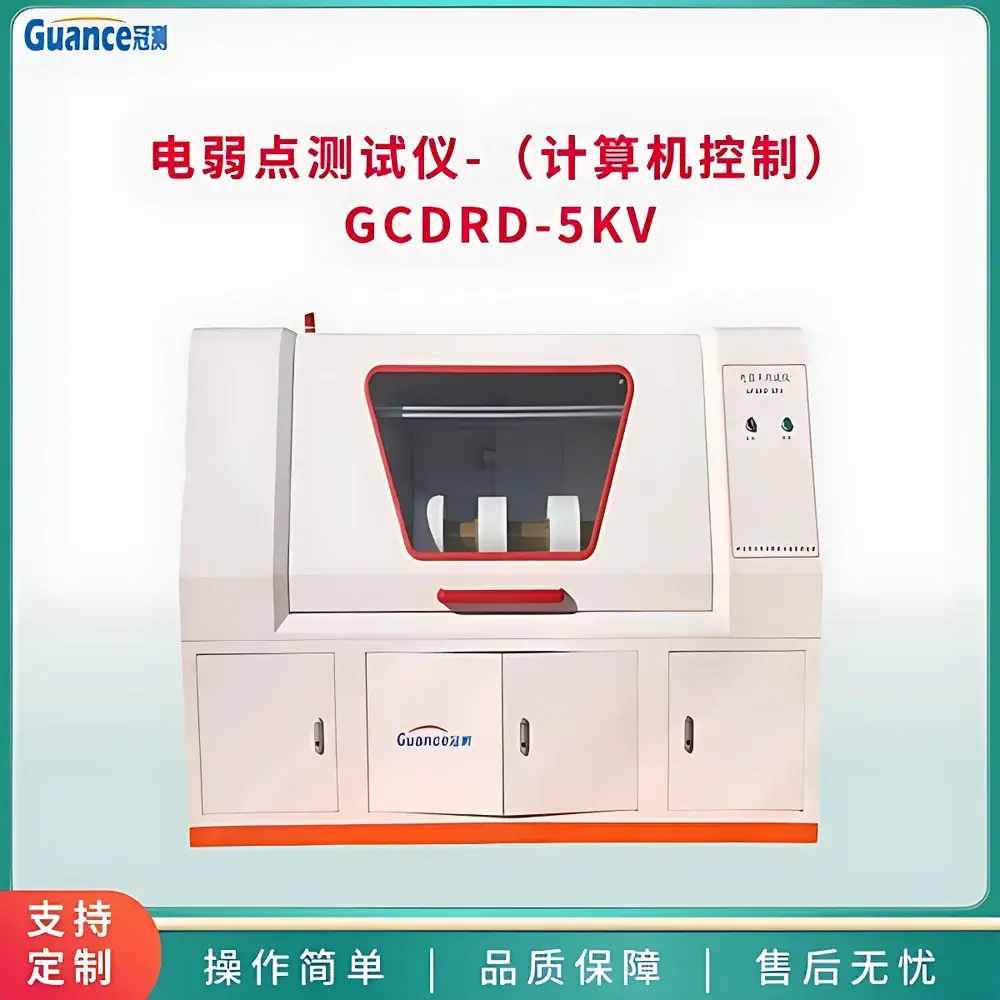
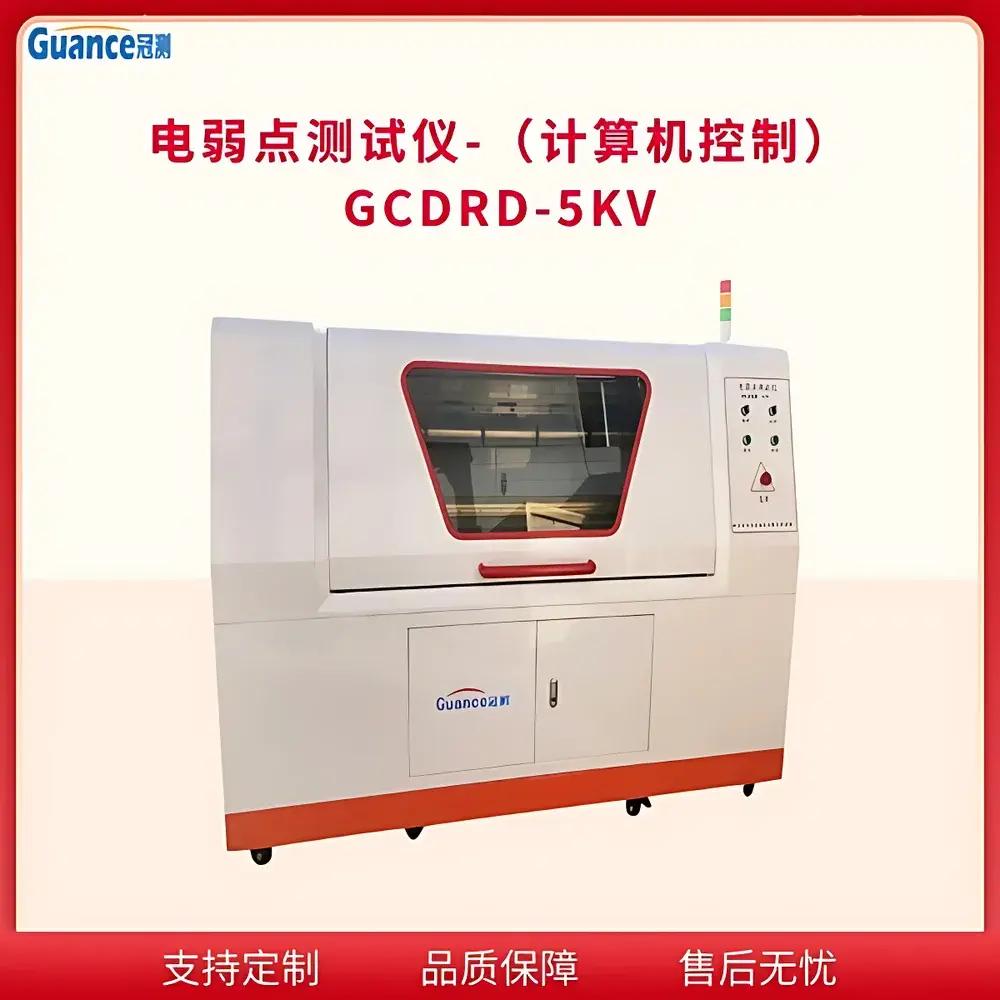
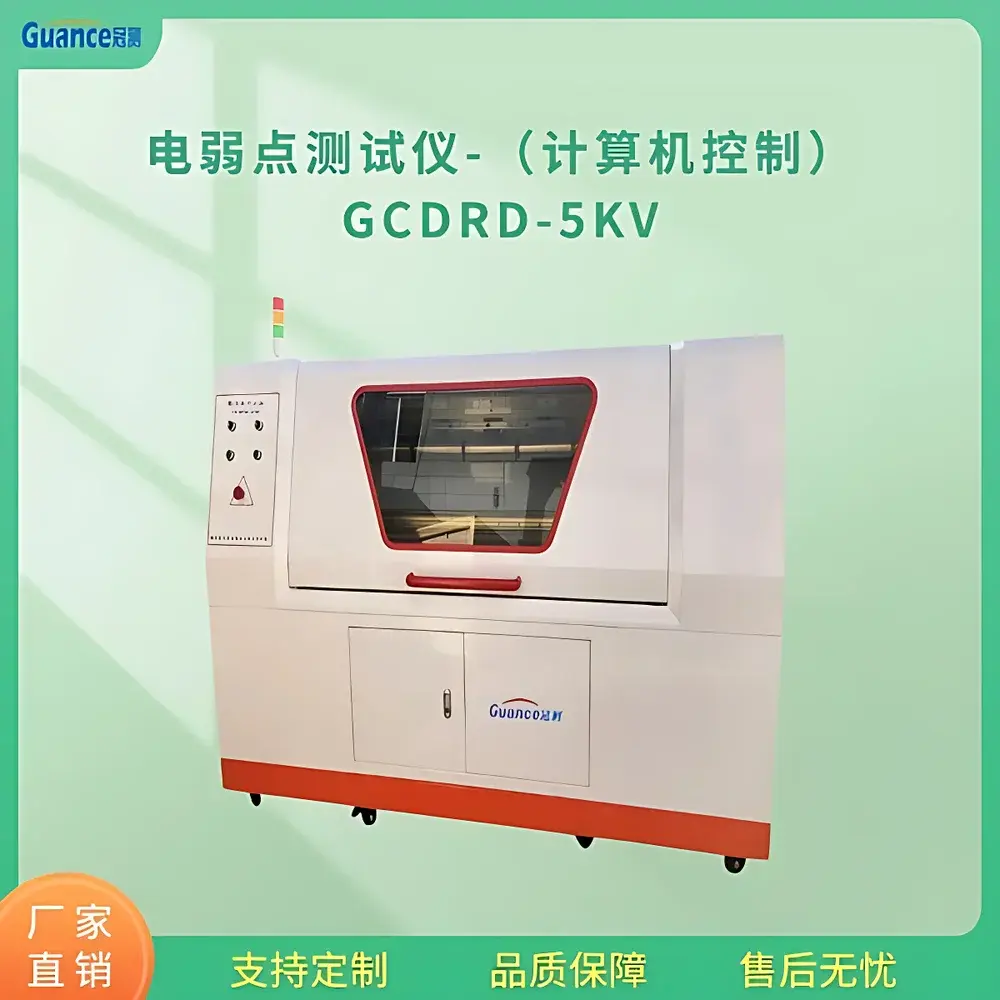
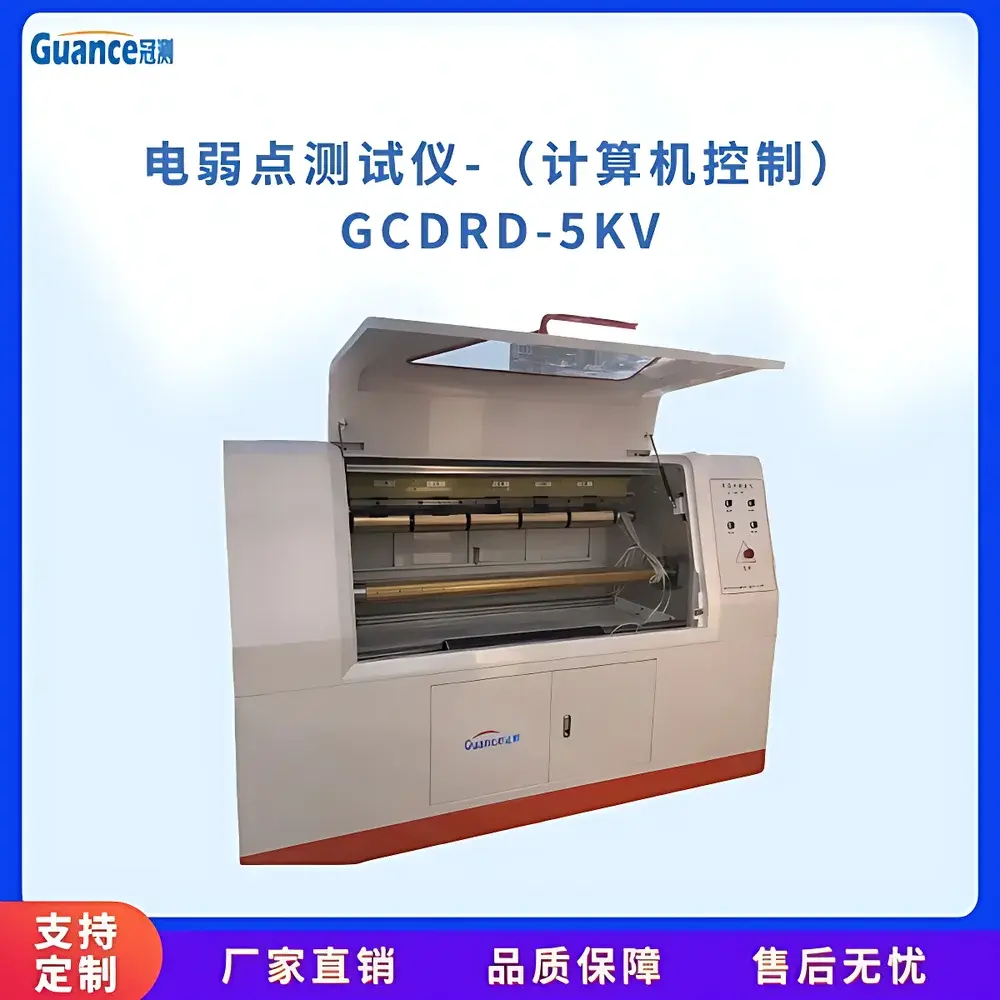
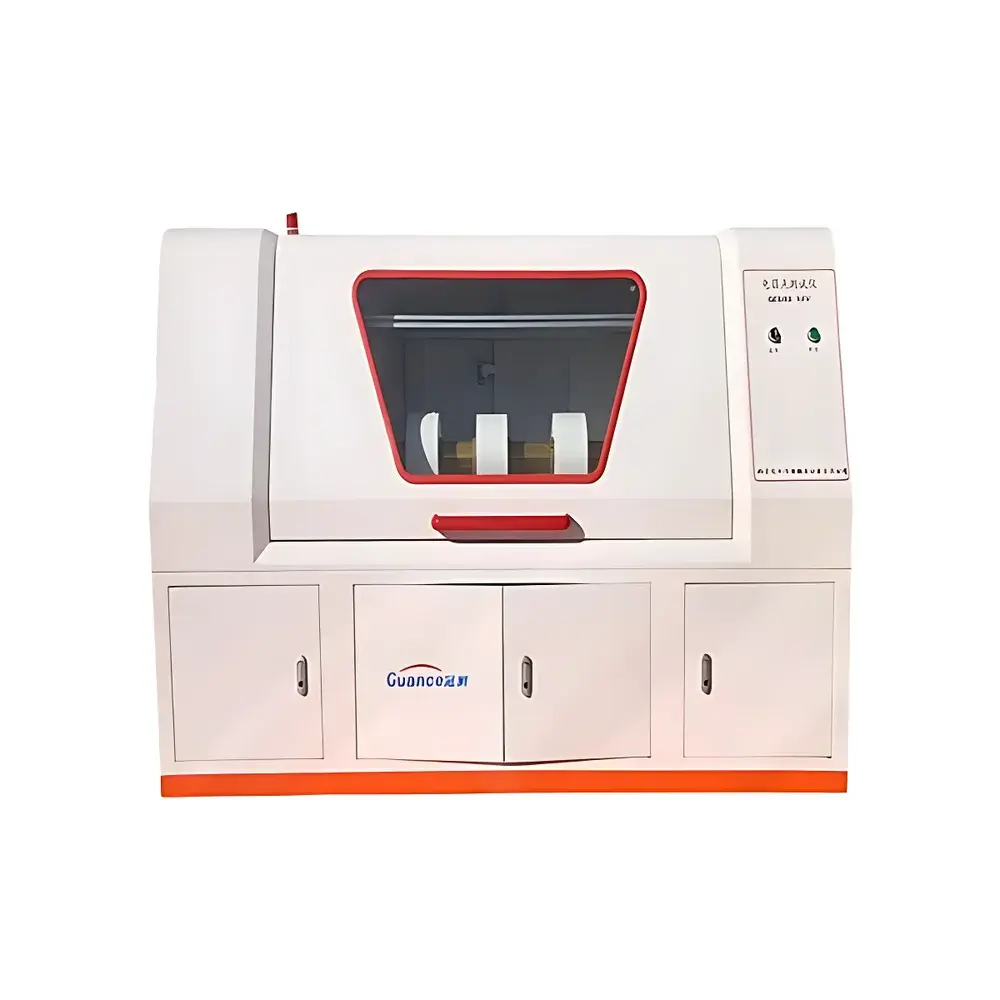
GuanCe GCDRD-5KV Computer-Controlled Electrical Weak Point Tester
| Brand | GuanCe Instruments |
|---|---|
| Origin | Beijing, China |
| Manufacturer Type | Authorized Distributor |
| Country of Origin | China |
| Model | GCDRD-5KV |
| Voltage Range | 0–5 kV DC |
| Compliance | GB/T 13542.2–2009, IEC 60674-2:1988 |
| Application | Electrical Weak Point Detection in Polymer Insulating Films |
| Control System | PC-based Closed-loop Voltage Ramp & Real-time Data Acquisition |
| Sample Handling | Motorized Unwind/Re-wind with Adjustable Linear Speed |
| Output Metrics | Weak Point Count per m², Weak Line Count, Automatic Zero Return & Statistical Summary |
Overview
The GuanCe GCDRD-5KV Computer-Controlled Electrical Weak Point Tester is a dedicated high-voltage diagnostic instrument engineered for quantitative assessment of localized dielectric weaknesses in thin polymer insulating films. It operates on the principle of controlled DC voltage ramping—applying a precisely regulated, continuously increasing direct current voltage across a moving film sample until electrical breakdown occurs at defect sites. Each breakdown event corresponds to an “electrical weak point” (EWP), defined as a localized region of reduced dielectric strength caused by impurities, thickness variation, pinholes, or microstructural inhomogeneities. The system conforms strictly to GB/T 13542.2–2009 and IEC 60674-2:1988, which specify test methodologies for electrical insulation films used in capacitors, transformers, and flexible printed circuits. Designed for routine quality assurance in film production lines and R&D laboratories, the GCDRD-5KV delivers traceable, repeatable quantification of defect density—expressed as weak points per square meter (WP/m²)—enabling statistical process control and material qualification against industry-defined acceptance thresholds.
Key Features
- Full-range DC voltage output from 0 to 5 kV with programmable ramp rate (V/s), ensuring compliance with standardized stress profiles specified in IEC 60674-2.
- Motorized film transport system with adjustable linear velocity (0.1–2.0 m/min), enabling consistent electrode contact and uniform field distribution across variable-width samples (up to 300 mm).
- Integrated analog front-end circuitry featuring high-impedance current sensing (resolution ≤10 nA) and synchronized voltage sampling (10 kHz acquisition rate) for precise breakdown event detection and timestamping.
- Real-time data streaming to Windows-based control software via isolated USB 2.0 interface, supporting simultaneous display of voltage, leakage current, and instantaneous breakdown localization.
- Automated post-test sequence including hardware-initiated voltage discharge, mechanical return-to-zero positioning of unwind/re-wind spindles, and generation of ISO/IEC 17025-aligned test reports with digital signature fields.
- Modular mechanical architecture with floor-standing configuration, tool-free film loading mechanism, and interchangeable electrode assemblies for ASTM D876/D149-compliant parallel-plate or cylindrical electrode configurations.
Sample Compatibility & Compliance
The GCDRD-5KV accommodates continuous roll-fed specimens of thermoplastic and thermoset insulating films—including polypropylene (PP), polyester (PET), polyimide (PI), and polyurethane (PU)—with nominal thicknesses ranging from 6 µm to 250 µm. Film width is configurable up to 300 mm; minimum sample length is 5 m for statistically robust defect mapping. All electrical safety subsystems meet IEC 61010-1:2010 requirements for measurement category CAT II 600 V, with double-insulated high-voltage cabling and interlocked enclosure doors. Test methodology and reporting structure support audit readiness for GLP environments and are compatible with FDA 21 CFR Part 11 requirements when deployed with validated software version 2.3.1 or later (including electronic audit trail, user access levels, and data integrity safeguards).
Software & Data Management
The proprietary GCDRD Control Suite (v3.2) provides full instrument orchestration through a deterministic real-time kernel. Users define test protocols—including target voltage, ramp slope, dwell time, maximum allowable leakage current threshold, and pass/fail criteria—via intuitive parameter templates. During operation, the software logs raw voltage/current waveforms at 10 kHz, tags each breakdown event with spatial coordinates (derived from encoder-based film position tracking), and classifies events as isolated weak points or extended weak lines based on temporal proximity and current magnitude. Post-run analysis includes Weibull distribution fitting for breakdown voltage statistics, spatial clustering analysis (using DBSCAN algorithm), and export of structured CSV/Excel datasets compliant with LIMS integration standards (ASTM E1482, ISO/IEC 17025 Annex A.3). All data files include embedded metadata: operator ID, calibration certificate ID, environmental conditions (recorded via optional external sensor input), and cryptographic hash for tamper-evident archiving.
Applications
- Quality control of capacitor-grade metallized PP and PET films during extrusion and metallization processes.
- Root cause analysis of premature dielectric failure in flexible printed circuit substrates.
- Comparative evaluation of surface treatment efficacy (e.g., corona, plasma) on film dielectric homogeneity.
- Validation of coating uniformity for nanocomposite insulating layers containing conductive fillers.
- Supporting technical documentation for UL 60674-2 certification submissions and customer-facing material datasheets.
- Academic research into space charge accumulation dynamics under DC stress in polymer nanodielectrics.
FAQ
What standards does the GCDRD-5KV comply with?
It fully implements GB/T 13542.2–2009 and IEC 60674-2:1988 for electrical insulating films, and its electrical safety design meets IEC 61010-1:2010.
Can the system test non-continuous sheet samples?
Yes—by disabling the motorized transport and using static electrode fixtures, it supports discrete sheet testing per ASTM D149 (dielectric breakdown voltage) with manual positioning.
Is calibration traceable to national metrology institutes?
All high-voltage and current measurement channels are calibrated annually using NIST-traceable reference standards (Fluke 9500B + Keysight B2987A), with certificates issued per ISO/IEC 17025.
Does the software support multi-user role-based access control?
Yes—administrator, technician, and reviewer roles are enforced with password protection, session logging, and granular permissions for method editing, result approval, and report export.
What maintenance intervals are recommended?
High-voltage transformer oil inspection every 12 months; electrode cleaning after every 50 test hours; full system verification against reference film standards every 6 months.
Related Products







