
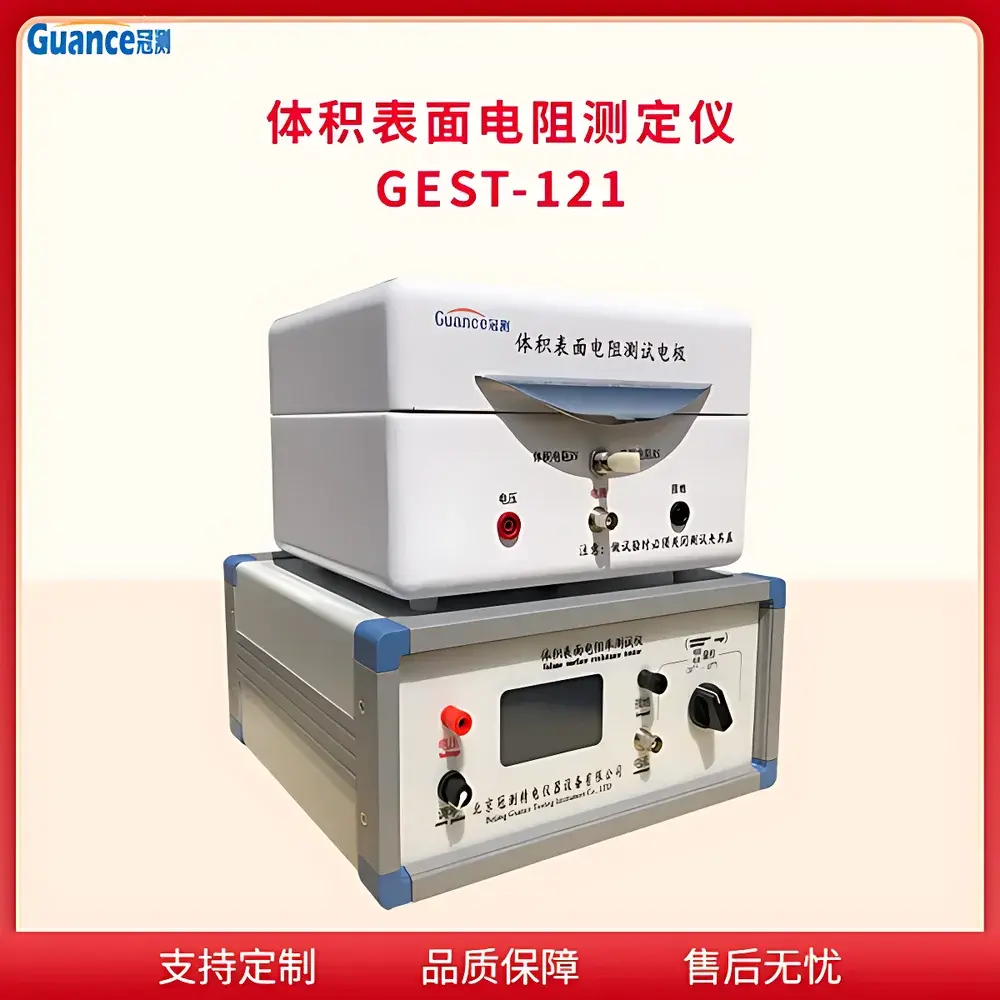
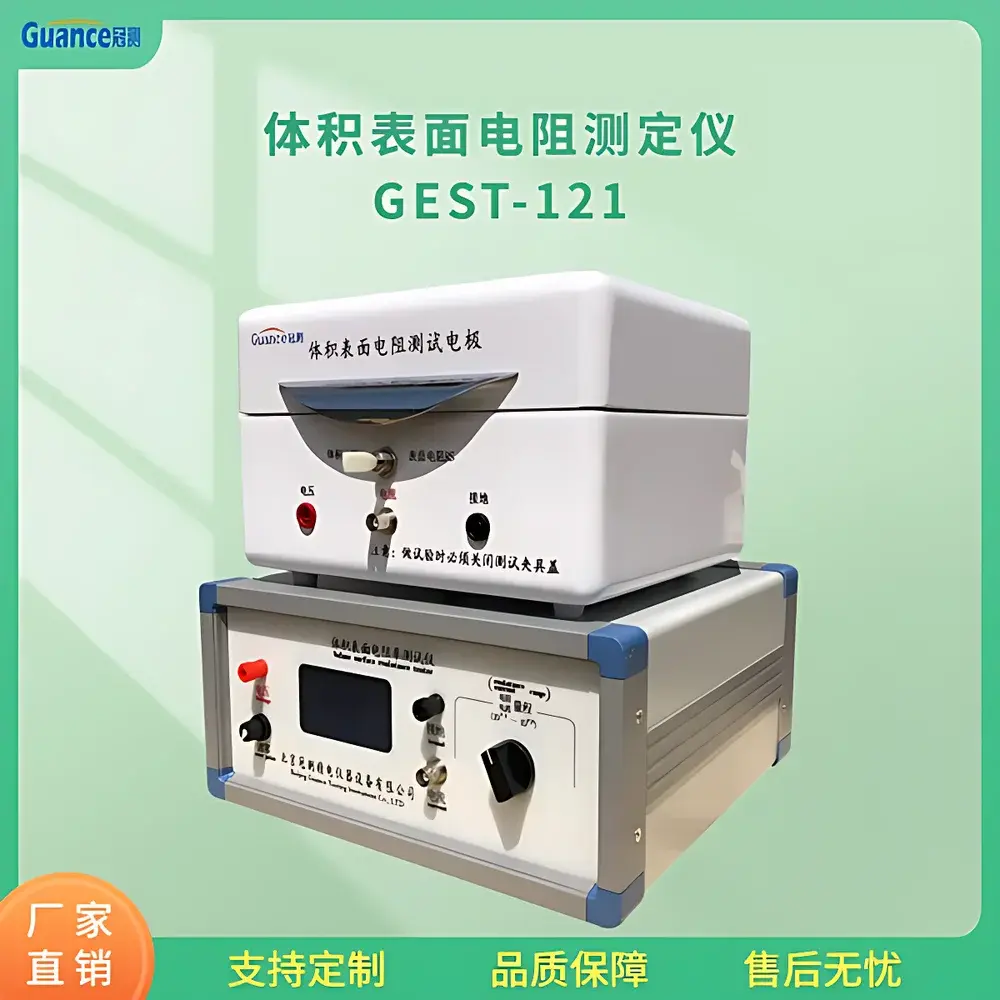
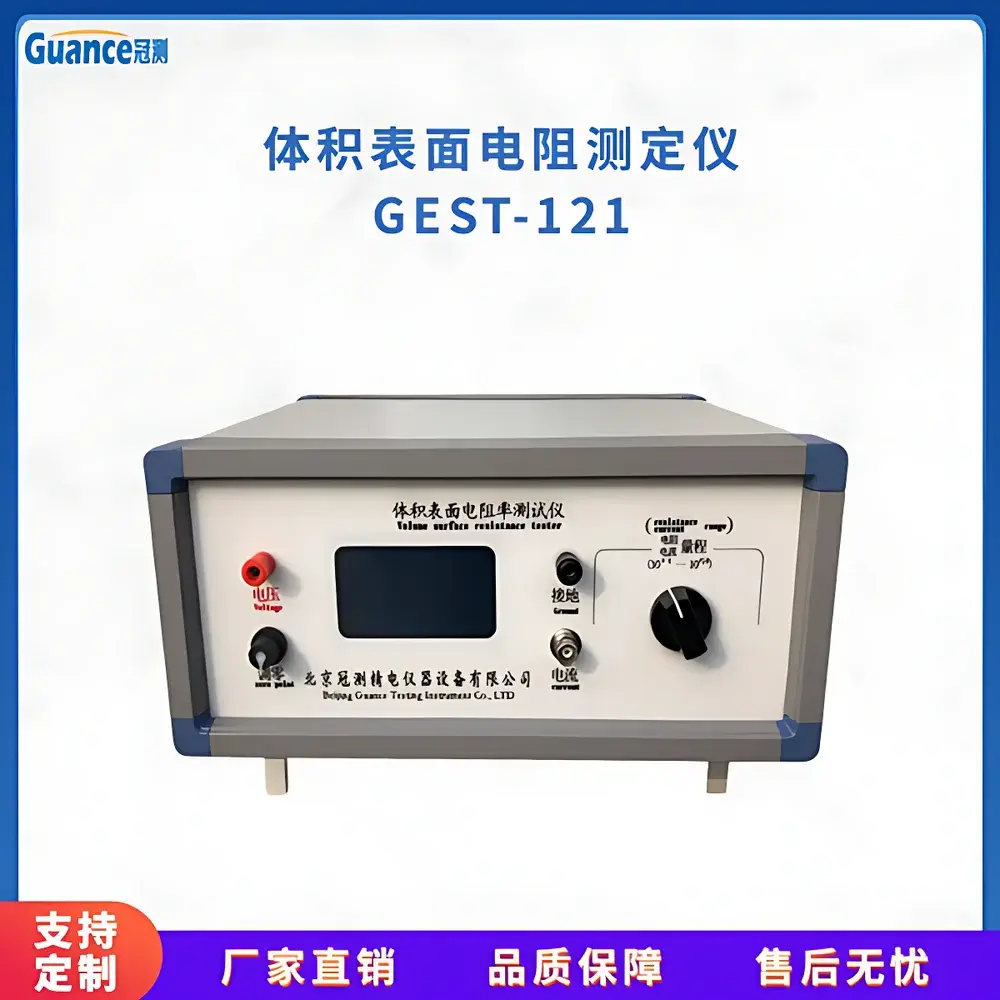
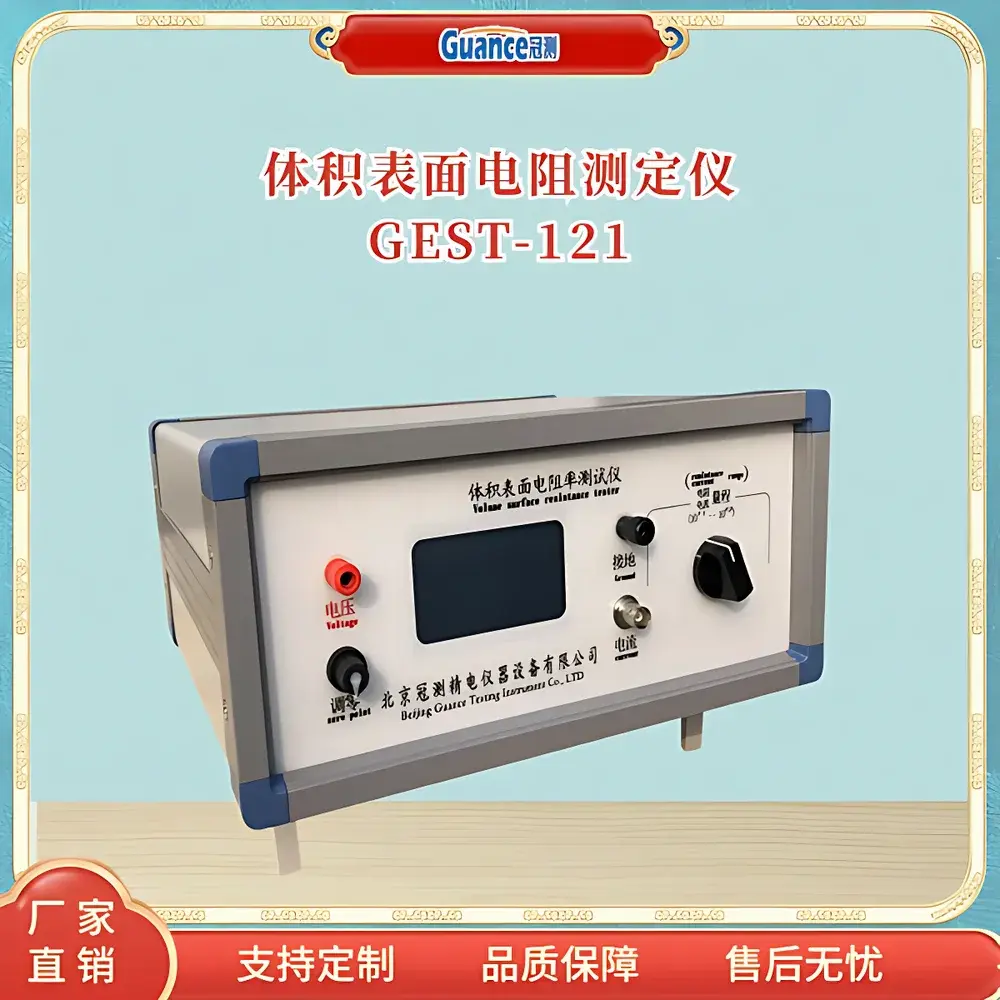
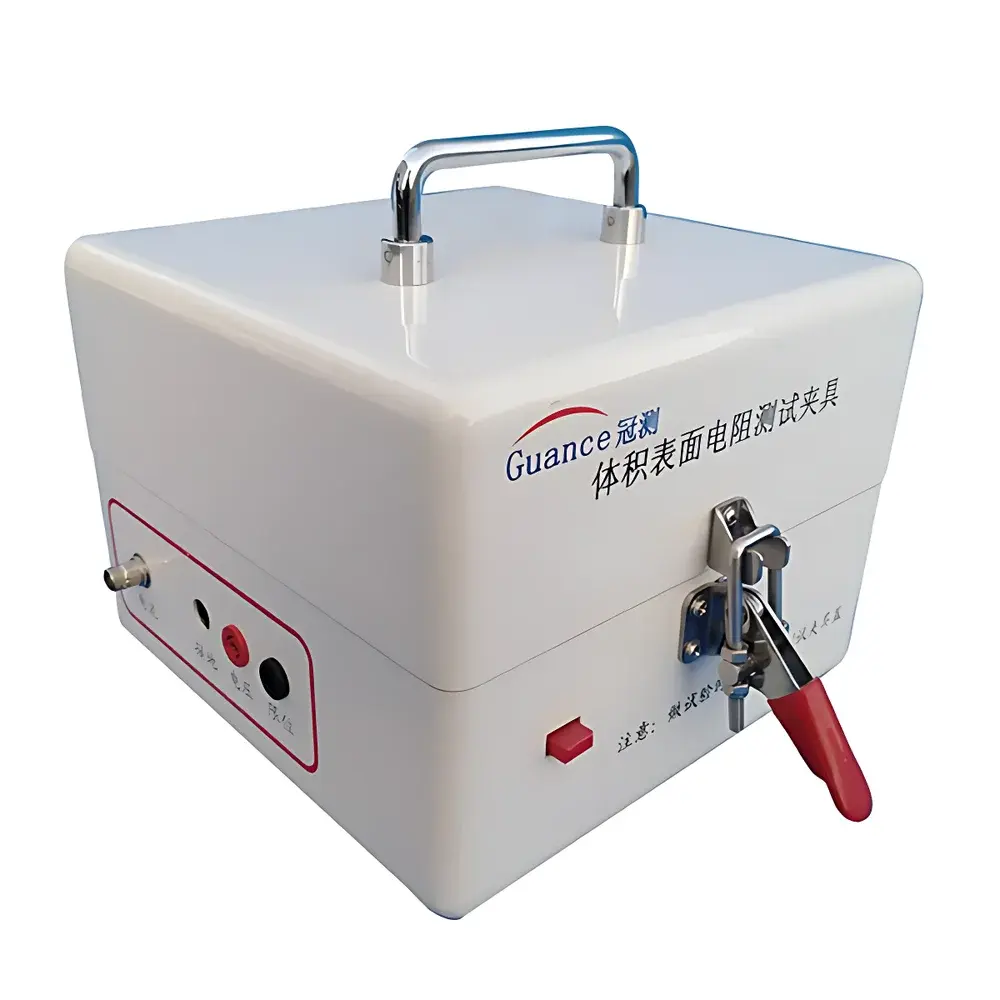
GuanCe GEST-121 Volume & Surface Resistivity Tester
| Brand | GuanCe Instruments |
|---|---|
| Origin | Beijing, China |
| Manufacturer Type | Authorized Distributor |
| Country of Origin | China |
| Model | GEST-121 |
| Price | USD 700 (FOB) |
| Resistance Range | 1×10⁴ Ω to 1×10¹⁸ Ω |
| Current Range | 1×10⁻¹⁶ A to 2×10⁻⁴ A |
| Test Voltages | 10 V, 50 V, 100 V, 250 V, 500 V, 1000 V |
| Accuracy | ±1% (≤1×10¹⁰ Ω), ±5–10% (≥1×10¹⁰ Ω) |
| Display | Digital LCD |
| Power Supply | 220 V AC / 50 Hz |
| Power Consumption | 100 W |
| Dimensions (L×W×H) | 300 mm × 300 mm × 150 mm |
| Weight | ~5 kg |
| Standard Electrode | Three-terminal solid electrode set (for discs/films ≥80 mm diameter) |
Overview
The GuanCe GEST-121 Volume & Surface Resistivity Tester is a precision electrometric instrument engineered for high-impedance DC resistance measurement in insulating and electrostatic-dissipative materials. It operates on the principle of constant-voltage DC bias application across a defined electrode geometry, enabling simultaneous determination of volume resistivity (ρᵥ, in Ω·cm) and surface resistivity (ρₛ, in Ω/sq) per ASTM D257, IEC 60093, and GB/T 1410. The instrument employs guarded current measurement architecture with low-noise electrometer circuitry to minimize leakage errors and ensure stable readings up to 1×10¹⁸ Ω — a critical capability for evaluating ultra-high-resistivity polymers, ceramic substrates, optical coatings, and cleanroom-grade static-control materials. Its modular electrode interface supports standardized configurations required for compliance-driven testing environments, including those governed by ISO/IEC 17025-accredited laboratories.
Key Features
- Wide resistance measurement range: 1×10⁴ Ω to 1×10¹⁸ Ω, covering insulators, antistatic composites, and conductive polymers
- Programmable test voltages: six discrete DC output levels (10 V, 50 V, 100 V, 250 V, 500 V, 1000 V) selectable via front-panel interface
- High-sensitivity current detection: resolution down to 1×10⁻¹⁶ A with auto-ranging feedback stabilization
- Digital LCD display with real-time resistance value, applied voltage, and measurement status indicators
- Integrated three-terminal solid electrode system compliant with ASTM D257 geometry requirements for disc- and film-form samples ≥80 mm in diameter
- Modular electrode expansion capability: supports optional liquid cells, powder holders, concentric ring electrodes, and footwear test fixtures
- Stable thermal design with low-power (100 W) operation and passive heat dissipation for continuous lab use
Sample Compatibility & Compliance
The GEST-121 accommodates diverse physical forms of dielectric and dissipative materials without modification to core electronics. Solid specimens include rigid plastics, elastomeric sheets, laminated films, and sintered ceramics; powders are evaluated using compression-type electrodes with controlled compaction pressure; liquids and gels require guarded liquid-cell configurations to suppress edge leakage. All measurements adhere to internationally recognized test standards: volume resistivity per ASTM D257 Section 11 (using guarded electrode assembly), surface resistivity per ASTM D257 Section 12 (concentric ring method), and flooring/shoe resistance per ANSI/ESD S7.1 and EN 61340-4-1. The instrument’s traceable calibration protocol aligns with ISO/IEC 17025 requirements for uncertainty reporting and metrological validity. While not FDA 21 CFR Part 11–certified out-of-box, its manual data recording workflow supports GLP-compliant documentation when integrated into validated laboratory SOPs.
Software & Data Management
The GEST-121 operates as a standalone benchtop instrument with no embedded firmware-based data logging or PC connectivity. All measurements are displayed and held on the LCD screen for manual transcription into laboratory notebooks or LIMS-compatible spreadsheets. For regulated environments requiring audit trails, users may integrate external digital multimeters (e.g., Keysight B2987A) or electrometers with IEEE-488/GPIB interfaces using custom LabVIEW or Python scripts. Optional third-party software packages—such as WinQbase or QDA LabSuite—support automated parameter sequencing, statistical analysis (mean, SD, CV%), and report generation aligned with ISO 10012 and ISO/IEC 17025 clause 7.7. Raw data export is facilitated via RS-232 or USB-to-serial adapters (not included), enabling direct import into Excel, MATLAB, or Minitab for regression modeling of resistivity vs. humidity/temperature variables.
Applications
- Quality control of polymer insulation layers in aerospace wiring harnesses and medical device encapsulants
- Development of ESD-safe packaging films and semiconductor wafer carriers per JEDEC J-STD-033
- Validation of antistatic floor systems in pharmaceutical cleanrooms (ISO Class 5–8) per ISO 14644-1
- Resistivity mapping of thin-film photovoltaic substrates during R&D process optimization
- Characterization of conductive filler dispersion homogeneity in carbon-black–loaded TPEs
- Baseline testing of reference materials for national metrology institutes (NMIs) and calibration labs
- Failure analysis of field-aged cable insulation exhibiting tracking or dendritic growth
FAQ
What standards does the GEST-121 support for volume and surface resistivity testing?
ASTM D257, IEC 60093, GB/T 1410, and ISO 3915 — all implemented via standardized electrode configurations and voltage selection.
Can the instrument measure resistivity of liquid electrolytes or colloidal suspensions?
Yes, when used with an optional guarded liquid-cell electrode assembly that maintains defined electrode spacing and minimizes polarization effects.
Is calibration traceable to NIST or other national standards bodies?
Calibration certificates issued by authorized GuanCe service centers include uncertainty budgets and traceability statements to CNAS-accredited reference standards; NIST-traceable calibration requires third-party metrology lab engagement.
Does the GEST-121 meet requirements for GLP or GMP-regulated testing?
It supports GLP/GMP workflows through documented operator training, equipment logbooks, and periodic verification against certified resistors (e.g., IET Labs SR1010 series); electronic audit trail functionality requires external data acquisition systems.
What maintenance is required for long-term accuracy stability?
Annual verification of voltage source linearity and current measurement offset using calibrated high-resistance standards; cleaning of electrode contacts with isopropyl alcohol and lint-free wipes after each use.



