
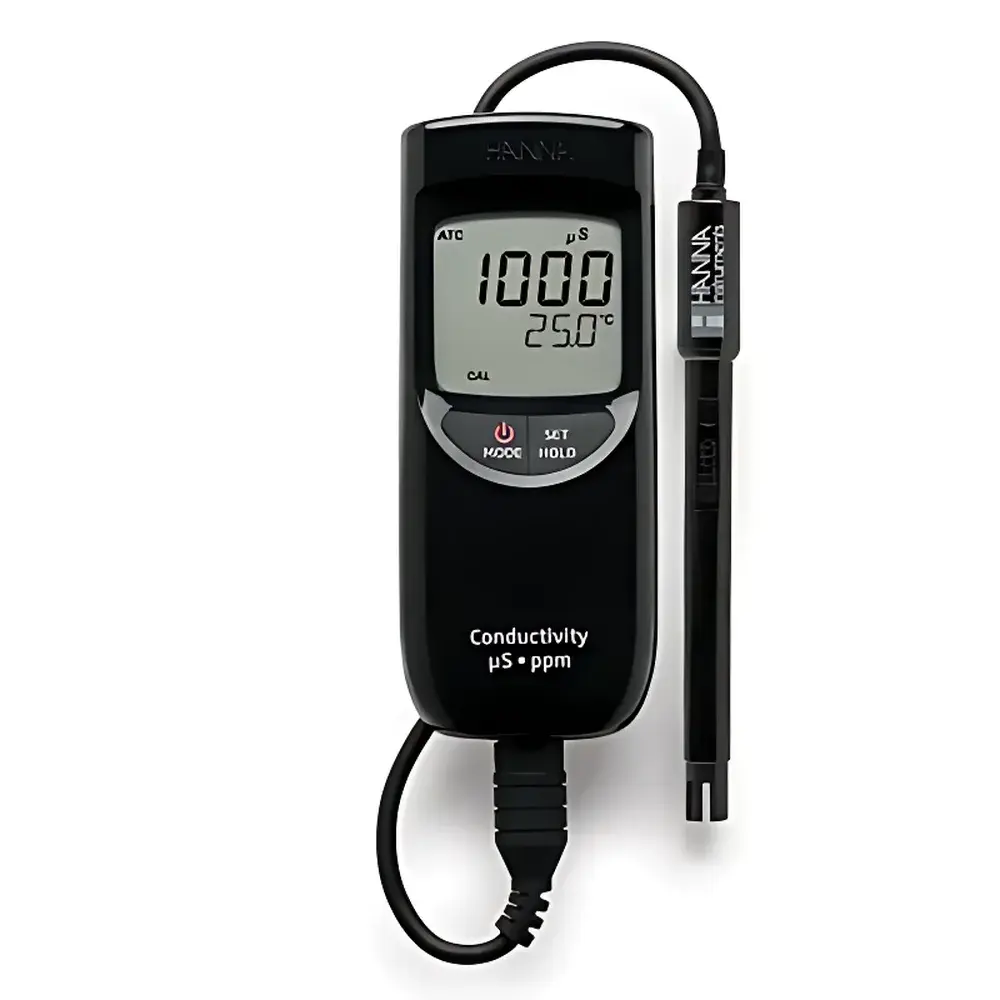
Hanna Instruments HI99300 Portable Low-Range EC/TDS/°C Meter
| Brand | Hanna Instruments |
|---|---|
| Origin | Italy |
| Model | HI99300 Portable Low-Range EC/TDS/°C Meter |
| Instrument Type | Portable |
| Parameter Type | Single-parameter |
| Measurement Range | EC: 0 to 3999 µS/cm |
| TDS | 0 to 2000 ppm (mg/L) |
| Temperature | −5.0 to 105.0 °C |
| Resolution | EC: 1 µS/cm |
| TDS | 1 ppm (mg/L) |
| Temperature | 0.1 °C |
| Accuracy | ±2% of full scale @ 20°C/68°F |
| Calibration | Automatic single-point recognition with built-in standards (EC: 1413 µS/cm |
| TDS | 1382 ppm or 1500 ppm) |
| Temperature Compensation | β coefficient adjustable from 0.0 to 2.4 %/°C (step 0.1) |
| IP Rating | IP67 |
| Power | 3 × 1.5 V AAA batteries |
| Dimensions | 154 × 63 × 30 mm |
| Weight | 196 g |
Overview
The Hanna Instruments HI99300 is a rugged, handheld electrochemical meter engineered for field and laboratory measurement of electrical conductivity (EC), total dissolved solids (TDS), and temperature in aqueous solutions. It operates on the principle of two-electrode conductometric measurement, where conductivity is derived from the solution’s ability to carry current between platinum electrodes housed in a DIN-compatible, integrated probe (HI763063). The instrument applies automatic temperature compensation (ATC) using a built-in NTC thermistor and supports user-selectable β coefficients (0.0–2.4 %/°C) to align with sample-specific thermal response characteristics. TDS values are calculated from EC readings via a programmable linear conversion factor (0.45–1.00), accommodating diverse water matrices—including freshwater, hydroponic nutrient solutions, and low-ionic-strength environmental samples. Designed for trace-level monitoring, the HI99300 delivers high reproducibility in the low-conductivity range (0–3999 µS/cm), making it suitable for applications requiring detection sensitivity below 1 mS/cm without dilution.
Key Features
- Integrated HI763063 probe with embedded temperature sensor and signal amplifier—eliminates external cable noise and ensures stable signal transmission.
- Large dual-line LCD with real-time simultaneous display of EC, TDS, and temperature; intuitive on-screen calibration prompts guide users through single-point standard recognition.
- Stability indicator icon disappears automatically when measurement reaches equilibrium—no subjective judgment required for endpoint determination.
- HOLD function freezes displayed values for documentation under variable lighting or ergonomic constraints.
- DIN-style waterproof connector (IP67-rated) enables rapid, repeatable probe attachment/detachment; rubberized cable jacket resists abrasion, kinking, and moisture ingress.
- Battery Error Prevention System (BEPS™) provides visual low-battery alert (flashing icon at <5% capacity) to prevent data loss during critical measurements.
- Configurable auto-off intervals (8 min, 60 min, or disabled) optimize battery life while maintaining operational flexibility in extended deployments.
Sample Compatibility & Compliance
The HI99300 is validated for use with deionized water, rainwater, irrigation runoff, aquarium systems, nutrient solutions, and low-salinity surface waters. Its measurement architecture complies with fundamental principles outlined in ASTM D1125 (Standard Test Methods for Electrical Conductivity and Resistivity of Water) and ISO 7888 (Water quality — Determination of electrical conductivity). While not certified for GLP/GMP-regulated environments as a standalone system, its calibration traceability—when used with Hanna-certified standards (HI7031, HI7032, HI70442)—supports audit-ready documentation workflows. The instrument’s IP67 rating certifies full dust protection and submersion resistance up to 1 m for 30 minutes, enabling reliable operation in humid greenhouses, outdoor monitoring stations, and industrial wash-down zones.
Software & Data Management
The HI99300 operates as a stand-alone instrument with no onboard data logging or PC connectivity. All calibration and measurement data must be recorded manually or transcribed into external LIMS or spreadsheet platforms. However, its consistent output formatting, stable endpoint detection, and standardized calibration protocols facilitate structured manual entry and reduce transcription error rates. For laboratories requiring electronic records compliant with FDA 21 CFR Part 11, integration with third-party data capture tools (e.g., barcode scanners linked to validated Excel templates or ELN systems) is feasible—provided procedural controls govern calibration verification, operator authentication, and audit trail generation per organizational SOPs.
Applications
- Hydroponics and controlled-environment agriculture: Monitoring nutrient solution EC drift and TDS stability across growth cycles.
- Environmental field surveys: Rapid screening of freshwater streams, wetlands, and stormwater outfalls for baseline salinity assessment.
- Aquaculture facility management: Verifying osmotic suitability of intake water and recirculating systems prior to stocking.
- Education and teaching labs: Demonstrating ionic strength relationships, temperature dependence of conductivity, and TDS conversion theory.
- Quality control in beverage production: Confirming rinse-water purity and low-residue validation post-CIP procedures.
FAQ
What calibration standards are supported for EC and TDS?
The HI99300 supports automatic recognition of three built-in reference points: EC = 1413 µS/cm (HI7031), TDS = 1382 ppm (HI7032, 0.5 conversion factor), and TDS = 1500 ppm (HI70442, 0.7 conversion factor).
Can the TDS conversion factor be adjusted for non-standard solutions?
Yes—the TDS multiplier is fully programmable from 0.45 to 1.00 in 0.1 increments, allowing empirical alignment with solution-specific gravimetric or ion-chromatographic validation data.
Is the HI763063 probe replaceable and serviceable?
Yes—the probe is a modular, field-replaceable component with a standard DIN connector. Hanna offers replacement units and certified recalibration services through authorized service centers.
Does the instrument meet any international waterproofing standards?
It conforms to IP67 per IEC 60529, verified by independent testing for dust-tightness and temporary immersion resistance.
How does temperature compensation work on this meter?
It uses linear β-compensation with user-selectable coefficients (0.0–2.4 %/°C), enabling correction for both natural waters (β ≈ 1.9–2.2 %/°C) and synthetic solutions with atypical thermal behavior.
Related Products





