
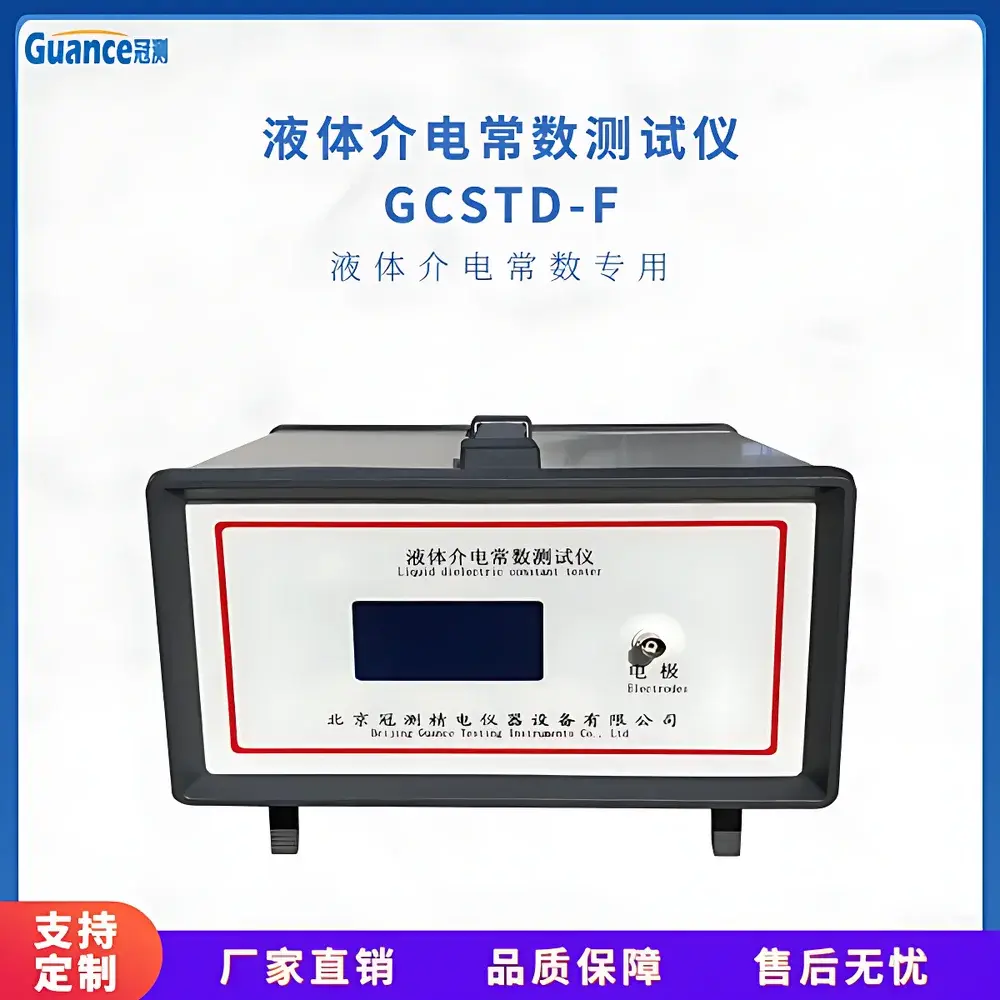
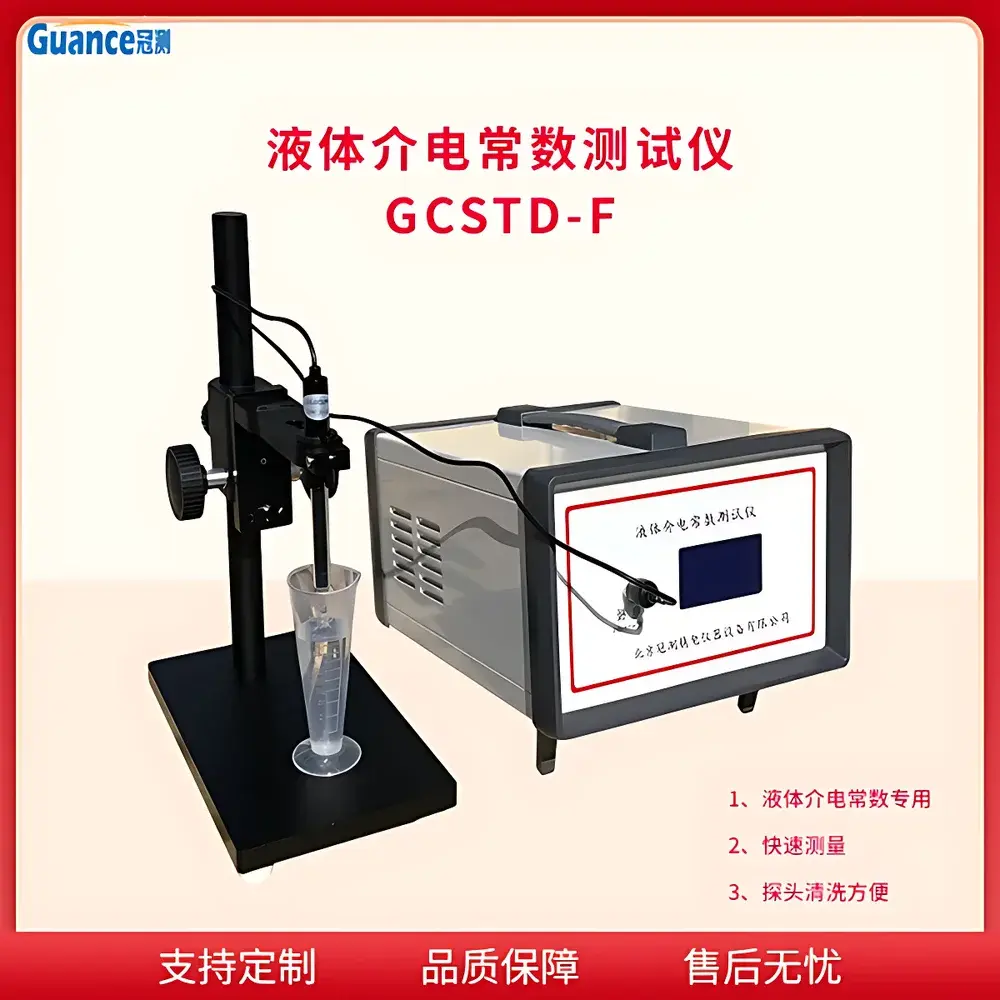
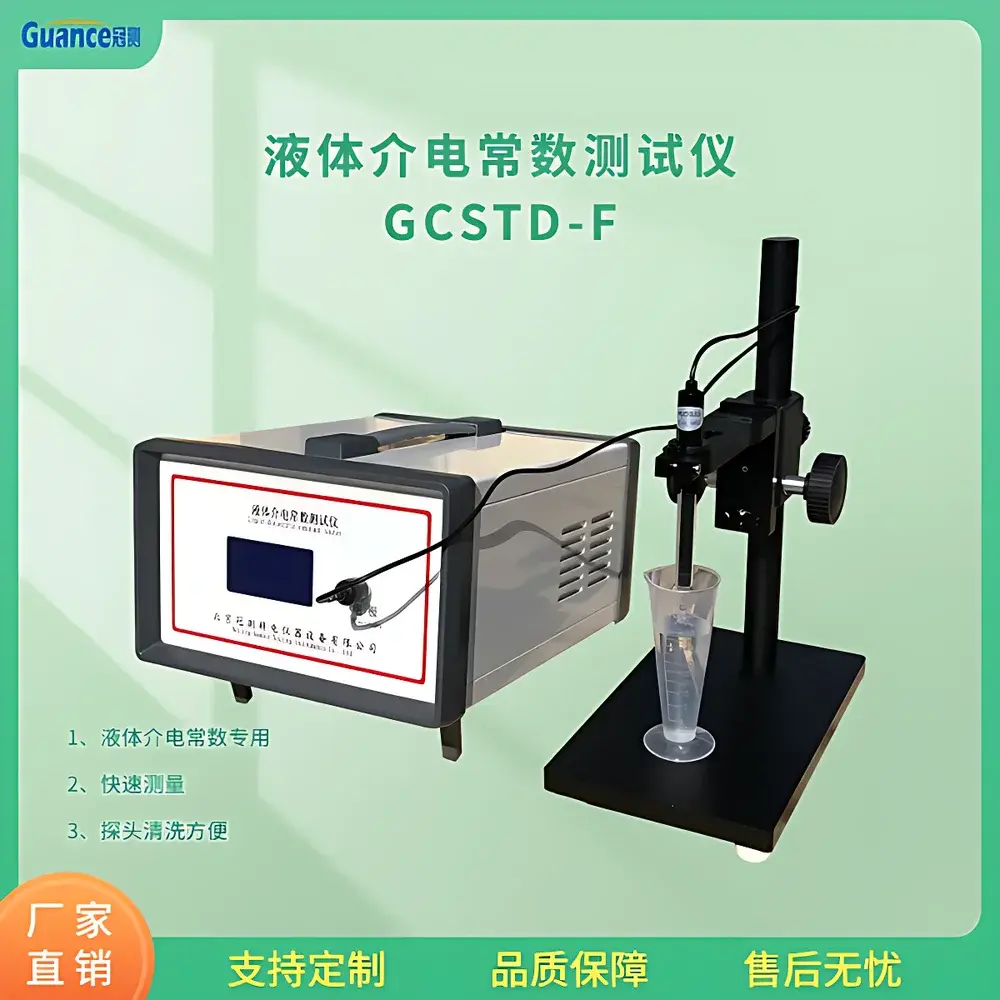
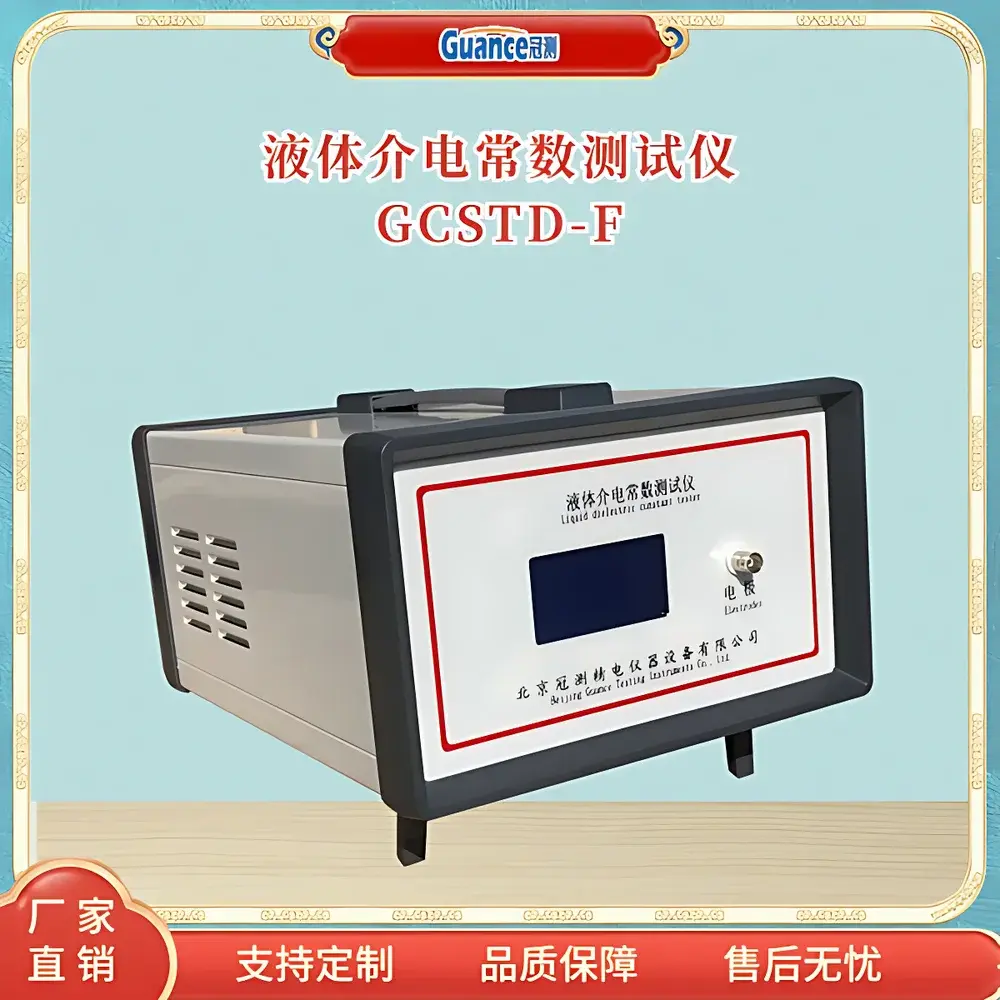
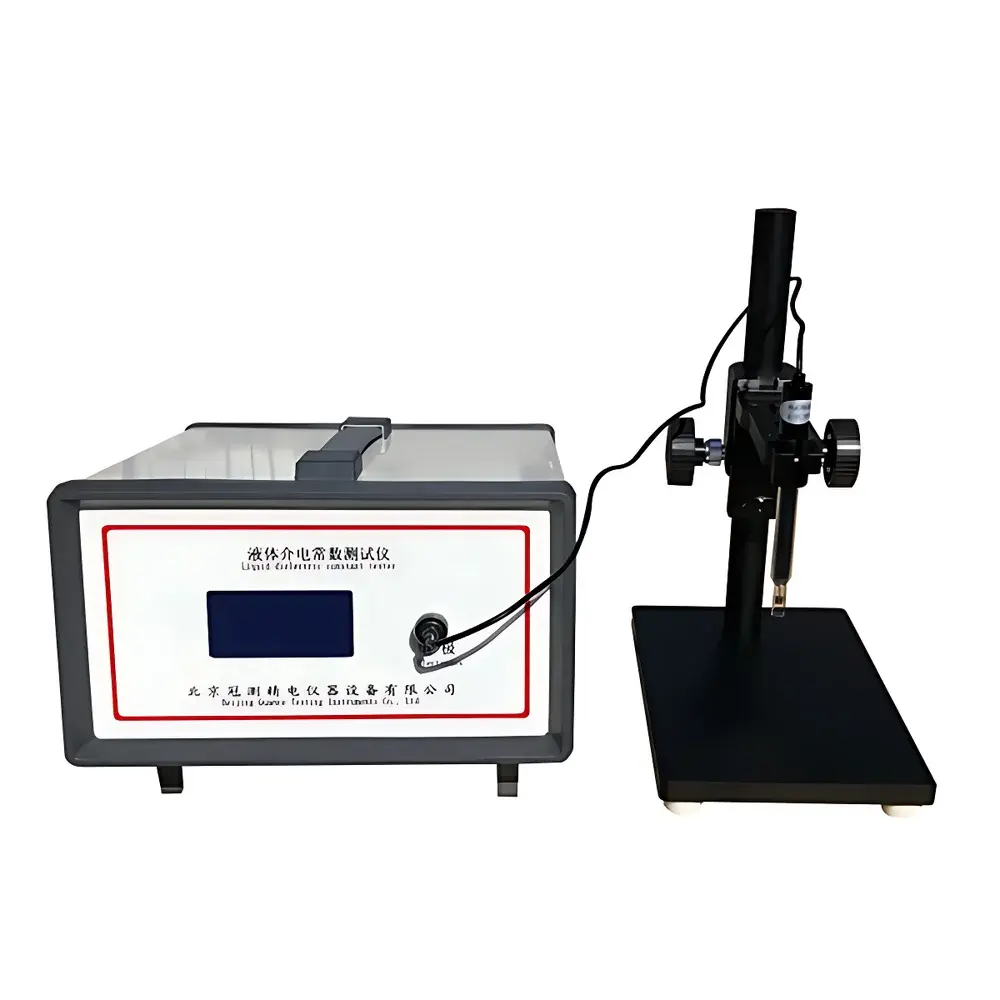
Guance Instruments GCSTD-F1 Liquid Dielectric Constant Analyzer
| Brand | Guance Instruments |
|---|---|
| Origin | Beijing, China |
| Manufacturer Type | Authorized Distributor |
| Country of Origin | China |
| Model | GCSTD-F1 |
| Price | USD 1,850 (FOB Beijing) |
Overview
The Guance Instruments GCSTD-F1 Liquid Dielectric Constant Analyzer is a precision benchtop instrument engineered for the quantitative determination of relative permittivity (εr) and conductivity (σ) of homogeneous liquid samples across a fixed-frequency AC excitation signal. It operates on the fundamental principle of parallel-plate (cylindrical coaxial) capacitance measurement under controlled electric field conditions. When a liquid sample is introduced into the defined inter-electrode volume, its polarization response alters the system’s effective capacitance and conductive loss component. By measuring the complex impedance—specifically the real (capacitive) and imaginary (resistive) parts—the instrument computes εr using calibrated geometric constants and validated dielectric models rooted in Maxwell–Wagner interfacial polarization theory. Designed for laboratory-based physical property characterization, the GCSTD-F1 supports routine quality control, formulation development, solvent purity verification, and academic research in colloid science, electrochemistry, and petroleum product analysis.
Key Features
- Coaxial cylindrical electrode assembly fabricated from high-purity 316 stainless steel—optimized for mechanical stability, corrosion resistance, and long-term dimensional fidelity.
- Fixed-gap geometry maintained by six non-conductive nylon spacers—ensuring repeatable electrode separation (±0.5 µm tolerance) without mechanical drift or thermal hysteresis.
- Open-access electrode architecture facilitating rapid sample loading, visual inspection, and residue-free cleaning—critical for sequential testing of immiscible or high-viscosity liquids.
- No disassembly required during routine maintenance; structural integrity of the electrode cavity is preserved to maintain traceable calibration traceability per ISO/IEC 17025 guidelines.
- Integrated temperature-stabilized measurement environment compatible with external thermostatic baths (not included), enabling εr vs. T profiling within ±0.1 °C control.
- Low-noise analog front-end with 4-wire Kelvin sensing eliminates lead resistance artifacts, supporting reliable measurements from εr ≈ 1.5 (e.g., hydrocarbons) to εr > 80 (e.g., water-based electrolytes).
Sample Compatibility & Compliance
The GCSTD-F1 accommodates transparent, low-to-moderate viscosity liquids (kinematic viscosity < 50 cSt at 25 °C), including polar solvents (methanol, acetone, ethylene glycol), non-polar hydrocarbons (hexane, toluene), aqueous salt solutions, and formulated lubricants. Samples must be free of suspended particulates, air bubbles, or emulsified phases to ensure volumetric homogeneity within the electrode gap. The instrument complies with core electrical safety requirements per IEC 61010-1:2010 and electromagnetic compatibility (EMC) standards EN 61326-1:2013. While not certified for hazardous area use (ATEX/IECEx), it meets GLP documentation requirements for raw data logging, operator ID tagging, and audit-ready test records when paired with optional PC software.
Software & Data Management
Data acquisition is performed via RS-232 or USB-to-serial interface using Guance’s proprietary GC-Studio v3.x application (Windows 10/11 compatible). The software enables real-time impedance plotting, εr/σ dual-parameter export in CSV/Excel format, user-defined calibration curve storage, and timestamped measurement logs with operator annotations. All raw impedance values are retained with 16-bit ADC resolution, supporting retrospective recalibration against NIST-traceable reference fluids (e.g., air εr = 1.00059, methanol εr = 32.63 at 20 °C, 1 kHz). Audit trails include firmware version, sensor serial number, ambient temperature/humidity stamps, and digital signature fields compliant with FDA 21 CFR Part 11 Annex 11 principles for regulated environments.
Applications
- Quality assurance of transformer oils and insulating fluids per ASTM D924 and IEC 60247 standards.
- Monitoring ethanol/water blend ratios in biofuel production.
- Characterizing dielectric relaxation behavior in polymer precursor solutions.
- Verifying purity of high-dielectric solvents used in lithium-ion battery electrolyte R&D.
- Educational labs demonstrating Clausius–Mossotti relationships and Debye dipole relaxation theory.
- Supporting ISO 15270:2008-compliant studies on plasticizer migration kinetics in PVC formulations.
FAQ
Can the electrode be disassembled for deep cleaning?
No. Disassembly compromises the calibrated inter-cylinder spacing and voids factory calibration. Cleaning must be performed in situ using ultrasonic agitation in appropriate solvents (e.g., acetone for hydrocarbon residues, isopropanol for polar deposits).
What is the recommended cleaning protocol after measuring viscous or high-boiling-point liquids?
Rinse thoroughly with a miscible solvent matching the sample chemistry, followed by 30-second ultrasonic bath treatment (40 kHz), then dry with oil-free compressed air—never heat-dry or wipe with cloth.
Does the GCSTD-F1 support variable-frequency measurement?
No. It operates at a single fixed frequency (1 kHz nominal), optimized for reproducibility and compliance with standardized test methods requiring defined excitation conditions.
Is calibration verification traceable to national standards?
Yes. Each unit ships with a certificate of conformance referencing calibration against NIST-traceable dielectric reference materials, with annual recalibration intervals recommended per ISO/IEC 17025 Clause 6.5.2.
Can the instrument measure conductive aqueous solutions?
Yes—within conductivity limits up to 5 mS/cm. For highly conductive media (>10 mS/cm), measurement uncertainty increases due to dominant resistive losses; use of guard electrodes or alternative techniques (e.g., RF impedance spectroscopy) is advised.



