
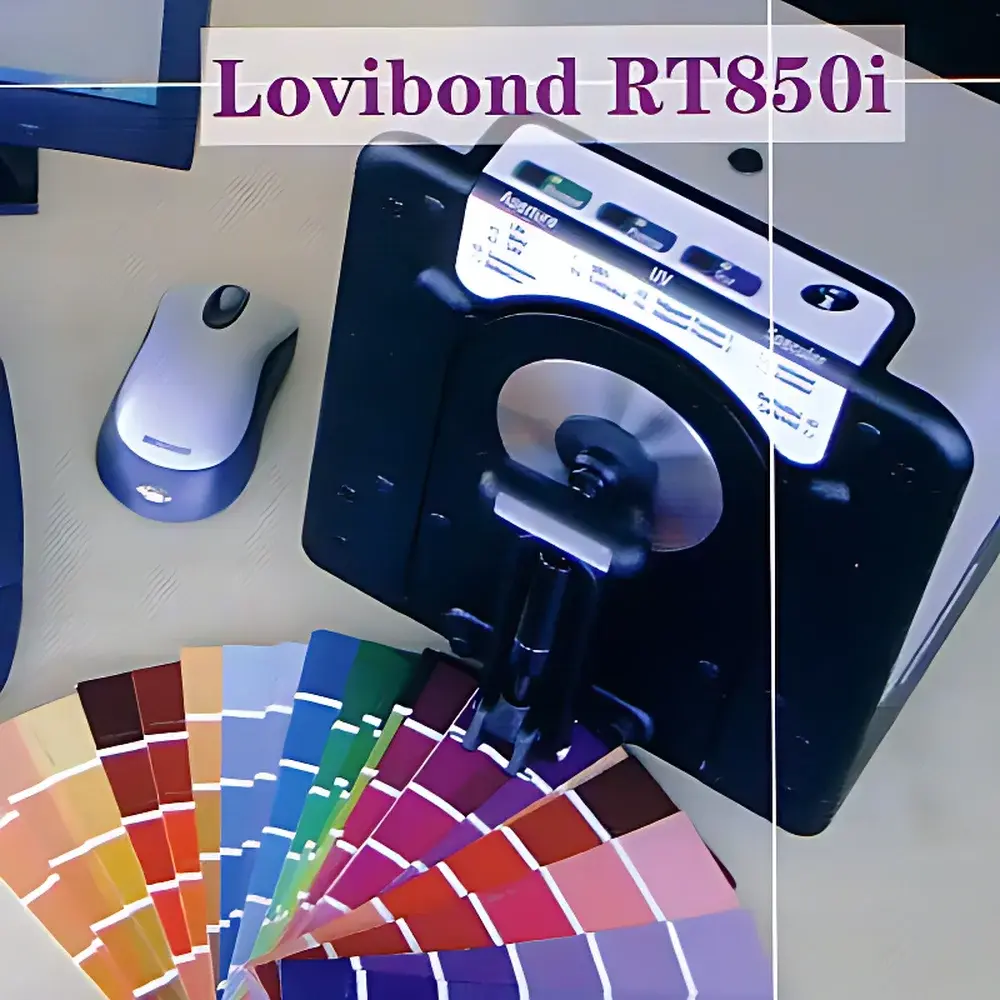
Lovibond RT850I Benchtop Surface Colorimeter
| Brand | Lovibond (Tintometer) |
|---|---|
| Origin | United Kingdom |
| Model | RT850I |
| Instrument Type | Integrating Sphere Spectrophotometer |
| Measurement Geometry | d/8° (diffuse illumination / 8° viewing angle), compliant with CIE No. 15, ISO 7724-1, ASTM E308, and DIN 5033-7 |
| Illuminants | D65, A, C, F2, F7, F11 |
| Observer Angle | 10° standard observer |
| Wavelength Range | 400–700 nm |
| Optical Resolution | 10 nm |
| Repeatability | ΔE*ab < 0.02 (white tile, 10 readings) |
| Inter-instrument Agreement | ΔE*ab < 0.15 (BCRA Series II tiles) |
| Sample Port Diameter | 25 mm (standard), optional 8 mm & 4 mm apertures |
| Data Output | CIE L*a*b*, L*C*h*, ΔE*ab, ΔE*cmc, ΔE*94, ΔE*00, Yxy, XYZ, spectral reflectance curves |
| Compliance | CE, UKCA, RoHS |
Overview
The Lovibond RT850I is a high-precision benchtop surface colorimeter engineered for industrial color quality control in regulated and high-volume production environments. Based on integrating sphere spectrophotometry with d/8° optical geometry, the instrument conforms to internationally recognized colorimetric standards including ISO 7724-1, CIE Publication No. 15, ASTM E308, and DIN 5033-7. Its 400–700 nm spectral range captures full reflectance data at 10 nm intervals, enabling traceable calculation of all major color spaces (CIE L*a*b*, L*C*h*, Yxy, XYZ) and advanced difference metrics (ΔE*00, ΔE*94, ΔE*CMC). Unlike filter-based tristimulus colorimeters, the RT850I’s diffraction grating spectrometer delivers inherent stability, minimal drift, and metrological traceability—critical for inter-laboratory correlation and long-term process validation.
Key Features
- Integrating sphere optics with calibrated tungsten-halogen illumination ensures uniform diffuse lighting and eliminates directional bias from surface texture or gloss.
- Dual-aperture design (standard 25 mm, optional 8 mm and 4 mm) accommodates diverse sample geometries—from large flat panels to small granules or viscous liquids in cuvettes.
- Motorized sample port shutter and automatic calibration verification reduce operator dependency and support GLP-compliant workflows.
- Robust mechanical architecture includes temperature-stabilized detector array and internal reference tile monitoring for drift compensation across ambient fluctuations (15–30 °C).
- Integrated USB and RS-232 interfaces enable direct connection to laboratory networks; optional Ethernet module supports remote configuration and firmware updates.
Sample Compatibility & Compliance
The RT850I is validated for opaque solids (plastics, painted metals, textiles, ceramics), translucent films, powders (e.g., pigments, pharmaceutical excipients), and clear to turbid liquids (coatings, beverages, chemical solutions). Its large sample chamber accepts specimens up to 120 × 120 mm with optional fixtures—including magnetic holders for metallic substrates, powder cups with compression plates, and universal liquid cuvette adapters (10 mm, 20 mm, 50 mm path lengths). All measurement protocols align with ISO 11664-4 (colorimetric observers), ISO 11664-6 (color-difference formulas), and FDA-recommended practices for color consistency in GMP-regulated manufacturing. Audit trails, user access levels, and electronic signature support are available when paired with ONCOLOR™ software under 21 CFR Part 11 compliance mode.
Software & Data Management
ONCOLOR™ software serves as the certified analytical engine for the RT850I, providing real-time spectral visualization, batch reporting, tolerance mapping (ellipsoidal or rectangular), and statistical process control (SPC) charting (X-bar/R, Cp/Cpk). Raw spectral data (.spc files) and metadata (operator ID, timestamp, instrument serial, calibration history) are stored in encrypted SQLite databases. Export options include CSV, PDF, XML, and industry-standard .qtx (QualityTech) formats compatible with enterprise QMS platforms (e.g., TrackWise, MasterControl). The software supports multi-instrument fleet management, allowing synchronized calibration schedules and centralized deviation logging across distributed facilities.
Applications
- Automotive OEMs: Quantifying color match tolerances between body panels, interior trims, and injection-molded components against master standards.
- Coatings & Inks: Monitoring batch-to-batch consistency of solvent-based and waterborne formulations during QC release testing.
- Pharmaceuticals: Verifying tablet film-coat hue uniformity per USP and visual inspection guidance in ICH Q5C.
- Food & Beverage: Assessing natural pigment stability in dairy products, fruit juices, and confectionery under accelerated aging protocols.
- Textiles & Plastics: Enforcing AATCC TM173 and ISO 105-J03 pass/fail criteria for dye lot acceptance.
FAQ
What is the recommended calibration frequency for the RT850I in a production QC lab?
Daily verification using the included white ceramic tile is required; full recalibration with NIST-traceable standards is advised every 30 days or after 500 measurements—whichever occurs first.
Can the RT850I measure metallic or pearlescent finishes?
No—it is optimized for non-directional (diffuse) reflectance. For gonioapparent materials, a multi-angle spectrophotometer (e.g., Lovibond RT880) is required.
Is ONCOLOR™ software validated for 21 CFR Part 11 compliance?
Yes—when deployed with audit trail activation, electronic signatures, and role-based permissions, it meets ALCOA+ data integrity principles and supports FDA inspection readiness.
Does the RT850I support custom illuminants or user-defined color spaces?
ONCOLOR™ allows creation of proprietary illuminant spectra and export of custom CIELAB-derived indices (e.g., yellowness index YI E313, whiteness index WI CIE); however, no hardware-level modification is possible.
What environmental conditions affect measurement repeatability?
Ambient light interference is eliminated by the integrated shutter; however, sustained operation above 30 °C may trigger thermal compensation algorithms—maintain ambient temperature between 15–25 °C for optimal long-term reproducibility.



