
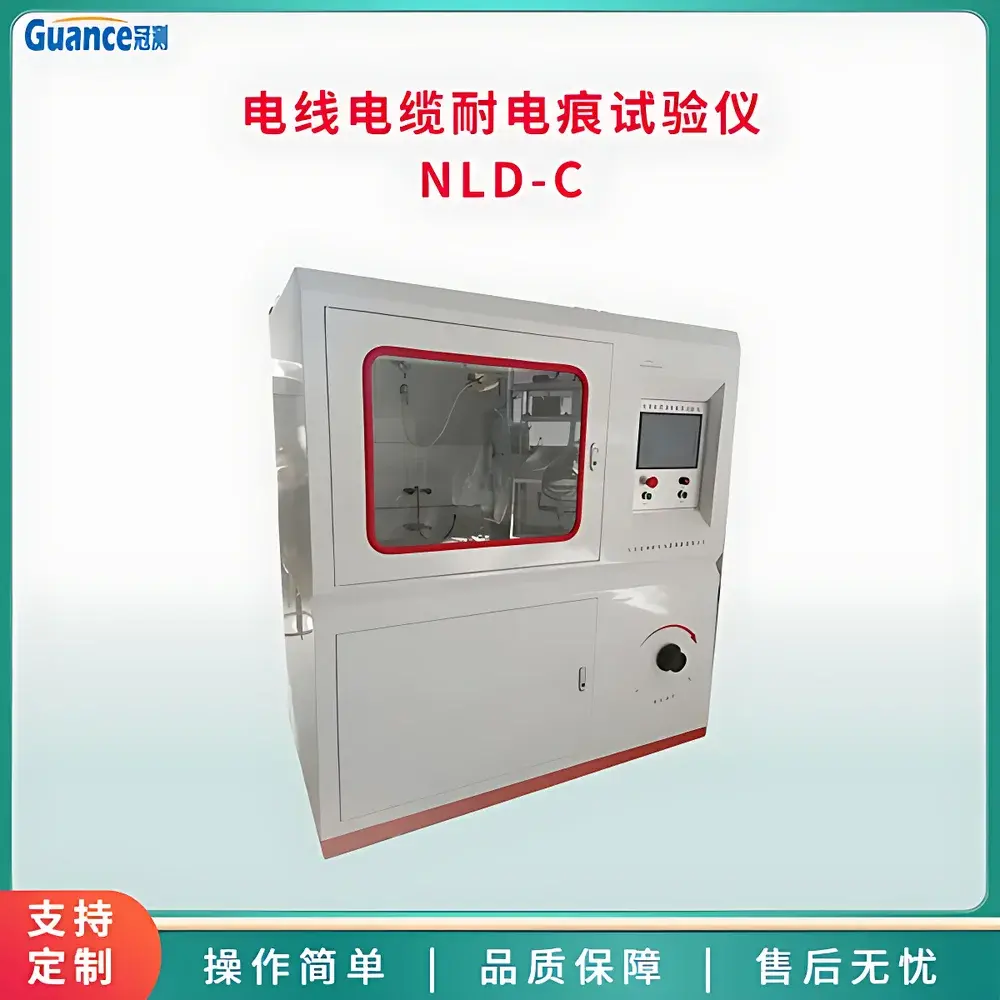
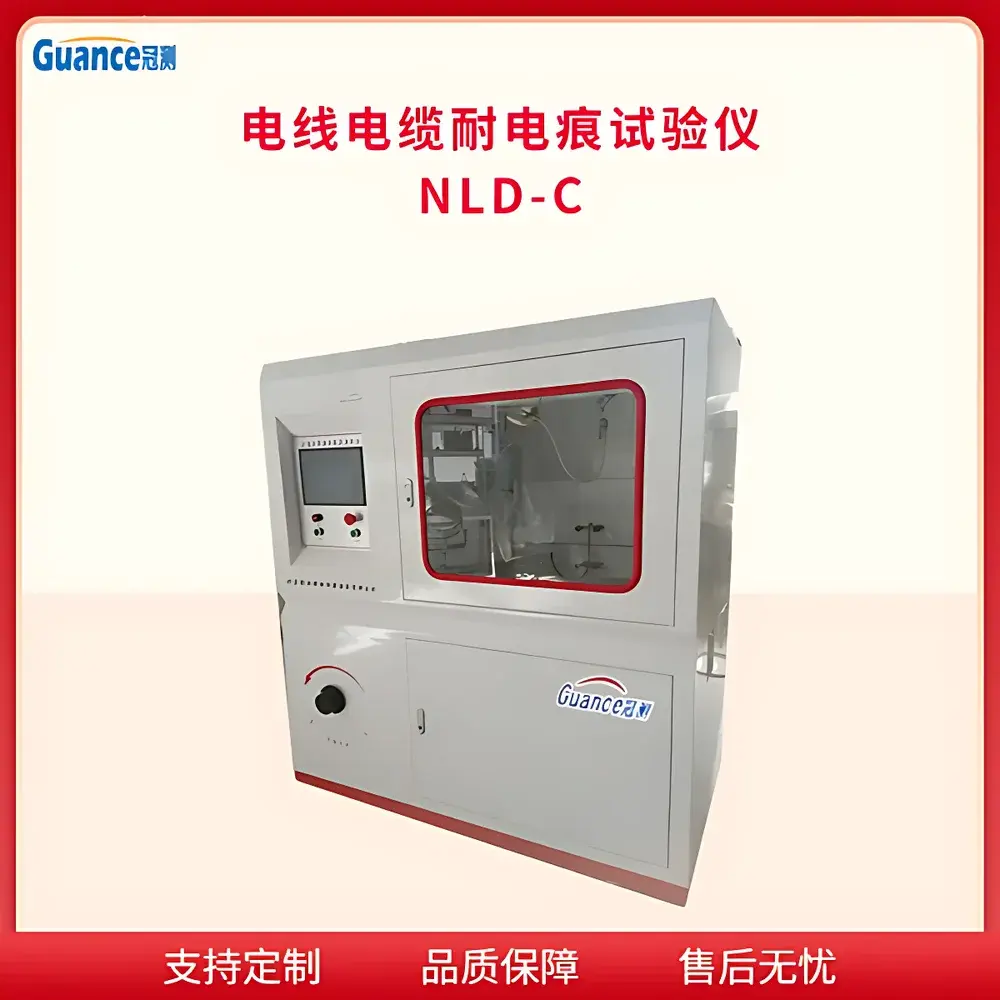
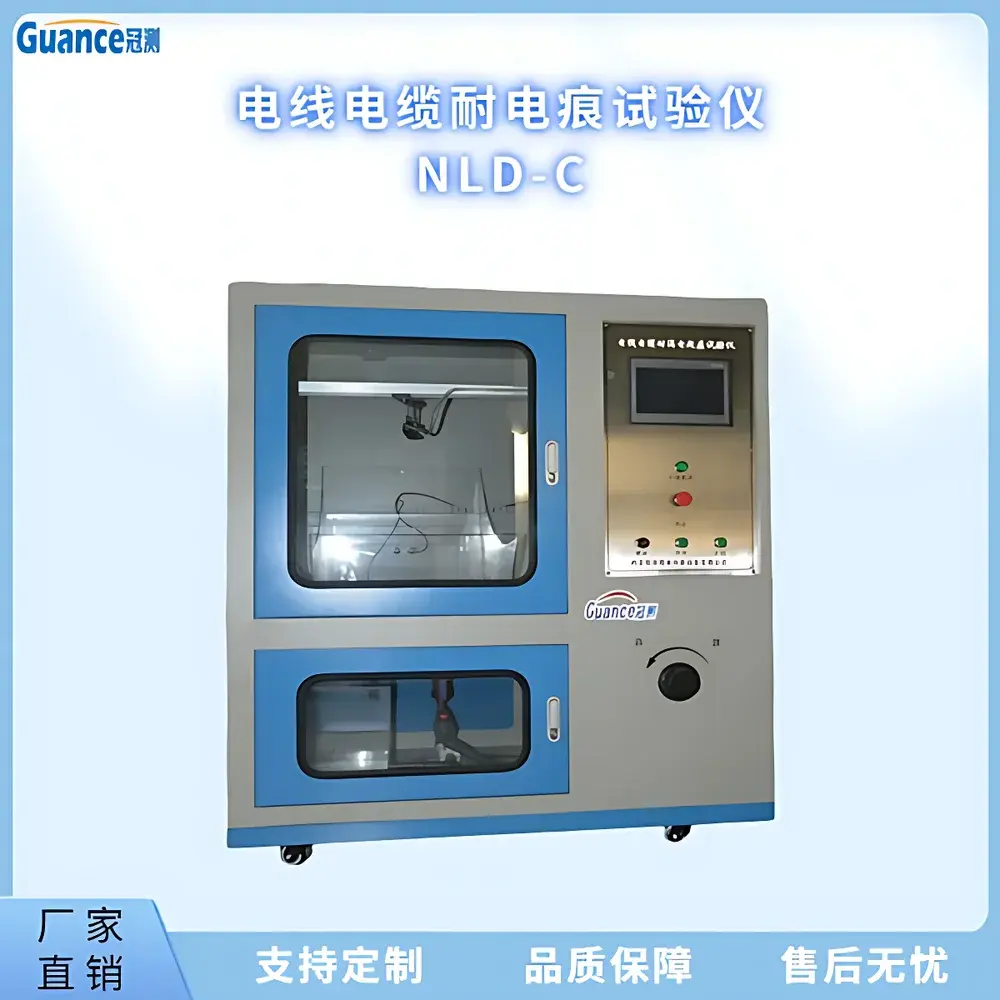
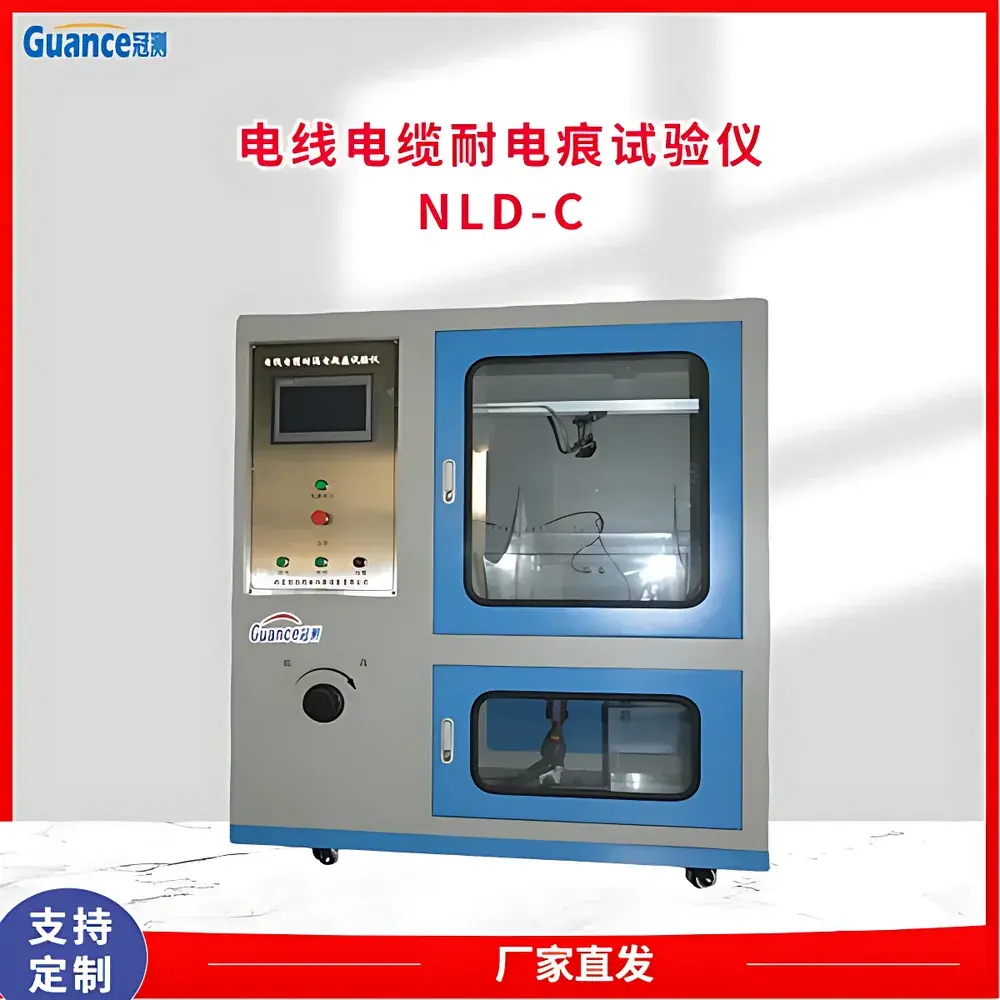
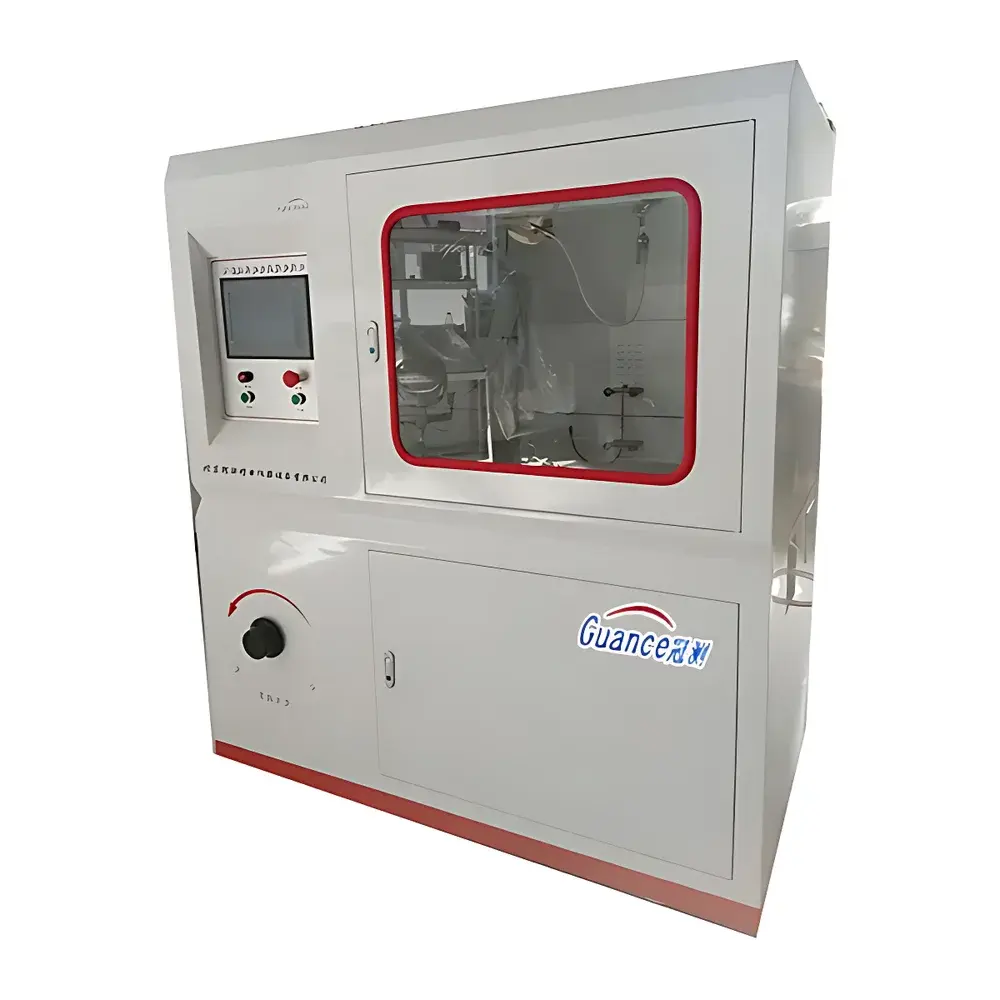
GuanCe NLD-C Touchscreen Electrical Tracking Resistance Tester for Wires and Cables
| Brand | GuanCe Instruments |
|---|---|
| Origin | Beijing, China |
| Manufacturer Type | Authorized Distributor |
| Regional Classification | Domestic (China) |
| Model | NLD-C |
| Instrument Category | Electronic Universal Testing Machine |
| Rated Price | USD 1,950 (approx.) |
| Input Voltage | AC 220 V |
| Output Voltage Range | AC 0–5 kV |
| Power Rating | 5 kVA |
| Voltage Accuracy | < ±2% |
| High-Voltage Output Current | > 1 A |
| Short-Circuit Current at ≥250 mA | Voltage Drop < 5% |
| Current Measurement Accuracy | < ±1% |
| Spray Nozzle Distance to Specimen | ≥500 mm |
| Spray Angle Relative to Specimen Axis | 45° |
| Spray Velocity at Specimen Surface | 3 m/s |
| Spray Rate | 0.5 mm/min |
| Standard Spray Cycle | 10 s spray / 20 s pause |
| Specimen Length | ≥150 mm |
| Specimen Preparation | Exposed conductor segment (20 mm), grounding wire wrap (1 mm bare copper, 2–3 turns at 100 mm from cut edge) |
Overview
The GuanCe NLD-C Touchscreen Electrical Tracking Resistance Tester is a purpose-built apparatus designed to evaluate the resistance of solid insulating materials—particularly polymer-based cable sheaths and jacketing compounds—to electrical tracking under controlled high-voltage and electrolytic stress. Based on the principle of comparative surface degradation under alternating electric field and conductive electrolyte exposure, the instrument replicates real-world contamination-induced failure mechanisms observed in outdoor power distribution systems, railway signaling cables, and building wiring installations. It operates in strict accordance with GB/T 3048.7–2007, the Chinese national standard equivalent to IEC 60587 (Electrical insulating materials used under severe ambient conditions – Test methods for electrical resistance to tracking by liquids), and supports methodological alignment with ASTM D2303 and UL 746A for comparative tracking index (CTI) screening. The system applies adjustable AC high voltage (0–5 kV) across a standardized specimen while delivering calibrated droplets of ammonium chloride–based electrolyte at defined intervals and velocity. Tracking onset is detected via continuous monitoring of leakage current between electrodes; failure is recorded when current exceeds 1 A or when visual evidence of carbonized path formation, arcing, or dielectric breakdown occurs.
Key Features
- 10-inch industrial-grade resistive touchscreen interface with intuitive HMI navigation, enabling parameter configuration, real-time waveform display, and test log review without external PC dependency.
- Siemens S7-1200 PLC core controller ensures deterministic timing control, electromagnetic immunity (IEC 61000-4-3/4-4 compliant), and long-term operational stability under laboratory or quality control floor environments.
- Galvanically isolated voltage and current acquisition channels (optocoupler-based signal conditioning) guarantee measurement integrity in high dv/dt and noisy EMI environments typical of high-voltage testing.
- Manual voltage ramping with dual-stage safety interlocks: mechanical key switch + software-enforced upper limit prevents accidental overvoltage application.
- Adjustable spray cycle programming (spray duration, pause interval, total cycle count) allows customization for material screening, accelerated aging studies, or compliance verification per specific product specifications.
- Integrated flow-regulated nozzle assembly with calibrated rotameter enables precise electrolyte delivery (0.5 mm/min ±5%) and maintains consistent droplet size and impact energy across tests.
- Dedicated corrosion fluid recirculation path with quick-release drain valve simplifies maintenance and reduces consumable waste—no disassembly required for routine fluid exchange.
- Integrated exhaust fan (rated ≥100 m³/h) with activated carbon filter option mitigates ozone and chlorine gas accumulation during prolonged testing, supporting safe operation within ISO 14644 Class 8 cleanrooms or QC labs.
- LED task lighting with independent on/off control enhances visual inspection of surface carbonization, dendritic growth, or localized erosion during and post-test.
- Configurable audible alarm (85 dB, 2–10 s duration) triggers upon either leakage current exceeding 1 A or completion of preset cycle count—both thresholds independently programmable.
- 45° precision-machined stainless steel guide trough ensures repeatable nozzle alignment and eliminates lateral drift; integrated drip containment prevents electrolyte migration onto baseplate or electronics housing.
Sample Compatibility & Compliance
The NLD-C accommodates rigid or semi-rigid cylindrical specimens ≥150 mm in length and ≤25 mm in outer diameter, including extruded PVC, XLPE, LSHF, TPE, and rubber-insulated wires per GB/T 5023, JB/T 8734, and IEC 60227 series. Specimen preparation follows GB/T 3048.7–2007 Section 6: conductor exposure at one end, grounding wire wrap at fixed offset, and insulated termination at the opposite end to suppress flashover. The system supports full traceability documentation per GLP requirements, including timestamped test logs with operator ID, environmental temperature/humidity metadata (optional external sensor input), and raw current/voltage time-series export in CSV format. While not FDA 21 CFR Part 11 certified out-of-the-box, audit-ready data files meet basic electronic record retention criteria for ISO/IEC 17025-accredited laboratories conducting third-party certification testing.
Software & Data Management
The embedded firmware stores up to 500 test records locally with automatic timestamping, cycle-by-cycle current maxima, and pass/fail status flags. Data export is supported via USB 2.0 port (FAT32 formatted drive) in plain-text CSV with column headers: “Test_ID”, “Date_UTC”, “Voltage_kV”, “Cycle_Count”, “Max_Leakage_A”, “Failure_Mode_Code”, “Operator_ID”. No cloud connectivity or remote access functionality is implemented—consistent with industrial control system security best practices for high-voltage equipment. Optional RS-485 Modbus RTU interface (add-on module) enables integration into SCADA or MES platforms for automated report generation and SPC charting of CTI trends across material lots.
Applications
- Quality assurance of low- and medium-voltage power cables prior to type testing or batch release.
- Comparative evaluation of halogen-free flame-retardant (HFFR) compounds versus traditional PVC formulations under simulated polluted coastal or industrial atmospheres.
- R&D validation of nano-filled polyolefin composites intended for use in smart grid infrastructure exposed to salt fog and dust.
- Root cause analysis of field failures involving insulation tracking on buried or aerial distribution cables.
- Supporting certification submissions to CCC, CE (under Low Voltage Directive), and PSE mark requirements where tracking resistance is a mandatory performance criterion.
FAQ
What standards does the NLD-C comply with?
It is fully aligned with GB/T 3048.7–2007 and technically compatible with IEC 60587, ASTM D2303, and UL 746A test protocols.
Can the instrument be used for non-circular specimens?
No—the test fixture geometry and electrode positioning are optimized for cylindrical wire/cable samples only; flat sheet or molded plaque testing requires alternative fixtures not supplied with this model.
Is calibration certificate included with shipment?
A factory calibration report (traceable to CNAS-accredited reference standards) is provided; annual recalibration is recommended and supported via authorized service centers in Beijing, Shanghai, and Shenzhen.
What electrolyte solution is required?
Standard formulation per GB/T 3048.7: 0.1% (w/w) ammonium chloride (NH₄Cl) in deionized water (conductivity 1.0 ± 0.1 mS/cm at 23 °C).
Does the system support automated pass/fail decision logic?
Yes—thresholds for current (1 A default, adjustable 0.5–2.0 A), cycle count (1–999), and alarm duration (2–10 s) are all user-configurable in the HMI.
Related Products



