
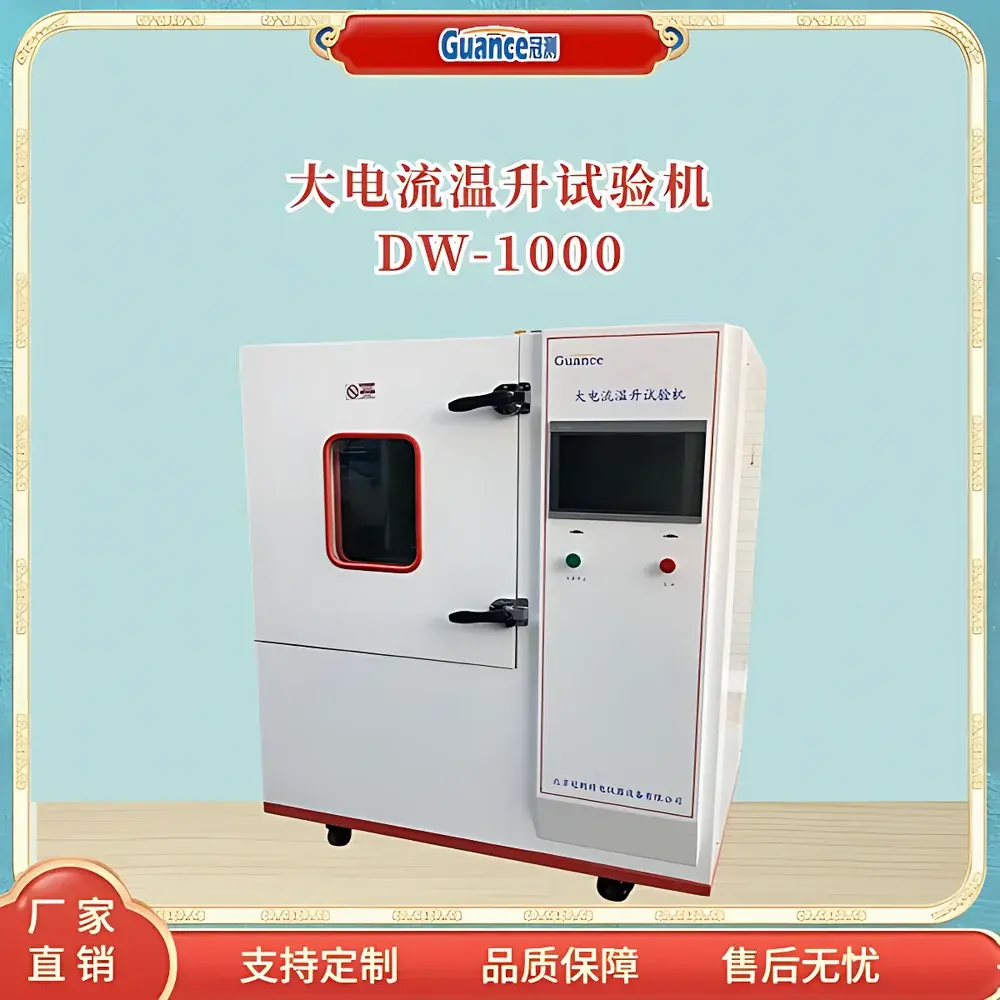
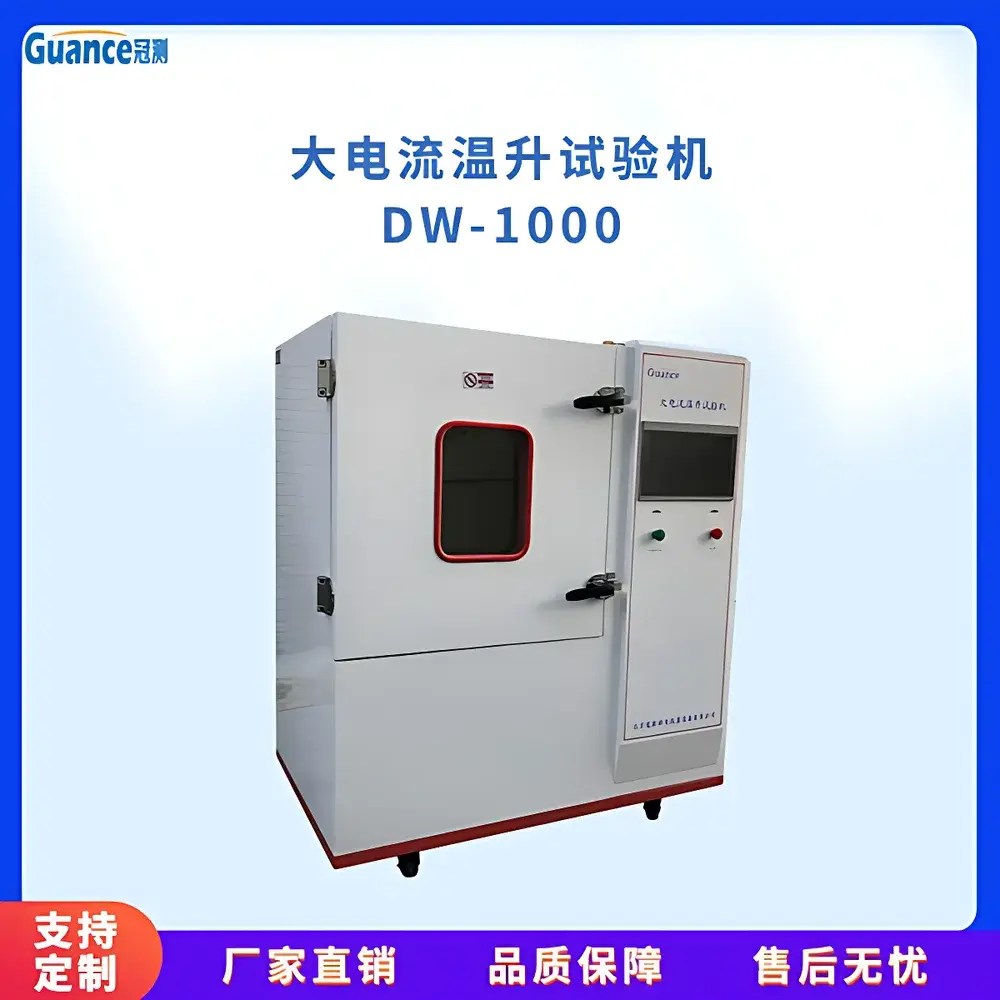
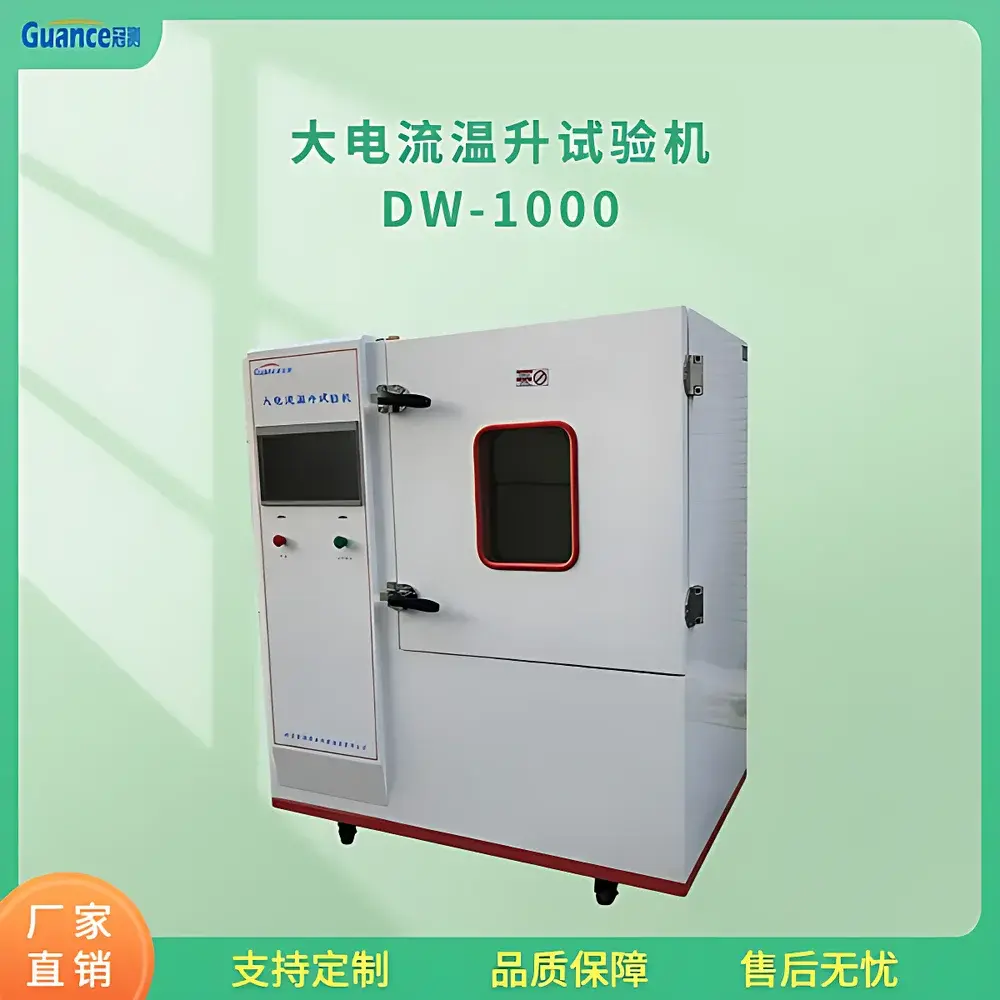
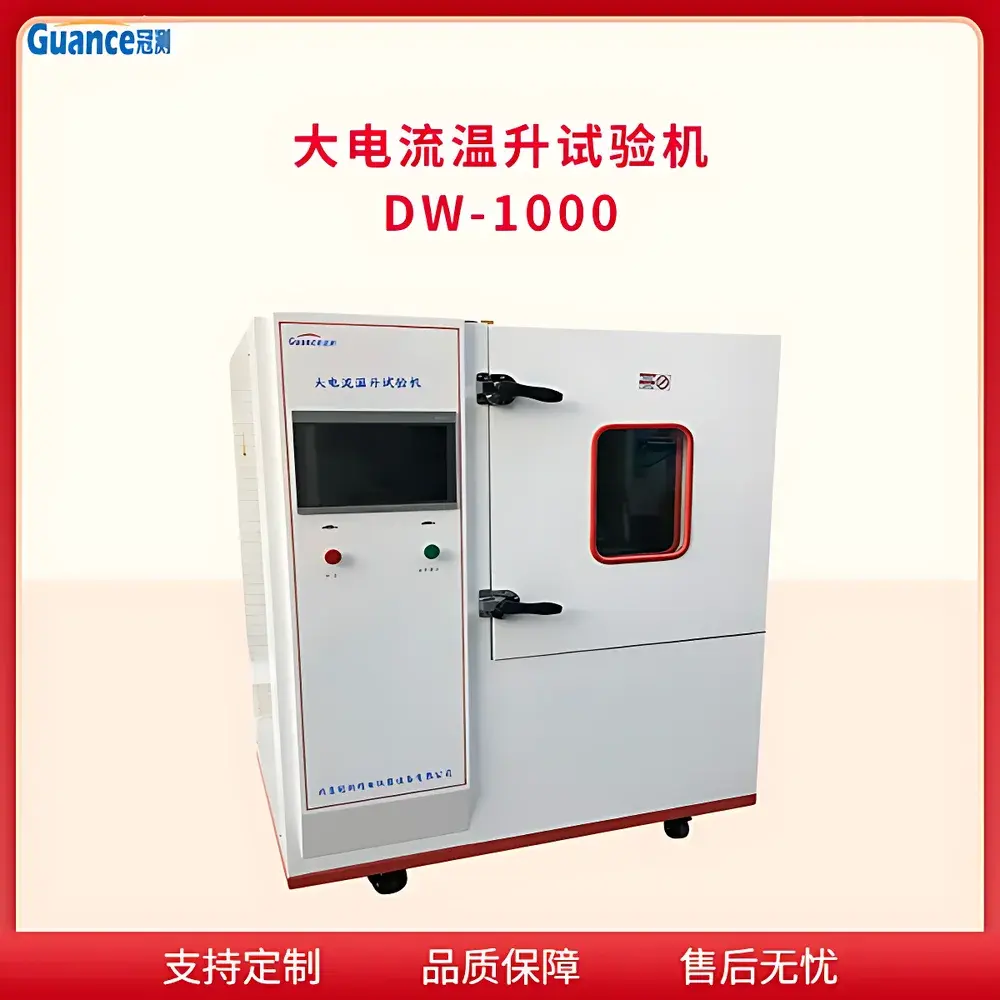
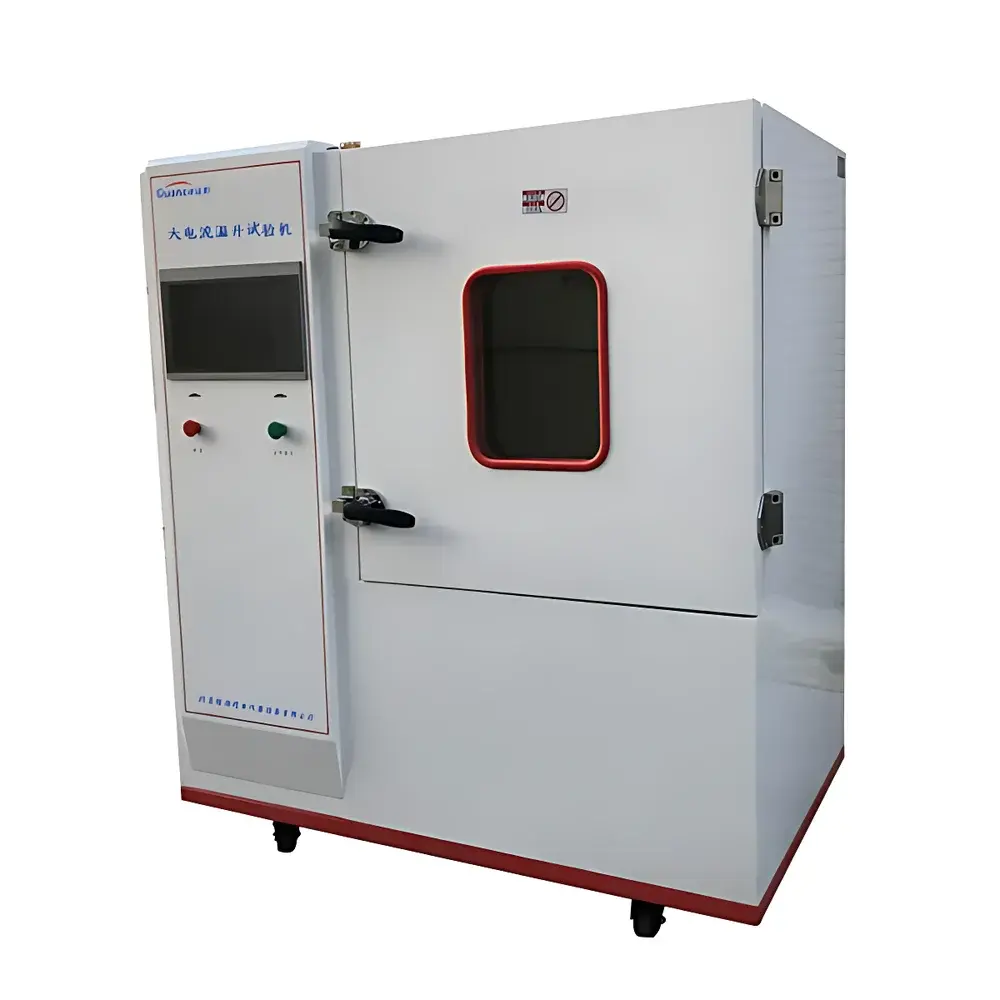
Brookfield DW-1000 High-Current Thermal Rise & Multi-Parameter Physical Property Tester
| Brand | Guance Instruments |
|---|---|
| Origin | Beijing, China |
| Manufacturer Type | Authorized Distributor |
| Region of Origin | Domestic (China) |
| Model | DW-1000 |
| Price | USD 2,800 (FOB Beijing) |
| Max Output Current | 1000 A AC |
| Temperature Channels | 2 independent acquisition + 1 closed-loop control |
| Control System | Siemens S7-1200 PLC + 15″ HMI touchscreen |
| Power Supply | 380 VAC ±10%, 50 Hz ±0.5 Hz, 20 kW |
| Ambient Operating Range | −30–40 °C, ≤85% RH, ≤1000 m altitude |
| Enclosure Dimensions (L×W×H) | 1400 × 1150 × 1700 mm |
| Weight | 500 kg |
| Protection | Overcurrent, overtemperature, grounding fault, voltage anomaly, seismic-rated (horizontal 3 m/s² / vertical 1.5 m/s²) |
| Grounding Resistance | ≤4 Ω |
Overview
The Guance DW-1000 High-Current Thermal Rise & Multi-Parameter Physical Property Tester is an industrial-grade, PLC-controlled test system engineered for standardized evaluation of thermal behavior and electrical integrity under sustained high-current stress. Designed in accordance with IEC 60947-1, IEC 61000-4-30 (power quality monitoring), and GB/T 14048.1–2012 (Low-voltage switchgear and controlgear), the DW-1000 applies precisely regulated alternating current—up to 1000 A RMS—to conductors, busbars, connectors, or low-voltage protective devices while simultaneously monitoring real-time temperature response at two spatially distinct points: ambient chamber temperature and specimen surface temperature. Its core measurement architecture relies on calibrated current transducers (CTs) and PT100-class RTD sensors interfaced via analog signal conditioning to a Siemens S7-1200 PLC, ensuring traceable, repeatable data acquisition under continuous load conditions. The system supports unattended operation for extended durations (≥72 h), making it suitable for qualification testing in compliance with UL 489, GB/T 20641, and EN 60947-7-1.
Key Features
- High-fidelity 1000 A AC current source with programmable ramp rate, hold time, and stepwise current profiling via HMI interface
- Dual-channel temperature acquisition (±0.5 °C accuracy, 0.1 °C resolution) using industrial-grade Pt100 RTDs—one for environmental chamber monitoring, one for direct specimen contact
- Integrated closed-loop temperature regulation module enabling active thermal stabilization during current application
- Real-time graphical display of synchronized current vs. time and dual-temperature vs. time curves on a 15″ capacitive touchscreen HMI
- Comprehensive safety architecture: overcurrent tripping (<10 ms response), ground-fault detection, thermal runaway shutdown, and hardware interlocked emergency stop
- Full audit trail capability: all setpoints, measured values, alarms, and operator actions are timestamped and stored locally on the PLC SD card (retention ≥30 days)
- Calibration traceability: field-adjustable gain/offset compensation for current, voltage, and temperature channels—documented per ISO/IEC 17025 calibration procedures
Sample Compatibility & Compliance
The DW-1000 accommodates rigid and semi-flexible specimens up to 120 mm in width and 80 mm in height, including copper/aluminum busbars, circuit breaker terminals, cable lugs, fuse holders, and molded-case switch components. Specimen mounting utilizes insulated brass clamps with torque-controlled fastening (5–10 N·m) to ensure consistent contact resistance. All electrical interfaces comply with IP2X enclosure rating and meet creepage/clearance requirements per IEC 60664-1. The system satisfies electromagnetic compatibility (EMC) criteria outlined in EN 61000-6-2 (immunity) and EN 61000-6-4 (emissions), and its structural design conforms to seismic performance Category II per IEEE 693–2018. It is routinely deployed in third-party certification labs conducting tests for CCC, CE, and KC mark submissions.
Software & Data Management
Data acquisition and visualization are managed entirely through the embedded Siemens WinCC Runtime Advanced HMI environment. All raw sensor data—including instantaneous current (A), RMS voltage (V), ambient temperature (°C), specimen temperature (°C), and elapsed test time (s)—are sampled at 10 Hz and logged in CSV format. Exported files include embedded metadata: operator ID, test ID, calibration due date, and firmware revision. Optional USB-to-Ethernet gateway enables integration with enterprise LIMS platforms supporting ASTM E1578-compliant data exchange. Audit trails adhere to FDA 21 CFR Part 11 principles: electronic signatures, role-based access control (three-tier password protection), and immutable event logging. No cloud connectivity or remote telemetry is enabled by default; all data remains on-device unless explicitly exported.
Applications
- Thermal rise validation of low-voltage power distribution components per IEC 60947-1 Clause 8.3.3.3
- Temperature-rise endurance testing of busbar joints and compression connectors under rated current loading
- Comparative evaluation of contact resistance degradation in switching devices subjected to cyclic high-current stress
- Qualification of heat-dissipation performance in EV battery pack bus systems (pre-validation stage)
- Verification of thermal management efficacy in photovoltaic combiner box designs
- Root-cause analysis of premature failure in molded-case circuit breakers during short-time withstand testing
FAQ
What standards does the DW-1000 support out-of-the-box?
The system’s control logic and reporting templates are preconfigured for IEC 60947-1, GB/T 14048.1, UL 489, and EN 60947-7-1 thermal rise test sequences—including automatic pass/fail evaluation based on ΔT limits.
Can the DW-1000 perform DC current testing?
No—the DW-1000 is designed exclusively for AC current generation (50 Hz sinusoidal output). DC testing requires external rectification and is not supported by the integrated power stage.
Is third-party calibration certification included?
Factory calibration is performed prior to shipment using NIST-traceable standards; however, formal ISO/IEC 17025 calibration certificates require separate procurement and on-site verification by an accredited lab.
How is data integrity ensured during long-duration tests?
All measurements are buffered in non-volatile PLC memory and written to redundant microSD storage at configurable intervals (default: 1-second intervals); power-loss recovery preserves the last 10 minutes of buffered data.
Does the system support automated report generation?
Yes—test reports in PDF format (including curve plots, summary tables, and pass/fail status) can be generated and printed directly from the HMI after test completion.



