
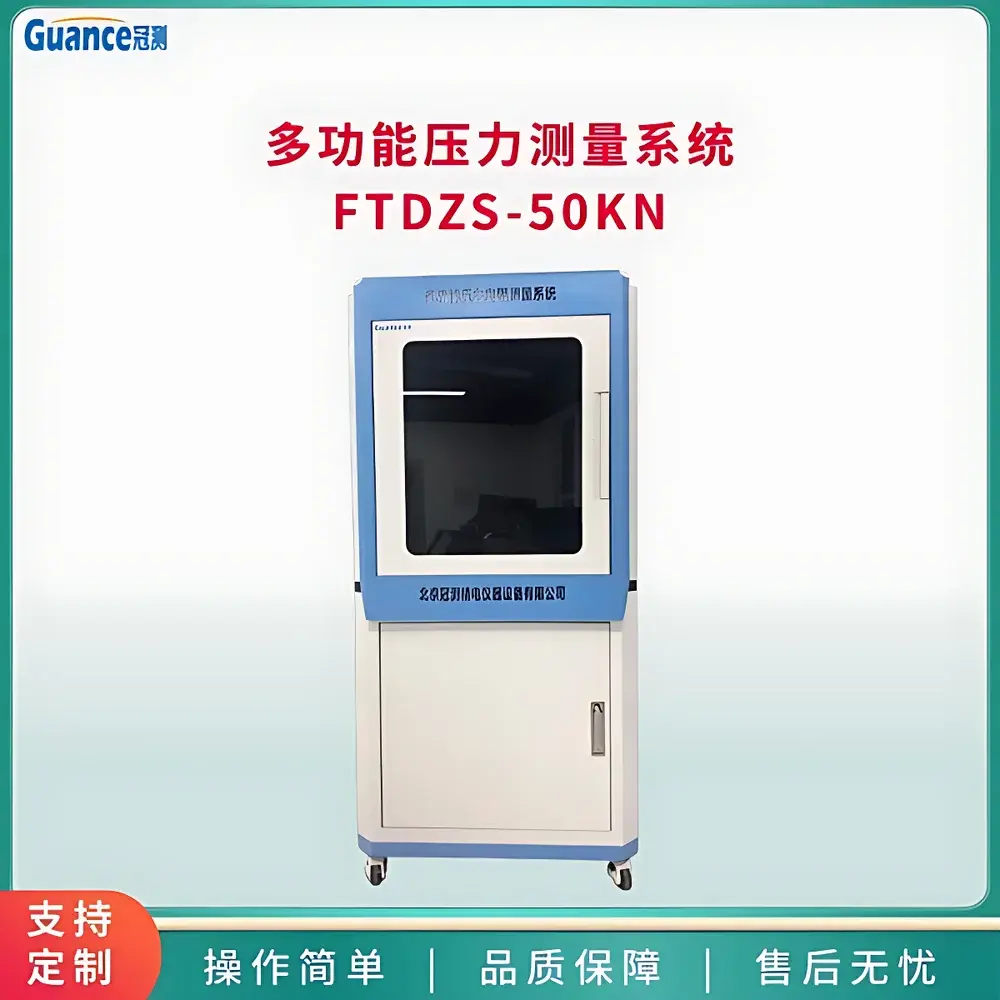
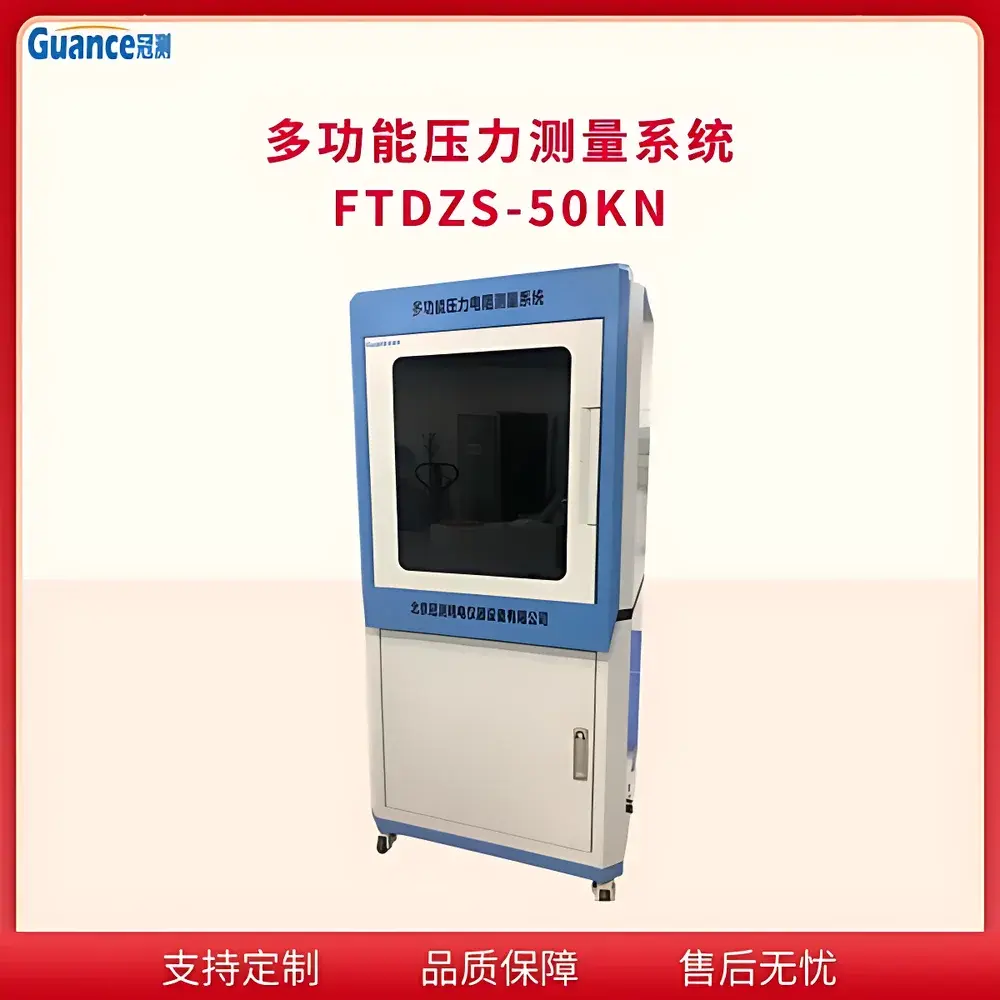
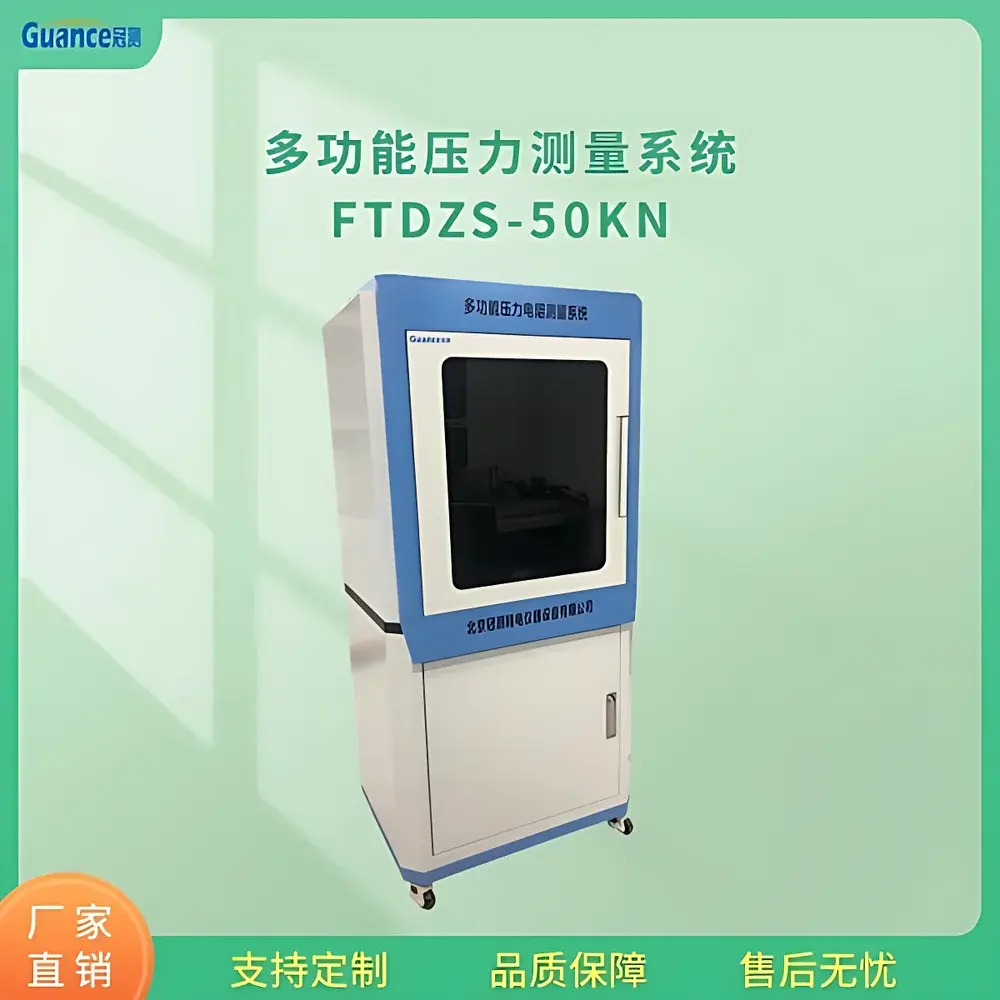
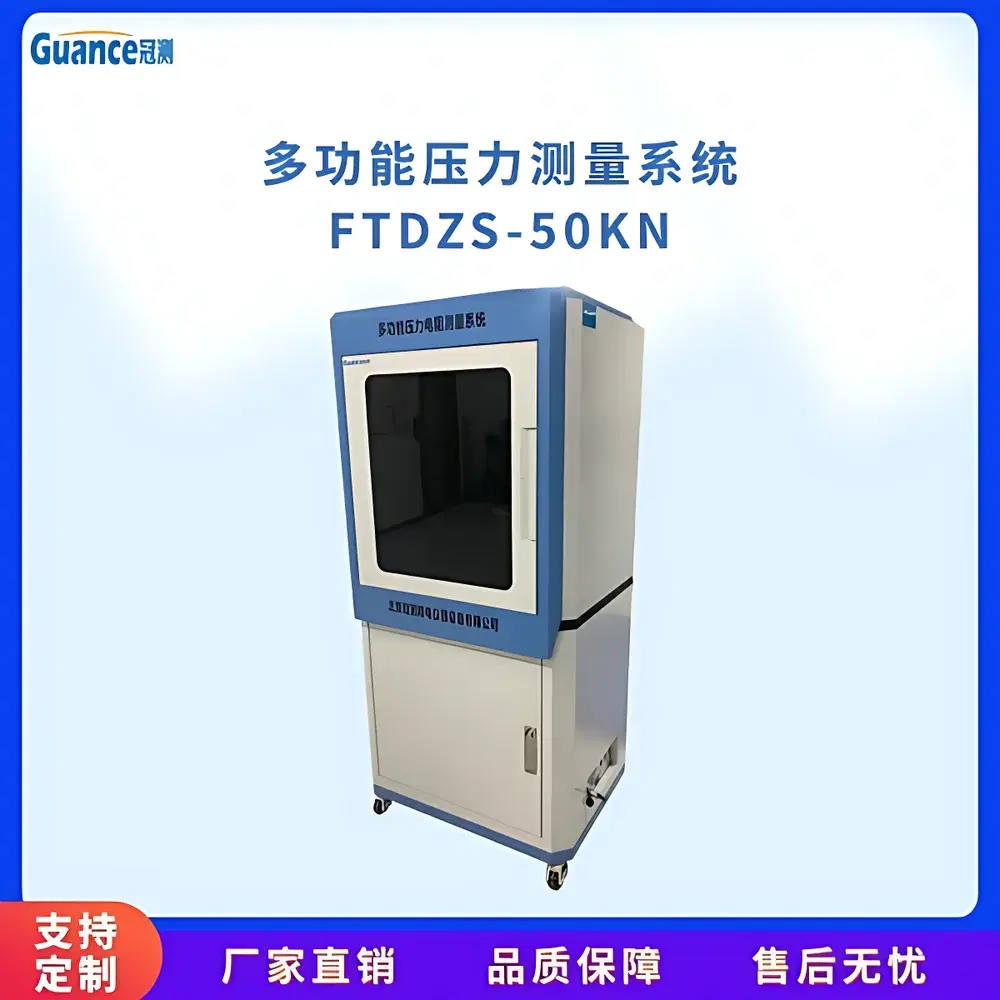
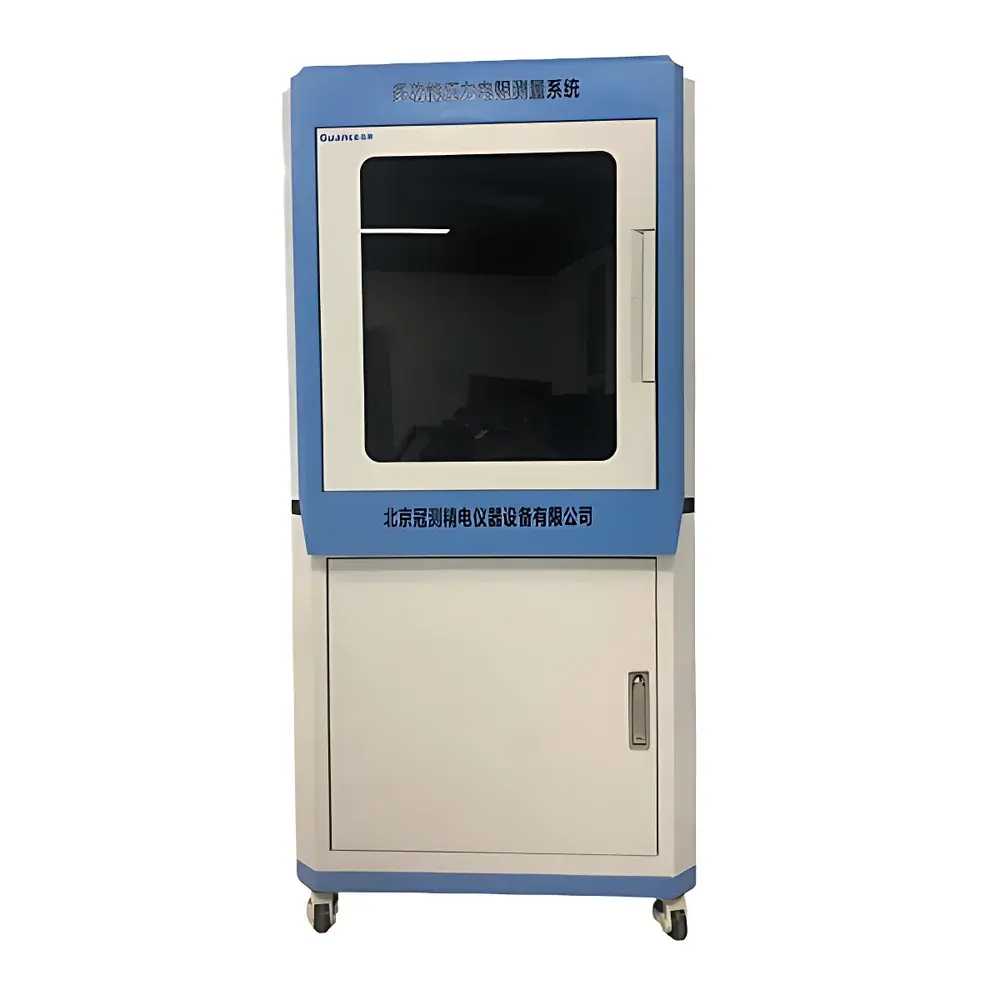
GuanCe FTDZS-50KN Multifunctional Powder Resistivity and Compaction Density Testing System
| Brand | GuanCe |
|---|---|
| Origin | Beijing, China |
| Manufacturer Type | Authorized Distributor |
| Origin Category | Domestic (China) |
| Model | FTDZS-50KN |
| Max. Applied Force | 50 kN |
| Measurement Principle | Four-Point Probe & Two-Point Probe DC Resistivity + Uniaxial Compaction Density |
| Display & Control | 12-inch Embedded Industrial PC with Real-Time Data Acquisition |
| Compliance | GB/T 30835–2014, GB/T 24521–2018, GB/T 24533–2019 |
| Test Modes | Constant Force, Constant Pressure, Gradient Force, Gradient Pressure, Compression Ratio Control |
| Data Output | CSV/Excel Export, On-Screen Real-Time Plotting, Thermal Print Support |
| Electrode Options | Removable Four-Probe Electrode, Two-Probe Electrode, Standardized Compaction Die Cavity (Φ12.7 mm or Φ16 mm per GB standards) |
| Force Resolution | ≤0.1% FS |
| Displacement Resolution | 0.1 µm |
| Resistance Range | 10⁻⁴ Ω to 10⁶ Ω |
| Resistivity Accuracy | ±1.5% (at 23 °C, RH ≤ 65%) |
| Density Resolution | 0.001 g/cm³ |
Overview
The GuanCe FTDZS-50KN Multifunctional Powder Resistivity and Compaction Density Testing System is an integrated electromechanical instrumentation platform engineered for precise, standardized evaluation of electrical and mechanical properties of granular and powdered materials under controlled uniaxial compression. It operates on two complementary physical principles: (1) direct-current four-point probe (4PP) and two-point probe (2PP) resistivity measurement—eliminating contact resistance error in low-resistance powders—and (2) volumetric compaction density determination via simultaneous force-displacement monitoring and mass-normalized volume calculation. Designed to meet the metrological requirements of GB/T 30835–2014 (LiFePO₄-based cathode materials), GB/T 24521–2018 (carbonaceous raw materials and coke resistivity), and GB/T 24533–2019 (graphitic anode materials), the system delivers traceable, repeatable data essential for R&D labs, QC/QA departments, and battery material manufacturers operating under ISO/IEC 17025 or internal GLP frameworks.
Key Features
- 50 kN servo-driven loading system with closed-loop force control, enabling noiseless, continuous, and programmable compression profiles—including constant-force, constant-pressure, gradient-force, gradient-pressure, and compression-ratio modes.
- Dual-probe electrical measurement architecture supporting both ASTM D257-compliant two-point probe configuration and GB/T 30835–2014–mandated four-point probe geometry, with automatic electrode recognition and calibration compensation.
- Real-time synchronized acquisition of six primary parameters: applied force (kN), pressure (MPa), displacement (mm), compacted thickness (mm), electrical resistance (Ω), and calculated resistivity (Ω·cm) or conductivity (S/cm).
- Modular electrode and die cavity system: interchangeable four-probe electrodes, two-probe electrodes, and standardized compaction dies (12.7 mm and 16 mm diameters) compliant with national standard specimen dimensions.
- 12-inch embedded industrial PC with intuitive GUI, full-screen real-time trend plotting, customizable report templates, and thermal printer interface for immediate hardcopy output of single-point or multi-gradient test records.
- Automated post-test return-to-zero sequence, integrated safety interlocks, and hardware-based overload protection ensure operational reliability and operator safety during high-force compaction cycles.
Sample Compatibility & Compliance
The FTDZS-50KN is validated for use with electrically conductive and semiconductive powders across battery, metallurgical, and carbon industries. Typical sample types include lithium iron phosphate (LiFePO₄) cathode composites, synthetic graphite and silicon-carbon anodes, calcined petroleum coke, needle coke, metal injection molding (MIM) feedstocks, and sintered metal powders. All test protocols align with Chinese national standards referenced in the system’s firmware—including mandatory electrode spacing, sample mass tolerance (±0.001 g), and environmental conditioning (23 ± 2 °C, 45–65% RH). While not certified to ISO/IEC 17025 by default, the system supports audit-ready data logging with timestamped metadata, user ID tagging, and electronic signature fields—enabling laboratories to configure it for FDA 21 CFR Part 11–compliant environments when paired with validated software validation packages.
Software & Data Management
The embedded control software provides deterministic, non-volatile data handling: all raw sensor inputs (load cell, LVDT, current source, voltage meter) are sampled at ≥100 Hz and stored in binary format with CRC-32 checksums. Each test record includes instrument serial number, operator ID, date/time stamp, environmental conditions (manual entry), and full parameter history. Export functions support CSV (comma-separated values) and Excel-compatible XLSX formats, preserving units and uncertainty annotations. Gradient-mode tests generate auto-calculated delta-resistivity (%) between adjacent pressure steps, with statistical summaries (mean, SD, CV%) across replicate runs. Audit trails log all parameter changes, calibration events, and user login/logout actions—critical for GLP/GMP documentation workflows.
Applications
- Characterization of solid-state electrolyte powder compaction behavior and ion-conduction onset pressure thresholds.
- Correlation studies between particle morphology (via SEM), tap density, and DC resistivity under varying compaction pressures.
- Quality control of batch-to-batch consistency in Li-ion battery electrode active materials and conductive additives.
- Development of pressure-dependent conductivity models for porous carbon electrodes used in supercapacitors.
- Validation of binder distribution homogeneity through localized resistivity mapping across compacted discs.
- Supporting DOE-compliant experimental design for optimizing cold-pressing parameters in powder metallurgy preforms.
FAQ
Does the system support ASTM or ISO standards in addition to GB/T?
Yes—the hardware architecture and measurement algorithms are fully compatible with ASTM D3764 (bulk resistivity of carbon materials) and ISO 11713 (electrical resistivity of powders); however, full compliance documentation requires lab-specific validation per ISO/IEC 17025.
Can the system be integrated into a LIMS or MES environment?
Yes—via optional RS-232/RS-485 serial interface or TCP/IP Ethernet port, supporting Modbus RTU/TCP protocol for bidirectional data exchange with laboratory information management systems.
What calibration certificates are provided upon delivery?
Each unit ships with factory calibration certificates for load cell (traceable to NIM China), displacement transducer, and resistance measurement module, valid for 12 months under normal operating conditions.
Is remote software update capability available?
Yes—firmware updates can be performed via USB flash drive or secure HTTPS upload through the embedded web server interface, with version rollback and integrity verification.
How is electrode wear compensated during long-term testing?
The system includes automated contact resistance compensation routines executed prior to each 4PP test cycle; users may also schedule periodic zero-offset recalibration using certified shunt resistors.



