
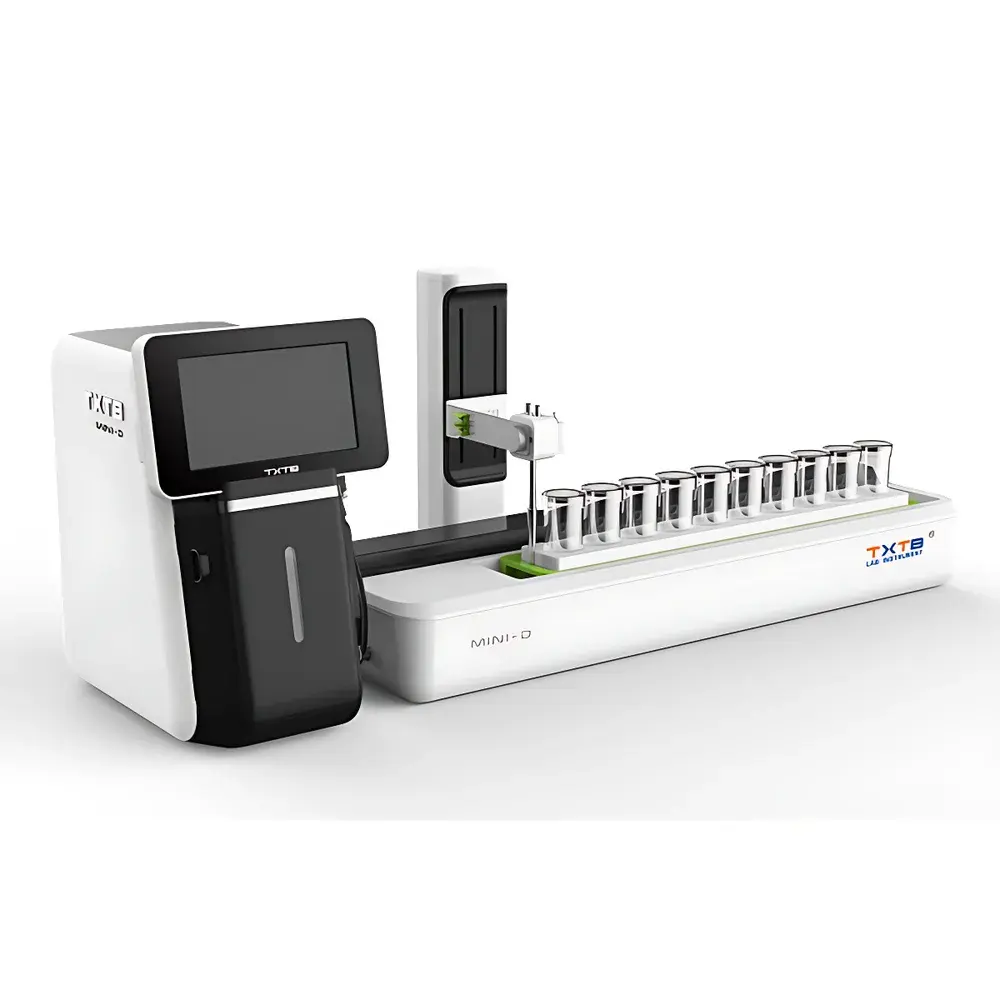
Tongxintianbo Mini-D Automated Dilution System
| Brand | Tongxintianbo |
|---|---|
| Origin | Beijing, China |
| Model | Mini-D |
| Dimensions (W×D×H) | 1000 × 350 × 400 mm |
| Power Supply | 220 V / 50 Hz |
| Power Consumption | 500 W |
| Manufacturer Type | Authorized Distributor |
| Country of Manufacture | China |
| Pricing Range | USD 7,700 – 11,200 (FOB Beijing) |
Overview
The Tongxintianbo Mini-D Automated Dilution System is a compact, benchtop liquid handling platform engineered for high-precision serial and single-step dilutions in regulated and research laboratory environments. Based on positive-displacement pipetting and gravimetric verification principles, the Mini-D delivers reproducible dilution ratios from 1:2 to 1:10,000 with volumetric accuracy compliant with ISO 8655–6 and ASTM E2758 standards for automated liquid handlers. Its closed-system architecture minimizes aerosol generation and cross-contamination risk—critical for applications involving hazardous, volatile, or low-volume analytes such as clinical toxicology standards, environmental calibration stocks, or pharmaceutical reference solutions. Designed for integration into routine QC workflows, the Mini-D operates without requiring external compressed air or vacuum sources, relying instead on integrated peristaltic pumps and calibrated syringe-driven dispensing modules.
Key Features
- Compact footprint (1000 × 350 × 400 mm) optimized for space-constrained analytical labs and cleanroom-compatible workbenches
- Independent dual-channel fluid path with segregated reagent and sample lines, supporting simultaneous preparation of two independent dilution series
- Gravimetric endpoint verification via integrated high-resolution load cell (±0.1 mg resolution), enabling real-time mass-based volume confirmation per dispense step
- Programmable dilution protocols with up to 12 sequential steps per run, including intermediate mixing, pause points, and rinse cycles
- Touchscreen HMI with intuitive workflow builder; supports method import/export via USB and password-protected user roles (Operator, Supervisor, Administrator)
- Compliance-ready architecture: audit trail logging, electronic signature support, and configurable data retention aligned with FDA 21 CFR Part 11 and GLP/GMP documentation requirements
Sample Compatibility & Compliance
The Mini-D accommodates aqueous buffers, organic solvents (e.g., methanol, acetonitrile, DMSO), viscous solutions (up to 50 mPa·s), and surfactant-containing matrices without line clogging or carryover. Sample vessels include standard 13-mm and 16-mm glass or polypropylene vials, 96-well microplates (flat- and V-bottom), and custom tube racks. All wetted components are chemically resistant (PTFE, PEEK, borosilicate glass, and stainless-steel 316L). The system meets CE marking requirements under the EU Machinery Directive 2006/42/EC and Electromagnetic Compatibility Directive 2014/30/EU. Documentation includes full IQ/OQ protocols, traceable calibration certificates for mass and volume modules, and material compatibility reports per USP .
Software & Data Management
The embedded Mini-D Control Software (v3.2+) provides protocol development, execution monitoring, and raw data export in CSV and PDF formats. Each dilution run generates a timestamped record containing operator ID, method name, source/target vessel IDs, gravimetric mass readings, calculated dilution factors, and deviation alerts. Audit trails are immutable and stored locally on encrypted internal flash memory with optional network backup to secure NAS or LIMS endpoints. Data integrity safeguards include automatic checksum validation, session locking during critical operations, and configurable auto-archiving intervals (1–90 days). Software updates are delivered via signed firmware packages with SHA-256 hash verification.
Applications
- Preparation of certified reference material (CRM) working standards for ICP-MS, GC-MS, and LC-MS/MS quantitation
- Automated dilution of high-potency drug substances in early-phase formulation development
- Environmental lab compliance with EPA Method 525.3 and ISO 17025–accredited water analysis workflows
- Calibration curve generation for clinical immunoassays (ELISA, CLIA) requiring sub-nanogram/mL sensitivity
- QC release testing of biologics where lot-to-lot consistency demands ≤2% RSD in dilution factor reproducibility
FAQ
Does the Mini-D support variable dilution ratios within a single protocol?
Yes—each step in a multi-step protocol can be assigned an independent dilution factor, mixing volume, and dwell time.
Is third-party software integration (e.g., LabVantage, STARLIMS) supported?
Yes, via RESTful API interface with documented JSON schema and OAuth 2.0 authentication for secure LIMS synchronization.
What maintenance is required for long-term accuracy?
Monthly gravimetric performance verification using NIST-traceable weights and quarterly syringe seal inspection; no routine recalibration needed under normal operating conditions.
Can the Mini-D handle radioactive or cytotoxic samples?
Yes—when configured with optional shielded enclosure and HEPA-filtered exhaust module (sold separately), it complies with IAEA SSG-46 and ANSI Z9.7 guidelines for containment.
Is training provided with purchase?
Yes—includes on-site installation qualification, hands-on operator training (8 hours), and access to the Tongxintianbo Digital Academy for refresher courses and SOP templates.



